
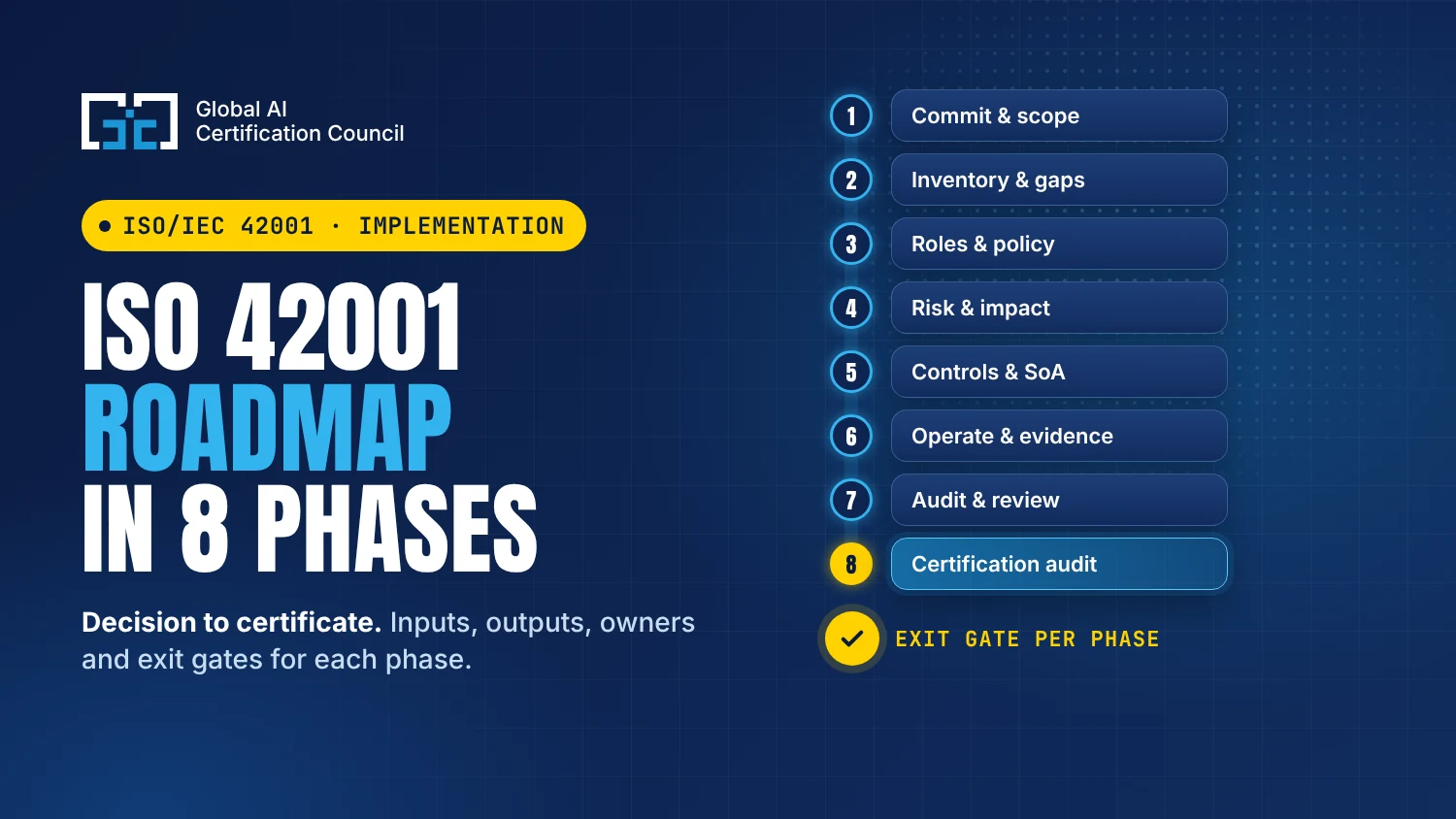
An ISO/IEC 42001 implementation roadmap is the ordered plan an organization follows to build an AI management system (AIMS) and take it through a certification audit. GAICC’s version has eight phases. It runs from the decision to commit, through scope, inventory, roles, risk, controls, operation and internal review, to the Stage 1 and Stage 2 audits. Each phase closes at a gate where someone with authority signs a record, and the signed gates, read in order, show how ready you are.
The project described here belongs to the company. ISO/IEC 42001 certificates go to organizations. A certification body issues them, normally one accredited for ISO/IEC 42001. How long a person takes to earn the Lead Implementer credential is a separate question, answered in the Lead Implementer exam and certification guide. Each phase links to the GAICC page that covers its work in depth.
Why there is no official ISO sequence
ISO/IEC 42001 does not tell you what to do first. The introduction to the standard says the order of its requirements reflects neither their importance nor the order in which you implement them. It also lets organizations apply the requirements with a risk-based approach. ISO’s own implementation guidance standard, ISO/IEC 42003, is still an early work item with no publication date. Every roadmap you read, this one included, is therefore one writer’s interpretation of ISO/IEC 42001:2023.
GAICC orders the work by dependency, so a phase starts only when the records it needs exist. Clause 6.1.3, for example, cannot produce a Statement of Applicability until the risk assessment under 6.1.2 has shown which controls are necessary. Readers who prefer to go clause by clause can use GAICC’s page on what each clause requires you to produce.
The eight phases at a glance
The eight phases of an ISO/IEC 42001 implementation run from a recorded commitment to a certification decision. Each row names a phase’s main output, the clauses it serves and the gate that closes it.
| # | Phase | Main output | Clauses served | Gate that closes it |
| 1 | Commit and scope | Approved scope statement and AI roles | 4.1 to 4.4, 5.1 | Top management approves the scope |
| 2 | Inventory and gap analysis | AI system inventory and gap register | 4.1, 4.3, 7.1, A.4 | Every in-scope system has an owner; the plan is resourced |
| 3 | Roles and policy | AI policy, AI objectives, role assignments | 5.1 to 5.3, 6.2, A.2, A.3 | Policy signed; risk acceptors named |
| 4 | Risk and impact assessment | AI risk criteria, risk assessments, impact assessment records | 6.1.1, 6.1.2, 6.1.4, A.5 | Each in-scope system assessed for risk and impact |
| 5 | Controls and SoA | Statement of Applicability, AI risk treatment plan | 6.1.3, Annex A, Annex B | Designated management approves the plan and residual risk |
| 6 | Operate and evidence | Operating records for every applicable control | 7.1 to 7.5, 8.1 to 8.4, 9.1 | Records exist for every line marked applicable |
| 7 | Internal audit and management review | Audit report, corrective actions, review minutes | 9.2, 9.3, 10.1, 10.2 | Top management has reviewed the audit results |
| 8 | Certification audit | Stage 1 and Stage 2 reports, certification decision | Whole AIMS, audited under ISO/IEC 17021-1 and ISO/IEC 42006 | The certification body grants certification |
The grouping and gate wording are GAICC editorial analysis, while the clause numbers come from the published standard’s table of contents.
Phase by phase: inputs, outputs, owners and exit criteria
Every phase block records what the phase needs, what it produces, the clauses it serves, a typical owner and the condition that ends it. ISO/IEC 42001 names no job titles, so the owner lines are GAICC suggestions. The standard does assign some duties to top management and to “designated management”, and the blocks say where.
Phase 1: Commit and scope
The first phase turns a decision to pursue ISO/IEC 42001 into an approved scope statement. The trigger usually comes from outside, such as a customer questionnaire, a contract clause or a board request. Forum threads from technology suppliers describe one customer that set a one-year deadline and another that would not proceed without the certificate.
- Inputs: the trigger and any deadline, a first-pass list of AI systems, existing management systems, known legal and contractual requirements.
- Outputs: a record of management commitment, plus the internal and external issues, including a decision on whether climate change is relevant (4.1 asks for one). Interested parties and their requirements, the AI role for each system, and the scope statement that clause 4.3 requires as documented information.
- Clauses served: 4.1, 4.2, 4.3, 4.4, 5.1.
- Owner: top management commits; the AIMS lead drafts.
- Exit criteria: top management has approved the scope. Each in-scope system has a stated role. A named sponsor owns the project.
Clause 4.1 makes role determination a requirement and lists the roles that ISO/IEC 22989 describes: AI provider, AI producer, AI customer, AI partner, AI subject and relevant authorities. Your roles can decide which requirements and controls apply, and how far. US teams often trip on one term in that list. The “AI deployer” there is a kind of AI producer, while a “deployer” under the EU AI Act or Colorado law is a separate legal category.
A scope can also cover only part of a larger company, and then “organization” and “top management” mean only that part. The method for drawing the boundary is on the page about scoping the AIMS.
Phase 2: Inventory and gap analysis
Two lists come out of Phase 2: the AI systems inside the scope, and the gaps between current practice and the standard. ISO/IEC 42001 never uses the word “inventory”. The need comes from clause 4.1 (the purpose of the systems you develop, provide or use), clause 4.3 (scope) and the A.4 controls on documenting resources. The NIST AI Risk Management Framework names the practice directly, since its GOVERN 1.6 subcategory calls for mechanisms to inventory AI systems.
- Inputs: the approved scope and roles, procurement and single sign-on records, expense data, and existing policies and records.
- Outputs: the AI system inventory, with an owner, role and purpose for each system. A gap register scored against clauses 4 to 10, a provisional view of Annex A and a resourced work plan (clause 7.1).
- Clauses served: 4.1, 4.3, 7.1, A.4.2 to A.4.6.
- Owner: the AIMS lead, with system owners, procurement and IT.
- Exit criteria: every in-scope system appears with a named owner, and the sponsor has agreed the gap register and the resources.
Phases 1 and 2 overlap on purpose. A rough list of AI systems informs the scope, and the scope then bounds the full inventory. Expect one loop back before the scope is final.
Keep the Annex A columns of the gap register provisional. The standard’s definition of the Statement of Applicability notes that you may not need every Annex A control. You may also need controls beyond Annex A. A gap analysis that scores all of Annex A as mandatory creates work the risk assessment may later remove. Discovery methods for the tools nobody declared are covered under finding undeclared AI systems, and scoring and the report follow the gap analysis method.
Phase 3: Roles and policy
A signed AI policy, measurable objectives and named people give the AIMS its authority in Phase 3. Under clause 5.3, top management must hand out two duties. One is making sure the AIMS meets the standard’s requirements, and the other is reporting on how the AIMS performs.
- Inputs: scope, inventory, gap register, existing corporate policies.
- Outputs: the AI policy (clause 5.2), with the A.2 controls on alignment and review, and AI objectives that are measurable where practicable (6.2). Role assignments, including who accepts AI risk, a route for reporting concerns (A.3.3) and a first list of competence needs (7.2).
- Clauses served: 5.1, 5.2, 5.3, 6.2, A.2, A.3.
- Owner: top management approves; the AIMS lead drafts.
- Exit criteria: the policy is signed, objectives have owners and measures, and the people who will approve risk treatment are named.
Objectives have to exist before controls are chosen, because clause 6.1.3 asks that the necessary controls align with the objectives set under 6.2. A RACI matrix is one way to record who decides what; the standard does not require one. Templates and edge cases are on the page about the roles clause 5 expects, and policy contents are covered under writing the AI policy.
Phase 4: Risk and impact assessment
Every in-scope AI system goes through two linked processes in Phase 4. One is the AI risk assessment under clause 6.1.2, and the other is the AI system impact assessment under 6.1.4. Clause 6.1 first asks you to set AI risk criteria, so the scoring scale exists before any system is scored.
- Inputs: the inventory, the policy and objectives, named risk owners, the informative risk sources in Annex C.
- Outputs: AI risk criteria, a risk assessment and an impact assessment record for each system, and a ranked list of risks.
- Clauses served: 6.1.1, 6.1.2, 6.1.4, A.5.
- Owner: system owners and risk owners, supported by whoever performs impact assessments.
- Exit criteria: every in-scope system has a current risk assessment and impact assessment on file, scored against the agreed criteria.
A common shortcut says the risk assessment looks inward and the impact assessment looks outward. ISO/IEC 42001 does not split them that way. The 6.1.2 risk assessment also weighs consequences for individuals and societies. Clause 6.1.4 sets up its own documented process, whose results flow into the risk assessment. That is why the impact assessment process has to exist before any risk result is final.
ISO/IEC 42005:2025 gives guidance on running AI system impact assessments. Clause 6 as a whole is explained under the risk requirements, and the record itself is covered in the impact assessment artifact.
Phase 5: Controls and SoA
Phase 5 turns risk results into decisions. Each one records which controls apply, why they apply and who accepts the risk that remains. Clause 6.1.3 asks you to choose treatment options, determine the necessary controls and compare them with Annex A so that nothing needed is missing. The same clause asks you to consider the Annex B guidance, produce the Statement of Applicability and write an AI risk treatment plan.
- Inputs: risk and impact results, risk criteria, objectives, Annex A, Annex B.
- Outputs: the Statement of Applicability, with a justification for each control included or excluded. The AI risk treatment plan and a signed acceptance of residual AI risk.
- Clauses served: 6.1.3, Annex A, Annex B.
- Owner: the AIMS lead drafts; designated management approves the plan and the residual risk, as clause 6.1.3 requires.
- Exit criteria: the SoA is approved and under version control, the treatment plan is approved, and residual risks are accepted in writing.
Annex A of ISO/IEC 42001:2023 lists 38 controls in nine areas (A.2 to A.10) under ten control objectives. Check each control’s wording in your licensed copy. Annex B is normative and gives implementation guidance for those controls, while Annexes C and D are informative. Clause 6.1.3, as secondary reproductions print it, allows two reasons to exclude a control. Either the risk assessment did not call for it, or no external requirement demands it. The selection logic is set out on the page about the SoA.
Control-by-control content sits under Annex A controls, with a worked area for the A.7 data controls.
Phase 6: Operate and evidence
During Phase 6 the AIMS runs and produces records. Clause 8.1 asks you to plan and control the processes that carry out the actions decided in clause 6. Clauses 8.2 to 8.4 then repeat the risk assessment, risk treatment and impact assessment during operation.
- Inputs: the approved SoA and treatment plan, the policy, assigned roles.
- Outputs: operating records for every applicable control, with competence evidence (7.2), awareness and communication records (7.3, 7.4) and controlled documents (7.5). Monitoring results against objectives (9.1), and impact assessments repeated at planned intervals or when significant changes are proposed (8.4).
- Clauses served: 7.1 to 7.5, 8.1 to 8.4, 9.1.
- Owner: system owners and data owners run the controls; the AIMS lead tracks the evidence.
- Exit criteria: each line marked applicable in the SoA has records showing the control operated. Each objective has at least one measurement.
Phase 6 sets most of the calendar. Nobody can write proof that a control ran before it runs. Competence work peaks here too. The page on training and awareness records explains what counts as evidence for clauses 7.2 to 7.4. The full list of required records sits in the documentation set.
Phase 7: Internal audit and management review
Before an outsider tests the AIMS, Phase 7 tests it from the inside. Clause 9.2 requires internal audits at planned intervals that check conformity and effective implementation, and clause 9.3 then requires a management review.
- Inputs: operating records, objectives and measurements, the SoA, any earlier findings.
- Outputs: an internal audit program and plan (9.2.2), audit reports, and nonconformities with corrective actions (10.2). Management review minutes that record decisions on improvement and changes (9.3.3).
- Clauses served: 9.2, 9.3, 10.1, 10.2.
- Owner: an objective internal auditor for the audit; top management for the review.
- Exit criteria: one audit cycle has covered clauses 4 to 10 and the applicable controls, the review has considered its results, and corrective actions have owners.
Inside Phase 7 the audit comes first, because management review takes trends in audit results as an input. You can run the internal audit yourself or hire an outside party to run it. ISO/IEC 42006:2025 (clause 5.2.2) bars your certification body from doing it, even when the work is renamed an assessment. Planning, sampling and AI-specific tests for the first internal audit have their own page.
Phase 8: Certification audit
The final phase hands the AIMS to an accredited certification body for a two-stage initial audit. Certification bodies work under ISO/IEC 17021-1, and ISO/IEC 42006:2025 adds requirements for AIMS audits, including a normative annex on audit time.
- Inputs: an application to an accredited certification body, scope details, the documented AIMS.
- Outputs: a Stage 1 report, a Stage 2 report, any nonconformities with corrective actions, the certification decision.
- Clauses served: the whole AIMS, meaning every clause from 4 to 10 and each control the SoA marks applicable.
- Owner: the AIMS lead coordinates; top management attends and owns the corrective actions.
- Exit criteria: the certification body grants certification.
Stage 1 reviews the documented system and your readiness for Stage 2. According to the International Accreditation Service summary of ISO/IEC 17021-1, Stage 1 also checks whether internal audits and management reviews are planned and under way. Stage 2 then checks how the system runs in practice, including whether it works. In the United States, ANAB’s ISO/IEC 42001 accreditation program accredits certification bodies, and its directory listed 20 of them on 6 October 2026. The steps, findings and surveillance visits are explained under the two-stage audit.
What cannot start before what
Some ISO/IEC 42001 phases overlap safely, and some cannot start until another phase has produced a record. Each hard dependency in the table traces to a clause or to the certification rules.
| Work item | Cannot start or finish before | Why |
| Scope statement (4.3) | A first-pass list of AI systems and their roles | Scope must consider the 4.1 issues and 4.2 requirements, and roles decide applicability |
| Full inventory | Approved scope | The scope sets the boundary |
| Risk assessment (6.1.2) | AI risk criteria (6.1.1) and named risk owners | Systems are scored against agreed criteria |
| Final risk results | The impact assessment process (6.1.4) | Impact assessment results feed the risk assessment |
| Statement of Applicability (6.1.3) | Treatment decisions and AI objectives (6.2) | The SoA lists necessary controls, and controls align with objectives |
| Residual risk acceptance | Designated management named in Phase 3 | Clause 6.1.3 requires their approval |
| Operating evidence | Approved SoA and treatment plan | Records prove that a decided control operated |
| Management review (9.3) | Internal audit results (9.2) | Audit results are a required review input |
| Stage 1 audit | Internal audit and management review planned and under way | ISO/IEC 17021-1 Stage 1 objective |
| Certification decision | Major nonconformities corrected and verified | Without verification within six months after Stage 2, Stage 2 is repeated |
Three tracks can run alongside the main sequence. Document control (7.5) can start in Phase 1 and serve every later phase, while competence and awareness work can begin once roles exist. The inventory keeps growing as discovery finds more systems, and each new system re-enters Phase 4.
Read from start to end, the critical path runs through eight steps:
- Roles and scope.
- Inventory of in-scope systems.
- Risk criteria and the impact assessment process.
- Risk results and treatment decisions.
- Approved SoA and treatment plan.
- Operating records.
- Internal audit, then management review.
- Stage 1, then Stage 2.
GAICC’s course includes a module on planning an AIMS implementation project. Teams that plan an AIMS rollout with Lead Implementer training can map this path onto their own systems there.
The ISO 42001 implementation timeline
ISO/IEC 42001 sets no implementation timeline, and no primary source gives one. The ranking guides GAICC reviewed on 5 October 2026 quote anything from about 90 days to 18 months. None cites a source for its figure. A better planning question asks which parts of the calendar the certification rules fix, since everything else depends on the organization.
The fixed points
The certification rules create a few fixed points. They come from ISO/IEC 17021-1:2015, read through the IAS summary cited in Phase 8, and from ISO/IEC 42006:2025.
| Fixed point | What it sets | Source |
| Stage 1 objectives | Looks at whether internal audits and management reviews are being planned and carried out | ISO/IEC 17021-1, 9.3.1.2.2 |
| Gap between Stage 1 and Stage 2 | Set by the time you need to resolve Stage 1 concerns; no fixed length | ISO/IEC 17021-1, 9.3.1.2.4 |
| Stage 2 content | Includes internal auditing and management review | ISO/IEC 17021-1, 9.3.1.3 |
| Major nonconformities | Corrections verified within 6 months after the last day of Stage 2, or Stage 2 is repeated | ISO/IEC 17021-1, 9.5.3.2 |
| Audit days | Calculated under a normative annex | ISO/IEC 42006, Annex A |
| First surveillance | No more than 12 months after the certification decision | ISO/IEC 17021-1, 9.1.3.3 |
| Certificate cycle | Three years: surveillance in years one and two, recertification in year three | ISO/IEC 17021-1, 9.1.3.2 |
None of these rules sets a minimum number of months of operation before Stage 1. In practice the floor is the time it takes to run your controls, complete one internal audit and hold one management review on real records. When you apply, ask your certification body how long it wants the AIMS to have run.
What moves the calendar
GAICC sees five drivers behind the spread between published timelines.
- Number of AI systems in scope: each system needs its own risk and impact assessment, and each new discovery re-enters Phase 4.
- Your AI role: a company that builds or trains models is more likely to need the A.6 life cycle and A.7 data controls. A company that only uses third-party AI may exclude more of them, each with a reason.
- Existing management systems: shared processes such as document control, internal audit and corrective action may already run.
- Approval latency: every gate needs a signature. One slow signature stops everything downstream.
- Evidence period: nobody can backdate records, so the operating phase lasts as long as producing them takes.
Why roadmaps show 3, 4, 8 or 18 steps
Published ISO/IEC 42001 roadmaps describe the same work at different resolutions. A three-step model usually reads prepare, implement, certify. A four-phase model groups the work into Plan, Do, Check and Act. Lists of 9 to 18 steps split those phases into tasks, often one per clause.
Models also differ on where they start and stop. Some begin at leadership buy-in and others at the gap analysis, and some end at Stage 2 while others include surveillance. A plan built on 30, 60 and 90 days adds dates that the standard does not supply.
GAICC groups its eight phases by approval gates. A phase ends when someone with authority signs a record, because those signed records are what an auditor samples. Any model works if it respects the hard dependencies between phases.
Planning backwards from a customer deadline
A customer deadline is best planned backwards, by working out the latest possible date for each event in this order:
- The certification decision.
- Time to correct and verify any major nonconformities after Stage 2.
- The Stage 2 audit, scheduled with the certification body.
- The Stage 1 audit, with room to resolve its concerns.
- The management review, after the internal audit.
- The internal audit, sampling real operating records.
- The start of operation, once the SoA and treatment plan are approved.
If the start of operation lands in the past, the deadline needs a narrower scope or a talk with the customer. A supplier’s certificate does not shorten the plan, because it covers the supplier’s own organization. Microsoft’s ISO/IEC 42001 compliance page tells its customers they remain responsible for engaging an assessor to evaluate their own organization.
The path when ISO 27001 already exists
A company that already holds ISO/IEC 27001 certification runs the same eight phases, but several get shorter. Both standards use ISO’s harmonized structure, so the existing processes behind clauses 7.5, 9.2, 9.3 and 10.2 can be extended to cover AI. The AI-specific work stays new.
| Phase | What an ISMS already gives you | What is still new |
| 1 Commit and scope | A context and interested-party method | An AI role for each system; the AIMS scope boundary |
| 2 Inventory and gap | Asset management habits | An AI system inventory that also catches unapproved AI tools |
| 3 Roles and policy | Management commitment and a policy approval route | The AI policy, AI objectives and named AI risk acceptors |
| 4 Risk and impact | A risk method and register | AI risk criteria covering people and society; the 6.1.4 impact assessment |
| 5 Controls and SoA | An SoA format and approval route | Selection against the AI controls of Annex A, with justifications |
| 6 Operate | Document control, competence and awareness processes | Records for the A.5 to A.10 controls; 8.4 reassessments |
| 7 Audit and review | Internal audit program, management review, corrective action | Auditors competent in AI; AI inputs to the review |
| 8 Certification | An existing certification body relationship | Confirmation that the body is accredited for ISO/IEC 42001 |
Phases 2 and 4 shrink least, because no ISMS process produces an AI inventory or an impact assessment. The extension order, the integrated audit rules and the single SoA question are covered in moving from ISO 27001 to ISO 42001.
How the phases differ for startups and enterprises
A startup and an enterprise follow the same eight ISO/IEC 42001 phases, but the slow step differs. The comparison is GAICC editorial guidance.
| Factor | Startup or single-product company | Enterprise with several business units |
| Scope | Often one product and one or two AI roles | Several roles; scope may cover only part of the company |
| Top management | The founders | The leaders who direct the in-scope part |
| Inventory | Short, mostly third-party AI services | Long, with discovery across procurement and identity systems |
| Roles | One person holds several roles | Separate owners, often a governance board |
| Internal audit | Often bought from an external party for objectivity | An internal audit function may extend its program |
| Usual bottleneck | The time of a few people to produce evidence | Sign-off across committees |
Two provisions in the standard help small teams. Internal audits may be carried out by an external party hired for the job. And where the scope covers part of a company, top management means whoever directs that part. A founder-level version of this sequence is in the startup roadmap.
Where ISO 42001 roadmaps slip
ISO/IEC 42001 roadmaps tend to slip at the gates, where work waits for a decision or a signature. The patterns listed here come from forum threads and from errors on ranking guides.
- Scope before inventory: a scope drawn before anyone lists the AI systems usually needs redrawing after discovery.
- Stalled sign-off: one ISO 27001 implementer wrote in February 2026 that policies waiting for approval “sit with them for weeks with no movement, which means everything downstream stalls too.”
- Ownership gaps: a forum member discussing an ISO 42001 rollout in September 2026 wrote: “We underestimated ownership more than documentation.”
- Annex A as a checklist: marking every control applicable before the risk assessment leaves an SoA without justifications.
- A one-time impact assessment: clause 8.4 repeats impact assessments on a planned schedule and whenever a system changes significantly, so a single project deliverable goes stale.
- Invented frequencies: several ranking guides present an annual internal audit or management review as a rule. ISO/IEC 42001 asks only for planned intervals; the yearly surveillance rhythm belongs to the certification body’s rules.
- Booking Stage 1 too early: a Stage 1 date fixed before the first internal audit leaves the auditor little to evaluate.
The habits behind these slips, such as governance nobody owns and policy nobody enforces, are covered in the failure modes.
After the certificate: the roadmap becomes a cycle
After certification, Phases 4 to 7 of the ISO/IEC 42001 roadmap keep running as a loop. Impact assessments repeat on schedule and when systems change (8.4). Internal audits and management reviews continue at the intervals you planned, and corrective actions feed continual improvement (10.1, 10.2). When you change the AIMS itself, such as adding a product line to the scope, clause 6.3 requires the change to be planned. The certification body returns for surveillance at least once in each calendar year except the recertification year. Its first visit falls within 12 months of the decision, and recertification comes in year three.
Which phase to start from
Your AI role and your existing management systems set the starting point.
| Your situation | Start at | Expect |
| You use only third-party AI services | Phase 1 | The inventory and the A.10 supplier controls carry most of the work |
| You build or train models | Phase 1 | Heavier Phase 4 and Phase 6 work under the A.6 and A.7 controls |
| You hold ISO/IEC 27001 | Phases 1 and 2 in full | Existing processes extended from Phase 3 onward |
| A customer has set a date | The backward plan | A scope sized to the latest workable start of operation |
| You will lead the project yourself | The roles page | Most gates need a signature you cannot give yourself |
For the person in that last row, GAICC offers ISO 42001 implementation training for project leads. Its four days cover AIMS team roles and RACI, risk and impact assessment, and preparation for both audit stages.
Frequently Asked Questions
How long does ISO 42001 implementation take?
ISO/IEC 42001 sets no implementation period. The guides GAICC reviewed on 5 October 2026 quoted 90 days to 18 months, and none cited a source. The real floor is the time it takes to run your controls, finish one internal audit and hold one management review, with scope size, AI role and sign-off speed setting the rest.
Is there a minimum operating period before the Stage 1 audit?
GAICC found no minimum number of months in the IAS summary of ISO/IEC 17021-1 or in the parts of ISO/IEC 42006 it read. Stage 1 does check that internal audits and management reviews are planned and performed. Ask your certification body what it expects when you apply.
What is the first step in implementing ISO 42001?
ISO/IEC 42001 names no first step. GAICC’s roadmap starts with a recorded management commitment and a first-pass list of AI systems. Clause 4.1 asks you to determine your role for each system, and those roles shape the scope you document under clause 4.3.
Do we need a consultant to implement ISO 42001?
ISO/IEC 42001 does not require a consultant; it asks the organization to determine and evidence the competence its AIMS work needs (clause 7.2). An external party may also run the internal audit for you. Your certification body is the exception, because ISO/IEC 42006:2025 forbids it from consulting on your AIMS or running its internal audit.
Does the person leading the implementation need Lead Implementer certification?
ISO/IEC 42001 requires no personal certificate for anyone. Under clause 7.2 the organization decides what competence each role needs and keeps evidence of it, which a credential can supply. The organization’s certificate and a person’s credential are separate, and different kinds of certification body issue them.
Is ISO 42001 harder to implement if we build our own AI models?
Building or training models usually adds work, because your AI roles can determine which requirements and controls apply and how far (clause 4.1). A model builder is more likely to need the A.6 life cycle and A.7 data controls. A company that only uses third-party AI may exclude more controls, but each exclusion needs a justification in the Statement of Applicability.
What happens when we add a new AI system after certification?
The new system enters the inventory and goes through risk and impact assessment, since clause 8.4 repeats impact assessments when significant changes are proposed. If the change alters the AIMS itself, clause 6.3 requires it to be planned. A system outside the certified scope needs a request to expand the scope, which the certification body may review during a surveillance audit under ISO/IEC 17021-1.