GAICC AI Conference & Awards 2026 "Governing the Future – Building Responsible, Safe and Human-centric AI"


GAICC Financial AI Governance Professional (GAICC-FAIGP)

Govern AI where money, trust and regulation meet, from model risk, fairness and conduct to DORA resilience, financial crime AI and agentic AI controls.
Last Updated: 2026
4 Days (32 Contact Hours)
English
Certification Trusted by Professionals at:

AI Certification Council

4.8 / 5.0 Rating
27,143+

Students

Our training programs are CPD Accredited by CPDSO

GAICC Financial AI Governance Professional

Exam Content Outline (ECO)

Download the GAICC-FAIGP Exam Content Outline for all 8 domains and 45 tasks, the knowledge statements, the reference frameworks and sample questions. The Candidate Handbook covers booking, exam-day rules, fees and renewal.

Career Opportunities

The GAICC-FAIGP prepares you for senior roles where AI meets model risk, conduct and supervision in financial services.

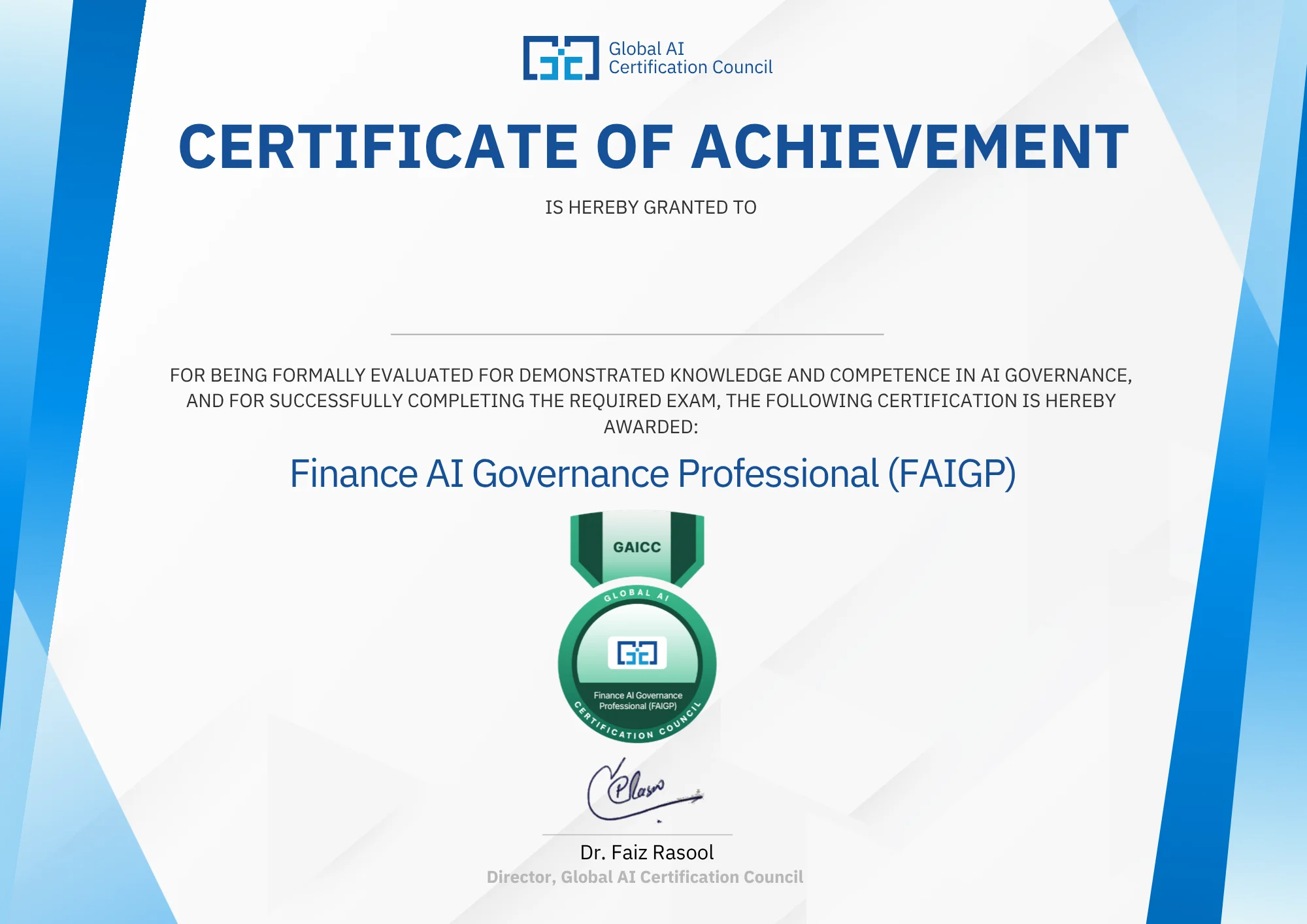
GAICC-FAIGP Certification

Issued By Global AI Certification Council

Prepare for your FAIGP Certification with this course

GAICC-FAIGP Certification

Banks, insurers, asset managers, payment firms and fintechs now use AI in decisions that move money and decide access to credit, cover and advice. The GAICC FAIGP programme shows you how to turn overlapping model risk, conduct, prudential, data protection and resilience rules into one proportionate control framework, including for generative and agentic AI that classic model risk management was not built to catch. It is equally relevant to the technology, consulting and services firms that build and run AI for financial institutions, and to supervisory staff who examine it.

The course runs over four days and 32 contact hours, in 18 modules plus a capstone across 8 domains. It follows the order a financial institution meets AI risk: landscape, accountability and regulation; model risk and fair outcomes; data, crime and third parties; and agentic AI and assurance. Every module uses realistic banking, insurance, capital markets and payments cases, and learners leave with a 12-template working toolkit.

Practical Outcomes You'll Achieve

By the end of this course, you will be able to:

Who Is This Certification For?

Designed for professionals who govern AI in banking, insurance, capital markets and payments

Course Modules

Day 1

Landscape, Accountability and Regulation (8 Hours)

Module 1
AI Across the Financial Services Value Chain

Workshop Exercise

Triage fifteen AI use cases from a composite universal bank and insurer, rate materiality, and decide which belong in the model inventory, the AI inventory or both.

Workshop Exercise

In a simulated board risk committee, defend a draft AI risk appetite statement and responsibilities map for a mid-sized bank after a chatbot mis-selling incident.

Workshop Exercise

Classify six AI systems at an EU bancassurance group, including a small business credit model used for sole traders, and scope the FRIA for a life insurance pricing model.

GAICC Differentiator

One module reconciles US, UK, Singapore, Hong Kong, Australia, Malaysia, India and New Zealand expectations with FSB, IOSCO and Basel positions into a single common control set.

Workshop Exercise

Build an obligations map for a banking and insurance group operating in the UK, US, Singapore, Hong Kong and Australia, then reconcile it into twelve common controls with named evidence owners.

Day 2

Model Risk and Fair Outcomes (8 Hours)

Module 5
Model Scope, Tiering and Conceptual Soundness

Workshop Exercise

Review the development pack for a gradient-boosted mortgage default model and raise conceptual soundness findings on target leakage, through-the-cycle representativeness and monotonicity.

Workshop Exercise

Validate an LLM complaints-triage model at a retail bank, building a stratified evaluation set that tests vulnerable customer detection and routing of reportable complaints.

Workshop Exercise

Decide whether a vendor's unannounced upgrade to the base model behind a fraud scoring service is a material change, and what re-validation it requires.

Workshop Exercise

Produce adverse action reason codes for a gradient-boosted credit card model, and run a Colorado-style inferred-demographic bias test on a life insurer's accelerated underwriting model.

Workshop Exercise

Design outcome metrics and a redress plan after a home insurance renewal pricing model is found to charge long-standing customers in a vulnerable cohort more.

Day 3

Data, Crime and Third Parties (8 Hours)

Module 10
Financial Data Governance and Privacy for AI

Workshop Exercise

Trace lineage for a small business lending model that uses open banking data, then design data controls for a relationship manager copilot that retrieves client files.

GAICC Differentiator

Goes beyond model governance into the financial crime front line: defending AML alert-suppression models to examiners and redesigning onboarding against deepfakes, injection attacks and synthetic identities.

Workshop Exercise

Prepare an examiner evidence pack for a machine learning alert-scoring model that suppresses low-risk alerts, then redesign remote onboarding after a deepfake-enabled account takeover.

Day 4

Agentic AI and Assurance (8 Hours)

Module 14
GenAI Advice, Communications and AI in Trading

Workshop Exercise

Review a wealth manager's GenAI portfolio commentary tool for suitability, AI-washing and recordkeeping gaps, then test an AI trading strategy's RTS 6 kill functionality and frontier-AI cyber exposure.

GAICC Differentiator

Hands-on control design for AI agents that can move money: agent identity, transaction limits enforced outside the model, dual approval, registries and live kill switch testing.

Workshop Exercise

Design controls for an agentic payments pilot that pays supplier invoices, with dual approval above thresholds, out-of-band payee verification and a live kill switch test.

Workshop Exercise

Classify an incident in which a servicing assistant gave thousands of customers wrong fee information, then draft the board report and the regulator notification decision.

Exam Domain Weighting

80 scenario-based questions across 8 domains

Most questions present a realistic sector scenario and ask for the most appropriate action, judgement or control. Recall of clause numbers is not tested.

Domain Weight Scored Items
I. Financial Services AI Landscape and Accountability
10%
~7
II. Financial AI Regulation and Supervisory Expectations
15%
~11
III. Model Risk Management for AI
15%
~11
IV. Fairness, Explainability and Consumer Outcomes
13%
~9
V. Data Governance, Privacy and Financial Crime AI
11%
~8
VI. Third-Party, Concentration and Operational Resilience
12%
~8
VII. Generative, Agentic and Emerging AI in Finance
12%
~8
VIII. Assurance, Audit, Incidents and Board Reporting
12%
~8
4.8 / 5.0 Rating

Trusted by Professionals Across AI, GRC & Legal Industries

Arjun Mehta

⭐⭐⭐⭐⭐

The course gave me a practical understanding of AI risk management in financial services. The modules on regulation, model risk, and accountability were relevant and helped me understand governance challenges much better.

Priya Sharma

⭐⭐⭐⭐⭐

I appreciated how the programme connected AI regulations with real business scenarios. The sessions on fairness, privacy, and consumer protection provided useful insights that I can apply directly in my professional work.

Daniel Carter

⭐⭐⭐⭐⭐

The sections on model validation, third-party risks, and operational resilience were particularly valuable. The course offered practical frameworks that helped me better understand how financial institutions can manage AI risks effectively.

Neha Kapoor

⭐⭐⭐⭐⭐

This programme provided an excellent balance of technical knowledge and practical guidance. I gained valuable insights into financial crime AI, data governance, and regulatory expectations across modern financial services environments.

Jason Lim

⭐⭐⭐⭐⭐

The discussions on generative AI, agentic systems, and consumer outcomes were especially useful. The course strengthened my understanding of responsible AI adoption and gave me a clearer governance perspective for product development.

Elena Rossi

⭐⭐⭐⭐⭐

The course was well structured and easy to follow. Its coverage of AI assurance, audit, and board reporting improved my understanding of accountability and supervisory expectations within financial institutions.

This Course Includes: 32 Total Learning Hours

Financial AI Governance Professional

Issued by Global AI Certification Council

What's included?

Member Price

US$898

Full Price

US$1075

US$99 is included in the above member price.

Certification Renewal (Members / 3-yr) – $69

Certification Renewal (Non-Members / 3-yr) – $119

Have Questions?

Frequently asked question.

The Financial AI Governance Professional is a senior, sector-specialist credential. It confirms that you can govern predictive, generative and agentic AI across banking, insurance, capital markets and payments, and produce the evidence that boards, auditors and supervisors expect.
No. The only eligibility requirement is 32 contact hours of FAIGP training completed before the exam. Five years in financial services risk, compliance, model development or validation, audit or technology delivery, including two years with AI or quantitative models, is recommended but never used to refuse a candidate. CPAIG, or equivalent foundational knowledge, is recommended but not required.

The course runs over four days and 32 contact hours:

  • Day 1: Landscape, Accountability and Regulation
  • Day 2: Model Risk and Fair Outcomes
  • Day 3: Data, Crime and Third Parties
  • Day 4: Agentic AI and Assurance, ending in a capstone

It is available in person, live online, or self-paced.

The exam has 80 scenario-based multiple-choice questions (70 scored + 10 unscored pilot) in 120 minutes. It is closed book and delivered online with AI-assisted proctoring, 24/7. The pass mark is 70%, a scaled 350 on a 100–500 scale, and there is no negative marking.
No. The course covers banking, insurance, capital markets and payments equally. It is also built for the technology, consulting and services firms that build and run AI for financial institutions, and for supervisory examination staff.
Yes. Domain VII is dedicated to it: GenAI copilots and customer communications, AI in trading, and controls for AI agents that can initiate payments, including identity, transaction limits, dual approval, registries and kill switches.
The course covers the EU, US and UK in depth, plus Singapore, Hong Kong, Australia, Malaysia, India and New Zealand, and global standard setters such as the FSB, IOSCO and the Basel Committee. You must recognise which regime applies and what it requires, not recall clause numbers.
The certification is valid for 3 years. Renewal requires 60 CPD hours per cycle (Technology 27, Humanity 12, Strategy 21), reaffirming the Code of Ethics and paying the renewal fee. A three-month grace period applies after expiry.
certify(at)gaicc(dot)org · support(at)gaicc(dot)org · www(dot)gaicc(dot)org
Instructor

Dr Faiz Rasool

Director at the Global AI Certification Council (GAICC) and PM Training School

A globally certified instructor in ISO/IEC, PMI®, TOGAF®, SAFe®, and Scrum.org disciplines. With over three years’ hands-on experience in ISO/IEC 42001 AI governance, he delivers training and consulting across New Zealand, Australia, Malaysia, the Philippines, and the UAE, combining high-end credentials with practical, real-world expertise and global reach.

Other GAICC ISO/IEC 42001 Courses

Best Selling
⭐ 4.8
29,899+
Best Selling
⭐ 4.8
23,357+
Best Selling
⭐ 4.8
25,183+

Start Your 'Financial AI Governance Professional (GAICC-FAIGP)' Today

4.8 / 5.0 Rating

Self-Paced Course (Certification Exam included)

Member Price

US$898

Full Price

US$1075

GAICC Annual Membership US$99 is included in the above member price.

Trusted by 24,000+ Professionals

Ready to Become a Financial AI Governance Professional?

AI Governance Job Insights 2026