
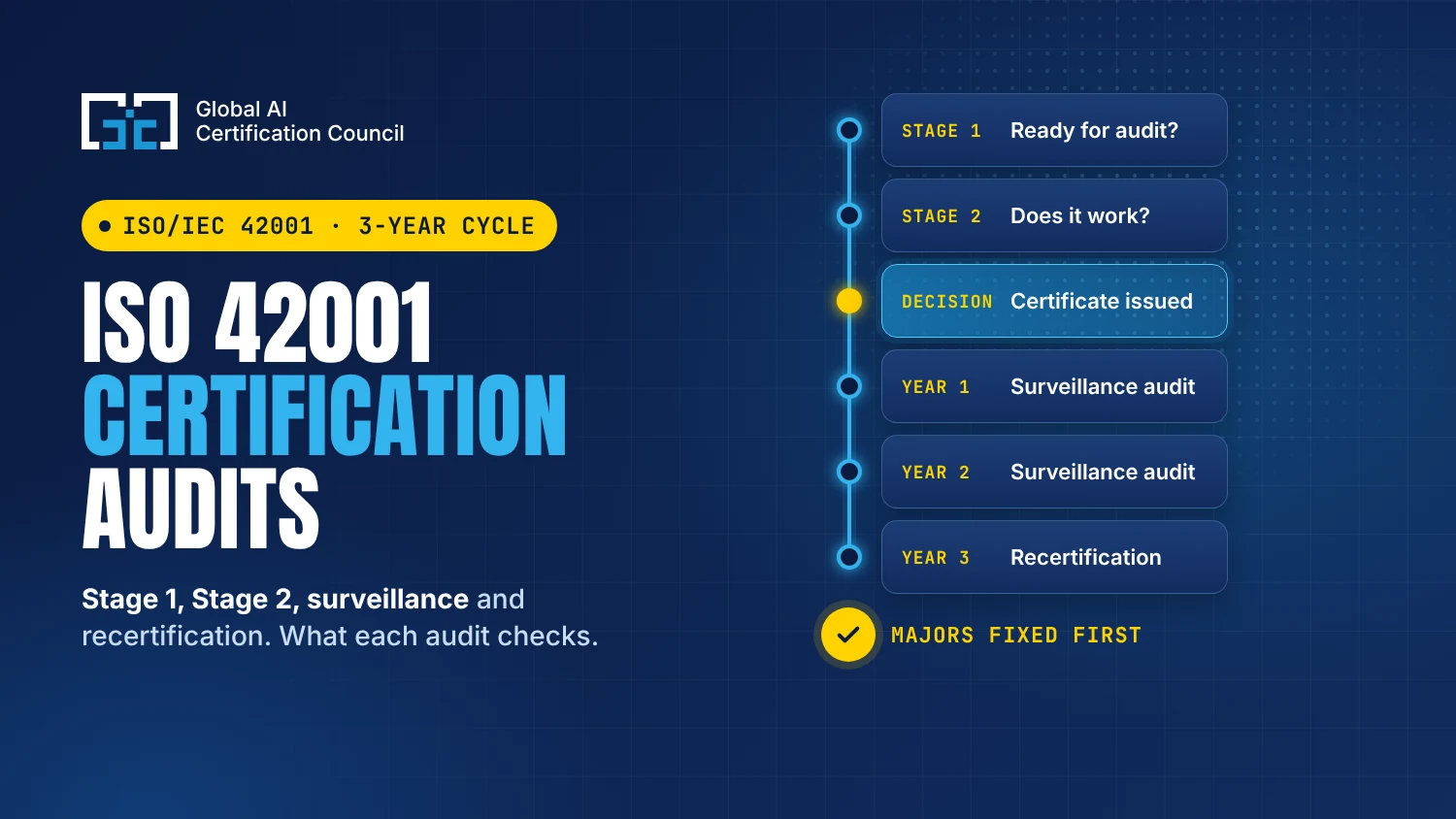
An ISO/IEC 42001 certification audit is the third-party assessment in which an accredited certification body checks an organization’s AI management system (AIMS) against the standard before issuing a certificate. The first audit runs in two stages: Stage 1 reviews the written system, the scope and your readiness, and Stage 2 tests whether it works in practice. The certificate then lasts three years. A surveillance audit in each of the next two years keeps it valid, and a recertification audit in year three renews it.
Two kinds of “ISO 42001 certification” are on offer, and this page covers only one. Companies are certified to ISO/IEC 42001, while people hold credentials about it, such as Lead Implementer or Lead Auditor. A personal credential never certifies an employer. How the builder’s role differs from the auditor’s is set out in the Lead Implementer and Lead Auditor credentials compared. Everything that follows concerns the company’s audit.
Who can certify an ISO 42001 management system
A certification body is the firm that audits your AIMS and decides whether to certify it. ISO itself does not perform certification or issue certificates. An accreditation body checks that the certification body is fit to do the work, so accreditation acts as a check on the checker. For US companies, one such body is ANAB, the ANSI National Accreditation Board. On 6 October 2026 the ANAB directory of accredited certification bodies listed 20 bodies for ISO/IEC 42001. That count moves, so check it on the day you draw up a shortlist.
Above the national accreditation bodies sits a global layer, and until the end of 2025 that layer was the International Accreditation Forum (IAF). Since 1 January 2026, Global Accreditation Cooperation Incorporated has carried out the work the IAF used to do. Guides that still point to the IAF as the global body are out of date on this point.
Certification bodies follow two rulebooks when they audit an AIMS. ISO/IEC 17021-1:2015 applies to bodies that certify any type of management system, from quality to security. ISO/IEC 42006:2025 adds rules for bodies that audit and certify an AIMS. ANAB checks bodies against both through its ISO/IEC 42001 program.
Where each document fits among the AI standards is mapped in the ISO 42000 series.
What ISO/IEC 42006 asks of the auditors
ISO/IEC 42006 matters to you because it decides who turns up and what they may do. Four of its rules shape the audit you will face.
| Rule in ISO/IEC 42006:2025 | What it means for you |
| The audit team as a group must know every Annex A control of ISO/IEC 42001 and how each is put into practice | Expect questions on any control in your Statement of Applicability, including the ones you left out |
| The team must know the legal duties that apply to AI | Auditors may ask how you found the laws that apply to your AI systems |
| The team must be able to trace an incident that seriously harmed people back to the parts of the AIMS involved | Incident records get followed back through your risk and impact work |
| Each auditor needs at least four years of full-time work in IT or data protection, at least one year of work with AI systems, and at least 24 hours of training that covered AIMS audits | A team that falls short is a matter to raise with the certification body |
Audit time is a fifth rule that shapes your calendar, because ISO/IEC 42006 sets it in normative Annex A and gives worked examples in Annex B. The standard also sorts audits by “technical area”. That label covers the field of AI, such as computer vision or natural language processing, and the use, such as fraud detection or healthcare. The certification body then staffs the team to match.
Why your certification body cannot help you build the system
Impartiality rules keep the auditor and the builder apart. In its published text, ISO/IEC 42006 bars a certification body from consulting for its own certification clients. The ban covers AI, information security, data protection and risk management systems. The body may not run your internal audits either, and calling that work an “assessment” or an “inspection” does not get around the ban. Pre-audit work is allowed when its only aim is to fix the audit scope and judge whether you are ready. During its audits, a certification body may still point out chances to improve, as long as it does not prescribe a fix. So the internal audit program stays your job, run by your own staff or by a firm that is not certifying you.
The ISO 42001 audit cycle at a glance
The audit cycle holds five audit events over three years, and each one asks a different question. The rules in this table come from ISO/IEC 17021-1, as paraphrased in a Section 9 summary published by the International Accreditation Service, itself an accreditation body.
| Audit event | The question it answers | What you hand over | What can stop progress |
| Stage 1 | Is the AIMS designed, written down and ready to test? | Scope, policy, risk and impact assessment method, Statement of Applicability, internal audit and management review plans or records | Areas of concern that would become nonconformities at Stage 2 |
| Stage 2 | Does the AIMS work as written? | Operating records, interviews, walkthroughs, internal audit results, management review outputs | Major nonconformities not fixed and verified |
| Surveillance 1 | Is the system still running and improving? | Records since the decision, corrective actions, changes | Refusing the audit or leaving majors open |
| Surveillance 2 | Same question, a year on | As above | As above |
| Recertification | Should the certificate be renewed for another cycle? | Evidence across the whole cycle, including surveillance reports | Majors not closed before the certificate expires |
Stage 1: documents, scope and readiness
Stage 1 is the first half of the initial audit, and its job is to decide whether Stage 2 is worth running yet. Under ISO/IEC 17021-1 the auditor reviews your written system and judges how ready you are for Stage 2. The auditor also tests how well you understand the standard and gathers facts about scope, sites, processes and the laws that apply. Two more aims affect your planning. The auditor agrees the Stage 2 plan with you, and wants evidence that internal audits and management reviews are planned and being performed.
For an AIMS, the records behind those aims are specific. In GAICC’s view, five of them carry most of the weight.
- The scope statement and your AI roles. Clause 4.1 requires you to decide your roles for the AI systems in scope, such as AI provider, AI producer or AI customer. A scope that names no role leaves an obvious first question for the auditor.
- The list of AI systems in scope. The word “inventory” does not appear in ISO/IEC 42001. Even so, scope, roles and the Annex A.4 resource controls all depend on knowing which systems you run. Building an AI system inventory covers the method.
- The Statement of Applicability. Clause 6.1.3 requires it, and the auditor reads each reason for including or excluding a control against your risk assessment. How to write one is explained in the Statement of Applicability guide.
- The impact assessment process. Clause 6.1.4 asks for a set process for judging effects on individuals, groups and society, and its results feed the risk assessment. The working method is on the AI system impact assessment page.
- Internal audit and management review evidence. Since Stage 1 asks whether both are planned and performed, a finished internal audit and a minuted management review show more than a schedule can.
Stage 1 closes with a written record of whether each aim was met, plus any areas of concern. If nothing changes, those concerns can be graded as nonconformities at Stage 2, so fix them first. ISO/IEC 17021-1 sets no fixed gap between the two stages, because the gap depends on how long you need to fix the concerns. The certification body may also revise its Stage 2 plan or repeat part of Stage 1.
Stage 2: testing whether the AIMS works
Stage 2 evaluates how your AIMS is implemented, including whether it is effective, and it is the main test. ISO/IEC 17021-1 sets it at your site, and ISO/IEC 42006 adds a clause on remote audits. The standard’s list of what Stage 2 covers includes tracking performance against your goals and your record on legal and contract duties. It also covers day-to-day control, internal audit, management review and top management’s ownership of policy. Auditors gather evidence by sampling: they interview staff, watch work being done and read records. Because nobody can read everything, the auditor chooses what to test, and AI records belong in that sample.
What auditors sample for AI
AI records are what set an AIMS sample apart from the sample in an ISO 27001 audit. This table is GAICC editorial analysis that maps the evidence an auditor is likely to pull to the clause or control behind it. The certification body’s own audit plan sets the real sample.
| Evidence sampled | Clause or control | What the sample tests | Common weak spot |
| Finished AI system impact assessments | 6.1.4, 8.4, A.5 | Each system in scope has one, and repeats happened on schedule or after a big change | One assessment per system, never repeated |
| Statement of Applicability against reality | 6.1.3 | A control marked “included” exists and runs; exclusions match the risk assessment | Controls listed as planned but never run |
| AI system list against other sources | 4.1, 4.3, A.4 | Systems found in purchasing, expense or single sign-on data also appear in scope, or have a reason to sit outside it | AI features added by vendors you already use |
| Model and system change records | 8.4, A.6.2 | A retrained model or a new vendor version set off the review your process promises | Changes made with no record of the trigger check |
| Human oversight records | Your own risk and impact decisions | Where you promised human review, records show it happened and what the reviewer did | Sign-off logs with no sign of real review |
| Incident and concern records | A.3.3, A.8.4 | An incident can be traced to the risk, impact and control records that should have caught it | Incidents closed without a risk update |
Two cautions apply to that table. First, check control numbers and wording against your licensed copy of ISO/IEC 42001, because the map paraphrases. Second, no Annex A control title mentions penetration testing or red teaming. Reports from such tests can still count as evidence, for example under A.6.2.4 on verification and validation.
Audit findings: major, minor and opportunities for improvement
Audit findings are the results an auditor records, and ISO/IEC 17021-1 recognizes three kinds. European Accreditation’s guidance on findings classification quotes the standard’s terms. A nonconformity is the “non-fulfilment of a requirement”. A major nonconformity is one that “affects the capability of the management system to achieve the intended results”, and a minor one is anything less severe. An opportunity for improvement records a suggestion, and the standard forbids recording a finding that is a nonconformity as one. Some certification bodies add an “observation” label, which European Accreditation accepts only if auditors can keep it clearly apart from opportunities for improvement.
| Finding | What it means | What must happen before certification |
| Major nonconformity | The AIMS cannot be relied on to deliver its intended results in that area | A fix and corrective action, verified by the certification body |
| Minor nonconformity | A requirement is not met, without putting the system’s intended results in doubt | An accepted plan for the fix and corrective action |
| Opportunity for improvement | A point worth thinking about | Nothing required |
Each nonconformity must name the rule it breaks and the evidence behind it. The auditor discusses it with you but may not suggest a cause or a fix. You then find the root cause and describe your fix and corrective action within a set time. The closing meeting tells you how long you have to send that plan. The certification body then reviews your answer and checks the fix, either from documents or on site.
Majors carry a hard limit of six months. If the certification body cannot verify the fix within six months of the last day of Stage 2, it must run Stage 2 again before recommending you. When you pick a Stage 2 date, plan for the follow-up work that could fill those six months as well as for the audit days. The common implementation failures that sit behind many majors are collected on the implementation hub.
The certification decision and the certificate
The certification decision is made after the audit by people who did not run it. Before deciding, the certification body confirms three things. The evidence must be enough, majors must be closed, and minors must have a corrective action plan. The first three-year cycle starts on the date of that decision, and the 12-month limit for the first surveillance audit counts from the same date.
ISO/IEC 42006 adds two items every AIMS certificate must carry, and the first is the version of the Statement of Applicability it rests on. The second is a line saying the certificate does not authorize labelling of products, processes or services. A person the certification body has authorized signs it. Check both on any certificate you receive, since together they tie the certificate to one version of your Statement of Applicability and keep it off product labels.
Surveillance audits in years one and two
A surveillance audit is a lighter, repeat audit that checks the certified AIMS still runs. ISO/IEC 17021-1 calls for at least one each calendar year, except in the year of recertification. The first one must take place within 12 months of the decision date. Surveillance audits need not cover the whole system, but each one still reviews a fixed set of topics. Those are internal audits and management review, action on earlier nonconformities, and how complaints were handled. The auditor also looks at whether the AIMS meets your goals and how continual improvement is going. Day-to-day control, any changes, and how you use the certification mark complete the list.
Changes between audits take their own route. To widen the certified scope, for example to a new business unit, you apply to the certification body. It reviews the request and may audit it during a surveillance visit. Complaints or changes can also lead to a short-notice audit. If you refuse a surveillance audit at the required frequency, the certification body must suspend the certificate. While suspended, the certificate is not valid, and a suspension left unresolved ends in withdrawal or a smaller scope.
Recertification in year three
Recertification renews the certificate. It confirms that the AIMS still conforms and still works across the whole scope, and it draws on the past surveillance reports. The audit must take place in time to renew before the expiry date, and any major it finds must be fixed before the certificate expires. Big changes to the AIMS or to the law can mean recertification needs a Stage 1 of its own.
A lapsed certificate can sometimes be brought back. After expiry, ISO/IEC 17021-1 lets the certification body restore it within six months if the missing recertification work is done. After that, at least a Stage 2 audit is needed.
How long does ISO 42001 certification take?
ISO 42001 certification for a company takes as long as it takes to build a working AIMS, build up operating records and pass a two-stage audit. Neither ISO/IEC 42001 nor ISO/IEC 17021-1 states a total time, so any month figure you read is an estimate. In October 2026, GAICC captured two of Google’s AI answers for this topic, and they disagreed. One said Stage 2 takes “1 to 3 weeks” and the other said “3 to 9+ days”, yet neither figure traces to a standard.
The rules do fix some waypoints.
- Before Stage 1, no minimum run time is set. Stage 1 does check whether internal audits and management reviews are planned and under way, so hold one of each first.
- Between the stages there is no fixed gap; it depends on the Stage 1 concerns you must fix.
- After Stage 2, majors must be verified within six months, or Stage 2 is repeated.
- After the decision, the first surveillance audit falls within 12 months.
Audit days set the length of each visit. ISO/IEC 17021-1 names the inputs a certification body weighs when it sets audit time. For an AIMS, Annex A of ISO/IEC 42006 gives the method. The table pairs each input with a question you can prepare for (the right-hand column is GAICC editorial analysis).
| Input named in ISO/IEC 17021-1 | What to prepare for an AIMS |
| Size of the organization in scope and number of sites | Headcount and locations inside the AIMS scope, not the whole group |
| Complexity of the organization and its AIMS | How many AI systems, AI roles and business units the scope holds |
| Technological and regulatory context | The AI techniques you use and the laws that apply to them |
| Outsourcing of activities in scope | Model training, data labeling or hosting done by others |
| Results of prior audits | Earlier certification audits, including other standards |
| Risks of the organization’s products, processes or activities | Uses of AI that can harm people, such as hiring or credit decisions |
| Combined, joint or integrated audits | Whether ISO/IEC 27001 is audited at the same time |
Ask the certification body which inputs drove its number. The audit rules govern the last part of the timeline, and your own build plan sets the part before it. The order of that work is on the ISO 42001 implementation roadmap. Fees and budgets are kept on one page, the cost of certification, so the figures stay current.
How to check that an ISO 42001 certificate is legitimate
A legitimate ISO/IEC 42001 certificate comes from a certification body accredited for ISO/IEC 42001, and it is in force for the scope you care about. Buyers vetting a supplier, and teams picking an auditor, can run the same five checks.
- Accreditation for this standard. Find the certification body in its accreditation body’s directory, filtered for ISO/IEC 42001. Accreditation for ISO/IEC 27001 or ISO 9001 does not cover an AIMS, and a logo on a website proves nothing.
- A scope that matches your purchase. The scope should name the products, services or AI systems you rely on, since a certificate for one business unit says nothing about another.
- The SoA version. ISO/IEC 42006 requires the certificate to cite it, so if it is missing, ask why.
- Current status. A certificate more than a year old should be backed by a surveillance audit, so ask whether it is active, suspended or withdrawn.
- Who it covers. A supplier’s certificate covers the supplier alone. Microsoft’s ISO/IEC 42001 compliance page tells its customers that they must hire their own assessor to evaluate their own controls.
Watch the wording too, because companies are certified while certification bodies are accredited. A firm that calls itself “ISO 42001 accredited” has mixed up the two terms, and the slip is worth a follow-up question.
What an ISO 42001 certificate does not prove
An ISO/IEC 42001 certificate shows that an accredited body sampled your AIMS and found it conforming for a stated scope at one point in time. Four things fall outside that claim.
- Legal compliance. ISO/IEC 17021-1 notes that a management system certification audit is not a legal compliance audit. Compliance with the EU AI Act or a US state law needs its own analysis.
- Every record. Audit reports must state that the audit rests on a sample of the information available.
- Product safety or quality. ISO/IEC 42006 makes the certificate say it does not authorize product labelling, and product marks belong to separate schemes.
- Anything outside scope. Systems, units and roles outside the scope statement were not audited.
Where certification sits among AI audits
A certification audit is one layer of AI assurance. Writing in AI and Ethics (2024), Mökander, Schuett, Kirk and Floridi set out three layers of audit for large language models. The first layer reviews how the technology provider designs and releases its models. The second tests a model after training and before launch, and the third tests the downstream products that use it. An ISO/IEC 42001 certification audit sits mostly in the first layer, a distinction that matters to buyers. Auditors check that your processes assess and control model and product risk, and the certificate makes no statement about how any one model behaves. The authors add that “it is important to remain realistic about what auditing can reasonably be expected to achieve.” That caution fits a certificate as well as any audit.
A Stage 1 readiness checklist
A Stage 1 readiness checklist turns the auditor’s aims into items you can tick before you book. The list is GAICC editorial analysis, built from the Stage 1 aims in ISO/IEC 17021-1 and the 42001 clauses they touch. A certification body may run a readiness check itself, but only to fix the scope and confirm you are ready.
- ☐ Scope statement approved, kept as documented information, with your AI roles named (4.1, 4.3)
- ☐ Every AI system in scope listed with an owner, or given a reason to sit outside scope
- ☐ AI policy approved by top management (5.2)
- ☐ Risk criteria, risk assessment and risk treatment plan approved, with residual risk accepted by the named managers (6.1.2, 6.1.3)
- ☐ Impact assessments done for systems in scope, with results fed into the risk assessment (6.1.4)
- ☐ Statement of Applicability with a reason to include or exclude each Annex A control (6.1.3)
- ☐ AI objectives set and tracked (6.2, 9.1)
- ☐ Competence records for people whose work affects AI performance (7.2)
- ☐ At least one internal audit done, with findings logged (9.2)
- ☐ At least one management review held and minuted (9.3)
- ☐ Nonconformities from the internal audit under corrective action (10.2)
- ☐ Operating records for each included control, kept where the control runs
The records behind each line are listed in the mandatory documentation guide. If several boxes stay empty, start with a readiness gap analysis before you call a certification body.
The person who will face the auditors can rehearse both visits through Stage 1 and Stage 2 preparation in the Lead Implementer course. Its modules cover the Stage 1 document review and readiness check, Stage 2 interviews and reporting, and a mock audit.
Next steps by starting point
Where to go next depends on what you already hold.
- Organizations at the very start can read what ISO/IEC 42001 requires of an organization and plan the build before booking any audit.
- An ISO/IEC 27001 holder can ask its certification body about auditing both standards together. Internal audit, management review and document control carry over, while the impact assessment and the AI-specific controls are new work.
- Builders and providers of AI systems should expect deeper sampling of change records, test evidence and repeat impact assessments.
- Organizations that mostly use AI made by others will face tests of their supplier controls. Auditors will also probe how fully they found the AI features inside tools they already buy.
- With Stage 1 already booked, run the checklist against real records. The person leading that push may want certification readiness training, and GAICC’s Lead Implementer course closes with a mock audit and a certification preparation module.
Frequently Asked Questions
What are the steps in the ISO 42001 certification process?
The organization builds and runs its AIMS, then picks a certification body accredited for ISO/IEC 42001. Stage 1 reviews the documented system and readiness, Stage 2 tests whether it works, and an independent decision follows once majors are closed. Surveillance audits come in years one and two, and a recertification audit in year three renews the certificate.
How long is an ISO 42001 certificate valid?
Under ISO/IEC 17021-1 the cycle lasts three years from the date of the certification decision. Surveillance audits at least once each calendar year keep it valid, and a recertification audit before the expiry date renews it. A lapsed certificate can be restored within six months if the missing recertification work is finished.
What does it mean to be ISO 42001 certified?
Being certified means that an accredited certification body sampled your AIMS and found it conforming to ISO/IEC 42001 for the scope named on the certificate. The certificate cites the Statement of Applicability version it rests on and states that it does not authorize product labelling. It is not a legal compliance audit, so laws such as the EU AI Act still need their own analysis.
What happens if Stage 2 finds a major nonconformity?
You analyse the cause and send a correction and corrective action by the deadline set at the closing meeting, and the certification body verifies them. If that verification does not happen within six months of the last day of Stage 2, the certification body must repeat Stage 2. Minor nonconformities need only an accepted action plan before the decision.
Can ISO 42001 certification audits be done remotely?
Partly, and the answer depends on the plan your certification body writes. ISO/IEC 17021-1 places Stage 2 at the client’s site, while ISO/IEC 42006 adds a clause on deploying remote audits. Ask early how much of your audit will run remotely, especially for AI systems hosted in the cloud.
Can we add a new AI system or business unit to the certificate?
Yes, through a scope extension. You apply to the certification body, it reviews the application, and the extra audit work can be done together with a surveillance audit. Until the extension is granted, the new system or unit sits outside the certified scope, so customers should not be told it is covered.
Can we move to a different certification body during the cycle?
Transfer is possible under ISO/IEC 17021-1. The receiving body takes account of the certificate already granted and collects enough evidence, such as earlier reports and corrective action records, before deciding. Certification schemes can also set their own transfer rules, so ask both bodies early.