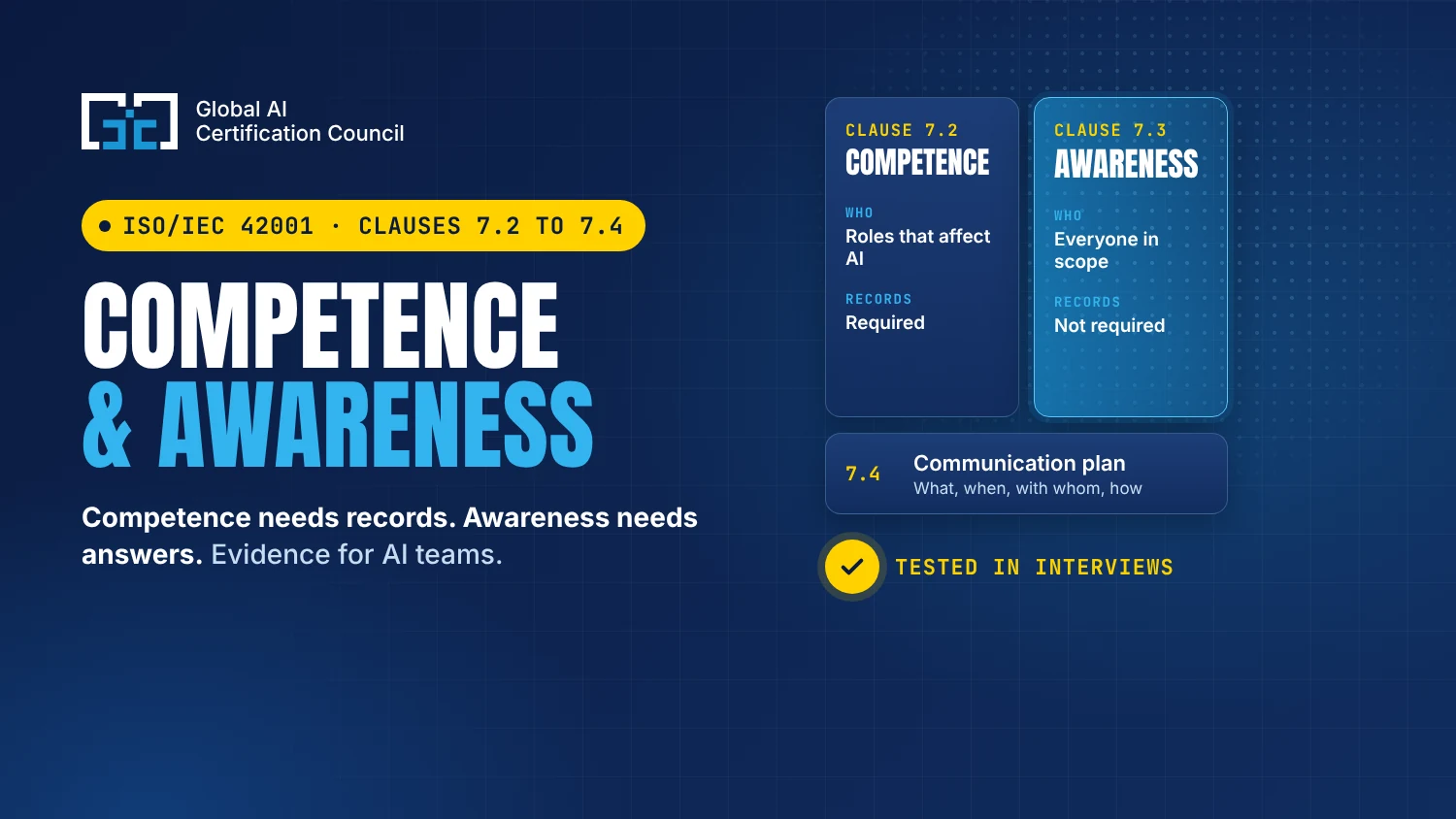
ISO/IEC 42001 competence and awareness are the clause 7.2 and 7.3 support requirements that make an organization show its AI-affecting staff are capable and informed. Clause 7.2 asks you to define the competence each role needs and close gaps through education, training or experience. You then check that the actions worked and keep records available as proof. Clause 7.3 asks that people know the AI policy, their part in the AI management system (AIMS) and what nonconformity leads to. Clause 7.4 adds a communication plan.
Two neighboring ideas get confused with these clauses. A personnel certificate, such as a GAICC credential, certifies one person. Organizations are certified against ISO/IEC 42001, and the standard requires no particular certificate for anyone. AI literacy under Article 4 of the EU AI Act is a legal duty with its own wording, and it reaches further than clause 7.3. Both outside ideas get their own sections after the clause requirements and the evidence that holds up at audit.
What clauses 7.1 to 7.4 require
Clauses 7.1 to 7.4 of ISO/IEC 42001 sit in clause 7, Support. They are short. They reuse the harmonized structure text shared by ISO management system standards, with AI wording added. Wording below is paraphrased from the published text, so confirm it in a licensed copy of ISO/IEC 42001:2023.
Clause 7.1 resources
Clause 7.1 requires the organization to determine and provide the resources the AIMS needs to be set up, run, maintained and improved. People are the resource most often short. A note to 7.1 points to the A.4 controls in Annex A and their guidance in B.4. That note joins two kinds of planning: resources for the management system, and resource records for each AI system. Top management also owns resource availability as one of its clause 5.1 leadership duties.
Clause 7.2 competence
Clause 7.2 sets four duties concerning people doing work under the organization’s control that affects its AI performance:
- Determine the competence each such role needs.
- Make sure people hold it through suitable education, training or experience.
- Where needed, act to acquire it, then evaluate whether the action worked.
- Keep suitable documented information available as evidence of competence.
The standard defines competence in clause 3.9 as the “ability to apply knowledge and skills to achieve intended results.” That definition shapes the evidence. A finished course records knowledge received, while competence shows in the results a person produces, and results are what auditors sample.
The published text asks that evidence be available. Several secondary reproductions print the duty as a lettered item d) that asks you to “retain” evidence instead. The practical effect is close. Either way, the records must exist, sit under document control in 7.5, and be found when an auditor asks. When you quote the clause, quote your licensed copy.
Clause 7.2 also carries two notes that widen it. The first sends readers to B.4.6 in Annex B for guidance on human resources and the expertise to consider. The second lists actions that can close a gap: training, mentoring or re-assigning current staff, or hiring or contracting people who are already competent.
Clause 7.3 awareness
Clause 7.3 requires everyone doing work under the organization’s control to be aware of three things:
- The AI policy.
- Their own contribution to an effective AIMS, including the benefits of better AI performance.
- The implications of not conforming with AIMS requirements.
Clause 7.3 names no documented information, and neither does 7.4. Auditors still test both, mostly by talking to people, so plan a record even where the text asks for none. A note to clause 5.1 adds a cultural point. Top management that models a responsible approach to AI, and makes sure people know about it, helps the AIMS succeed.
Clause 7.4 communication
Clause 7.4 requires an organization to settle its internal and external AIMS communications: what it will say, when, with whom and how. The clause is short, but Annex A fills it in. Control A.8.4 asks for a documented plan for telling users about incidents. A.8.3 asks for a way for outside parties to report adverse impacts. A.8.5 covers what the organization must report to interested parties, and A.3.3 sets up a route for raising concerns. A plan that skips those controls leaves gaps an auditor will find.
| Subclause | What it asks (paraphrase) | Documented information named | What auditors usually sample |
| 7.1 Resources | Determine and provide resources for the AIMS | None in 7.1; A.4 controls require resource documentation | Staffing and budget decisions; A.4 records |
| 7.2 Competence | Define needs, ensure competence, close gaps, evaluate actions | Yes, as evidence of competence | Records for people in sampled roles |
| 7.3 Awareness | AI policy, own contribution, implications of nonconformity | None | Staff interviews; induction and briefing records |
| 7.4 Communication | What, when, with whom and how | None | The plan and a dated message that went out |
Read clause by clause, these four subclauses look light, but most of their weight arrives through Annex A, starting with the control on people.
Control A.4.6 and the Annex B guidance on people
Annex A control A.4.6, Human resources, asks the organization to document the people and competences used across an AI system’s life cycle. The control names the stages: development, deployment, operation, change management, maintenance, transfer and decommissioning, plus verification and integration. It sits in the A.4 group on resources for AI systems, next to data, tooling and computing resources.
A.4.6 and clause 7.2 look alike, but they work at different levels: clause 7.2 works per role across the whole management system. A.4.6 works per AI system: who builds, tests, runs and retires this system, and what they know. One record set can serve both. Each AI system’s resource entry simply points to named roles in the competence matrix.
Annex B is normative in ISO/IEC 42001, so its guidance forms part of the standard itself. B.4.2 lists human resources among the resources to document. It means people with the expertise for development, sales, training, operation and maintenance, judged against the organization’s AI role. It also notes that resources can come from the organization, its customers or third parties. B.4.6 asks the organization to consider diverse expertise across the life cycle. Its examples include data scientists, human oversight roles, and experts in safety, security and privacy.
Annex C makes the same point. Its list of potential AI-related objectives includes AI expertise, which an organization can adopt as a measurable objective under clause 6.2. Clause 7.5.1 closes the loop. A note there says the amount of documented information an AIMS needs depends partly on the competence of its people.
Competence evidence versus awareness evidence
Competence evidence shows a person can do a defined AIMS task. Awareness evidence is different. It shows a person knows the policy, their part and the consequences of not conforming. Mixing the two weakens many clause 7 files. A spreadsheet of course completions often gets offered for both, and it proves neither well.
| Question | Competence (clause 7.2) | Awareness (clause 7.3) |
| Who it covers | People whose work affects AI performance, by role | Everyone doing work under the organization’s control |
| Starting point | A defined competence requirement per role | The AI policy and the AIMS requirements |
| Typical evidence | Role-to-competence matrix, assessment against it, certificates, work samples, gap actions and effectiveness reviews | Induction records, policy acknowledgments, briefing logs, short knowledge checks, interview answers |
| Documented information required | Yes | No, though auditors look for something |
| How it fails | Training logged against no defined requirement, or no check that it worked | People cannot say what the AI policy means for their own job |
| What triggers a refresh | New role, new AI system, changed method, failed effectiveness check | Policy change, new AI tool in use, an incident, the yearly cycle you set |
An illustrative competence matrix for AIMS roles
A competence matrix links each AIMS role to the competence it needs, the evidence that proves it and the action taken when someone falls short. ISO/IEC 42001 prescribes no format and uses no job titles. The matrix below is GAICC’s illustrative model and does not come from the standard. Its role names follow GAICC’s page on AIMS roles and responsibilities, which holds the RACI.
| Role | Competence it needs | Evidence that holds up | Typical gap action |
| Top management | Purpose of the AIMS, the AI policy, risk acceptance duties, management review | Briefing record, signed policy, review minutes that show informed decisions | Executive briefing; outside adviser for the first review |
| AIMS owner or lead | Clauses 4 to 10, Annex A, the organization’s AI role, performance reporting | Implementer-level credential, prior management system work, performance reports | Implementer training; mentoring by someone who has run an ISO management system |
| AI risk owner | Risk criteria, treatment options, residual risk acceptance | Acceptance records with reasons; training on the risk method | Risk method workshop; paired review of first acceptances |
| AI system owner | Intended use, limits of the system, when to pause it | Approved system documentation, sign-off history, briefing record | System briefing before go-live |
| Impact assessment lead | Consequences for individuals, groups and societies; ISO/IEC 42005 method | Assessments reviewed by a second assessor; relevant training | Mentored first assessment; study of the guidance standard |
| Data scientist or ML engineer | Internal design and development procedures, evaluation, documentation duties | Model review records, evaluation reports, procedure training | Procedure training; peer review of first release |
| Data owner | Provenance, quality, preparation and permitted use of data | Data documentation they approved; training record | Data governance training |
| Human oversight operator | Reading outputs, known failure modes, escalation and override | Scenario test results, supervised operation sign-off | Hands-on training per system; re-test after a model change |
| Internal auditor | Audit principles, the 42001 requirements, AI-specific tests, independence | Auditor training or credential; reviewed work papers | Auditor training; shadowing an experienced auditor |
| Procurement | Spotting AI in purchases, supplier terms, A.10 duties | Supplier review records; intake checklist training | Checklist briefing; legal support on terms |
The matrix stays honest under two rules. Each competence statement should describe a result a person can show, such as an approved assessment, instead of naming a course. Each row should also name who assesses the person, because a person’s own rating of themselves rarely satisfies an auditor. Staff who only use approved AI tools usually need awareness training and no competence row, unless their work affects AI performance.
Building the matrix through a training needs analysis
A training needs analysis turns the role list into a working matrix in five steps.
- Take the roles from your RACI and add every role named in the A.4.6 records of in-scope AI systems.
- Write two to five competence statements per role, each a task someone could watch the person do.
- Assess each person against the statements using evidence such as work samples or observed tasks.
- Log each gap with an action, an owner and a date.
- Check whether the action worked, and record the result.
Step 5 is the one most files miss. Auditors ask about it. The standard asks for an evaluation of effectiveness, and a completion certificate alone does not show that the person can now do the task.
People who are not your employees
Clause 7.2 covers people doing work under the organization’s control, which reaches past the payroll. In GAICC’s reading, that includes contractors, consultants and outsourced teams working to your instructions. Data labelers following your guidelines, an external red team you direct, and a consultant drafting your impact assessments all fall inside it. Their evidence usually comes through the contract. Think competence terms in the statement of work, CVs or credentials checked at onboarding, and a review of their first output. A vendor’s staff running the vendor’s own processes are a different case. They sit under the supplier controls in A.10, covered on GAICC’s page on reviewing AI suppliers.
When an AI agent does the work
Clause 7.2 applies to persons, so an AI agent has no competence record of its own. Competence attaches to the people who configure the agent, grant its permissions, review its output and decide when it stops. Those roles belong in the matrix, with statements specific to agents, such as setting tool permissions or reading action logs. The agent itself is a resource, documented under A.4 and controlled through the A.6 life cycle controls.
How training, mentoring, hiring and outside expertise count
Training, mentoring, re-assignment, hiring and contracting all count as ways to acquire competence under the second note to clause 7.2. The standard does not rank them. Each one leaves a different evidence trail and needs a different effectiveness check.
| Action | When it fits | Evidence it leaves | How to check it worked |
| Training, internal or external | A known skill gap shared by several people | Course outline, attendance, assessment or exam result | Observed task or reviewed output some weeks later |
| Mentoring | Judgment learned by doing, such as risk acceptance or impact assessment | Mentoring plan, logged sessions, mentor sign-off | Mentor and a second reviewer approve independent work |
| Re-assignment | A better-placed person already exists | Role change record, updated matrix | Matrix shows the requirement met by the new holder |
| Hiring | A gap too large or lasting for training | Job description tied to competence statements, selection record, verified credentials | Probation review against the statements |
| Contracting outside expertise | Short-term need, or independence needed | Contract with competence terms, CVs or credentials, deliverables | Deliverable review; a handover plan where the need is lasting |
Contracted expertise carries one risk, because knowledge leaves with the contractor. Where the need is permanent, the contract should include handover to a named internal role. External training also needs a clear link to the statements it closes. For an AIMS owner, the competence and resources module of GAICC’s Lead Implementer course covers clauses 7.1 to 7.3. The matrix can cite it against those rows.
Evaluating whether the action worked
Evaluating effectiveness means checking that the person can now do the task, which attendance alone cannot show. Practical checks include a supervised task, a peer review of the first real output or a scenario test. The trend in audit findings for that activity also counts. Set the check when you set the action, and record the outcome next to the gap. If the check fails, the gap stays open.
Awareness that people can explain
Awareness under clause 7.3 is met when people can explain the AI policy, their part and the cost of not conforming in their own words. A policy acknowledgment click shows the policy reached someone, but it does not show that they understood it or could apply it at work. The simplest test is to ask them.
Most organizations need three tiers of awareness content.
- Everyone using AI at work: what the AI policy allows, which tools are approved, how to raise a concern, and what follows a breach.
- People who build or change AI systems: the A.6 processes for responsible design and development, the records they owe, and how their work feeds risk assessment.
- Approvers and managers: what they sign, their risk acceptance limits, and how nonconformities get handled.
Builders are the tier most often handed generic material. A practitioner on r/grc asked in August 2025 for responsible AI development training that would serve both clause 7.3 and control A.6.1.3. The replies offered only generic courses. Content built from your own development procedures answers both, because A.6.1.3 concerns those processes and 7.3 asks that people know their part in them.
Measure awareness with questions asked the way an auditor would. Three work well:
- Where is the AI policy, and what does it say about your work?
- What do you do that keeps the AIMS working?
- What happens here if someone breaks the rules on AI use?
Record answers from a sample each cycle. Treat a weak result as an input to corrective action, and keep it out of the training statistics. Awareness content should follow the policy closely, so revisit it whenever the AI policy changes.
A communication plan for clause 7.4
A clause 7.4 communication plan lists each AIMS message with its timing, audience, channel and owner. The rows below are GAICC’s illustrative starting set. Adjust them to your AI role and to the interested parties you identified under clause 4.2.
| What | When | With whom | How | Owner |
| AI policy and later changes | On approval and each revision | All staff and contractors in scope | Intranet notice, induction, team briefing | AIMS owner |
| AI objectives and progress | Quarterly | Managers and teams holding objectives | Dashboard, team meetings | AIMS owner |
| New or changed AI system | At go-live or significant change | Users, operators, support teams | Release note, system briefing | AI system owner |
| How to raise a concern (A.3.3) | At induction, then yearly | Everyone in scope, contractors included | Policy page, reporting channel details | AIMS owner with legal |
| Incidents affecting users (A.8.4) | On the incident plan’s timelines | Affected users and customers | Channels set in the incident plan | AI system owner with security |
| How to report adverse impacts (A.8.3) | At release, then kept visible | Users and other outside parties | Public reporting channel, product help pages | AI system owner |
| Reporting obligations to interested parties (A.8.5) | As each obligation requires | Customers, partners, authorities as relevant | Reports, trust pages, contract notices | Legal with the AIMS owner |
| AI duties for suppliers (A.10) | At onboarding and renewal | Suppliers and partners | Contract terms, supplier briefings | Procurement |
| Management review outputs | After each review | Top management and affected managers | Minutes and action list | AIMS owner |
Clause 7.4 requires no communication records, yet a planned message is an easy auditor sample. Keep the dated notice, its distribution list and any questions it raised.
How auditors test clauses 7.2 and 7.3
Certification auditors test clause 7.2 by tracing from sampled work to the people who did it. They test clause 7.3 mainly through interviews. At Stage 1 they usually confirm that a competence process and matrix exist. At Stage 2 they check that both work in practice for the people who do AIMS work. GAICC’s page on Stage 1 and Stage 2 audits covers the wider certification cycle.
A typical competence trace runs in four moves:
- Pick an AI system from the inventory and open its A.4.6 record.
- Choose a person named there, such as the impact assessor.
- Ask for that role’s competence requirement and the evidence this person meets it.
- Check any gap action and the record showing it worked.
Interviews cover awareness. Auditors usually talk to a sample of staff across functions beyond the AIMS team, and contractors in scope can be sampled too. They ask open questions about the policy and the person’s own work. Rehearsed answers that collapse under one follow-up question tend to get noticed.
The weak points are predictable. Competence requirements exist for the AIMS team but not for operators or data roles. Training is logged with no effectiveness check. Awareness ran once at launch, and later joiners missed it. Your own internal audit should look for these gaps first, and the internal audit program page shows how to plan that coverage.
The certification body’s own auditors face competence rules too. Clause 7.1.3 of ISO/IEC 42006:2025 requires the audit team, taken together, to know all the Annex A controls and how they are implemented. The same clause requires the audit team to know the legal obligations that apply to AI.
Clause 7 is a certification requirement, while AI literacy duties come from law and public policy.
AI literacy rules next to clause 7
AI literacy is a separate legal and policy idea, and conformity with ISO/IEC 42001 does not satisfy any of the texts below by itself. None of them names ISO/IEC 42001. A clause 7 program can still produce evidence that helps with each, if you design it with them in mind.
EU AI Act Article 4 after Regulation (EU) 2026/1744
Article 4 of the EU AI Act changed when the Digital Omnibus on AI entered into force on 27 July 2026. The original text asked providers and deployers to ensure, to their best extent, a sufficient level of AI literacy. The replacement says they “shall take measures to support the development of AI literacy of their staff.” It also covers other people operating or using AI systems on their behalf. The new text adds that the duty does not require anyone to guarantee a specific literacy level for any individual.
Some ranking pages still describe Article 4 in its old, stricter form. The Act also defines AI literacy broadly, covering the skills and understanding needed to deploy AI in an informed way and to grasp its risks. That reaches further than clause 7.3, which asks only about the AI policy, a person’s contribution and nonconformity. EU-exposed organizations can map one training program to both. GAICC’s page on EU AI Act and ISO 42001 differences explains why the two obligations stay separate.
US federal context
US federal agencies work under OMB memorandum M-25-21, issued 3 April 2025. Its workforce section says federal staff should hold, at a minimum, “foundational knowledge of how to use AI responsibly.” Agency AI strategies must plan how to “achieve AI literacy for non-practitioners involved in AI.” For high-impact AI, agencies must provide “sufficient and periodic training, assessment, and oversight” for operators. The memo binds federal agencies only. Vendors selling AI to agencies may still be asked how their own staff are trained.
The NIST AI Risk Management Framework is voluntary. It binds no one. Its GOVERN 2.2 subcategory says “the organization’s personnel and partners receive AI risk management training.” That training should let them perform their duties in line with related policies, procedures and agreements. A Microsoft-provided crosswalk listed by NIST maps GOVERN 2.2 to clause 7.2, and it maps MAP 1.2, on interdisciplinary competencies, to B.4.6 and 7.2. It also maps MAP 3.4, on operator and practitioner proficiency, to 7.2. The crosswalk was drawn against the final draft of 42001, and NIST says listing it implies no endorsement. GAICC’s explainer on the NIST AI RMF covers the framework itself.
| Source | Who it binds | Key wording | Relation to ISO/IEC 42001 |
| EU AI Act Art. 4, as amended by Reg. (EU) 2026/1744 | Providers and deployers in EU scope | “take measures to support the development of AI literacy” | Does not mention 42001; clause 7 records serve as supporting evidence only |
| OMB M-25-21 | US federal agencies | “foundational knowledge of how to use AI responsibly” | Does not mention 42001; reaches vendors only through agency contracts |
| NIST AI RMF GOVERN 2.2 | Voluntary | “personnel and partners receive AI risk management training” | Mapped to 7.2 in a crosswalk Microsoft provided |
| ISO/IEC 42001 clauses 7.2 and 7.3 | Organizations seeking conformity or certification | Defined competence, evidence, awareness of the policy | The requirement a certification auditor tests |
The Stanford AI Index 2026 draws on a 2025 McKinsey survey of organizations. It reports that knowledge and training gaps remain the most cited obstacle to implementing responsible AI. Their share rose from 51% in 2024 to 59% in 2025.
Where personnel credentials fit
Personnel credentials are one form of competence evidence, and ISO/IEC 42001 requires none. A credential shows a person passed an examined standard on a given date. It does not show they know your AI policy, your systems or your risk criteria. Auditors therefore weigh a certificate as part of the record, next to work samples and the matrix.
Most AIMS teams need credentials at two depths. Data stewards, model reviewers, product owners and others who work on the AIMS without owning it need a working knowledge of the standard and its vocabulary. An examined entry-level credential gives them shared vocabulary and a dated record, and GAICC’s guide to starting at Foundation level explains that exam.
The person who owns or builds the AIMS needs implementation depth: scoping, risk and impact methods, the Statement of Applicability and audit readiness. A Lead Implementer credential examines that depth. To certify the person accountable for your AIMS, GAICC’s Lead Implementer course pairs clause 2 to 10 training with an exam attempt. Internal auditors have a separate credential route, and GAICC lists the full course range by level.
Whatever the credential, record it against a competence statement in the matrix. A certificate filed with no stated requirement answers none of the questions an auditor asks.
Two GAICC candidates have written about the training from the learner’s side. A New Zealand practitioner describes what the Lead Implementer course changed in her client work, and an ESG professional recounts the 11 intense days she spent on the course.
People weighing a privacy or legal credential first can read AIGP set against the ISO 42001 courses.
Next steps by seat
The next move depends on the job you hold in the AIMS.
- AIMS owners can read how clause 7 work fails when it is left to the end of implementing an AIMS.
- Records keepers can check where competence evidence sits among the documents ISO/IEC 42001 requires.
- Training leads can start from the matrix above and choose a credential level for each row, timed to the phases of the implementation roadmap.
- Teams with an audit coming up can run the four-move trace on two AI systems before the auditor arrives.
Frequently Asked Questions
Is ISO 42001 competence training mandatory?
ISO itself says certification to ISO/IEC 42001 is voluntary, so clauses 7.2 and 7.3 bind an organization only once it claims conformity or seeks a certificate. From then on, the competence and awareness duties are requirements an auditor tests like any other clause. Whether your business needs the standard at all is covered in what ISO 42001 solves for US organizations.
Does ISO 42001 require training certificates?
ISO/IEC 42001 does not require training certificates for anyone. Clause 7.2 accepts education, training or experience as the basis for competence. A certificate is useful evidence, but the requirement is met by the matrix, the assessment and the records together.
Is an attendance list enough evidence for clause 7.2?
An attendance list alone is rarely enough for clause 7.2, because it records only that a session took place. It says nothing about the competence the role needed or whether the training closed the gap. Pair it with the competence statement and an effectiveness check.
How often should AI awareness training run?
ISO/IEC 42001 sets no frequency for awareness activity, so most organizations brief at induction and then repeat on a cycle they choose and can defend. Triggers matter more than the calendar: a policy change, a new AI tool, an incident or a new role should each prompt a refresh.
Does ISO 42001 awareness training satisfy EU AI Act Article 4?
ISO/IEC 42001 awareness training does not by itself satisfy Article 4 of the EU AI Act. The amended article asks providers and deployers to support AI literacy, judged against staff knowledge and the context of use. A clause 7 program designed with that wording in mind can supply supporting evidence.
Which clauses sit around competence in ISO 42001?
Competence belongs to clause 7, Support, which holds 7.1 resources, 7.2 competence, 7.3 awareness, 7.4 communication and 7.5 documented information. Clause 5.1 makes top management answer for resource availability, and Annex A control A.4.6 records the people behind each AI system. Our clause-by-clause tour of ISO 42001 covers clauses 4 to 10 in turn.
Do auditors check competence again after certification?
Yes, auditors can sample competence again at the surveillance audits ISO/IEC 17021-1 sets for years one and two, before recertification in year three. Each surveillance reviews changes since the last audit, so in GAICC’s view new roles, joiners and AI systems draw the first requests for fresh records. Our page on surveillance and recertification audits covers the full cycle.