
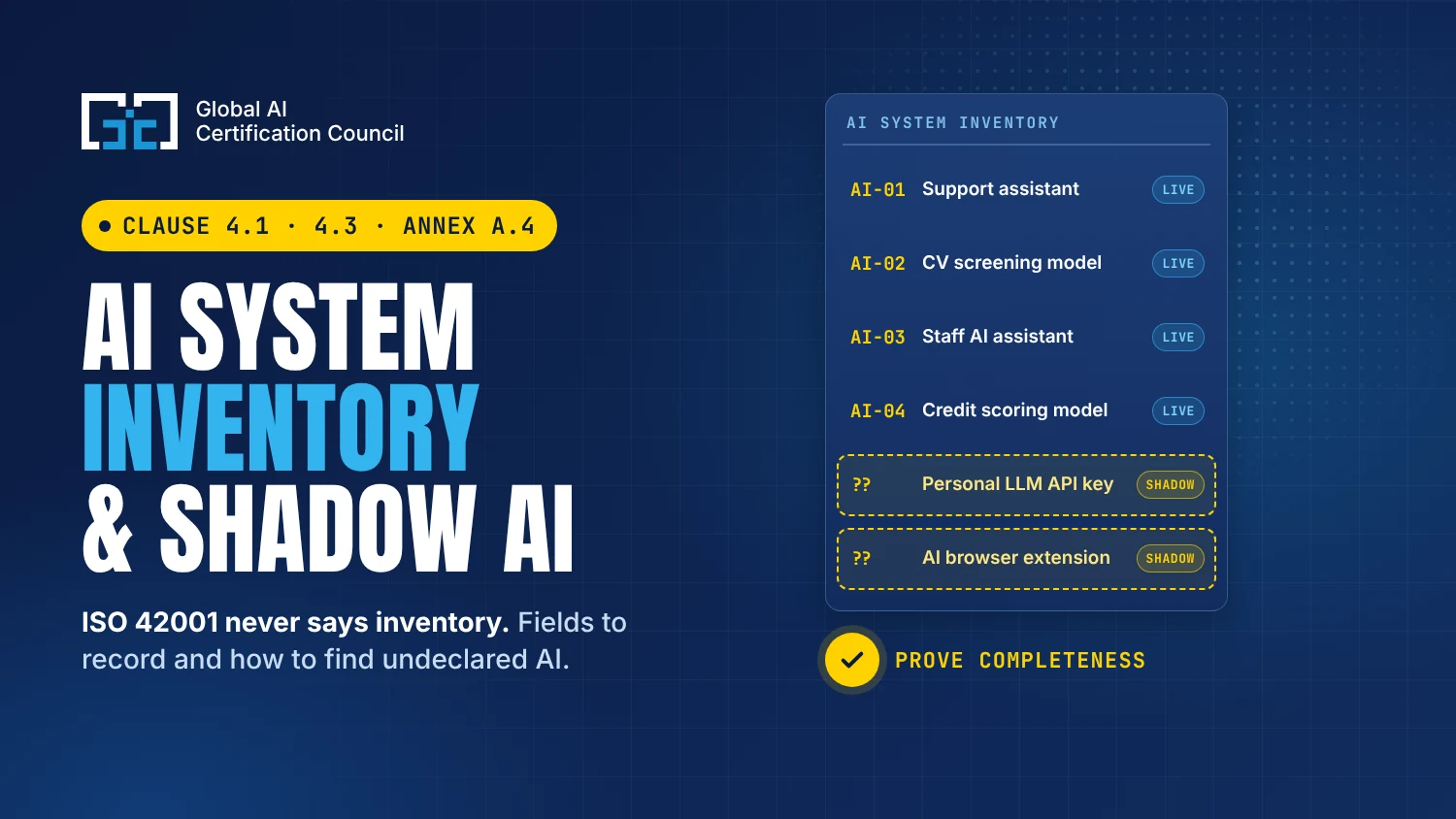
An ISO/IEC 42001 AI system inventory is a maintained record of every AI system an organization develops, provides or uses, with each system’s purpose, role, owner and resources. ISO/IEC 42001 never uses the word “inventory”. The duty is traced through clauses 4.1 and 4.3, the Annex A resource controls A.4.2 to A.4.6, and the A.6 life cycle records. Shadow AI, meaning AI that staff use without approval, is the hardest part of the list to complete.
Practitioners give the same record several names: AI inventory, AI register, AI system register and, in US federal agencies, AI use case inventory. The AI system inventory differs from your IT asset list or configuration management database, although both feed it. It also differs from the AIMS scope. The scope draws a boundary, and the inventory lists what sits inside it, plus anything discovery found near it.
The clause trail behind the inventory
The clause trail behind an AI system inventory starts at clause 4.1 of ISO/IEC 42001:2023. Under clause 4.1 you must weigh what each AI system you develop, provide or use is meant to do. It also requires you to determine your role toward those systems, and neither duty can be met for a system nobody has listed. Clause 4.3 then turns that knowledge into a documented scope.
Annex A supplies the detail. The objective in A.4 covers resources for AI systems, and its five controls ask you to document those resources. Read together with the A.6 life cycle controls, they describe a record per system. Each row paraphrases its source, so read the wording as a pointer and check the exact text in your licensed copy.
| Clause or control | Topic (paraphrased) | Inventory field it produces |
| 4.1 Understanding the organization and its context | Intended purpose of AI systems developed, provided or used; your roles toward them | Purpose; organizational AI role |
| 4.2 Interested parties | Who has requirements of the AIMS | Users and affected parties |
| 4.3 Determining the scope | Boundaries and applicability, kept as documented information | In-scope flag; scope version |
| 6.1.3 AI risk treatment | Statement of Applicability with justified inclusions and exclusions | Control references per system |
| 6.1.4 and 8.4 AI system impact assessment | Consequences for individuals, groups and societies, repeated at planned intervals or when significant changes are proposed | Impact assessment reference; review trigger |
| A.4.2 Resource documentation | Resources each AI system needs across its life cycle | The record itself |
| A.4.3 Data resources | Data the system uses | Data categories; provenance pointer |
| A.4.4 Tooling resources | Tools, models and frameworks | Model, provider, version |
| A.4.5 System and computing resources | Hosting and compute | Deployment and hosting |
| A.4.6 Human resources | People and skills involved | Operators and overseers |
| A.6.2.5 to A.6.2.8 | Deployment, operation and monitoring, technical documentation, event logs | Life cycle status; logs location |
| A.9.4 Intended use of the AI system | Use that matches the documented purpose | Approved and prohibited uses |
| A.10.3 Suppliers | Suppliers of AI products and services | Supplier and contract reference |
The NIST AI Risk Management Framework does use the word. Its GOVERN 1.6 subcategory calls for mechanisms to inventory AI systems, resourced by risk priority. A Microsoft-provided crosswalk, listed on NIST’s AI Resource Center and built on the final draft of ISO/IEC 42001, maps GOVERN 1.6 to Annex B items B.4.2 to B.4.6. Those items are the guidance behind the A.4 controls, and NIST states that listing a crosswalk does not imply endorsement. Even so, the mapping points to the same place this table does.
US federal agencies already work this way. OMB memorandum M-25-21 (April 2025) tells most agencies to inventory their AI use cases at least annually and publish a public version. The memorandum binds agencies only, yet their practice shows what a mature AI inventory looks like in the United States.
Why the missing word matters
The missing word matters because auditors write findings against clause numbers. At least one ranking page describes an “AI inventory requirement” in ISO/IEC 42001 and quotes supposed requirement text. No such text exists. Google’s AI Overview for “iso 42001 ai inventory” (captured 5 October 2026) called the inventory mandatory. Its shadow AI percentage carried a citation card pointing to a LinkedIn post.
A missing inventory can still produce a finding, which would cite clause 4.1, clause 4.3 or A.4.2. Your evidence should cite the same references, so the record and the finding speak one language.
What counts as an AI system
An AI system, for ISO/IEC 42001 purposes, takes its meaning from ISO/IEC 22989, the standard’s only normative reference. Clause 3 of 42001 adopts the 22989 terms. ISO/IEC 22989 describes an AI system as an engineered system that produces outputs such as content, forecasts, recommendations or decisions toward objectives that humans set.
The OECD definition, revised in November 2023, takes a different angle. It describes a machine-based system that infers from its inputs how to generate outputs such as predictions, content, recommendations or decisions. Those outputs can influence physical or virtual environments. Illinois copied the OECD wording into its employment amendment that took effect on 1 January 2026.
Emphasis is where the two definitions part. 22989 centers on outputs produced for human-set goals. The OECD text centers on inference. A fixed rules engine usually fails the inference test, while a credit scoring model trained on historical data passes both definitions. For borderline cases, GAICC’s editorial rule is to list the item, mark it “assessed, not AI” and record the reason. An auditor can test a written decision, while a silent omission leaves nothing to show.
| Borderline item | Inventory decision (GAICC editorial view) | Reason |
| AI feature switched on in an approved SaaS tool | Separate entry, linked to the parent application | New purpose and new data flow under an old contract |
| General-purpose assistant licensed for staff | One entry per tenant or configuration, with approved uses | Same model, different data and uses |
| Personal API key to an LLM provider, used in a team script | Entry owned by the team lead | Company data leaves through an unmanaged channel |
| AI agent with tool access | Entry for the agent, separate from its model | Its permissions define what it can do |
| Model embedded in a purchased product or device | Entry when its outputs inform in-scope decisions | The vendor builds it; you act on its outputs |
| Statistical scoring model built years ago | Entry, same as any new model | Age does not exempt a system that infers |
| Fixed-rule automation with no learning | “Assessed, not AI” record with a reason | Keeps the boundary decision visible |
| Browser extension with AI features | Entry or a blocked status, per policy | Many read whatever page the user opens |
AI features switched on inside approved SaaS
AI features inside already-approved SaaS are easy to miss, because no new purchase or login announces them. A security practitioner described the problem on a public forum in September 2026: AI features kept appearing inside applications the company had already approved. The only reply came from a vendor.
NIST’s Generative AI Profile (NIST AI 600-1) offers a useful rule. Its suggested action GV-1.6-002 says organizations should define any inventory exemptions for generative AI embedded in application software in their policies. An exemption therefore has to be written down, and an unstated assumption does not count as one.
A practical routine has four parts:
- Ask each SaaS supplier, in the contract, to give notice before enabling AI features and to state whether your data trains its models.
- Check AI feature toggles in admin consoles at each planned review, and record who switched each one on.
- Send supplier release notes to the AIMS lead as well as to IT.
- Give each feature its own entry, so meeting summaries, email drafting and document Q&A stay separate, because each touches different data.
The supplier side of this work, including due diligence and contract clauses, sits in GAICC’s guide to assessing AI vendors.
Agents, API keys and embedded models
Agents, API keys and embedded models are inventory objects in their own right. Each one hides AI use behind something that looks like ordinary software.
An AI agent needs fields a chatbot does not. Record the identity it runs under, the tools and systems it can call, and the permissions it holds. Add the points where a human must approve an action, and the location of its event logs under A.6.2.8. When an agent gains a new tool, treat the change as a change to the system.
API keys are often the only trace of a script or prototype. Map every key for an AI provider to an entry and a named owner. Revoke keys that map to nothing.
Embedded models sit inside purchased products, such as a vision model in a camera system. Record the supplier, the update channel and the decisions its outputs inform. You cannot inspect the model, but you can document what you do with it.
Fields to record for each AI system
The fields an AI system inventory needs follow from the clause trail above. The schema is GAICC editorial guidance and quotes no clause text. Each row names the clause or control it serves and the later artifact that reads it.
| # | Field | What to record | Traces to | Read later by |
| 1 | ID, name and version | Unique ID, the name staff use, current version | A.4.2; A.6.2.7 | Every other record |
| 2 | Purpose and intended use | What it does, for whom, which decisions it informs, known misuse | 4.1; A.9.4 | Impact assessment; use rules |
| 3 | Organizational AI role | Provider, producer, customer or partner; several may apply | 4.1 | Scope; control applicability |
| 4 | Owners | Accountable business owner; technical owner | 5.3; A.3.2 | Sign-offs; reviews |
| 5 | Model and provider | AI type, base model, version, provider, access mode | A.4.4; A.10.3 | Supplier review; change triggers |
| 6 | Deployment | Hosting, region, integrations, agent permissions | A.4.5; A.6.2.5 | Security review; jurisdiction |
| 7 | Data | Inputs, outputs, training, tuning and retrieval sources, personal data flag | A.4.3; A.7 | Data controls; privacy review |
| 8 | People | Operators, output reviewers, required skills | A.4.6; 7.2 | Competence records |
| 9 | Users and affected parties | Internal users, customers, people affected by outputs | 4.2; 6.1.4 | Impact assessment scope |
| 10 | Life cycle status | Proposed, in development, in validation, live, suspended, retired | A.6.2 series | Audit sampling; retirement |
| 11 | Risk assessment reference | Record ID and date | 6.1.2; 8.2 | Risk treatment |
| 12 | Impact assessment reference and tier | Record ID, date, criticality tier | 6.1.4; 8.4; A.5.2; A.5.3 | Reassessment |
| 13 | SoA references | Controls applied or excluded for this system | 6.1.3 | Statement of Applicability |
| 14 | Supplier and contract | Vendor, contract ID, AI terms on training use and retention | A.10.2; A.10.3 | Supplier review |
| 15 | Logs and monitoring | Where logs live; who watches them | A.6.2.6; A.6.2.8 | Incident handling |
| 16 | Discovery source and date | Declared, procurement, identity logs, scan, survey | Evidence practice | Completeness tests |
| 17 | Approval status | Approved, conditional, under review, prohibited | A.9.2 | Use enforcement |
| 18 | Review dates | Last review, reviewer, next planned review | 8.4; 9.1 | Keeping it current |
NIST’s Generative AI Profile points the same way for generative systems. Its suggested action GV-1.6-003 lists data provenance, known issues and human oversight roles. It adds rights in sensitive or licensed data, and the underlying foundation models with their versions and access modes. Fields 5, 7 and 8 above cover most of that list; add known issues and incident references to field 15 to cover the rest.
A minimum version for a small organization
A small organization can start an inventory with ten fields and grow it later. Use fields 1, 2, 3, 4, 5, 7, 10, 12, 16 and 18. That set answers what the system is, why it exists, who owns it, what data it touches, how it was found and when someone last looked. A spreadsheet is enough at this size, because a version history and a named owner matter more than the tool that holds them.
An illustrative entry
This illustrative entry comes from the schema and describes no real client. Picture a 300-person US engineering consultancy that has just switched on AI meeting summaries inside its approved video platform.
| Field | Illustrative value |
| ID, name and version | AI-017, “Meeting summaries”, feature version shown in the admin console |
| Purpose and intended use | Summarize internal project meetings; not for client calls without consent; not for performance reviews |
| Organizational AI role | AI customer (user) of the platform supplier |
| Owners | Head of Operations (business); IT collaboration lead (technical) |
| Model and provider | Supplier’s generative model, version not disclosed; SaaS feature |
| Data | Meeting audio and transcripts, which may hold client confidential data and personal data |
| Life cycle status | Live, pilot group of 40 users |
| Impact assessment reference and tier | IA-017, Tier 2 |
| Discovery source and date | Supplier release note, flagged by IT on 12 September 2026 |
| Review dates | Next review on contract renewal or on any change to the supplier’s data terms |
Sorting systems into criticality tiers
Criticality tiers let an AI system inventory decide how much assessment and review each system gets. ISO/IEC 42001 does not prescribe tiers. The Annex B guidance for the impact assessment process lists factors such as the criticality of purpose and context, complexity, level of automation and data sensitivity. The three tiers apply those factors as GAICC editorial guidance.
| Tier | Typical profile | What the tier triggers |
| 1 | Outputs inform decisions about people’s jobs, credit, housing, health or education; or the system acts on other systems without human approval | Full impact assessment before go-live; shortest review interval; first choice for audit samples |
| 2 | Customer-facing outputs, or confidential or personal data, with a human reviewing before use | Proportionate impact assessment; standard review interval |
| 3 | Internal productivity use on non-sensitive data, with a human always deciding | Short screening record; longest review interval |
Tiers only work when the triggers for moving between them are written down. A Tier 3 drafting tool becomes Tier 2 the day someone pastes client data into it.
Shadow AI and why inventories miss it
Shadow AI is AI used inside an organization without the knowledge or approval of the people accountable for it. Wikipedia’s article on shadow IT now carries a shadow AI section that names ChatGPT and GitHub Copilot as typical examples. It adds that rapid consumer adoption of such assistants has accelerated shadow AI inside enterprises.
The most quoted survey figure needs its base stated. Microsoft and LinkedIn’s 2024 Work Trend Index reported that “78% of AI users are bringing their own AI tools to work (BYOAI)”. The base is AI users, a narrower group than all employees. The same report found 52% of people who use AI at work are reluctant to admit using it for their most important tasks. A survey alone will therefore undercount.
Breach data shows the cost. IBM’s 2025 Cost of a Data Breach findings state: “One in five organizations reported a breach due to shadow AI, and only 37% have policies to manage AI or detect shadow AI.” Organizations with high levels of shadow AI averaged US$670,000 more in breach costs than those with little or none. Among organizations with AI governance policies, only 34% audit regularly for unsanctioned AI. The Ponemon study behind these figures covers breaches at 600 organizations from March 2024 to February 2025. IBM published a 2026 edition in July 2026; the numbers here come from the 2025 release.
Practitioner experience points the same way. In a public AI governance forum in August 2026, one practitioner said the tally from a first discovery exercise “is usually 3-5x what leadership thought.” It is one practitioner’s field experience and carries no statistical weight. GAICC’s account of the Samsung ChatGPT data leak shows how a single pasted prompt turns shadow AI into an incident.
Shadow AI opens direct ISO/IEC 42001 gaps. A system missing from the inventory has no role decision, no impact assessment and no line in the Statement of Applicability. Each of those gaps can become a finding.
Discovery methods that find undeclared AI
Discovery methods for undeclared AI work best in combination, because each source sees a different slice. The table names practices and no products. Many organizations already hold this data and only need to read it with AI in mind.
| Method | What it surfaces | Blind spots | Usual owner |
| Procurement, accounts payable and expense claims | Paid AI subscriptions, AI add-ons at renewal, small card purchases | Free tiers; personal accounts | Finance with procurement |
| Single sign-on and app consent logs | AI apps used with company identity; third-party apps granted access to mail or files | Personal logins | Identity team |
| Web gateway or cloud access security broker logs | Traffic to known AI services | Off-network and personal-device use; domain lists that age fast | Security operations |
| Endpoint and browser extension inventory | Desktop assistants; AI extensions | Unmanaged devices | Endpoint team |
| Code, secrets and cloud billing scans | AI provider API keys in repositories; AI services on cloud bills; ML workloads | Keys paid for personally | Engineering with cloud finance |
| Contract and release note review | AI features added inside approved SaaS; supplier terms on data use | Features enabled without notice | Procurement with the AIMS lead |
| Staff survey with an amnesty window | Personal accounts, real workflows, purposes | Self-report bias | AIMS lead with HR |
| Architecture and change reviews | AI built into products and internal tools | Work that skips review | Engineering leads |
A workable discovery sequence
A workable discovery sequence moves from records you already trust toward sources that need people’s cooperation.
- Seed the inventory with declared systems and the AI line items in procurement and expense data for the last twelve months.
- Add AI apps from identity logs and consent grants, then match them to entries.
- Run the technical scans: extensions, API keys, cloud bills and network logs.
- Review contracts and release notes for every approved SaaS tool with AI features.
- Open a survey with an amnesty window, and ask about purposes as well as tools.
- Reconcile all sources, assign owners and tiers, and record the date and sources used.
Surveys and amnesty windows
Surveys and amnesty windows uncover purposes that logs cannot show. An amnesty works when it is time-boxed, promises no discipline for declared use and offers an approved alternative. Make the questions concrete. Ask which tools people paste work into, which accounts they use and what decisions the outputs feed. Concerns about other people’s AI use belong in the process you set up under A.3.3, reporting of concerns.
Proving completeness to an auditor
Proving completeness means showing that the inventory matches independent records, because no auditor can see a system you never listed. Auditors test completeness indirectly. They pick a population that should contain every AI system, then check it against your list. You can run the same tests first.
| Test | Population compared | What a pass looks like |
| Procurement to inventory | AI-related purchases in the period | Each purchase maps to an entry or to a recorded exclusion |
| Identity to inventory | AI apps in single sign-on and consent logs | Each app maps to an entry, a blocked status or an exclusion |
| Inventory to reality | A sample of entries | Owner confirms the system; fields match what is running |
| Inventory to impact assessments | Tier 1 and Tier 2 entries | A current assessment dated after the last significant change |
| Inventory to the SoA | Per-system control exclusions | Exclusions match each system’s role, data and tier |
| Change records to inventory | Deployments and supplier change notices in the period | Entries updated, with dates |
Keep a dated reconciliation record for each run. Note the period, the populations, the exceptions found, who fixed them and by when. Exceptions that recur become corrective actions under clause 10.2.
Certification audits read this evidence in two passes. Under ISO/IEC 17021-1, Stage 1 checks documentation and readiness, and Stage 2 evaluates whether the system is implemented and effective. GAICC’s guide to what happens at Stage 1 covers the full cycle. Your own reconciliation belongs in the internal audit program, where clause 9.2 asks for audits at planned intervals.
Keeping the inventory current
Keeping the inventory current takes change triggers as well as calendar reminders. Clause 8.4 asks for impact assessments at planned intervals or when significant changes are proposed. No fixed frequency is set. Choose intervals per tier, record the reasoning, and remember that clause 6.3 requires changes to the AIMS itself to be carried out in a planned manner.
| Trigger | Where the signal appears | Fields to update | Follow-on action |
| Supplier enables a new AI feature | Release notes; admin console | New linked entry; data; approval status | Tier screening; supplier review under A.10.3 |
| Provider changes or retires a model version | Supplier notice; API deprecation | Model and provider; version | Revalidation; impact assessment under 8.4 if behavior changes |
| New data category or source | Change request; data owner | Data; personal data flag | Data controls under A.7 |
| New user group, market or jurisdiction | Product plan; sales | Users and affected parties | Impact assessment refresh |
| Agent gains a tool or permission | Identity and access change | Deployment; permissions | Security review; tier check |
| Incident or complaint | Incident log; concerns channel | Status; logs and monitoring | Communication under A.8.4; corrective action |
| Owner leaves or reorganization | HR change | Owners | Reassignment with sign-off |
| System retired | Decommission plan | Life cycle status; retirement date | Keep the record; close supplier access |
Retired systems stay on the record with their retirement date, because deleting them erases the evidence that the change was managed.
Who owns the inventory
Ownership of the AI system inventory splits in two. The AIMS lead maintains the record and runs discovery, while each system owner answers for the accuracy of their own entries. Clause 5.3 requires top management to assign responsibility for AIMS conformity and for reporting on its performance; A.3.2 extends role assignment to AI work. Procurement, identity and security teams supply discovery data but rarely own entries. A full RACI that places the inventory beside policy, risk acceptance and audit appears in who does what in an AIMS. An AIMS lead who maintains the record and wants formal training can take GAICC’s Lead Implementer certification for AI governance leads, which covers clauses 4 to 10 over four days with the exam included.
How the inventory feeds scope, risk and the SoA
The AI system inventory feeds five later steps, so an error in one field travels. The table shows where each field goes next and which GAICC guide covers that step.
| Inventory fields | Feed | Where the step is covered |
| Purpose, role, in-scope flag | AIMS scope under 4.3 | getting the scope right |
| Purpose, users and affected parties, data, tier | Impact assessment under 6.1.4 and 8.4 | the AI system impact assessment |
| Role, deployment, data, tier | Risk assessment under 6.1.2, then control selection | which controls apply |
| SoA references, role, tier | Per-system inclusions and exclusions | the Statement of Applicability |
| Data sources | Data quality and provenance controls in A.7 | data provenance controls |
A note to clause 6.1.3 also lets the organization justify exclusions for specific AI systems as well as for the AIMS as a whole. The inventory is where that per-system reasoning becomes traceable.
Where to start, by situation
The first discovery sources differ with the kind of AI you run and the governance you already have.
| Situation | Seed the inventory from | What to expect |
| Third-party AI tools only | Procurement, identity logs and SaaS release notes | Mostly AI customer entries, with supplier controls carrying the load |
| You build or fine-tune models | Model registries, repositories and cloud bills, then the shadow AI sources | Producer and provider entries, plus staff use of outside tools |
| ISO/IEC 27001 already in place | Asset records and the supplier register | New AI fields, since no ISMS process captures purpose, AI role or impact tier |
| Fewer than 100 staff | The ten-field minimum in a spreadsheet, and one discovery round with a short survey | A short list you can extend |
| Stage 1 is close | Two reconciliation tests run now, with a dated record | Evidence for the completeness question |
In the implementation sequence, the inventory is step two, after a first view of scope. Defining scope and context, where the inventory starts, is a Domain I task in the GAICC Lead Implementer exam outline.
For the other places AIMS projects stall, see where implementations go wrong.
Frequently asked questions
Does ISO 42001 require an AI inventory?
Not by name, because the word never appears in the standard. Clause 4.1 still requires you to consider the intended purpose of every AI system you develop, provide or use and to determine your role toward each. Control A.4.2 then asks you to document their resources. Whether the standard applies to you at all is covered in what ISO/IEC 42001 is and who needs it.
Is there a free AI inventory template?
The 18-field schema on this page can serve as one once its field names are copied into a spreadsheet, and small organizations can start with the ten-field minimum. ISO/IEC 42001 contains no inventory form, so any template, this one included, is a starting point to adapt to your own systems and roles.
Do we need dedicated software for an AI inventory?
Not at the start. A spreadsheet with a version history and a named owner is enough for a small organization. Dedicated tooling earns its cost once discovery data arrives automatically from identity, procurement and cloud billing systems. The standard asks for documented information and names no tool.
How often should the AI inventory be reviewed?
ISO/IEC 42001 sets no fixed frequency. Clause 8.4 repeats impact assessments at planned intervals or when significant changes are proposed. Set a review interval per criticality tier and add triggers such as a new model version or data source. US federal agencies work to at least once a year under OMB M-25-21.
Does ISO 42001 cover every type of AI?
It covers the AI systems an organization develops, provides or uses, and the term AI system takes its meaning from ISO/IEC 22989. Fixed-rule automation may fall outside the OECD definition, which turns on inference. Record borderline tools as “assessed, not AI” with a reason so the decision stays visible.
Is an AI use case inventory the same as an AI system inventory?
The two overlap. OMB M-25-21 asks US federal agencies to inventory AI use cases, while an ISO/IEC 42001 inventory is organized around systems and also records each one’s role, owners, resources and assessment references. One system with three uses can therefore become one entry with three approved uses, or linked entries when the data differs.
What happens to shadow AI that discovery finds?
List it first and decide afterwards. Each find gets an entry, an owner and a tier, and then one of three outcomes: approval with conditions, replacement with an approved tool, or a block. Keeping blocked tools on the record helps the completeness tests, because identity and procurement records are compared against the list.