
GAICC AI Conference & Awards 2026 "Governing the Future – Building Responsible, Safe and Human-centric AI"
Conventional AI governance asks whether a model’s output is accurate, fair and lawful. Agentic AI governance asks a harder question: what is this system permitted to do, on whose authority, within what limits, under whose supervision — and how do we stop it?
AAIGP is the advanced practitioner credential for the professionals who have to answer that question in writing, and stand behind the answer.





Students
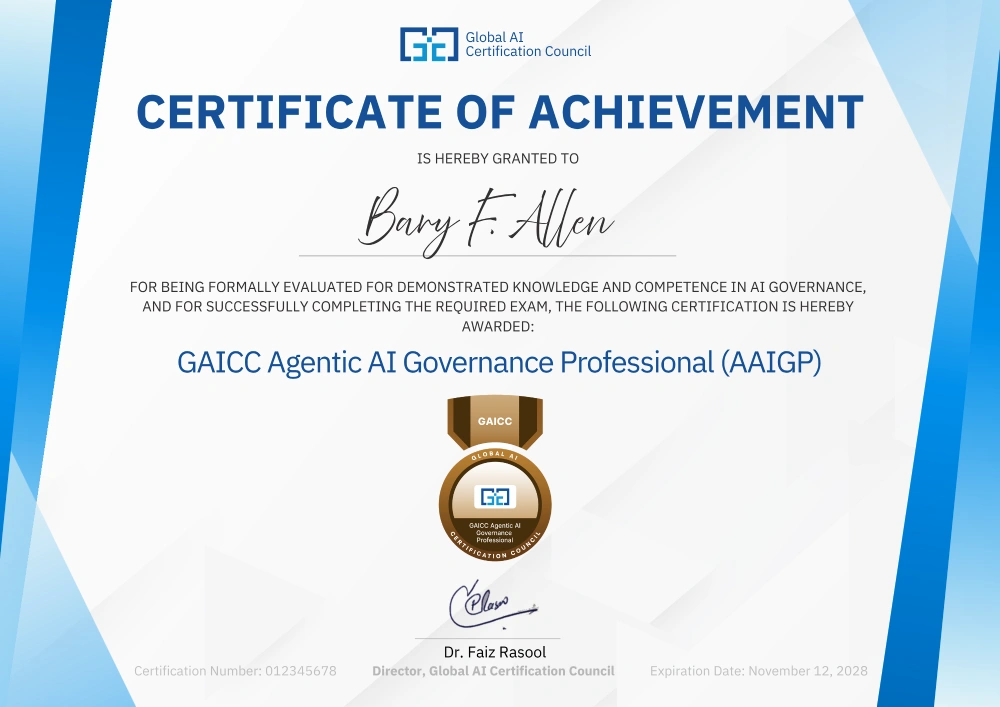
The GAICC Agentic AI Governance Professional (AAIGP) is an advanced practitioner credential for professionals who authorise, oversee, assure and shut down AI systems that take action in the real world.
It is the first GAICC credential written for hybrid human and autonomous-agent teams rather than for AI systems that only produce output. Where earlier generations of AI governance were built around a model returning a recommendation, AAIGP is built around a system that books the flight, moves the money, files the ticket, publishes the document and calls the next agent — often without a human in the loop for any single step.
AAIGP extends the GAICC AI Governance Framework, Maturity Model and Implementation Roadmap into agentic operation. It assumes the fundamentals taught in the GAICC Certified Professional in AI Governance (CPAIG) and does not re-teach them, which is why every hour goes to autonomy-specific competence.
The credential is issued under ISO/IEC 17024, the international standard for bodies certifying persons. Certification decisions are taken by the GAICC Certification Decision Authority, independently of the platform that scored your examination and independently of whoever delivered your training.
Frameworks and regulations applied throughout the programme: EU AI Act (Article 14 human oversight and GPAI obligations) · ISO/IEC 42001 · ISO/IEC 42005 · ISO/IEC 23894 · NIST AI RMF · GDPR and equivalent global privacy regimes (PIPL, PDPA, LGPD) · OECD AI Principles · the GAICC AI Governance Framework
Issued By Global AI Certification Council
Most organisations approved their AI governance framework when AI meant a model that produced text. That framework asks whether output is accurate, fair and explainable. It has no answer for a system that holds credentials, invokes tools, spends money, writes to production systems, calls other agents and completes a transaction end to end before a human sees it.
The result is a widening gap between authority granted and assurance held. AAIGP exists to close it.
Current AI regulation was drafted for systems that inform decisions, not systems that execute them. Practitioners are routinely asked to make defensible calls in areas where the law has not yet spoken — liability for an autonomous action, notification duties when the actor is an agent, the point at which agentic customisation converts a deployer into a provider.
AAIGP trains you to reason from first principles where regulation is silent, and to say so honestly rather than over-claim compliance. That is why no exam question can be answered from vendor terminology, and no question tests definition recall alone.
| Dimension | GAICC AAIGP | GAICC CPAIG | General AI Governance Credentials |
|---|---|---|---|
| Governing question | What may this system do, and how is that authority bounded and evidenced? | Is this AI system lawful, fair and well governed? | Is this AI system lawful and well documented? |
| Agent architecture literacy | Full domain — control loops, tool surfaces, memory, orchestration topologies | Introductory coverage within technical foundations | Rarely addressed |
| Authority and identity | Full domain — non-human identity, scoped grants, delegation chains, blast radius, authorisation gates | Delegation and accountability at principle level | Not addressed |
| Agentic threat modelling | Full domain — injection, tool misuse, goal drift, exfiltration through action, cascading failure | Failure modes mapped to legal exposure at model level | Bias and privacy focus |
| Oversight and containment | Full domain — approval gates, circuit breakers, kill switches, autonomy promotion and demotion | Human oversight requirements and override principles | "Human in the loop" stated as a principle |
| Evaluation and red teaming | Full domain — trajectory evaluation, agentic red teaming, continuous regression, assurance cases | Commissioning and interpreting model safety testing | Limited |
| Evidence and forensics | Full domain — trace specification, decision reconstruction, audit and litigation evidence | Documentation and record-keeping obligations | Documentation obligations |
| Delivery | 4 instructor-led days · 32 contact hours | Pre-course plus 2 intensive days · 28–30 hours | Varies |
| Examination | 100 scenario items · 2.5 hours · 70% pass | 80 scenario items · 2 hours · 70% pass | Typically 100 items · 3 hours · scaled pass |
Also strongly suited to: board members and executives setting enterprise risk appetite for autonomous action, and procurement leads assessing third-party agents and agent marketplaces.
Non-human identity governance · Credential issuance, rotation and revocation · Scoped and just-in-time authorisation · Least-privilege tool grants · Delegation-chain tracing · Confused-deputy analysis · Segregation of duties between agents · Blast-radius calculation · Agent registry and inventory design
Agentic risk taxonomy · Goal drift and specification gaming · Direct, indirect and cross-domain prompt injection · Tool-output poisoning · Exfiltration through action · Cross-tenant contamination analysis · Agentic impact assessment (ISO/IEC 42005 style) · Risk appetite for autonomy · Portfolio risk aggregation
Human-in / on / out-of-the-loop design · EU AI Act Article 14 application · Approval-gate placement and approval-fatigue controls · Circuit breakers and kill-switch testing · Graceful degradation and safe-stop states · Trajectory and behavioural evaluation · Agentic red teaming · Regression control over agent behaviour · Structured assurance cases
Agent trace specification · Decision reconstruction · Log integrity and litigation hold · Production monitoring for agent fleets · Agentic incident response · Multi-jurisdiction breach notification · Liability allocation across the agent supply chain · Third-party agent due diligence · Tiered enterprise governance · Board reporting on autonomy
Day 01
Agent architecture literacy, action surfaces, memory and orchestration; then agent identity, scoped authorisation, delegation chains, blast-radius limits and the authorisation gate.
Day 02
Agentic risk taxonomy, injection and exfiltration threat modelling, agentic impact assessment; then meaningful oversight, approval gates, circuit breakers, kill switches and autonomy promotion.
Day 03
Behavioural and trajectory evaluation, agentic red teaming, continuous regression and assurance cases; then trace specification, decision reconstruction, production monitoring and audit evidence.
Day 04
Agentic incident response, notification, liability allocation and third-party agent governance; then regulatory application, standards mapping, portfolio scaling and board advisory. Closes with the full mock examination and review.
Total Duration
32 Hours
AAIGP certifies the specific ability to authorise and constrain autonomy — a capability most AI governance credentials do not assess at all.
Issued under the international standard for personnel certification bodies, with certification decisions taken independently of training delivery and independently of the scoring platform.
A digital badge and verifiable certificate for LinkedIn, your CV and professional profiles, plus listing in the GAICC global credentials register.
Every item places you in a decision seat: authorise or refuse, escalate or contain, disclose or hold, promote or demote autonomy. Passing means you can make the call.
The programme outputs — authorisation gates, blast-radius limits, trace specifications, assurance cases — are artefacts you can take straight into your organisation.
AAIGP sits alongside CPAIG and the GAICC ISO/IEC 42001 credentials, mapping to the same Framework, Maturity Model and Implementation Roadmap your organisation may already use.

Confirm you meet one of the three education-and-experience pathways, and that your relevant experience falls within the last eight consecutive years.
Choose any one of the three recognised routes — GAICC self-paced, a GAICC-authorised instructor or training partner, or a GAICC-recognised institution. All three are equivalent for eligibility.
Book through the GAICC hub at hub.gaicc.org. Run the system check well before exam day — an unresolved network or camera problem is the most common avoidable delay.
100 scenario-based items in 150 minutes, closed book, from a quiet private space anywhere in the world. Your provisional result and domain-level feedback appear on screen at completion.
The GAICC Certification Decision Authority reviews the provisional result and confirms the decision within 72 hours. Successful candidates receive a verifiable certificate and digital badge.
| Exam Details | Information |
|---|---|
| Total questions | 100 scenario-based items (88 scored + 12 unscored pilot) |
| Format | Scenario-based multiple choice, four options (A–D), single best answer |
| Duration | 150 minutes (2 hours 30 minutes), no scheduled break |
| Pass mark | 70% of scored questions — a minimum of 62 of 88 |
| Scoring | Scaled 100–500; 350 is the passing threshold, anchored via a modified-Angoff study |
| Negative marking | None — answer every question |
| Cognitive split | Understanding 15% · Application 45% · Analysis and Evaluation 40% |
| Reference material | Closed book. No external reference material permitted |
| Delivery | AI-proctored online on the GAICC hub (hub.gaicc.org), global browser access |
| Language | English (other languages on request) |
| Results | Provisional on screen at completion, with domain-level performance feedback |
| Certification decision | Confirmed by the Certification Decision Authority within 72 hours |
| Educational Background | Professional Experience Required | Training Requirement |
|---|---|---|
| Secondary qualification (high school diploma, associate degree or global equivalent) | 5 years (60 months) in AI governance, risk, compliance, security, audit, data or AI delivery | 32 hours of AAIGP training via any recognised route |
| Bachelor's degree (or global equivalent) | 3 years (36 months) in AI governance, risk, compliance, security, audit, data, technology or law | 32 hours of AAIGP training via any recognised route |
| Master's degree or professional qualification | 2 years (24 months) in AI governance, law, risk, security or AI delivery | 32 hours of AAIGP training via any recognised route |
| Route | Description |
|---|---|
| 1. GAICC self-paced course | The 32-hour AAIGP course completed in your own time on the GAICC hub |
| 2. GAICC-authorised Certified Instructor or Authorised Training Partner | Instructor-led delivery of the 32-hour programme by an authorised partner or an authorised GAICC Certified Instructor |
| 3. A GAICC-recognised institution | 32 hours of AAIGP training delivered by an institution recognised by GAICC for this purpose |
Experience recency: All relevant experience must have been gained within the last eight (8) consecutive years before you submit your AAIGP application. Experience with agentic or automated decision systems, non-human identity, security assurance or audit is recognised alongside classic AI governance experience.

⭐⭐⭐⭐⭐

⭐⭐⭐⭐⭐

⭐⭐⭐⭐⭐

⭐⭐⭐⭐⭐

⭐⭐⭐⭐⭐

⭐⭐⭐⭐⭐
The AAIGP programme is 32 contact hours, structured as four eight-hour days covering two examination domains each. You can complete those hours instructor-led — over four consecutive days or a schedule set by your training provider — or self-paced on the GAICC hub, whichever suits your role and time zone.
Instructor-led delivery closes each day with applied scenario work and a module quiz, and Day 4 finishes with a full mock examination and review.
US$898
US$1075
US$99 is included in the above member price.
| CPD Category | What Counts | Minimum Hours |
|---|---|---|
| 1. Professional learning | GAICC-recognised training, conferences, webinars or workshops in AI governance, agentic AI, security, law, regulation or assurance | 20 |
| 2. Practical application | Direct involvement in agent authorisation, agentic risk assessment, oversight design, agent evaluation, audit or incident response | 20 |
| 3. Contribution and knowledge sharing | Publishing, mentoring, research, contributing to AI governance or agent safety standards, policy papers or community initiatives | 10 |
| 4. Elective activities | Additional learning or engagement supporting continuous professional growth in AI-adjacent disciplines | 10 |
| Total per three-year cycle | 60 CPD hours | |
At least 20 of those hours must come from practical application — this credential is maintained by doing the work, not only by attending sessions.
Where CPD evidence is insufficient, where certification has lapsed beyond any grace period, or where the standard or scheme changes materially, re-examination is required. Full rules are set out in the published recertification policy for this certification.
At least 20 of those hours must come from practical application — this credential is maintained by doing the work, not only by attending sessions.
Where CPD evidence is insufficient, where certification has lapsed beyond any grace period, or where the standard or scheme changes materially, re-examination is required. Full rules are set out in the published recertification policy for this certification.
Use of the certificate and GAICC marks: certified persons may state that they hold the certification while it is valid and use the GAICC certification mark in accordance with the Use of Certificates and Marks procedure. Certification applies to the named individual, is not transferable, and must not be used misleadingly or to imply accreditation that has not been granted. Lapsed or withdrawn certificants must cease use of the certification and the marks.
| Principle | Obligation |
|---|---|
| 1. Integrity and Fairness | Act honestly in all professional activities without bias, conflict of interest or misrepresentation of competence. Disclose potential conflicts proactively. |
| 2. Proportionate Authority | Never recommend or approve a level of agent autonomy that exceeds the assurance evidence held. Where authority and evidence diverge, say so in writing. |
| 3. Human Rights and Wellbeing | Ensure autonomous systems under your governance influence respect human dignity, fairness, privacy and non-discrimination — including for people who never interact with the system. |
| 4. Transparency and Accountability | Promote explainable and reconstructable agent behaviour. Ensure a named human remains accountable for every autonomous action. |
| 5. Data Protection and Privacy | Uphold confidentiality and data-protection principles across agent memory, tool access and trace data, consistent with applicable laws and international standards. |
| 6. Professional Competence | Maintain current knowledge in a field that is changing faster than its regulation, through continuous learning and active engagement with evolving standards. |
| 7. Reporting and Mitigation of Misuse | Take appropriate action when encountering unsafe autonomy, suppressed incidents, disabled controls or violations of applicable regulation or professional standards. |
| 8. Global Responsibility | Recognise that autonomous systems act across borders. Apply governance standards that protect individuals regardless of jurisdiction. |

Director at the Global AI Certification Council (GAICC) and PM Training School
A globally certified instructor in ISO/IEC, PMI®, TOGAF®, SAFe®, and Scrum.org disciplines. With over three years’ hands-on experience in ISO/IEC 42001 AI governance, he delivers training and consulting across New Zealand, Australia, Malaysia, the Philippines, and the UAE, combining high-end credentials with practical, real-world expertise and global reach.

Self-Paced Course (Certification Exam included)
US$898
US$1075
GAICC Annual Membership US$99 is included in the above member price.