
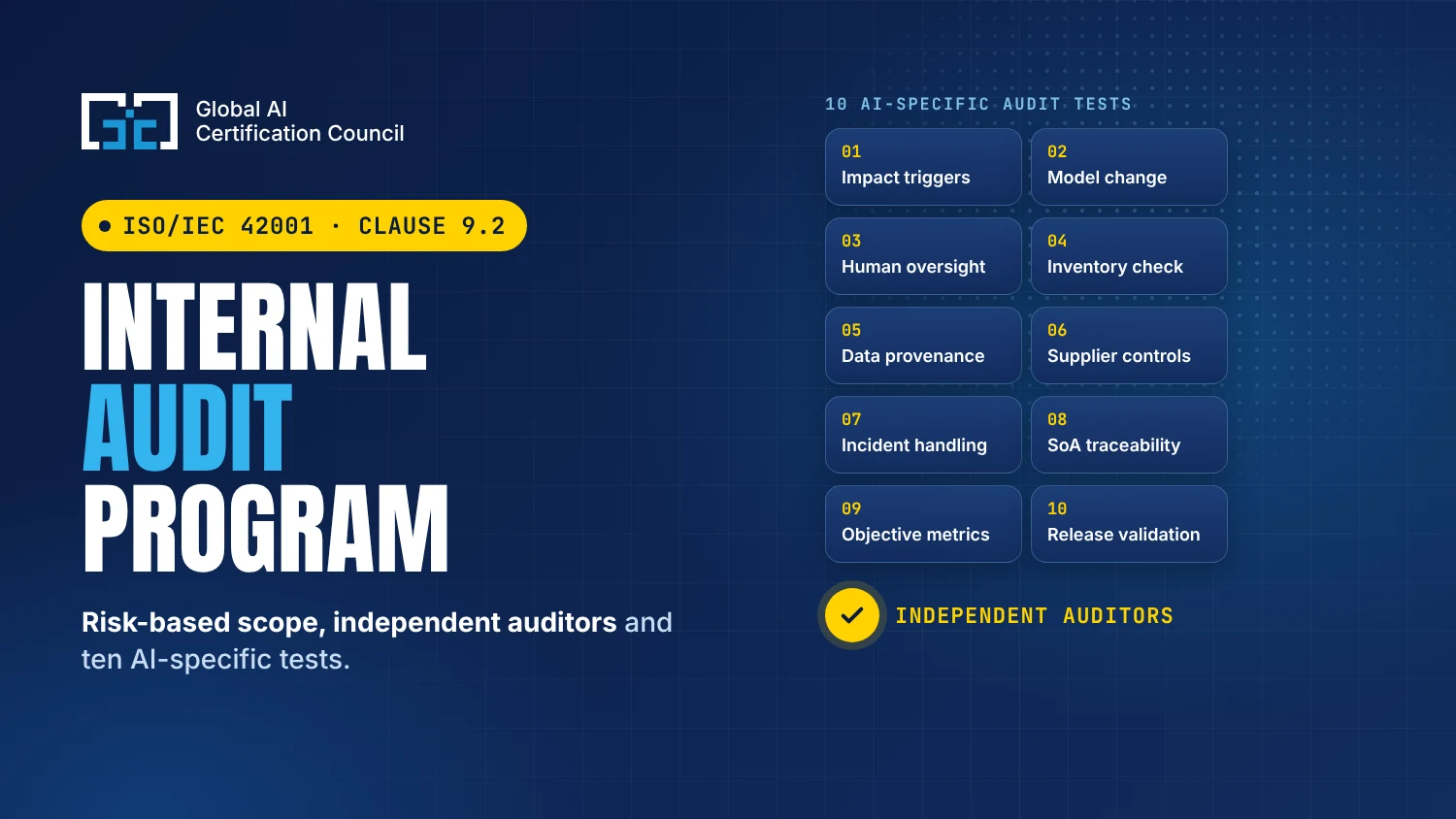
An ISO/IEC 42001 internal audit program is the set of planned first-party audits that clause 9.2 requires to test whether an AI management system (AIMS) conforms and works. The organization runs it, or appoints an external party to audit for it. Each audit needs set criteria and scope, an auditor who did not build what is being checked, a report to management and kept records. The standard fixes no frequency. The program decides how often each area is audited, based on its importance and what earlier audits found.
This page deals with the audits an organization runs on itself. An accredited certification body runs the certification audit, which is a separate event, and the last main section explains how that body judges your program. Readers looking for the personal credential will find the format and content of the Internal Auditor exam explained in their own guide.
What clause 9.2 requires
Clause 9.2 of ISO/IEC 42001:2023 requires internal audits at planned intervals that answer two questions. Does the AIMS conform? Is it effectively implemented and maintained? Conformity is tested against two sets of criteria. One is the standard itself. The other is the organization’s own AIMS requirements, such as its AI policy, its procedures and its impact assessment method. An AIMS can satisfy the standard on paper and still break its own procedures, so both sets count.
The clause has two parts. Clause 9.2.1 states the purpose, and clause 9.2.2 sets out the internal audit programme (ISO’s spelling). Because the table paraphrases the duties, confirm the exact text in your purchased copy.
| Element of clause 9.2 | What it means in practice | Record to keep |
| Planned intervals | Audits follow a schedule the organization sets and can defend | Approved audit schedule |
| A defined program | Frequency, methods, responsibilities, planning requirements and reporting are written down | Audit program document |
| Risk-based emphasis | The program weighs how important each process is and what previous audits found | Stated reason for each area’s frequency |
| Each audit defined | Objectives, criteria and scope are fixed before fieldwork starts | Audit plan for each audit |
| Objective, impartial auditors | Auditor selection and audit conduct keep bias and self-review out | Auditor assignment with an independence check |
| Reporting | Results reach the managers who must act on them | Audit report and its distribution |
| Retained evidence | Proof that the program ran, plus the results | Program, plans, checklists, reports and findings |
The audit definition behind the clause
Clause 3.18 of ISO/IEC 42001 defines an audit as a systematic and independent process for obtaining evidence and evaluating it objectively against audit criteria. Two notes to that definition shape the program. Note 1 calls the internal audit a first-party audit and says any audit can be combined, covering two or more disciplines at once. Note 2 says an internal audit is conducted by the organization itself or by an external party acting for it. A company that already audits to ISO/IEC 27001 can therefore fold AIMS checks into a combined audit. The AI criteria still need their own coverage. Note 3 sends readers to ISO 19011 for the meaning of audit evidence and audit criteria.
Internal audit frequency and planned intervals
ISO/IEC 42001 does not require an annual internal audit. The clause sets planned intervals and leaves their length to the program, which must reflect each process’s importance and the results of earlier audits. A high-impact AI system with open findings can justify two audits a year. A stable, low-impact process can be sampled less often, provided the program still covers the whole AIMS over its cycle.
Two errors circulate on ranking pages. One says internal audits must happen at least once a year. The other cites “clause 5.16” as the home of the internal audit rule. ISO/IEC 42001 has no clause 5.16, because clause 5 ends at 5.3, Roles, responsibilities and authorities. The number looks like an ISO/IEC 27001:2022 Annex A reference, and control 5.16 in that annex is identity management. In ISO/IEC 42001, as in other standards built on ISO’s harmonized structure with its shared clause numbers, internal audit is clause 9.2.
The yearly habit comes from certification body rules. Certification bodies follow ISO/IEC 17021-1, under which a certified client has at least one surveillance audit each calendar year except the year of recertification. Each surveillance audit reviews the client’s internal audits. Completing one full internal audit cycle between visits fits that rhythm. It is a sound planning choice, but calling it a clause 9.2 rule makes a justified risk-based schedule harder to defend.
Building the schedule from risk
Risk sets the schedule. ISO 19011:2026 advises giving priority to the parts of a management system with higher inherent risk and lower performance. GAICC suggests three AIMS signals for that risk: the impact level recorded for each AI system, the volume of change to a system, and open findings. The example program in this table is illustrative, built for a fictional software company with one AIMS and four AI systems.
| Audit area | Risk signal | Planned frequency (illustrative) | Suitable auditor |
| Core AIMS processes, clauses 4 to 10 | Every other audit depends on them | Once per program cycle, before surveillance | Internal audit function or an external party |
| High-impact AI system (a model that sets customer credit limits) | High recorded impact, monthly model updates | Twice per cycle | Auditor outside the product team |
| Low-impact AI systems (an internal drafting assistant) | Low impact, vendor managed | Once per cycle, by sample | Auditor from another function |
| Data for AI systems (Annex A.7) | Training and retrieval data change often | Once per cycle, plus after a major new data source | Auditor with data experience |
| Third-party and customer relationships (Annex A.10) | Third-party models and APIs | Once per cycle | Auditor independent of procurement |
| Any area with an open major finding | Result of the previous audit | Follow-up within the agreed corrective action window | Lead of the original audit team |
ISO 19011:2026, the method behind the program
ISO 19011:2026 is ISO’s guidance on auditing management systems. Its fourth edition, published in May 2026, replaced the 2018 edition. Being guidance, it is written in “should” statements, while ISO/IEC 42001 sets requirements with “shall”. It tells the person who manages a program how to set objectives, weigh program risks, choose auditors, plan single audits and evaluate auditor competence.
For AI audits, the change that counts in the 2026 edition is remote auditing. The foreword lists wider guidance on remote auditing methods, drawn from ISO/IEC TS 17012, and an expanded Annex A on remote methods and virtual locations. A virtual location is an online environment where people carry out work regardless of where they sit. Take an AI system that runs on a cloud platform or behind a model API. Its configuration, logs and approval trail can be reviewed through remote methods, which the new edition covers.
Three of the ISO 19011 principles carry most of the weight in an AIMS program.
- Independence. Auditors should be independent of the activity they audit wherever practicable, and free of bias and conflict of interest in every case.
- Evidence-based approach. Audit evidence should be verifiable and drawn from samples, because every audit has limited time.
- Risk-based approach. Risk should shape both the program and each audit, so effort lands where it matters to the organization.
ISO 19011 also lets one audit program cover several management system standards, audited separately or together as a combined audit. That supports one program for ISO/IEC 27001 and ISO/IEC 42001 in which shared evidence is collected a single time.
Who can audit the AIMS
Auditor independence for an AIMS comes from clause 9.2.2, which asks the organization to select auditors and run audits so that objectivity and impartiality hold. ISO/IEC 42001 never names a job title that may or may not audit. In practice the test is whether anyone would be auditing work they produced. Three questions follow from it.
Can the consultant who built the AIMS run its internal audit?
A consultant who built the AIMS should not audit it. Someone who wrote the risk method, drafted the impact assessments or designed the control evidence would be judging their own output. That is self-review, which the impartiality requirement in clause 9.2.2 exists to keep out, whatever the contract calls the work. The same firm can still help. A different consultant who had no part in the build can audit, as long as the records show who did what. The original consultant can also manage program logistics, such as scheduling and tracking corrective actions, without auditing anything.
The certification body is a separate case. Under ISO/IEC 42006, a certification body may not carry out internal audits for a client it will certify. A new label for the same work, such as inspection, does not get around the ban.
Can the Lead Implementer audit their own work?
No. A Lead Implementer can own the internal audit program: set the schedule, pick and brief auditors, and drive corrective action to closure. The Lead Implementer should not audit the procedures, assessments or records they produced. ISO 19011 accepts that internal auditors cannot always be independent of the activity, and asks for every effort to remove bias when they are not. GAICC reads that fallback as fitting an auditor from the same department. A person checking their own output is a different matter, because self-review is the very bias the principle aims to remove.
The same split belongs in the internal audit row of your AIMS roles and responsibilities matrix. How building and auditing divide across GAICC credentials is set out in the Lead Implementer and Lead Auditor credentials compared.
Implementers are examined on audit planning as well, in Domain III of the GAICC exam, which the Lead Implementer exam guide breaks down by domain.
Options for small organizations
Small organizations can meet the independence rule by arranging who audits what, even with very few staff. The note to clause 3.18 lets an external party run the internal audit for the organization, and that opens four workable patterns.
| Pattern | How it works | Record that shows impartiality | Watch for |
| Outsourced internal auditor | An external auditor runs the audit as the organization’s agent | Engagement letter with scope and a statement of no prior involvement | The auditor cannot be the AIMS consultant or the certification body |
| Cross-function audit | An auditor from another function, often the ISO/IEC 27001 or quality auditor, audits the AIMS | Assignment record showing no role in the audited process | AI subject knowledge; add a technical expert where needed |
| Peer cross-audit | Two small companies lend each other an auditor | Written agreement on scope and confidentiality | Exposure of model and customer data; competitor conflicts |
| Split coverage | Insiders audit areas they did not build, and an external party covers the rest | Coverage matrix listing area, builder and auditor | Areas where the only insider is also the builder |
What an AIMS internal auditor needs to know
ISO/IEC 42001 does not require an internal auditor to hold any credential. The organization decides what competence its auditors need. Clause 7.2 extends to anyone doing work that affects AI performance. Clause 7 of ISO 19011 gives a method for setting and evaluating auditor competence. In GAICC’s view, an AIMS auditor needs three things. The first two are audit method and working knowledge of the clauses and Annex A controls. The third is enough AI literacy to read a model card, an evaluation report or a data lineage record. When that third skill is thin, a technical expert can support the audit team, although ISO 19011 notes that such an expert does not act as an auditor. For structured training in this work, the ISO/IEC 42001 Internal Auditor course covers audit planning and checklists, evidence-based fieldwork, and reporting with corrective action plans.
Two lenses for planning AI audit coverage
Generic management system checklists test whether a process exists. An AI audit also has to test whether the process worked on a real system. Two research frameworks help plan that depth. Neither is part of ISO/IEC 42001, and both are offered here as GAICC’s suggested lenses.
Governance, model and application audits
Mökander and colleagues proposed a three-layered approach to auditing large language models in AI and Ethics (2024). The first layer reviews how a model provider is organized and governed. The second tests a trained model before it ships. The third tests the services and tools that downstream companies build with it. The layers were written for language model providers, yet they give any AIMS program a clear map of what an internal audit touches. The authors also urge realism about what audits can achieve.
| Layer | Question at that layer | ISO/IEC 42001 areas to sample (GAICC mapping) | Who produces the evidence |
| Governance | Is the management system designed and running? | Clauses 4 to 10; Annex A.2, A.3, A.5 | AIMS owner, risk owner, top management |
| Model | Was the model built, tested and documented as the procedures require? | A.6.2.2 to A.6.2.4, A.6.2.7; A.7 | Engineering and data teams |
| Application | Is the deployed system used, monitored and explained as intended? | A.6.2.5, A.6.2.6, A.6.2.8; A.8; A.9 | System owners, operations, support |
In GAICC’s mapping, an ISO/IEC 42001 internal audit is mostly a governance audit that reaches into the other two layers through sampled records. The internal auditor does not rerun a model evaluation. The auditor checks that the evaluation the procedure requires took place, met its acceptance criteria and was approved before release.
SMACTR as a per-system audit design
Raji, Smart and colleagues proposed SMACTR in 2020 as an internal audit framework for AI systems across the development life cycle. The name stands for Scoping, Mapping, Artifact Collection, Testing and Reflection. Each stage yields documents, and together they form the audit report. SMACTR judged a product against declared AI principles before launch, while clause 9.2 judges a management system against its audit criteria. The overlap is still useful, because SMACTR turns a clause checklist into a deep audit of one AI system.
| SMACTR stage | Use in an AIMS internal audit of one AI system | Clause 9.2.2 element it serves |
| Scoping | Fix the system, period and criteria; read its impact assessment to see what is at stake | Objectives, criteria and scope |
| Mapping | List who builds, runs and oversees the system; map its life cycle; rank failure modes to pick tests | Risk-based emphasis |
| Artifact collection | Gather the inventory entry, model and data documentation, release approvals and supplier terms | Evidence base |
| Testing | Run tests from the library in the next section on samples | Audit fieldwork |
| Reflection | Grade findings, update the risk picture and agree actions | Reporting, then clause 10.2 |
A clause checklist asks whether a procedure exists. SMACTR asks what happened to one system under that procedure. Stage 2 of a certification audit asks the same thing when it evaluates implementation and effectiveness.
AI-specific audit tests
The ten tests in this library are GAICC’s suggestions for the testing stage. Each row names the criteria, a sample, the evidence to pull and a finding the test can surface. Sample sizes are illustrative. ISO/IEC 42001 sets none, and ISO 19011 ties the use of sampling to the confidence that can be placed in the audit conclusions.
| Test | Criteria | Sample (illustrative) | Evidence to pull | Finding it can surface |
| 1. Impact assessment triggers | 6.1.4, 8.4, A.5.2 | Every AI system added or changed in the period, up to 10 | Inventory change log, dated impact assessments, written trigger criteria | System went live before its impact assessment was approved |
| 2. Reassessment after model change | 8.4, A.6.2.4, A.6.2.5 | 5 changes: new model versions, fine-tunes, provider-side updates | Change tickets, release approvals, updated risk and impact assessments | Provider changed the underlying model and nobody reassessed or recorded why not |
| 3. Human-oversight decision sampling | A.9.2, A.6.2.6, the oversight procedure | 10 to 15 decisions spread across the period | AI output as first generated, reviewer, time, final decision, override reason | Reviewers approve outputs with no recorded check |
| 4. Inventory reconciliation | 4.1, 4.3, A.4.2 | 10 items traced in from purchase, SSO and expense data; 10 entries traced out to live systems | Inventory, purchase records, SSO app list, expense reports | AI tools in use but missing from the inventory, and so from scope decisions |
| 5. Data provenance sampling | A.7.3, A.7.4, A.7.5 | 3 to 5 datasets used for training, fine-tuning or retrieval | Source, acquisition terms, version, quality checks, preparation steps | Dataset in production with no recorded origin or rights basis |
| 6. Supplier controls | A.10.2, A.10.3 | 3 AI suppliers, highest impact first | Contracts, responsibility allocation, supplier reviews, change notices | Contract silent on model changes, data use or incident notice |
| 7. Incident handling | A.8.4, A.3.3, 10.2 | All AI incidents and raised concerns in the period, or 10 | Incident log, event logs (A.6.2.8), messages sent, corrective action records | Incident closed with a fix but no cause analysis or effectiveness check |
| 8. SoA traceability | 6.1.3 | 5 included controls, every exclusion, 5 risks from the register | Statement of Applicability, risk register, treatment plan, operating evidence | Included control with no evidence it operates; exclusion no longer backed by current risks |
| 9. Objective metrics | 6.2, 9.1 | Every AI objective | Objective statements, measures, targets, monitoring results, review minutes | Objective with no measure, or results never analyzed |
| 10. Release validation | A.6.2.4 | 3 recent releases | Test plans, results against acceptance criteria, sign-off | Release approved with failed or missing test results |
Test 1 depends on trigger criteria written in advance. If the impact assessment procedure does not say which changes reopen an assessment, the auditor has nothing to test against. That gap is a finding in itself. Setting those triggers is covered in the guide to the AI system impact assessment.
Wording needs care in test 4. ISO/IEC 42001 never uses the word “inventory”, so the auditor traces the expectation to clauses 4.1 and 4.3 and control A.4.2. The test is only as good as the discovery behind the list, which is why building an AI system inventory starts with procurement, sign-on and expense data.
Annex A.7 is where test 5 looks, sampling the data provenance controls from acquisition through quality to preparation. Test 8 starts from the Statement of Applicability and walks in both directions, from listed controls to working evidence and from open risks back to listed controls.
Where penetration tests and red teaming fit
A penetration test or red-team exercise is a technical test of a system. No clause title or Annex A control title in ISO/IEC 42001 names either one, and neither stands in for an internal audit. Their results can still count as evidence, most naturally for verification and validation under control A.6.2.4. The internal auditor checks that the organization decided what testing each system needs, ran it and acted on the results. The team that runs the red team should not also audit the process that commissioned it. ISO’s guidance on red teaming, ISO/IEC TS 42119-7, was still a new work item in ISO’s data at the end of September 2026.
Findings, grading and corrective action
An internal audit finding records whether the evidence meets the audit criteria. ISO 19011 notes that findings show conformity or nonconformity, and can also point to risks, improvement opportunities or good practice. ISO/IEC 42001 does not grade findings. Certification bodies grade nonconformities as major or minor under ISO/IEC 17021-1. A similar internal scale shows management how a certification auditor would likely treat the same evidence.
| Grade (GAICC suggested internal scale) | When to use it | AI example | Expected response |
| Major nonconformity | A requirement is missing entirely, or a failure puts the AIMS’s intended results in doubt | No impact assessment exists for any system in scope | Correction now, root cause, corrective action verified before the next certification audit |
| Minor nonconformity | A requirement is met in general but failed in a sample | One of ten sampled releases lacks a validation sign-off | Corrective action plan with an owner and a date |
| Opportunity for improvement | No requirement is broken, but practice could be stronger | Two AI registers that could be merged | Owner decides; no mandatory action |
| Good practice | Evidence worth copying elsewhere | Each oversight decision record carries the control ID | Share across teams |
Clause 10.2 governs what happens next. In summary, the organization reacts to the nonconformity, controls and corrects it, and deals with its consequences. It then decides whether the cause needs removing by reviewing the problem, finding its causes and checking whether similar problems exist or could arise elsewhere. After that it implements the action, reviews its effectiveness and changes the AIMS if necessary. Documented information must capture the nature of each nonconformity, the actions taken and the outcome of any corrective action.
Correction and corrective action are different things. A correction fixes the instance, such as completing a missing impact assessment. A corrective action removes the cause, such as a release gate that blocks deployment until an approved assessment exists. Auditors look for both, and for proof that the corrective action worked. Implementers who want guided practice with this sequence can find it in the nonconformity and corrective action modules of the GAICC Lead Implementer course. Those modules cover identifying and reporting nonconformities, then corrective and preventive action.
Results then move to management review. Clause 9.3 lists trends in nonconformities, corrective actions and audit results among the inputs top management must consider. A program that reports findings one audit at a time, with no trend view, gives the review little to decide on.
What certification auditors check about the program
A certification body examines the internal audit program at Stage 1, at Stage 2 and at every surveillance audit. ISO/IEC 17021-1 writes it into each of those events. The table draws on an accreditation body’s training summary of that standard.
| Certification stage | What the certification body looks at | Have this ready |
| Stage 1 | Whether internal audits and management reviews are planned and being performed | Approved program, schedule and the first audit plans |
| Stage 2 | Internal auditing and management review as part of how the system is implemented, including effectiveness | Completed audit reports, findings, corrective action records, review minutes that used the results |
| Audit report | A summary of evidence on the internal audit and management review process | The same records, consistent with each other |
| Surveillance | Internal audits and management review, at every visit | A program updated since the last visit, with new results |
GAICC’s guidance is to finish the first full internal audit cycle, and take its results to a management review, before Stage 2 is booked. Stage 2 can only judge the effectiveness of a process that has produced results. The person who leads that preparation can build the skills through audit readiness training for implementers. That GAICC course includes modules on the Stage 1 and Stage 2 audits and a mock audit. The full sequence of Stage 1, Stage 2, surveillance and recertification, including how certification auditors grade findings, is covered in preparing for Stage 2.
Next steps by AIMS maturity
How mature the AIMS is today decides the first move.
- An AIMS still under construction needs its audit program written now, with the first audit scheduled for when records exist. The outputs an auditor will test are listed clause by clause.
- A team that asked for a checklist can start from the clause 9.2 table and the ten tests, then add rows for its own procedures.
- Where independence is the obstacle, pick one of the four small-organization patterns and record the choice in the program.
- Anyone planning to do the auditing personally should read the competence section first, then decide whether formal training is worth it.
- When the same findings keep coming back, look upstream at how the system was built. The hub on ISO 42001 implementation collects the failure patterns behind repeat findings.
Frequently Asked Questions
Does an ISO 42001 internal auditor need to be certified?
ISO/IEC 42001 does not ask for any auditor certificate. Clause 7.2 leaves the organization to decide the competence its auditors need, confirm it through education, training or experience, and keep records. ISO 19011 clause 7 offers a method for evaluating auditors, and a credential is only one of the ways to show that competence.
What should an ISO 42001 internal audit checklist include?
A usable checklist has one row for each clause 9.2 element and one for each AIMS procedure the organization wrote for itself. It should add AI-specific tests such as impact assessment triggers, model change reassessment and inventory reconciliation. Each row names the criteria, the sample and the evidence to pull, so two auditors would test it the same way.
How much evidence is enough for an internal audit?
Neither ISO/IEC 42001 nor ISO 19011 sets a sample size. ISO 19011 asks for verifiable evidence drawn from samples, and it ties sampling to the confidence that can be placed in the audit conclusions. Record the sample you chose and why, so the next auditor and the certification body can follow the reasoning.
Can one internal audit cover ISO 27001 and ISO 42001 together?
Yes. Note 1 to clause 3.18 of ISO/IEC 42001 allows a combined audit across disciplines, and ISO 19011 lets one audit program cover several management system standards. Give the AI criteria, such as impact assessments and the Annex A controls, their own lines in the plan so the security audit does not swallow them.
Does an internal audit have to be finished before the certification audit?
Stage 1 under ISO/IEC 17021-1 evaluates whether internal audits and management reviews are being planned and performed. Stage 2 then reviews internal auditing as part of how the system works. A completed internal audit with findings under corrective action therefore gives the certification body more to evaluate than a schedule does.
What happens to the internal audit program after certification?
The program keeps running at its planned intervals, and its scope and frequency should change as audit results and AI systems change. A certified organization has at least one surveillance audit each calendar year outside the recertification year. Under ISO/IEC 17021-1, every one of those audits reviews internal audits and management review.