
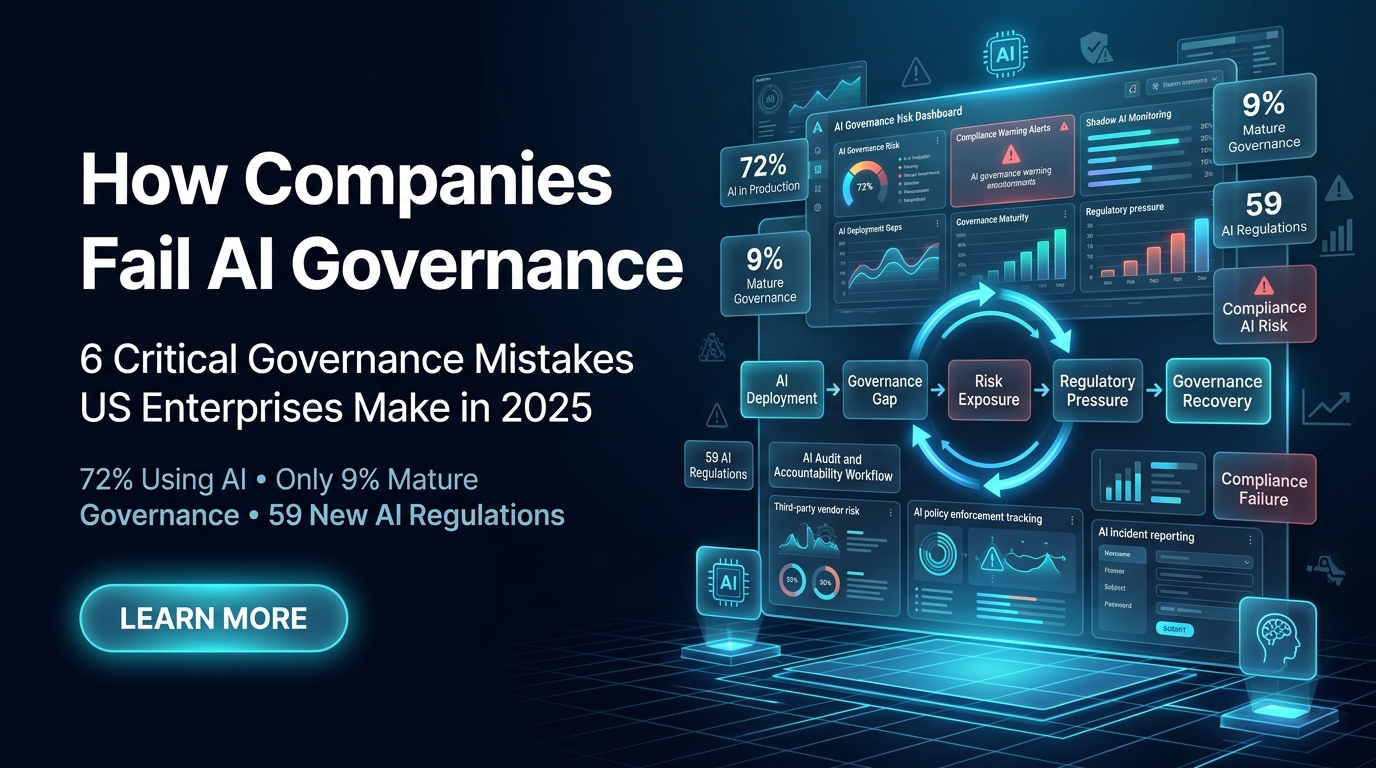
72% of US enterprises have AI systems running in production today. Only 9% describe their AI governance as mature. That gap is not a technology problem it is a leadership and structure problem, and it is getting more expensive by the quarter.
The cost shows up in regulatory penalties, reputational damage, and the compounding technical debt of deploying AI systems that nobody can fully explain or control. In 2024, US federal agencies introduced 59 AI-related regulations, more than double the number from 2023. The pressure is real, and most organizations are not ready for it.
This article breaks down the six most common ways companies fail at AI governance, with specific patterns, documented consequences, and practical fixes for each. No generic frameworks. No vague advice. Just the specific problems you are probably already experiencing and what to do about them.
The Governance-Deployment Gap: Building Fast, Governing Never
AI funding exceeded $100 billion in 2024, an 80% increase over the prior year. That capital creates pressure. When investors expect growth and competitors ship fast, governance becomes something to address “after the next release.” After the next release means never.
McKinsey’s 2024 State of AI report captures this precisely: while 72% of enterprises have AI in production, fewer than 10% have governance systems that can actually prove control at the decision level. Most organizations can tell you how many models they have deployed. Almost none can tell you which decisions those models are influencing right now, with what confidence levels, or what happens when one of them fails.
The pattern is consistent across industries. A business unit identifies an AI use case, procures a solution or builds one internally, deploys it to production, and adds governance as a later checklist item. By then the model is embedded in workflows, the vendor contracts are signed, and there is no realistic path to retrofit meaningful oversight.
The fix is not to slow down AI deployment. It is to build governance checkpoints into the deployment pipeline itself risk classification before build, documentation requirements before release, monitoring thresholds before go-live. Organizations that treat governance as a deployment gate rather than an audit afterthought deploy AI faster in the medium term, not slower, because they spend less time unwinding problems.
Accountability Vacuums: Nobody Actually Owns AI Governance
The 2024 IAPP Governance Survey found that only 28% of organizations have formally defined oversight roles for AI governance. The remaining 72% distribute AI governance responsibilities across compliance, IT, and legal teams without unified accountability. Everyone is responsible, which means no one is.
This creates what practitioners call accountability vacuum situations where an AI system causes harm, triggers a regulatory inquiry, or simply produces unexpectedly bad outputs, and no individual or team has clear authority to respond, remediate, or make decisions. The organizational response becomes a meeting about who should be in the meeting.
The accountability vacuum has three typical manifestations. First, AI incident response is improvised rather than practiced organizations discover their governance gaps in the worst possible moment, under regulatory scrutiny or public attention. Second, AI risk assessments are completed by whoever is available at the time rather than by people with the authority to act on findings. Third, vendor relationships for AI tools lack governance clauses because no one owned the process of including them.
Solving this requires more than naming a Chief AI Officer. It requires defining specific accountabilities at three levels: the model level (who owns this specific AI system and its outputs), the portfolio level (who has cross-functional authority over AI risk standards), and the board level (who receives governance reporting and can approve significant AI risk decisions). Without all three, accountability exists on paper but not in practice.
The Shadow AI Problem: Ungoverned Tools Are Everywhere
78% of AI users report bringing personal tools into the workplace. That statistic deserves a moment of consideration. Nearly four in five employees using AI are using at least some tools that their organization has not reviewed, approved, or governed.
Shadow AI is not primarily a security problem, though it is that too. It is a governance problem. When employees use personal AI tools for work tasks, they are making governance decisions that should be organizational decisions. Data is sent to third-party models under terms no compliance team has reviewed. AI-generated outputs enter workflows without disclosure. Decisions get influenced by systems that have no accountability structure, no audit trail, and no alignment with organizational AI policy.
The scale of this problem is compounding. Generative AI tools are cheap, capable, and frictionless to adopt. An employee who finds that an approved organizational tool is slower or less capable than a personal one will use the personal one, especially if the organizational governance process takes weeks. The 42% gap between anticipated and realized AI adoption in 2024 is partly explained by this dynamic—employees are getting AI value, but not through the channels that governance teams can see or measure.
The most effective response is not prohibition prohibition does not work and creates resentment. It is to make the governed path easier than the ungoverned one. Organizations that invest in curated, approved AI tool catalogs with clear use-case guidance see significant reductions in shadow AI adoption. Pair this with a rapid intake process for employees to request new tools, and the incentive structure shifts toward compliance.
Policy Without Enforcement: The Governance Theater Problem
Most organizations with formal AI governance programs have done the following: written an AI use policy, published it on an internal page, and called governance addressed. This is governance theater, and regulators are increasingly good at recognizing it.
The distinction that matters is between having a policy and having an enforceable policy. A policy that specifies AI risk classification requirements is only meaningful if someone checks whether classifications are being done, whether they are accurate, and whether the required controls for each risk level are actually in place. Without that verification loop, the policy is decorative.
Consider what enforcement actually requires in practice. For each policy requirement, there needs to be a mechanism to check compliance (automated monitoring, audit schedules, or attestation processes), a defined consequence for non-compliance (not necessarily punitive, but real), and a feedback loop that improves the policy when it proves unworkable in practice. Most AI governance programs have the first layer of requirements without the enforcement infrastructure.
The consequence of governance theater extends beyond regulatory risk. Teams that see governance requirements ignored in practice learn that governance is not serious. When a genuine risk emerges, the cultural muscle for governance response does not exist. In 2024, US federal agencies issued more AI regulations than in all previous years combined. Organizations with governance theater face a compounding problem: the more regulations arrive, the more their nominal compliance diverges from actual compliance.
The Third-Party Blind Spot: Governing AI You Did Not Build
A significant share of enterprise AI today is not built internally. It is purchased from vendors, embedded in SaaS platforms, or delivered through API integrations. The AI inside your CRM, your HR platform, your customer service tool—most organizations have never reviewed the governance controls on any of it.
This creates a specific and underappreciated risk profile. When AI is internally built, the organization at least has access to training data, model documentation, and architectural decisions. When it is third-party, the organization typically receives a product with AI capabilities and terms of service that were not drafted with AI governance in mind. What are the model’s known failure modes? What data was it trained on? How does the vendor handle incidents involving the AI’s outputs? In most enterprise vendor relationships, these questions have never been asked.
The EU AI Act and emerging US state regulations are beginning to change the legal landscape here. Organizations that deploy third-party AI systems bear increasing regulatory responsibility for those systems’ outputs, regardless of whether they built them. The “our vendor told us it was compliant” defense is not legally robust under frameworks like the EU AI Act, and it is unlikely to fare better under forthcoming US federal AI regulations.
The practical response is to build AI governance into procurement. Before any AI-enabled tool is purchased or renewed, a standard set of questions should be part of the evaluation: What risk tier does this AI system occupy? What documentation does the vendor provide about model behavior and failure modes? What contractual commitments exist regarding AI governance and incident notification? Organizations that build this into procurement processes surface vendor governance deficiencies before they become organizational liabilities.
Treating AI Governance as a Compliance Function, Not a Business Function
The final failure mode is a framing problem, and it is arguably the most consequential. When AI governance is owned by the compliance team, it is optimized for avoiding violations. When it is owned by the business, it is optimized for sustainable competitive advantage. These are genuinely different objectives, and they produce different governance structures.
Research from organizations with mature AI governance programs consistently shows that governance-as-compliance produces reactive, minimum-viable frameworks that check regulatory boxes without building organizational capability. Governance-as-strategy produces frameworks that accelerate AI deployment by creating clear decision boundaries, reducing rework, and building the institutional trust that allows faster experimentation.
The data supports this framing shift. Companies with trusted AI programs outperform peers by over 400%, according to research cited in the 2025 AI governance literature. Organizations with mature governance deploy AI 40% faster than those with governance bottlenecks. These are not coincidences. When governance is understood as the infrastructure that makes rapid AI deployment safe, it gets the organizational investment it needs.
For US companies navigating an increasingly complex regulatory landscape 59 new federal AI regulations in 2024 alone, plus state-level laws and international requirements for companies with global operations—the compliance-only framing is particularly dangerous. No compliance team can track and respond to all of it reactively. But an organization with a mature AI management system, one grounded in frameworks like ISO/IEC 42001 or the NIST AI Risk Management Framework, has the structural capability to adapt to new requirements systematically rather than scrambling to catch up.
What Mature AI Governance Actually Looks Like
The organizations getting AI governance right share several structural characteristics that distinguish them from the majority still in compliance theater mode.
Clear AI risk classification exists and is actually used. Every AI system in the portfolio has been classified by risk level, and that classification determines what documentation, review, and monitoring requirements apply. The classification is not a spreadsheet on a shared drive it is a living register that updates as systems change and as organizational risk tolerance evolves.
Accountability is specific, not diffuse. A named individual owns each AI system and is accountable for its performance and risk profile. A cross-functional AI governance committee has actual authority to stop or modify AI deployments, not just advisory authority. Board-level reporting on AI risk happens on a regular cadence.
Governance is built into the development and procurement process, not added at the end. Risk assessments happen before build decisions, not before launch. Vendor governance requirements are part of RFPs, not afterthoughts. Monitoring requirements are specified before deployment, not diagnosed after incidents.
The NIST AI Risk Management Framework and ISO/IEC 42001 both provide structural frameworks for achieving this. Organizations that have invested in formal AI governance certifications or structured implementations of these frameworks report significantly better outcomes on the metrics that matter: faster deployment cycles for new AI systems, fewer AI-related incidents, and stronger positions in regulatory inquiries. The investment is not trivial, but neither is the alternative.
Frequently Asked Questions
1.What is the most common AI governance failure in US companies?
The most documented failure is deploying AI without building accountability structures—specifically, no defined owner for AI systems and no formal risk classification process. The 2024 IAPP Governance Survey found that 72% of organizations lack formally defined AI governance roles, making it structurally impossible to respond effectively when problems emerge.
2. How does shadow AI create governance risk?
Shadow AI personal or unapproved AI tools used for work tasks bypasses all organizational controls: data governance, output review, vendor vetting, and audit trails. When nearly 78% of AI users bring personal tools into the workplace, organizations are making implicit governance decisions by default rather than explicit ones by design.
3. What frameworks should US companies use for AI governance?
The NIST AI Risk Management Framework (NIST AI RMF) is the most directly relevant for US companies, developed with US regulatory context in mind. ISO/IEC 42001 provides a complementary international management system standard. Both are voluntary, but organizations with documented framework implementations are substantially better positioned in regulatory inquiries and enterprise vendor negotiations.
4. What is the cost of AI governance failure?
The costs span regulatory penalties (EU AI Act penalties reach €35 million), reputational damage from public AI failures, innovation gridlock from ungoverned AI deployments requiring remediation, and competitive disadvantage organizations with governance bottlenecks deploy AI roughly 40% slower than those with mature governance infrastructure.
5. How do you fix AI governance without slowing down AI deployment?
Embed governance checkpoints into the AI development and procurement pipeline rather than treating them as post-deployment audits. Organizations that build risk classification, documentation requirements, and monitoring thresholds into their deployment gates consistently report faster medium-term deployment velocity, not slower, because they reduce rework and incident remediation.
Conclusion
Most AI governance failures share a root cause: governance was treated as something to address after deployment rather than infrastructure to build before it. The statistics tell the story 72% of enterprises with AI in production, only 9% with mature governance, and 59 new federal AI regulations in a single year.
The organizations pulling ahead are not those with the most sophisticated AI models. They are the ones that have built governance structures capable of keeping pace with rapid AI deployment. Start with the simplest possible fix: identify who owns each AI system currently in production. If that question does not have a clear answer, you have located your most urgent governance gap.
GAICC’s ISO/IEC 42001 certification programs are designed specifically for professionals building and leading these governance structures. Explore the Lead Implementer certification to build the skills your organization needs.