
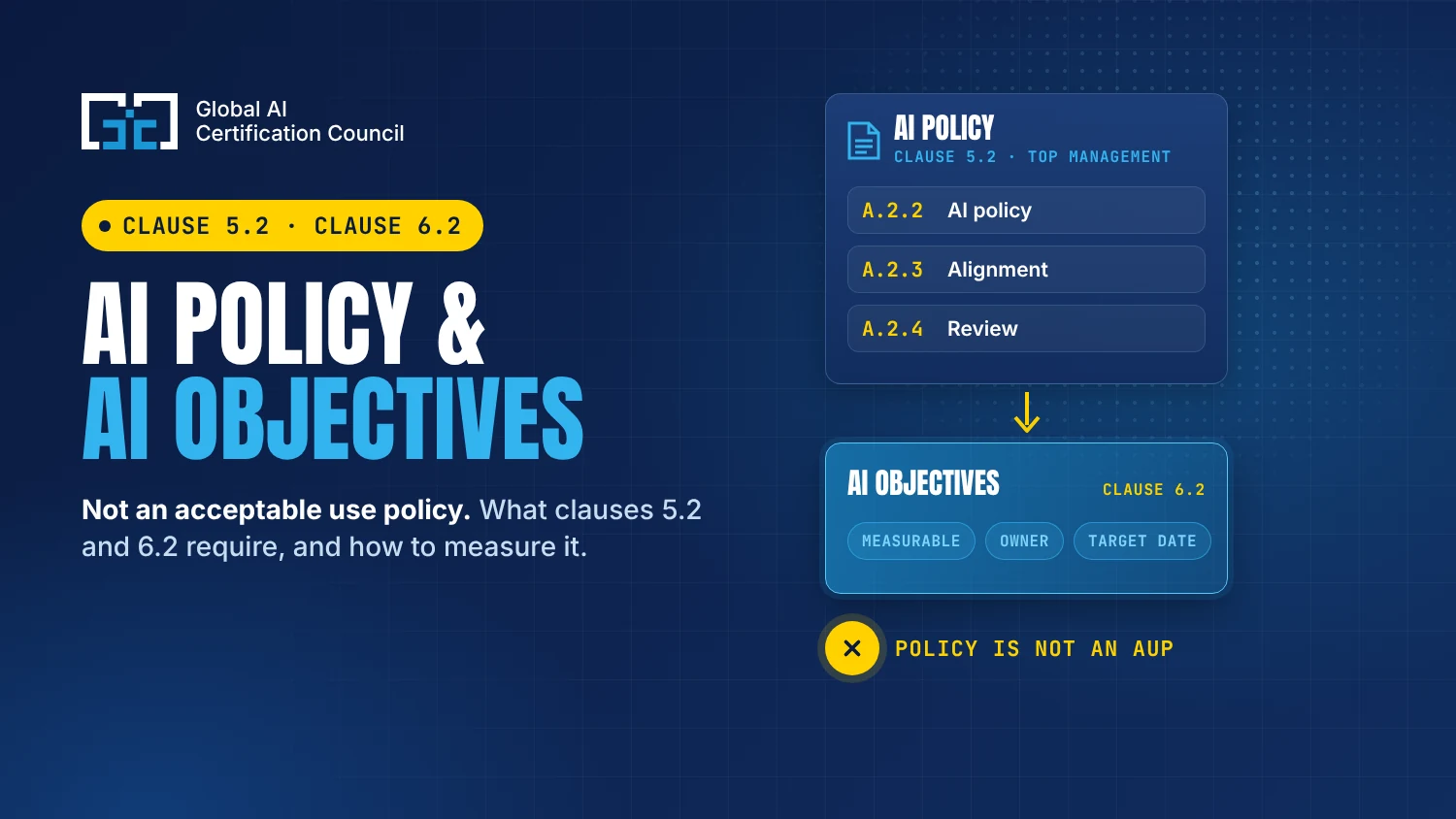
The ISO/IEC 42001 AI policy is the statement of intent and direction that top management sets under clause 5.2, framing the AI objectives clause 6.2 requires. The policy fits its purpose, commits the organization to meeting applicable requirements and to continual improvement, and gives a framework for objectives. Annex A area A.2 then adds three controls: the policy itself, alignment with other policies, and planned review. Objectives turn the policy into results that someone owns, measures and reports.
Two mix-ups follow this topic. “AI objectives” here means the targets your organization sets under clause 6.2, which are different from the aims of the standard itself. The AI policy is also a separate document from an AI ethics statement or an acceptable use policy, though all three can travel under one name. A section-by-section outline and a worked set of objectives built from Annex C follow the requirements.
What clause 5.2 requires of the AI policy
Clause 5.2 of ISO/IEC 42001:2023 makes the AI policy a duty of top management and sets four content requirements and four handling requirements. The standard’s own definition of a policy is short: “intentions and direction of an organization as formally expressed by its top management.” A policy that only a working group has approved falls short of that definition, however good the text.
| Requirement (paraphrased) | What it means in practice | What an auditor asks to see |
| Suits the purpose of the organization | The policy reflects what you do with AI, in the AI roles you hold | The scope statement and AI role, and how the policy matches them |
| Gives a framework for setting AI objectives | The policy names the areas objectives must cover and who sets them | The objectives register, traced back to policy clauses |
| Commits to meeting applicable requirements | Legal, contractual and internal requirements are named or referenced | The obligations register the policy points to |
| Commits to continual improvement of the AIMS | Improvement is a stated duty with evidence behind it | Corrective actions and review decisions that changed something |
| Is available as documented information | The approved version is controlled, dated and retrievable | Version history and approval record |
| Refers to other organizational policies as relevant | Security, privacy, procurement and HR policies are cross-referenced | The cross-reference list and how conflicts are resolved |
| Is communicated within the organization | People who work on or with AI know it exists and what it asks | Communication records and interview answers |
| Is available to interested parties as appropriate | You decide who outside the organization may see it | The decision on external availability and any published version |
The clause 5 to 10 wording used here comes from secondary reproductions of the standard, so check it against your licensed copy before you quote it. The structure itself is stable. Clause 5.2 belongs to the harmonized structure shared with ISO/IEC 27001, so anyone who has written an information security policy will recognize the pattern.
The note on governing bodies
A note to clause 5.2 points to ISO/IEC 38507 for considerations when developing AI policies. ISO/IEC 38507 covers the governance implications of AI and is written for members of governing bodies such as boards. Clause 5.2 itself asks nothing of a board. For a US company with an audit or risk committee, though, 38507 shows what the board should ask of management. The standard’s definition of top management also follows the scope. If the AIMS covers one business unit, the leaders of that unit sign the policy.
The three Annex A.2 controls
Annex A area A.2, “Policies related to AI,” holds three controls that build on clause 5.2. They are A.2.2 AI policy, A.2.3 alignment with other organizational policies, and A.2.4 review of the AI policy. Both Annex A and Annex B are normative. Annex B gives the implementation guidance for each control. Like every Annex A control, the three must appear in your Statement of Applicability with a reason for including or excluding them. Excluding A.2.2 would be hard to defend, since clause 5.2 already requires the policy.
| Control | Intent | What it means in practice | Typical evidence |
| A.2.2 AI policy | The organization documents a policy for how it develops or uses AI systems | One approved policy, written for your AI roles, that covers the Annex B points as well as clause 5.2 | Approved policy, approval minute, distribution record |
| A.2.3 Alignment with other organizational policies | Other policies that touch AI are identified and kept consistent with the AI policy | A mapping of where privacy, security, procurement, HR and records policies apply to AI work, with owners | Alignment log, cross-references, change requests to other policy owners |
| A.2.4 Review of the AI policy | The AI policy is reviewed at planned intervals so it stays fit for purpose | A review cycle you set, plus event triggers such as a new law, a serious incident or a new AI role | Review records, redlined versions, management review minutes |
Per Annex A of ISO/IEC 42001:2023, there are 38 controls in nine areas (A.2 to A.10) under ten control objectives. Verify control wording against your licensed copy. The other eight areas, and the evidence each needs, sit in the guide to the Annex A controls.
What Annex B adds to the policy
Annex B guidance for A.2.2 asks for more than clause 5.2 does. The policy should state the principles that guide all of the organization’s AI activity. It should also set out how deviations and exceptions to the policy are handled. Annex B then lists topic areas that may need their own policy or a cross-reference, such as AI resources and assets, AI system impact assessment and AI system development.
The exception process is the item most drafts leave out. A product team will one day want to use a tool the policy does not allow, or to skip a review because of a deadline. If the policy says nothing about who can approve a deviation, for how long and with what record, the exception happens anyway. It just happens without evidence. An exception log with a named approver, an expiry date and a link to the risk entry closes that gap.
AI policy, ethics principles or acceptable use policy?
The AI policy, an AI ethics statement and an AI acceptable use policy are three different documents. Practitioners report audit findings when one is presented as another. The AI policy is the governance commitment from top management. An ethics statement sets out values, often for an outside audience. An acceptable use policy tells employees what they may and may not do with AI tools.
| Document | Question it answers | Approved by | Main audience | Where it sits in ISO/IEC 42001 | Why it fails as the AI policy |
| AI policy | How will we govern AI, and what results do we commit to? | Top management | The whole organization, and interested parties as appropriate | Clause 5.2; control A.2.2 | (It is the AI policy) |
| AI ethics statement or principles | What values guide our AI work? | Often a communications or ethics group | Customers, the public, staff | Principles belong inside the policy (Annex B guidance for A.2.2); ethics also appears as a context issue under clause 4.1 | No commitment to requirements or improvement; no framework for objectives |
| AI acceptable use policy (AUP) | Which AI tools may staff use, with what data, and how? | Usually the CISO or CIO under delegated authority | Employees and contractors | A topic-specific rule supporting responsible use (A.9.2, A.9.4) and awareness (7.3) | Covers users only; says nothing about development, impact assessment, suppliers or objectives |
Public principle sets, such as the OECD AI Principles adopted in 2019 and updated in 2024, are a sound source for the principles section. On their own they are not a 42001 policy, because they make no commitment that an auditor can test.
Why a copied acceptable use policy fails clause 5.2
An AUP written for chatbot use at work answers an employee’s question about tools. Clause 5.2 asks a governance question. Some organizations rename their AUP “AI policy” and present it at Stage 1. The gaps show quickly. There is no framework for objectives and no commitment to continual improvement. And the policy is silent on any AI the organization builds, buys or sells. One privacy practitioner wrote in October 2026 that their team had copied the IT acceptable use policy and only later saw how fast it dated.
Acceptable use rules still matter. Staff pasting confidential material into public tools is a real failure, as the Samsung chatbot leak showed. Keep the AUP as a topic-specific document that the AI policy names and governs.
How the documents stack
A workable document set has four layers. Each one points up to the layer above.
- The AI policy (5.2, A.2.2) sets commitments, principles, the framework for objectives and the authority for exceptions.
- Topic-specific AI policies cover areas such as AI system development, impact assessment, data for AI systems, and the AUP for staff use.
- Procedures and standards describe how intake, risk assessment, testing and release run.
- Records hold the inventory, risk register, impact assessments, exception log and objectives register.
If you already hold ISO/IEC 27001, the information security policy sits beside the AI policy at layer 1, and A.2.3 asks you to keep the two consistent.
Leadership evidence for the policy and objectives
Clause 5.1 asks top management to show leadership and commitment. Its first listed duty covers the AI policy and AI objectives: both must exist and suit the organization’s strategic direction. The rest of 5.1 follows the harmonized structure used in ISO/IEC 27001. Leaders build AIMS requirements into business processes, provide resources, and communicate why the AIMS matters. They also direct people, support other managers and promote continual improvement.
For the policy and objectives, leadership leaves a trail of decisions behind the signature. Useful records include:
- An approval minute that shows top management discussed the policy before someone signed it.
- Objectives that appear in business plans or team goals, with budget or staff assigned.
- Management review minutes in which leaders accept, change or reject objectives.
- A named owner for the policy itself, usually the person who also reports on AIMS performance.
The full split of duties, including the two assignments clause 5.3 requires, is covered in the guide to assigning AIMS responsibilities. Sign-off can stall for weeks, as one poster on an ISO 27001 forum described in February 2026. A policy that waits that long for an executive signature is itself evidence about leadership commitment. Put the AI policy on the agenda of an existing leadership meeting. Policy owners who want guided practice can work through clause 5 in the leadership and policy sessions in the Lead Implementer course. Those sessions pair leadership duties with responsible AI practice and a case workshop.
ISACA’s 2026 AI Pulse Poll, released 5 May 2026 with more than 3,400 respondents, found that only 38 percent of organizations had a “formal, comprehensive AI policy.” Another 30 percent had a limited one, and 25 percent had no active policy.
An AI policy outline, section by section
An ISO/IEC 42001 AI policy can follow the outline below. Each row says what the section must do and which requirement it answers. The outline is a GAICC editorial specification. It quotes no text from the standard, and the wording of each section should be your own.
| # | Section | What it must say | Requirement it answers | Record it points to |
| 1 | Purpose and context | Why the organization uses or builds AI, and what the AIMS is for | 5.2 (suits purpose); 4.1 | Context and issues register |
| 2 | Scope and AI roles | Which units, systems and AI roles (provider, producer, customer) are covered | 4.3; 4.1 role determination | Scope statement; AI system inventory |
| 3 | Commitments | Meeting applicable requirements; continual improvement of the AIMS | 5.2 (two commitments) | Obligations register |
| 4 | Guiding principles | The principles that guide AI work, in testable terms | A.2.2 with Annex B guidance | Principle-to-control map |
| 5 | Framework for AI objectives | Which themes objectives cover, who sets them, how they cascade | 5.2; 6.2 | Objectives register |
| 6 | Risk and impact | That AI risk and impact assessments are required, and who accepts residual risk | 6.1.2; 6.1.3; 6.1.4 | Risk criteria; risk register; impact assessments |
| 7 | Roles and authorities | Who owns the policy, the AIMS and each AI system | 5.3; A.3.2 | Role register or RACI |
| 8 | Related policies | Which policies also govern AI work, and which prevails if they conflict | 5.2; A.2.3 | Alignment log |
| 9 | Topic-specific policies | The list of subordinate AI policies, including the AUP | Annex B guidance for A.2.2 | Document register |
| 10 | Deviations and exceptions | Who may approve an exception, for how long, and how it is logged | Annex B guidance for A.2.2 | Exception log |
| 11 | Raising concerns | How anyone can report a concern about an AI system | A.3.3 | Concerns channel and log |
| 12 | Communication and availability | Who receives the policy, how, and whether it is published | 5.2; 7.4 | Communication plan |
| 13 | Review and approval | Review cycle, triggers, approver, version and effective date | A.2.4; 7.5 | Version history |
Reference the registers; do not copy them
The policy should point to the inventory, the risk process and the role register without reproducing them. If the policy lists every AI system by name, each new system forces a policy change and a fresh top-management approval. A policy that says “all systems recorded in the AI system inventory” stays stable while the register changes weekly. The same logic applies to risk and roles. Name the process and its owner in the policy, and keep the detail in the record.
Three links carry most of the weight:
- Inventory: section 2 defines scope by reference to the AI system inventory, so the policy covers every system the register holds.
- Risk and impact: section 6 commits to the processes in clause 6 and names who accepts residual risk. Method detail lives in the clause 6 risk requirements and in the AI system impact assessment under clause 6.1.4.
- Roles: section 7 names roles instead of people. A staff change then leaves the policy valid.
Where the policy sits among the other mandatory records is covered in the guide to what documents you must produce.
Communicating the policy and making it available
The AI policy must be communicated within the organization, and clause 7.4 asks you to decide what you communicate, when, to whom and how. Clause 7.3 then tests whether the message landed. People working under your control need to know the policy exists, what part they play in the AIMS, and the consequences of not conforming.
| Audience | What they need from the policy | Channel (illustrative) | When |
| Top management and the board | Commitments, objectives, risk appetite | Leadership meeting; board pack | At approval and each management review |
| AI system owners and developers | Principles, objectives, exceptions route, topic policies | Team briefing; intranet page; onboarding | At approval, on change, at onboarding |
| All staff | What the AUP allows, how to raise concerns | Short summary plus attestation | At onboarding and yearly |
| Suppliers and partners | The parts that bind them | Contract schedule; supplier portal | At contract and renewal |
| Customers and the public | Commitments and principles, where you choose to publish | Website summary | When published and on change |
External availability is a decision you record. The standard asks that the policy be available to interested parties “as appropriate,” so record who may see the full text and what you publish. Annex A area A.8, information for interested parties of AI systems, governs what you tell users and others about your AI systems. Any public AI statement should agree with that A.8 information. A gap between the two becomes a finding. Awareness checks and training records are covered in the guide to competence and awareness evidence.
Evidence that the policy operates
An AI policy passes Stage 1 as a document and Stage 2 only if records show it working. One security leader described the moment in a CISO forum in August 2026: “They asked for the AI acceptable use policy. We have one, it’s a lovely PDF. Then they asked how we evidence it’s enforced.” An auditor wants to see that the rules in the policy were applied over the audit period.
Evidence that tends to answer that question includes:
- An approved AI tool list, with the dates each tool was added or refused.
- The exception log, with approver, expiry and link to the risk entry.
- Intake records showing that each new AI system passed the review the policy requires before it went live.
- Attestation or training records tied to the current policy version.
- Technical signals where you have them, such as blocked uploads to unapproved AI services.
- Objectives results reported to management review.
The gap is wide in practice. IBM’s 2025 Cost of a Data Breach findings, based on 600 breached organizations, report that 63% either had no AI governance policy or were still developing one. Of the organizations that had a policy, only 34% performed regular audits for unsanctioned AI.
Policy versions and decisions made under an old version
AI policies change often, so each approval decision should record the policy version it relied on. Suppose a system was approved under version 1 and version 2 tightens a rule. Do not silently void the old approval. Mark which approvals the change affects, and reassess them on a set timetable. The change itself should follow clause 6.3, which asks that changes to the AIMS be planned. Version control for the policy document falls under clause 7.5.
AI objectives under clause 6.2
Clause 6.2 requires AI objectives at relevant functions and levels, consistent with the AI policy, and a plan to achieve each one. The standard defines an objective simply as a result to be achieved. A note adds that AI objectives are set by the organization, consistent with the AI policy, to achieve specific results. Objectives also come before control selection. Clause 6.1.3 asks that the necessary controls align with the objectives in 6.2.
| Clause 6.2 asks that AI objectives… (paraphrased) | Practical test |
| are consistent with the AI policy | Each objective traces to a policy commitment or principle |
| are measurable, where practicable | A defined indicator exists, or a written reason why one is not practicable |
| take applicable requirements into account | Legal and contractual duties shaped the objective or its target |
| are monitored | Results are collected on the schedule set in 9.1 |
| are communicated | Owners and affected teams know the objective and its status |
| are updated as appropriate | Changes follow review decisions, and the history is kept |
| are available as documented information | The objectives register is controlled |
For each objective, the plan states what will be done, what resources it needs, who is responsible, when it will be complete and how results will be evaluated. A note to 6.2 points to Annex C and to control guidance in A.6.1 and A.9.3. Control A.6.1.2 covers objectives for responsible development of AI systems. A.9.3 covers objectives for responsible use. So objectives can sit at three levels: organization-wide, function or team, and individual AI system.
What makes an AI objective measurable
An AI objective is measurable when anyone can tell, from a defined record, whether it was met. That takes six things written down: the indicator, how it is calculated, the data source, a baseline, a target with a date, and a measurement frequency. An objective missing any of the six becomes a matter of opinion at management review.
“Where practicable” is a real allowance, with limits. A first-year objective such as “set up a quarterly AI risk briefing to the board by the third quarter” is a milestone. It is evaluated by evidence that the briefings happened. An auditor can test it against those records. A qualitative objective is much harder to defend where a measure was plainly available. Record the reason whenever you choose a milestone over a metric.
From Annex C themes to objectives with owners
Annex C of ISO/IEC 42001, an informative annex, sets out potential AI-related organizational objectives next to risk sources. The objective themes in the final-draft table of contents are accountability, AI expertise, availability and quality of training and test data, and environmental impact. The list continues with fairness, maintainability, privacy, robustness, safety, security, and transparency and explainability. Verify the list against your licensed copy. None of the eleven is mandatory. Choose the themes your risk assessment and policy principles make relevant, and record why you left others out.
The table below is an illustrative objective set for a mid-sized US organization that builds some AI and buys more. Targets and owners are examples built from the standard’s structure, and none is a benchmark. Set your own targets from a measured baseline.
| Annex C theme | Illustrative objective | Metric | Illustrative target | Owner | Review cadence |
| Accountability | Every in-scope AI system has a named owner and a current risk acceptance | % of inventory entries with owner and in-date acceptance | 100% by end of Q2 | AIMS lead | Monthly check, quarterly report |
| AI expertise | People in AI roles meet the competence set for their role | % of role holders with current competence evidence | 95% | Learning lead | Quarterly |
| Availability and quality of training and test data | High-criticality datasets pass documented quality checks before use | % of datasets with a completed quality record before release | 100% for high tier | Head of data | Each release; quarterly summary |
| Environmental impact | Energy use of AI workloads is measured, then reduced | % of self-hosted training and inference workloads with energy data | 100% coverage in 12 months; reduction target set from baseline | Platform engineering lead | Twice a year |
| Fairness | Outcome disparity across defined groups stays inside the threshold set in the impact assessment | Chosen disparity metric per release | Within threshold for every release; breaches investigated in 10 business days | System owner with impact assessor | Each release; quarterly |
| Maintainability | Production models can be documented, retrained or rolled back | % of production models with current technical documentation and a tested rollback | 90% this year, 100% next | ML engineering lead | Quarterly |
| Privacy | AI systems that process personal data have a completed privacy review | % with review on file; AI-related data loss alerts per month | 100%; alerts falling quarter on quarter | Privacy officer | Monthly |
| Robustness | Production performance stays within agreed bounds | % of drift alerts closed within the agreed time | 95% | System owner | Monthly |
| Safety | Systems able to cause serious harm have a tested override and stop procedure | % with an override test in the last six months | 100% | Safety lead | Twice a year |
| Security | Exposed AI systems are tested against AI-specific attacks | % with adversarial testing in the last 12 months; overdue critical findings | 100%; zero overdue | CISO | Quarterly |
| Transparency and explainability | Users of AI systems get current, accurate information about them | % of user-facing systems with user information reviewed in 12 months | 100% | Product owner | Twice a year |
Several rows connect to work covered elsewhere. The data quality row depends on the A.7 data controls. The performance row needs the drift monitoring described in the guide to model drift and performance risk. The fairness row only works if the impact assessment has set the threshold first.
Cascading objectives to systems and teams
Organization-wide objectives rarely move on their own. Each one needs a function-level version and, for high-criticality systems, a system-level version. A fairness objective at the top becomes a release gate for the hiring model team, with its own threshold and owner. Responsible development objectives (A.6.1.2) and responsible use objectives (A.9.3) are the natural home for those system-level targets. Keep one register so that management review sees all three levels together.
Linking objectives to monitoring and management review
AI objectives feed clause 9.1, monitoring and measurement, and clause 9.3, management review. Clause 9.1 asks you to decide what to monitor and measure, the methods, when to measure, and when to analyze the results. The objectives register answers most of that for you, which is why objectives are the usual first set of AIMS metrics. The results must be kept as evidence.
Management review then closes the loop. Clause 9.3 lists inputs that include trends in monitoring and measurement results, audit results, and nonconformities and corrective actions. Its outputs include decisions on improvement and on any changes the AIMS needs. When review changes an objective or its target, clause 6.2 expects the objective to be updated and the record kept.
| Step | Clause | Frequency | Output |
| Set or revise objectives | 6.2 | At policy approval and after each management review | Objectives register, version dated |
| Measure and analyze | 9.1 | As set per objective | Results record and trend view |
| Check in internal audit | 9.2 | Per the audit program | Findings on objectives and their evidence |
| Review and decide | 9.3 | Planned intervals set by you | Minutes with decisions on objectives and the policy |
| Correct and improve | 10.1, 10.2 | When targets are missed or evidence fails | Corrective actions |
ISO/IEC 42001 sets no fixed frequency for any of these steps. It asks for planned intervals, so the schedule is yours to set and defend. Internal auditors will test whether objectives were measured as planned, which is covered in the guide to the internal audit program.
Findings auditors raise on policy and objectives
The findings below are GAICC’s editorial summary of patterns reported by practitioners and visible in public community threads. They are not statistics.
- Wrong signatory. A committee or the security lead approved the AI policy, and nobody at top-management level did.
- AUP presented as the AI policy. The document covers staff use only, with no framework for objectives.
- Objectives with no measure and no reason. “Promote trustworthy AI” with no indicator and no note on why one is not practicable.
- Objectives with no plan. A target exists, but no owner, resources, deadline or evaluation method.
- Alignment on paper only. The AI policy cites the privacy policy, but the privacy policy has never heard of AI.
- No review evidence. The policy carries last year’s date and no record of a planned review.
- Unaware staff. Developers cannot say where the policy lives or what it asks of them.
Where to start, by situation
- Organizations that only buy AI (AI customers) should write the policy around responsible use, supplier selection and staff rules. Leave A.6 development objectives out unless you customize or fine-tune models.
- Teams that build or fine-tune models should give the section 4 principles and the section 6 risk wording equal weight. Set system-level objectives under A.6.1.2 for each high-criticality model.
- Holders of ISO/IEC 27001 can reuse the policy approval route, document control and management review. Then write a separate AI policy and keep an alignment log under A.2.3.
- Where the current AI policy was built on the NIST AI RMF, keep it as an input. GOVERN 1.2 in the NIST AI Risk Management Framework asks that trustworthy AI characteristics be built into policies. It does not ask for objectives or the 5.2 commitments. GAICC’s guide to the NIST AI RMF for US organizations covers the framework in full.
- CEOs and board members should read the clause 5.1 section, then ask management for the objectives register before the policy text.
- Candidates for the GAICC Lead Implementer exam should know which body sets the policy (top management, under clause 5.2) and how the AI policy differs from an AUP.
Frequently asked questions
Is an AI policy mandatory under ISO 42001?
Yes. Clause 5.2 requires top management to establish an AI policy, and control A.2.2 requires it to be documented, so an AIMS that lacks one fails clause 5.2. For the wider question of whether your organization must certify at all, read GAICC’s explainer on who needs ISO 42001 certification.
Who should sign the ISO 42001 AI policy?
Top management, because ISO/IEC 42001 defines a policy as intentions and direction “formally expressed by its top management.” If the AIMS covers only one business unit, top management means the people who direct and control that unit, so its leaders sign. A committee can draft and review the text, but approval has to sit at that level.
Do we have to publish our AI policy?
No. Clause 5.2 asks for the policy to be available to interested parties “as appropriate,” which leaves the choice to you. Record who may see the full text and what you publish, and keep any public AI statement consistent with the information you give under Annex A area A.8.
How often should the AI policy be reviewed?
ISO/IEC 42001 sets no fixed frequency. Control A.2.4 asks for review at planned intervals, and additionally as needed, so that the policy stays suitable, adequate and effective. Annex B adds that the review should take management review results into account, which ties the policy cycle to clause 9.3 after certification.
Is there an ISO 42001 AI policy template?
No template comes with ISO/IEC 42001, and Annex B describes what the policy should include without giving model text. The section-by-section outline on this page works as a specification you can draft against. Write the wording yourself, so that the policy reflects your own scope, AI roles and principles.
How many AI objectives does an organization need?
Clause 6.2 sets no number and asks for AI objectives at relevant functions and levels, consistent with the policy and measurable where practicable. Annex C offers eleven objective themes as a non-exclusive list, so pick the ones your risk assessment and principles make relevant and record why you left others out.