
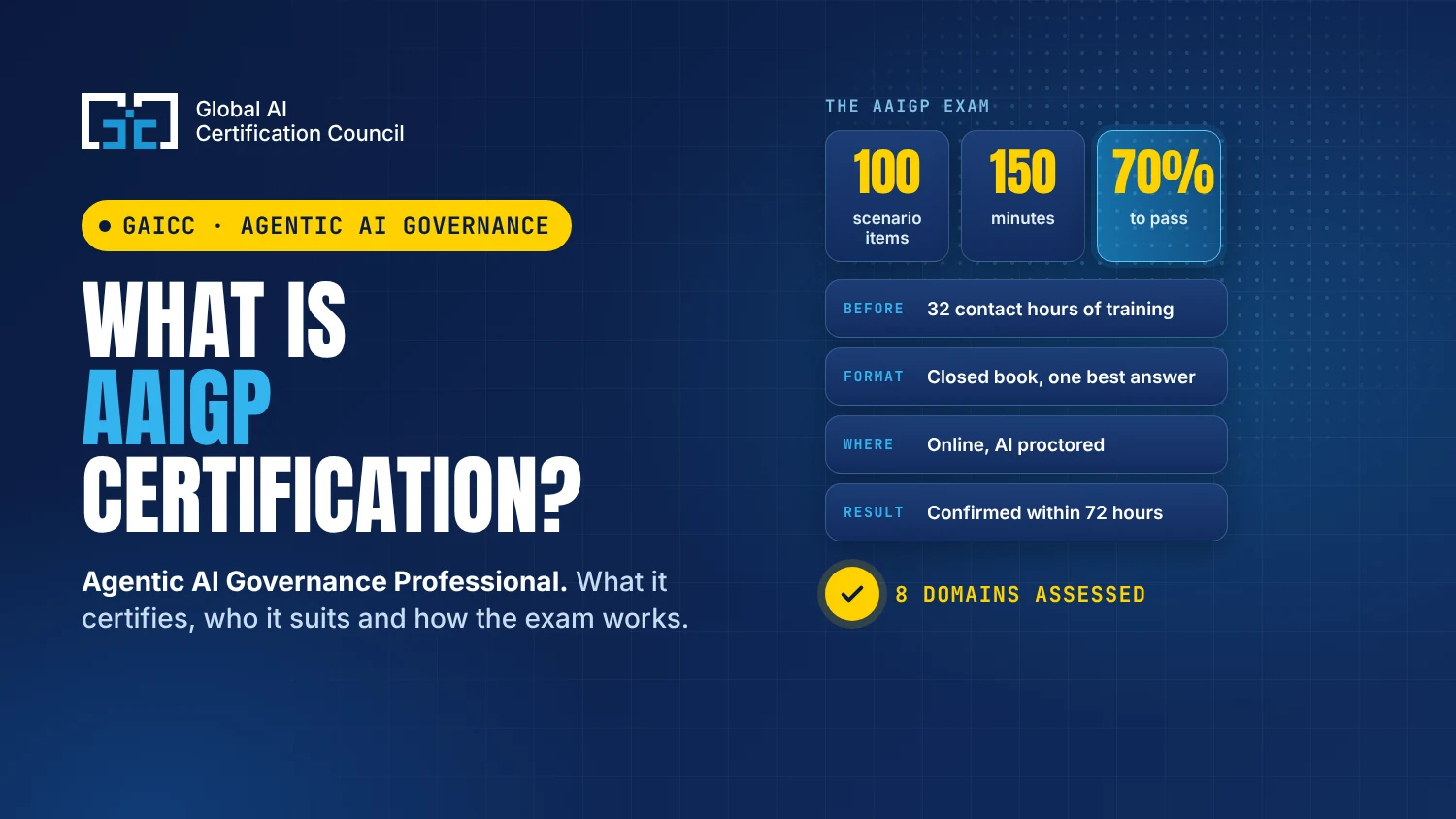
The GAICC Agentic AI Governance Professional (AAIGP) certification is a personnel credential, at advanced level, for people who authorize, oversee, assure and stop AI systems that act on their own. The Global AI Certification Council (GAICC) awards it after 32 contact hours of AAIGP training and a closed-book exam. That exam has 100 scenario items, 150 minutes and a 70 percent pass mark. Validity is three years, with 60 hours of continuing professional development (CPD) to renew. Formats, booking and fees sit on the AAIGP course, booking and fees page.
Two nearby names cause mix-ups. AAIGP is not the AIGP, a general AI governance credential from a professional association. A third body also uses the letters AAIGP, for an unrelated applied governance title. Every rule here is GAICC’s own.
GAICC AAIGP at a glance
The AAIGP Candidate Handbook, version 1.2 sets the rules below, and the Examination Content Outline (ECO) adds the exam blueprint. Where GAICC documents differ, follow the Handbook.
| Item | GAICC AAIGP |
| Issuer | Global AI Certification Council (GAICC); its Certification Decision Authority confirms results |
| Level | Advanced, in agentic AI governance |
| Before the exam | 32 contact hours of AAIGP training, the only eligibility requirement |
| Training routes | Three, all equal: GAICC’s self-paced course, an authorized partner or instructor, or a recognized institution |
| Recommended background | Working knowledge of AI governance, shown for example by GAICC’s Certified Professional in AI Governance (CPAIG) or a comparable credential |
| Items | 100 scenario items with one best answer from four options; 88 scored and 12 unscored pilot items |
| Time | 150 minutes in one sitting |
| To pass | 70 percent, which is 62 of the 88 scored items; shown on a 100 to 500 scale where 350 passes |
| Notes allowed | None; closed book |
| Where you sit it | Online on the GAICC hub, under AI proctoring; English, with other languages on request |
| Result | Provisional on screen, then confirmed within 72 hours |
| Exam fee | US$399, or US$299 if you already hold GAICC membership, which costs US$99 a year and is bought separately |
| Valid for | Three years from your certification date |
| To renew | 60 CPD hours per cycle, an ethics reaffirmation and good standing |
Older copies of the Handbook dated August 2026 (version 1.1) still circulate, and some of their rules have since changed. Check the version number on any copy you download.
What AAIGP certifies
AAIGP certifies that you can decide what an AI system that acts may do and on whose say-so, how far that authority reaches, who watches the system, and how it gets stopped. Those questions come from the Handbook, and every exam domain tests at least one.
Agentic AI governance is the practice of controlling the authority given to AI systems that plan and carry out tasks. GAICC’s guide to what agentic AI governance means in practice covers the discipline itself, while AAIGP certifies the person who makes those calls and signs them.
Conventional AI governance checks whether a model’s output is accurate, lawful and fair, and a person usually reads that output before anything happens. An agent can issue a refund, change a record or hand work to another agent with nobody checking each step, so the governance question moves from the output to the action. GAICC describes AAIGP as its first credential written for hybrid teams of people and autonomous agents.
A pass certifies you and nothing else.
| What gets certified | Example | What the holder can claim |
| A person who governs agents | GAICC AAIGP | You passed GAICC’s exam on authorizing, overseeing and stopping agents |
| An organization’s AI management system | An ISO/IEC 42001 certificate from a certification body | The organization runs an audited management system; no individual is certified |
| An agent system | Certification schemes for agent systems, some still in draft during 2026 | One system passed that scheme’s assessment |
| Attendance at a course | A certificate of completion | You attended; attendance is not an examined competence |
AAIGP does not test engineering either, and the ECO rules out items that vendor jargon alone could answer.
Who AAIGP is for
The Handbook names seven groups: AI governance leads, risk and compliance managers, auditors, security and identity architects, platform and AI engineering leaders, legal and privacy professionals, and consultants on agent deployment. GAICC’s course page adds boards and executives who set the enterprise’s appetite for autonomy, and procurement leads who vet third-party agents.
AAIGP fits you if:
- Agents already run in your organization, and someone has to sign off what each one may do.
- You audit controls and keep finding agents in scope, often running on service accounts that nobody owns or reviews.
- You manage identity and access, and agents now hold credentials of their own.
- You draft or review contracts for agents, tools or platforms that act on your systems.
Look elsewhere first if:
- You are new to AI governance. AAIGP assumes the fundamentals and skips them, so an AI governance fundamentals credential such as CPAIG comes first.
- You build agents and want proof of engineering skill, which developer and architect credentials test.
- Your organization wants a management system certificate, which only a certification body can issue.
A separate article covers why agent skills matter now.
Is AAIGP worth it?
AAIGP is worth it when your job already includes approving, overseeing or auditing AI agents. It is a weaker buy if your main goal is a credential that recruiters already filter for by name.
AAIGP is new; its course page went live in August 2026. On 27 October 2026, a GAICC keyword scan of public employer job boards found 152 open postings at 30 employers. Each had governance, risk, compliance, audit, policy, trust, safety or security in its title, and its description mentioned agentic AI or AI agents. None named AAIGP. Only one named any AI-specific credential at all, an ISO/IEC 42001 implementer or auditor certificate listed beside security certifications.
The postings do ask for the skills AAIGP tests. One AI developer’s October 2026 role in agent security compliance asks the hire to decide which agent actions require a person’s sign-off. The same posting treats non-human identities as a risk category of their own, and it notes that few people have yet governed AI agents at scale.
| Your situation | Worth it? | Why |
| GRC or risk lead with agents in production | Yes | The exam mirrors decisions you already make |
| Auditor asked to assess agent controls | Yes | Domains V and VI cover the evidence you will test |
| Identity, security or legal specialist | Usually | One or two domains map to your work, and the rest add the governance view |
| New to AI governance | Not yet | Start with the fundamentals, which AAIGP assumes |
| Engineer who builds agents | Rarely | The exam tests governance decisions; build skills belong to developer credentials |
| Job seeker who needs a name recruiters search for | Weigh it | None of the 152 postings scanned in October 2026 named AAIGP |
A forthcoming careers guide will cover jobs and pay in agent governance.
Eligibility in brief
The only eligibility requirement is 32 contact hours of structured AAIGP training, finished before you sit the exam. Training can come from any of three routes, and the Handbook gives GAICC’s own course no exam advantage over the others.
- GAICC’s self-paced course, which you work through at your own pace on the GAICC hub.
- Instructor-led delivery by a GAICC Authorized Training Partner or a GAICC Certified Instructor.
- Training from an institution GAICC recognizes.
Hours count per certification, so training done for another GAICC credential does not transfer.
Work experience is recommended only. The Handbook suggests working knowledge of AI governance plus experience of automated or agentic decision systems, security assurance or audit. GAICC never uses that recommendation to turn a candidate away. CPAIG, or an equivalent AI governance credential, is strongly recommended and still not a formal prerequisite.
Training is bought from the provider you choose, apart from the exam fee. The step-by-step route from AAIGP training to exam booking shows GAICC’s course formats and package prices. A separate guide will map routes into the field by starting background.
How AAIGP compares with general AI governance credentials
General AI governance credentials certify that you can govern AI systems as a whole, while AAIGP certifies that you can bound and evidence what an agent may do. GAICC’s content outline gives each type one governing question. For a general credential it is whether the AI system is lawful and well documented. For AAIGP it is how the agent’s authority is bounded and proven.
GAICC’s own CPAIG gives agentic and generative AI one domain of eight, weighted at 12 percent, while all eight AAIGP domains concern systems that act. The human review between output and consequence thins out with agents, a change GAICC traces in where model-era AI governance stops working for agents.
| What you hold now | Where AAIGP fits |
| Nothing in AI governance | Take a fundamentals credential first |
| A general AI governance credential, or CPAIG | AAIGP is the agent layer on top; the Handbook accepts either as background |
| An ISO/IEC 42001 Lead Implementer or Lead Auditor credential | AAIGP applies the standard’s clauses and Annex A controls to agents inside an existing management system |
| A security or identity certification | Domain II overlaps most with your work; the regulatory and evidence domains add the most new ground |
A forthcoming guide will compare AI governance and agentic AI governance at the organizational level. Once you have decided, preparation starts with the eight domains.
What each of the eight domains certifies
Eight weighted domains make up the AAIGP exam, and each certifies a kind of decision you can make about agents. The Handbook calls the weights approximate, so one exam form may differ slightly from the next.
| Domain | Weight | What a pass says you can do |
| I. Agentic AI Systems and Architecture Literacy | 12% | Question an agent’s design for governance purposes: which steps the model chooses and which deterministic code controls, the tools within reach, what persists in memory, and how several agents divide a task |
| II. Agent Authority, Identity and Delegation | 14% | Issue every agent a separate, attributable identity, grant the least access a task needs, follow delegated authority hop by hop to sub-agents, and set spend and irreversibility limits ahead of release |
| III. Agentic Risk Assessment and Threat Modelling | 15% | Spot hazards unique to systems that act, including goal drift, loops that never end, prompt injection planted in material the agent reads, and exfiltration carried out through actions |
| IV. Human Oversight, Control and Containment | 14% | Pick an oversight mode (human in, on or out of the loop), put approval in front of irreversible steps, counter automation bias, and prove that circuit breakers and kill switches work |
| V. Agent Evaluation, Assurance and Red Teaming | 12% | Order evaluations of behavior over full task runs, scope agent red teaming, insist on re-tests after remediation, and assemble an assurance case |
| VI. Observability, Audit Evidence and Forensics | 10% | Define the contents of an agent trace, reconstruct an earlier decision from it, and package evidence that auditors, regulators and courts will accept |
| VII. Agentic Incident Response, Liability and Third-Party Governance | 11% | Halt and contain an agent mid-incident, secure traces before remediation overwrites them, make notification calls, and split liability among model, tool and platform providers |
| VIII. Regulatory Frameworks and Enterprise Scaling for Agentic AI | 12% | Map today’s laws and standards onto agents, name the gaps where the law says nothing, and grow governance across many agents without slowing the business down |
The domains hold 38 competencies between them, five in most domains and four in Domains V and VI, and exam items are written directly against their performance indicators. The skills behind each AAIGP domain, with the evidence that proves them, are set out in a companion guide.
Domains II and III together carry 29 percent of the exam. GAICC’s outline calls Domain II the one that sets agentic governance apart from earlier practice. Authority and identity are therefore a sensible place to begin revising.
How the AAIGP exam works
All 100 AAIGP items are scenarios with four options and a single best answer. Each one puts you in a decision seat, choosing whether to grant or refuse, escalate or contain, disclose or hold back, or raise or lower an agent’s autonomy.
Of the 100 items, 88 are scored and 12 are unscored pilot items. The Handbook does not say which are which, so give every item full effort. At 150 minutes you have a minute and a half per item, and the ECO allows no break. A wrong answer costs nothing extra, since there is no negative marking.
Passing takes 62 correct answers out of the 88 scored items. Scores are reported on a 100 to 500 scale with 350 as the threshold, set through a modified Angoff study.
| Cognitive level | Share of items | What the item asks of you |
| Understanding | 15% | Recognize what a concept means in a given setup |
| Application | 45% | Apply a control, rule or method to the scenario in front of you |
| Analysis and Evaluation | 40% | Weigh conflicting evidence and choose the most defensible decision |
No item tests definition recall alone. Regulation is often silent on agents, and there the ECO expects you to work from first principles. It also expects you to avoid claiming more compliance than the evidence supports.
One illustrative item: promoting an agent’s autonomy
The single-answer item below shows the style. GAICC’s editorial team wrote it for this page, and it does not come from the confidential item bank.
A retailer’s customer service agent has run in shadow mode for six weeks. It drafts refunds, and staff approve each one. The product owner now asks you to let it issue refunds of up to US$500 with no approval step. Its behavioral evaluation meets every acceptance criterion. Two weeks ago, a red team hid instructions in a customer email, a form of prompt injection, and made the agent raise a refund amount. Engineering says the fix shipped last week, but nobody has tested the agent since. What should you do?
A. Approve the promotion, because the evaluation meets the acceptance criteria B. Approve it with a US$100 limit and weekly sampling of issued refunds C. Hold the promotion until the injection scenario is re-tested on the fixed agent, and record the reason in writing D. Refuse the promotion and send the agent back for a full new evaluation cycle
Key: C. The ECO’s red teaming competency calls for a re-test after any fix and before any autonomy promotion, so the open finding blocks the change. Option A ignores that finding. Option B shrinks the blast radius, yet it still hands live authority to a fix nobody has verified. Option D goes further than the evidence demands, because one targeted re-test closes this gap. The written record matters too. Under the AAIGP Code of Ethics you may not approve autonomy that outruns the assurance evidence you hold, and any such gap must be put in writing.
Preparing for a closed-book scenario exam
Practice making decisions, because a closed-book paper with no recall-only items rewards judgment you can reach without notes. Turn each ECO performance indicator into a short scenario. Decide what you would do, then write one line naming the indicator behind the call.
The Handbook lists the frameworks the program applies. Learn what each says about agents and where it says nothing, since Domain VIII asks you to state plainly where regulation is silent.
| Framework | What it says about agents, as at October 2026 |
| EU AI Act | Article 14 covers high-risk systems and asks for oversight in line with a system’s level of autonomy. It applies from 2 December 2027 for Annex III systems and 2 August 2028 for Annex I, under the 2026 amending regulation. That regulation names agentic AI only in a code for designating notified bodies |
| ISO/IEC 42001:2023 | A management system standard for any AI system; ISO’s catalogue data of 14 October 2026 shows no ISO/IEC AI project with agents in its title or scope. The ECO asks you to extend an existing system to agents without rebuilding it |
| ISO/IEC 42005:2025 | Guidance on AI system impact assessment, which the ECO extends to autonomous action and to people who never interact with the agent |
| ISO/IEC 23894:2023 | Guidance on AI risk management; the ECO extends the AI risk register to agent-specific risk types |
| NIST AI RMF 1.0 | Four functions, Govern, Map, Measure and Manage, published in January 2023 with no discussion of agents. NIST’s agent work sits in the AI Agent Standards Initiative, which its Center for AI Standards and Innovation (CAISI) announced in February 2026 |
| GDPR and similar privacy laws | Rights around automated decision-making and human review, applied to what agents do |
| OECD AI Principles | The intergovernmental AI principles, adopted in 2019 and updated in May 2024 |
Your training route makes no difference to the exam. GAICC’s instructor-led course ends with a full mock exam and review. Leave alone anything sold as real exam questions, since exam content is confidential. Copying or sharing it is misconduct under the Handbook and can void your result and cost you the certificate.
[TRAINER INSIGHT NEEDED: Which AAIGP domain do early cohorts find hardest in the module quizzes and the Day 4 mock exam, and why?]
Exam day on the GAICC hub
You sit AAIGP online under AI proctoring on the GAICC hub, from a quiet, private room with a stable connection. Booking happens on the hub, which sends joining instructions and a system check. Run that check well ahead. The Handbook says a network or camera fault left unresolved is the most common avoidable delay.
No notes, devices or help are allowed unless an approved adjustment says otherwise. Booking means you consent to proctoring. GAICC governs its use of AI in proctoring through an AI Use Register and an AI Disclosure Statement, and no automated system takes a certification decision without documented human checking.
Request any reasonable adjustment, such as extra time or assistive technology, when you book, with supporting information. The Handbook lists online delivery only, so plan for a suitable room at home or at work. When you submit, the result process begins.
From provisional result to certificate
A provisional result appears on screen as soon as you finish, showing your overall score, pass or fail, and your performance in each domain. GAICC’s Certification Decision Authority then reviews the result and confirms it within 72 hours.
| When | What happens |
| On submitting | Provisional score, pass or fail status and domain feedback on screen |
| Within 72 hours | The Certification Decision Authority confirms the certification decision |
| After a confirmed pass | Certificate and digital badge issued, plus a listing in GAICC’s global credentials register |
| Certification date | Your three-year validity and CPD cycle both start |
The Authority decides separately from the system that marked your exam and from whoever trained you. If no confirmation reaches you after 72 hours, contact support@gaicc.org.
Save the domain feedback even after a pass. It shows where your margin was thin, which tells you where to aim your first CPD hours.
You may appeal a certification decision through GAICC’s Appeals and Complaints process. Lodging an appeal costs nothing, and people who took no part in the original decision handle it.
If you do not pass
You can re-sit the AAIGP exam, and a re-sit fee applies. The Handbook prints neither the fee, the booking window nor any waiting period, so ask support@gaicc.org for all three before you plan dates. A free retake offered on another GAICC credential does not carry over to AAIGP.
Every result includes domain-level feedback, so you can target revision. The program teaches the domains in pairs, one pair per training day, and reworking a weak pair together keeps related decisions side by side.
| Feedback shows weakness in | What to rework |
| Domains I and II | Reading agent designs, action classes, agent identity, scoped grants and delegation chains |
| Domains III and IV | Agentic threat models, harm to third parties, where approval gates sit, and when autonomy rises or falls |
| Domains V and VI | Trajectory evaluation, red-team scope and re-tests, trace content and decision reconstruction |
| Domains VII and VIII | Incident sequencing, notification calls, liability across the supply chain, and where regulation is silent |
Keeping AAIGP: CPD, ethics and renewal
AAIGP stays valid for three years from your certification date. To renew, you complete 60 CPD hours over the cycle, reaffirm the GAICC Code of Ethics, stay in good standing and pay the renewal fee.
| Item | AAIGP rule |
| Cycle | Three years from the certification date |
| CPD | 60 hours: 27 in Technology, 12 in Humanity and 21 in Strategy, with no elective category |
| What counts | Hours that map to one of those three competencies, such as authorizing agents, assessing agentic risk, designing oversight, running evaluations or audits, and handling incidents |
| Ethics | Reaffirm the GAICC Code of Ethics at renewal |
| Renewal fee | Published annually by GAICC; check the current figure before you renew |
| Late renewal | A three-month grace period after expiry |
| Re-examination | Required if CPD evidence falls short, the credential lapses beyond the grace period, or the scheme changes materially |
GAICC groups CPD under its AI Competence Triangle. Technology covers AI systems, data, models, tooling and technical controls. Humanity covers ethics, human oversight, fairness, transparency and impact on people, and Strategy covers governance, policy, risk, assurance and organizational alignment. Much of the agent work AAIGP prepares you for counts, so keep dated records as you go.
The Code of Ethics, which the ECO prints as the Code of Professional Conduct, has eight principles. Two bear most directly on agent authority. Proportionate Authority bars you from recommending or approving autonomy that goes beyond the assurance evidence held. Transparency and Accountability requires a named person to stay accountable for each action an agent takes. Breaches can lead to withdrawal of the certification.
Using AAIGP at work and on your profile
Claim AAIGP only while it is valid, in your own name, and name the issuer so readers can check it. On a resume or profile, write GAICC Agentic AI Governance Professional (AAIGP) in full.
The Handbook sets the limits. The certification applies to you alone and cannot be transferred. You may display the GAICC certification mark under GAICC’s marks procedure. Do not use the credential or the mark in a misleading way, or to imply any accreditation beyond what has been granted. If the credential lapses or is withdrawn, both come off your profile.
GAICC issues a verifiable certificate and a digital badge for LinkedIn, resumes and profiles, and it lists holders in its global credentials register. An employer can therefore confirm your status with the issuer.
GAICC states that it builds the scheme to ISO/IEC 17024, which sets requirements for bodies that certify people and reached its third edition in March 2026. A statement about scheme design differs from accreditation by an accreditation body. Describe AAIGP by its issuer, and leave accreditation out of your profile.
At work, the credential gives you a written standard to point to when a business case pushes autonomy ahead of the evidence. The Code asks for a written note whenever authority and evidence part ways, and that note protects the decision later. Your pass certifies you alone. It does not certify your employer’s management system or any agent you approve.
Where AAIGP leads next
A practical first step is to put the credential to work on one live agent. Pick an agent in production and check who owns it, what it can reach and who can halt it. Record each gap as a finding for the owner.
Then widen the view. List every agent your organization runs, with an owner, a risk tier, an autonomy level and an oversight mode for each. Domain II expects exactly those fields in the AI system inventory, so the list doubles as a check for shadow agents nobody approved.
Keep that work. Authorization reviews, risk assessments, oversight designs, evaluations, audits and incident reviews can all count toward the 60 CPD hours. Over three years, those records also show employers what you have governed.
If your organization holds or is building ISO/IEC 42001 certification, its agents belong inside that management system’s scope. Domain VIII prepares you to add them without starting over. The companion skills guide breaks each domain into work you can show.
Frequently Asked Questions
Is AAIGP related to similarly named AI governance credentials?
No. GAICC issues AAIGP, and its Handbook lists “AAIGP” and “Agentic AI Governance Professional” as GAICC trademarks. A professional association’s general credential uses a shorter acronym, and another body uses the same letters for an applied governance title. Neither counts toward AAIGP eligibility, though a general AI governance credential can serve as background.
Do I need to code to earn AAIGP?
No. Domain I asks you to read agent designs well enough to govern them, without becoming an engineer. You should be comfortable reading a tool inventory, a permission scope and an agent trace, because the domains cover all three. The Handbook recommends experience with automated decision systems, security assurance or audit, and says nothing about programming.
Can I sit the exam without taking GAICC’s course?
Yes. An Authorized Training Partner, a GAICC Certified Instructor or a GAICC-recognized institution can deliver the 32 hours instead. The Handbook says no route, GAICC’s own included, gives any advantage in the exam. Confirm that your provider is authorized or recognized by GAICC before you pay, and keep proof that you completed the hours.
Does the EU AI Act require a certification for people who oversee agents?
No. Article 26 tells deployers of high-risk AI systems to hand oversight to staff who have the competence, training and authority the role needs. It names no credential, so a certification is one way among several to show that competence. The deployer duties start on the same dates as Article 14, set out in the framework table above.
How long does it take to get AAIGP?
GAICC fixes three parts of the timeline: 32 contact hours of training, a 150-minute exam and a certification decision within 72 hours. Instructor-led training runs as four eight-hour days, and the self-paced course runs at your pace. Extra study time depends on how often you already make agent decisions at work.
Does AAIGP replace an ISO/IEC 42001 Lead Implementer or Lead Auditor credential?
No. Those credentials certify that you can build or audit an AI management system against ISO/IEC 42001. AAIGP certifies that you can govern agents. It draws on ISO/IEC 42001 as one framework among several and applies its clauses and Annex A controls to agents in Domain VIII. One credential covers the management system, the other the agents inside it.
How hard is the AAIGP exam?
GAICC publishes no pass rate for AAIGP, so distrust any figure you see quoted. The difficulty comes from the design. Some 85 percent of items ask you to apply or judge, and none tests recall alone. You also have no notes and 90 seconds per item, so practice at deciding under time pressure helps more than memorizing terms.