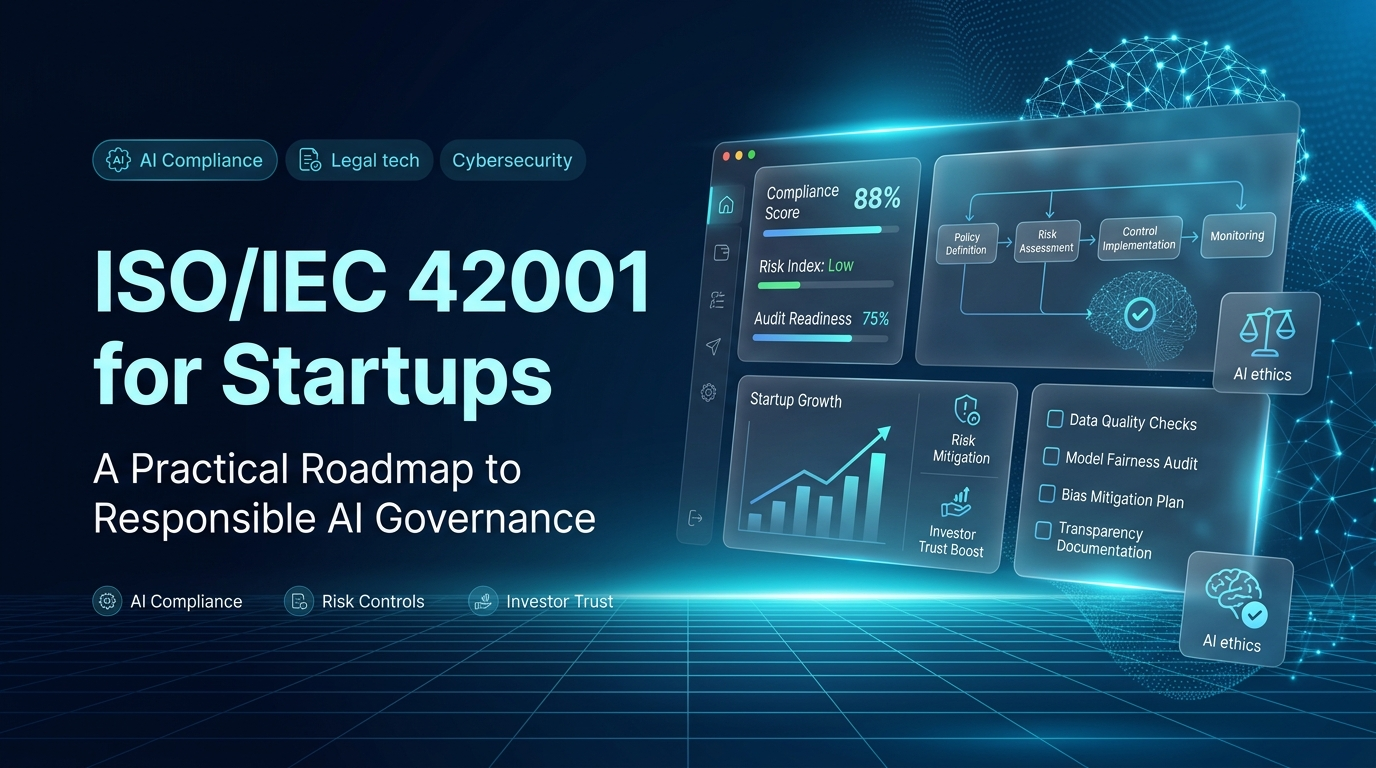
Sixty-two percent of startup investors now conduct AI ethics due diligence before committing capital a figure that barely registered two years ago. ISO/IEC 42001, the world’s first international standard for AI management systems, has become the benchmark those investors reference. For startups building AI-powered products, the question is no longer whether to adopt a governance framework it’s how to do it without grinding your product roadmap to a halt. This guide walks through exactly that: a phased, startup-realistic path to ISO/IEC 42001 implementation.
What Is ISO/IEC 42001 and Why Should Startups Care?
Published by the International Organization for Standardization in December 2023, ISO/IEC 42001 defines the requirements for an Artificial Intelligence Management System (AIMS). Think of it as ISO 27001 for AI a structured framework that tells your customers, regulators, and investors that your AI systems are built with documented controls, measurable accountability, and ongoing oversight.
The standard covers six core areas: organizational context, leadership commitment, planning, support resources, operational control, and performance evaluation. Each clause builds on the next, creating a closed-loop system where AI risk is identified, treated, monitored, and improved continuously.
For startups specifically, three realities make this relevant right now:
Regulatory pressure is arriving faster than expected. The FTC has issued guidance on AI transparency, and US states including Colorado, Texas, and California have passed or are advancing AI-specific legislation. Federal AI accountability legislation is moving through Congress. Startups that wait until regulation is finalized will face expensive retrofits.
Enterprise customers are asking for it. Fortune 500 procurement teams increasingly require AI governance documentation as a condition of vendor onboarding. A startup without a demonstrable AIMS risks losing contracts to competitors who have one—even if the competing product is technically inferior.
Early implementation is dramatically cheaper. Retrofitting governance into a 200-person company costs orders of magnitude more than building it into a 15-person team. The architectural decisions that shape your AI systems are being made right now. ISO/IEC 42001 gives you the structure to make those decisions correctly the first time.
The Business Case for AI Governance at the Early Stage
There’s a common misconception that AI governance is a compliance burden that slows startups down. The opposite is often true.
A 2024 McKinsey survey found that companies with mature AI governance practices launch AI features 34% faster than those without—primarily because they’ve eliminated the ‘is this safe to ship?’ debates that stall releases when no framework exists. When your team has documented risk thresholds and approval workflows, shipping decisions become faster, not slower.
The investor signal is increasingly concrete. Sequoia, a16z, and several major corporate venture arms have published investment criteria that explicitly reference AI governance maturity. For startups seeking Series A or beyond, an ISO/IEC 42001-aligned AIMS is becoming what SOC 2 Type II was to SaaS companies in 2018 table stakes for institutional capital.
Customer trust compounds over time. Enterprise customers sign three-to-five-year contracts. A startup that can demonstrate a living AI management system with documented controls, regular audits, and a clear improvement cadence signals durability that competitors without such a system cannot match.
Under emerging US AI liability frameworks, organizations that can demonstrate they followed a recognized governance standard face substantially lower legal exposure when AI outputs cause harm. ISO/IEC 42001 certification creates a documented paper trail that shows reasonable care was exercised.
How ISO/IEC 42001 Maps to Startup Reality
The standard’s structure mirrors the Plan-Do-Check-Act cycle that most engineering teams already use for product quality. Here’s the high-level architecture:
| Clause | Topic | Startup Equivalent |
|---|---|---|
| 4 | Context of the Organization | Market positioning, stakeholder mapping |
| 5 | Leadership | CEO/CTO commitment, AI policy |
| 6 | Planning | Risk register, AI objectives |
| 7 | Support | Resources, documentation, training |
| 8 | Operation | AI system controls, lifecycle management |
| 9 | Performance Evaluation | Monitoring, internal audit |
| 10 | Improvement | Nonconformity management, continuous improvement |
What often surprises startup founders is Annex B a set of 38 AI-specific controls organized across nine domains including data management, fairness assessment, transparency, and human oversight. Not all 38 apply to every organization; the standard explicitly expects you to select controls based on your specific AI risk profile.
This selectivity is the framework’s most startup-friendly feature. You scope the AIMS to your actual AI activities, and a team of eight can implement a meaningful, auditable AIMS without dedicating a full-time compliance person if they approach it systematically.
Phase 1: Foundation: Context, Leadership, and Planning (Clauses 4 – 6)
The first phase establishes what your AIMS is for and who’s accountable for it. Most startups can complete this phase in four to six weeks.
Clause 4: Organizational Context
This clause asks four questions: What AI activities does your organization perform? Who are your internal and external stakeholders? What do they expect from you regarding AI? And what’s the scope of your AIMS? The stakeholder mapping exercise often surfaces requirements that hadn’t been explicitly documented: investors expecting bias monitoring, customers expecting data handling transparency, regulators expecting audit trails.
Clause 5: Leadership and AI Policy
The standard requires top management to demonstrate visible commitment to the AIMS. Your AI policy needs to state your organization’s commitments to responsible AI in concrete terms. Vague language like ‘we take AI ethics seriously’ won’t pass an audit. The policy should reference specific principles transparency, human oversight, data minimization and connect them to your actual AI systems.
Clause 6: Planning
This is where the AIMS gets teeth. You conduct an AI risk assessment identifying where your AI systems could cause harm, who might be affected, and what controls reduce those risks to acceptable levels. For most early-stage startups, the risk assessment reveals three to five significant risks rather than dozens. That’s a manageable workload, and addressing them systematically is the difference between responsible and reactive AI development.
Phase 2: Building the System: Support, Operations, and AI Risk Controls (Clauses 7–8)
Phase 2 is where the AIMS becomes operational. Plan four to eight weeks depending on your AI system complexity.
Clause 7: Support
Three elements dominate this clause: resources, competence, and documentation. In a startup, resources often means carving out 20% of one technical person’s time rather than hiring a full-time compliance officer. Documentation is the area where most startups underinvest a well-structured Notion workspace or Confluence setup can handle this at early scale, but consistency and version control are essential.
Clause 8: Operations and AI Lifecycle Controls
This is the most technically intensive clause. The Annex B controls most relevant to startups include:
- A.6.1.2 (AI risk assessment): Formal process for assessing risk before deploying new AI features
- A.6.1.3 (AI risk treatment): Documented decisions on how each identified risk is addressed
- A.8.4 (Data for AI systems): Controls over training data quality, provenance, and bias testing
- A.9.3 (Human oversight): Defined points in your AI workflows where humans can review or override AI outputs
- A.10.4 (Transparency and explainability): User-facing documentation of how AI systems make or influence decisions
Phase 3: Proving It Works: Performance, Evaluation, and Improvement (Clauses 9–10)
Clause 9: Performance Evaluation
The standard requires monitoring, measurement, analysis, and evaluation of your AIMS. At startup scale, this typically means a monthly or quarterly AI risk dashboard reviewed by leadership, an annual internal audit, and a management review where leadership formally evaluates AIMS performance. The metrics you track should connect to your objectives from Clause 6.
Clause 10: Improvement
When something goes wrong an AI system produces biased outputs, a control fails, a customer complaint reveals an unaddressed risk the standard requires a documented nonconformity process: identify what happened, determine root cause, take corrective action, verify the fix worked. Organizations with mature nonconformity management catch AI issues before they become crises.
Common Mistakes Startups Make Implementing ISO/IEC 42001
Over-scoping on day one. Startups often try to bring every AI-adjacent tool into scope immediately. Start with your core AI products and add ancillary tools in subsequent AIMS cycles.
Policy documents that don’t connect to operations. An AI policy that says ‘we will conduct bias assessments’ but doesn’t specify who, when, or using what methodology will fail an audit. Every policy commitment needs an operational procedure behind it.
Treating risk assessment as a one-time exercise. AI systems change models get updated, data distributions shift, use cases expand. The risk assessment is a living artifact that updates whenever your AI systems materially change.
Ignoring Annex B during implementation. Many startups write a solid Clause 4-10 framework but treat Annex B controls as optional. Auditors will review the mapping between your identified risks and implemented controls in detail.
Underdocumenting competency evidence. ‘Our engineers are smart’ is not acceptable evidence of AI competency. Document what training was completed, by whom, and when screenshots, calendar invites, onboarding notes all count.
ISO/IEC 42001 vs. NIST AI RMF: Which Framework Fits Your Startup?
US-based startups frequently ask whether to pursue ISO/IEC 42001, the NIST AI Risk Management Framework, or both.
| Dimension | ISO/IEC 42001 | NIST AI RMF |
|---|---|---|
| Type | Certifiable standard | Voluntary framework |
| Geographic Reach | International | US-focused |
| Certification Available | Yes (third-party audit) | No |
| Structure | Requirements-based (shall) | Guidance-based (should) |
| Best For | Customer trust, investor signaling, regulatory readiness | Internal risk management, federal contracts |
| Startup Effort | Medium-high | Medium |
The practical answer for most US startups: use NIST AI RMF as your internal thinking framework to map AI risks, then implement ISO/IEC 42001 as your external-facing management system. The two are complementary NIST’s four core functions (Govern, Map, Measure, Manage) map naturally onto ISO/IEC 42001’s planning and operational clauses. If your startup sells to US federal agencies, NIST AI RMF alignment may be contractually required; ISO/IEC 42001 adds the certification layer on top.
The Certification Path: From Gap Assessment to ISO/IEC 42001 Certification
Certification isn’t required to benefit from ISO/IEC 42001 many startups implement the standard for operational and commercial reasons without formal certification. But for startups selling into regulated industries or enterprise markets, certification delivers significant credibility.
Step 1: Gap Assessment (Weeks 1-2)
Conduct a structured comparison of your current practices against each clause and Annex B control. This assessment becomes your implementation roadmap.
Step 2: Documentation and Implementation (Weeks 3-16)
Build out the AIMS documentation: AI policy, scope statement, stakeholder register, risk assessment, control decisions, procedures, training records. Implement the operational controls identified as gaps.
Step 3: Internal Audit (Weeks 17-18)
Conduct a formal internal audit against the standard’s requirements. This can be led by a trained team member who wasn’t responsible for implementing the areas being audited.
Step 4: Management Review (Week 19)
Leadership formally reviews AIMS performance, audit findings, and objectives. This meeting must be documented it’s evidence that top management is actively engaged.
Step 5: Certification Audit (Weeks 20-22)
Engage an accredited certification body. Stage 1 is a documentation review; Stage 2 is an on-site or remote assessment of whether documented procedures are actually being followed. For a typical early-stage startup engagement, expect USD $8,000–$20,000 for the certification audit.
Frequently Asked Questions
1. Can a startup implement ISO/IEC 42001 without a dedicated compliance team?
Yes and most do. A 15–20-person startup can implement a meaningful AIMS with 20–30% of one technical or operations person’s time over a 4–6 month period. The key is systematic documentation from day one rather than trying to reconstruct evidence retrospectively.
2. Does ISO/IEC 42001 apply to startups using third-party AI tools, or only those building AI?
It applies to organizations that develop, deploy, or are otherwise impacted by AI systems. If your product uses AI whether built in-house or via an API you’re in scope. The standard provides explicit guidance on managing AI supplier relationships (Annex B, A.5.2), making it directly applicable to API-dependent startups.
3. How long does ISO/IEC 42001 certification take for a startup?
From initial gap assessment to certification, most startups complete the process in five to seven months. Pre-existing quality management systems (ISO 9001, ISO 27001) shorten the timeline because many foundational processes already exist.
4. What’s the difference between ISO/IEC 42001 and a responsible AI policy?
A responsible AI policy is a statement of intent. ISO/IEC 42001 is a management system it requires documented procedures, measurable objectives, evidence of execution, and continuous improvement. A policy says ‘we value fairness.’ An AIMS demonstrates how fairness is defined, measured, and maintained across your AI systems.
5. Do US regulations require ISO/IEC 42001?
No US federal law currently mandates ISO/IEC 42001 certification. However, several state laws reference ‘reasonable’ AI governance practices, and ISO/IEC 42001 provides defensible evidence of reasonableness. Enterprise procurement requirements are increasingly referencing the standard explicitly.
6. Is ISO/IEC 42001 aligned with the EU AI Act?
ISO/IEC 42001 is explicitly referenced in EU AI Act compliance guidance as a recognized management system standard. Startups targeting European markets can use ISO/IEC 42001 implementation as part of their EU AI Act conformity assessment for high-risk AI systems.
Conclusion
AI governance isn’t a compliance checkbox you file and forget. At its best, it’s the organizational infrastructure that lets you build AI-powered products faster, with fewer costly surprises, and with the kind of documented accountability that enterprise customers and investors increasingly expect.
ISO/IEC 42001 gives startups a structured path to that infrastructure one designed to scale from a 10-person seed-stage company through IPO and beyond. The startups that begin this work now, while their systems are still small enough to govern affordably, will face far fewer obstacles when regulation fully arrives and enterprise procurement requirements tighten further.
Your first step: run a gap assessment against the standard’s requirements using your current AI systems as the scope. That single exercise will surface the three to five priorities that matter most for your specific situation.
To get certified or learn more about implementing ISO/IEC 42001 in your organization, explore GAICC’s ISO/IEC 42001 training programs built specifically for teams at every stage of the AI governance journey.