“Why would someone with a corporate communications and ESG/sustainability background suddenly decide to become an AI Governance Lead Implementer & Auditor?”
From Sustainability to AI Governance: Why I Decided to Learn How to Govern AI Instead of Competing with It?
A year ago, if someone had told me I would be spending my evenings reading ISO clauses, AI governance frameworks, risk registers and international AI regulations… I would probably have laughed.
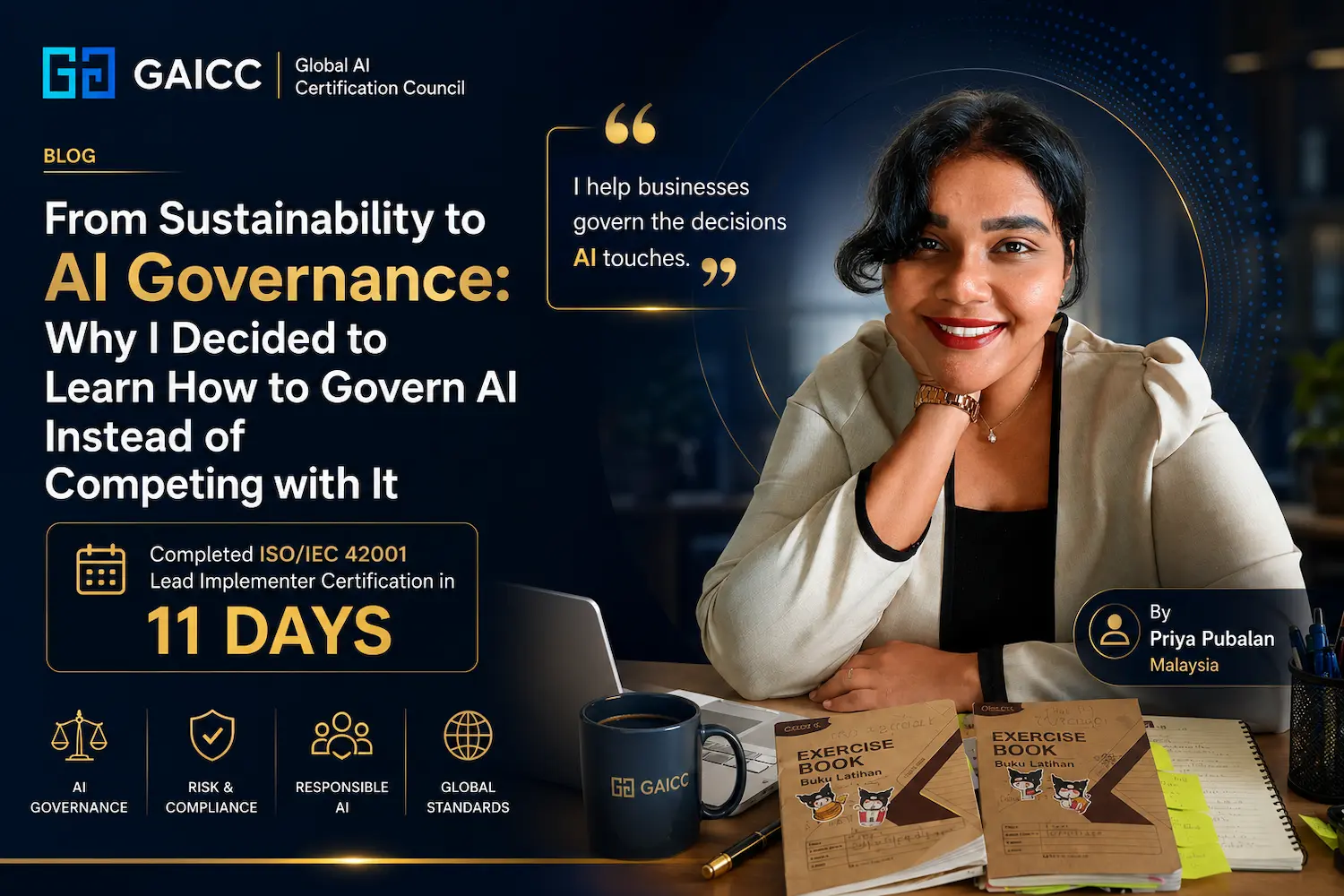
Fast forward to today, and I’m proud to have completed the ISO/IEC 42001 Lead Implementer Certification with the Global AI Certification Council (GAICC).
The exam certainly wasn’t easy, especially for someone coming from a corporate strategy, communications, sustainability and stakeholder engagement background rather than a technical one. There were moments I questioned whether I had wandered into the wrong classroom. Thankfully, Latha’s webinar convinced me!
My parents asked me, “Why AI governance?”
I said “Amma-Pappa, I do not have technical skills relevant for the job market, that’s why. My skill set is taken over by AI and my CV is being shortlisted by AI. AI decides my competence and my relevance to job market”.
These days, many organisations use AI to screen CVs before a human recruiter even sees them. Like many professionals, I found myself wondering whether AI was quietly making decisions about my future before I even had the chance to introduce myself.
Instead of worrying whether AI would replace me, I asked myself a different question:
Who makes sure the AI is making fair decisions?
That single question led me down a completely different career path.
Most people think AI governance is about building AI models or writing complex algorithms.
It isn’t.
Imagine an HR department receiving 1000 job applications and using AI to shortlist candidates. The AI can process applications within minutes, but who checks whether it unintentionally favours one group over another? Who ensures candidates aren’t rejected because of missing keywords, CV formats or people like me on career breaks?
That’s where AI governance comes in.
As an ISO/IEC 42001 Lead Implementer, the role is not to build the AI. It’s to help organisations establish the policies, governance structures, risk management processes, accountability and oversight needed to ensure AI is deployed responsibly, ethically and in line with business objectives.
In simple terms, I don’t teach AI how to think or I create AI Tools, I just help organisations decide how AI should be governed.
Regulations Framework
Around the world, governments and organisations are moving quickly from asking “How do we adopt AI?” to “How do we adopt AI responsibly?” Frameworks such as the EU AI Act, the NIST AI Risk Management Framework, and ISO/IEC 42001 reflect a growing recognition that innovation without governance can quickly become a business, legal and reputational risk.
Malaysia is on the same journey. The establishment of the National AI Office (NAIO) signals the country’s ambition not only to accelerate AI adoption but also to ensure it is governed responsibly. Through initiatives such as the AI Adoption Regulatory Framework, AI Code of Ethics, and AI Technology Action Plan, Malaysia is laying the foundations to become a trusted regional AI leader, not merely an enthusiastic AI user.
For someone with my background, this career pivot initially felt unusual.
I wasn’t a software engineer.
I wasn’t a data scientist.
I certainly wasn’t building large language models.
I don’t know coding or phyton.
But the more I learned, the more I realised AI governance is just as much about people, leadership, risk and communication besides, technology.
Looking back, perhaps this wasn’t a career change after all. It was a natural evolution.
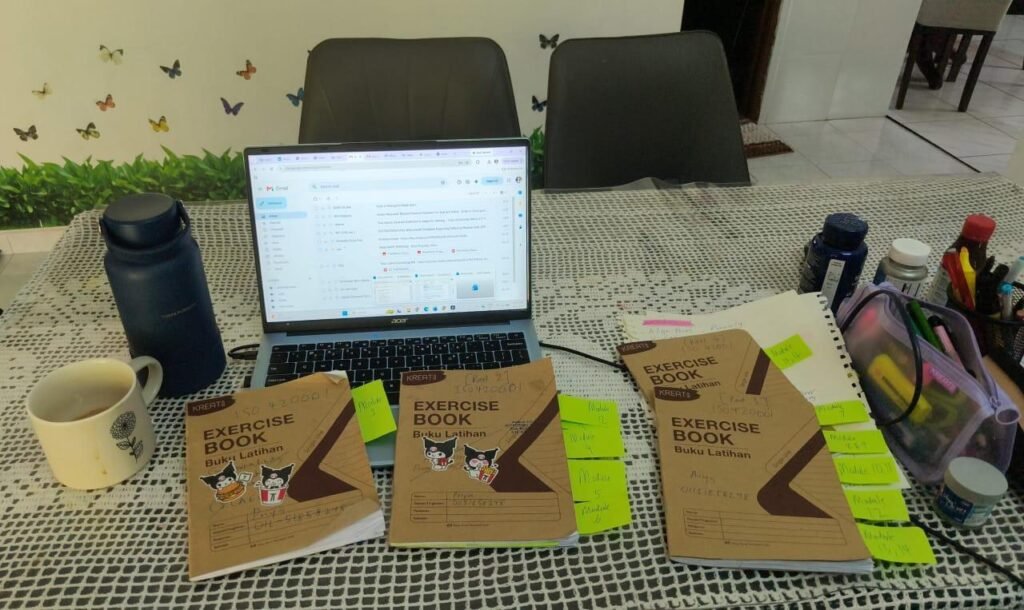
This journey took me just 11 days, but they were 11 very intense days. I spent my mornings, afternoons and many late nights working through the modules, usually completing one or two a day depending on their depth. I had to pause, reread and digest the concepts before moving on. The biggest challenge wasn’t the exam; it was learning a completely new language filled with standards, governance terms and AI jargon. My goal was to collect the certificate as fast as possible so I could update my CV but also to actually understand the subject-matter. I invested the time to understand the subject properly.
Of course, no learning journey happens alone.
I am sincerely grateful to Dr. Latha Karthigaa for her mentorship, encouragement and guidance for making AI governance understandable for professionals from every industry, not just those with technical backgrounds. Also, thanks to Global AI Certification Council (GAICC) for creating programmes like ISO/IEC 42001 that bridges the gap and helps us to become professional auditors.
And finally, a light-hearted gratitude.
To the neighbourhood café, stationery shops, and my mother’s kitchen, which somehow always knew I needed food for fuel, during my course moduls. The technology will continue to evolve. New regulations will emerge. New standards will be published. And I look forward to continuing to learn, contribute and, hopefully, help organisations implement AI ethically and fairly.