
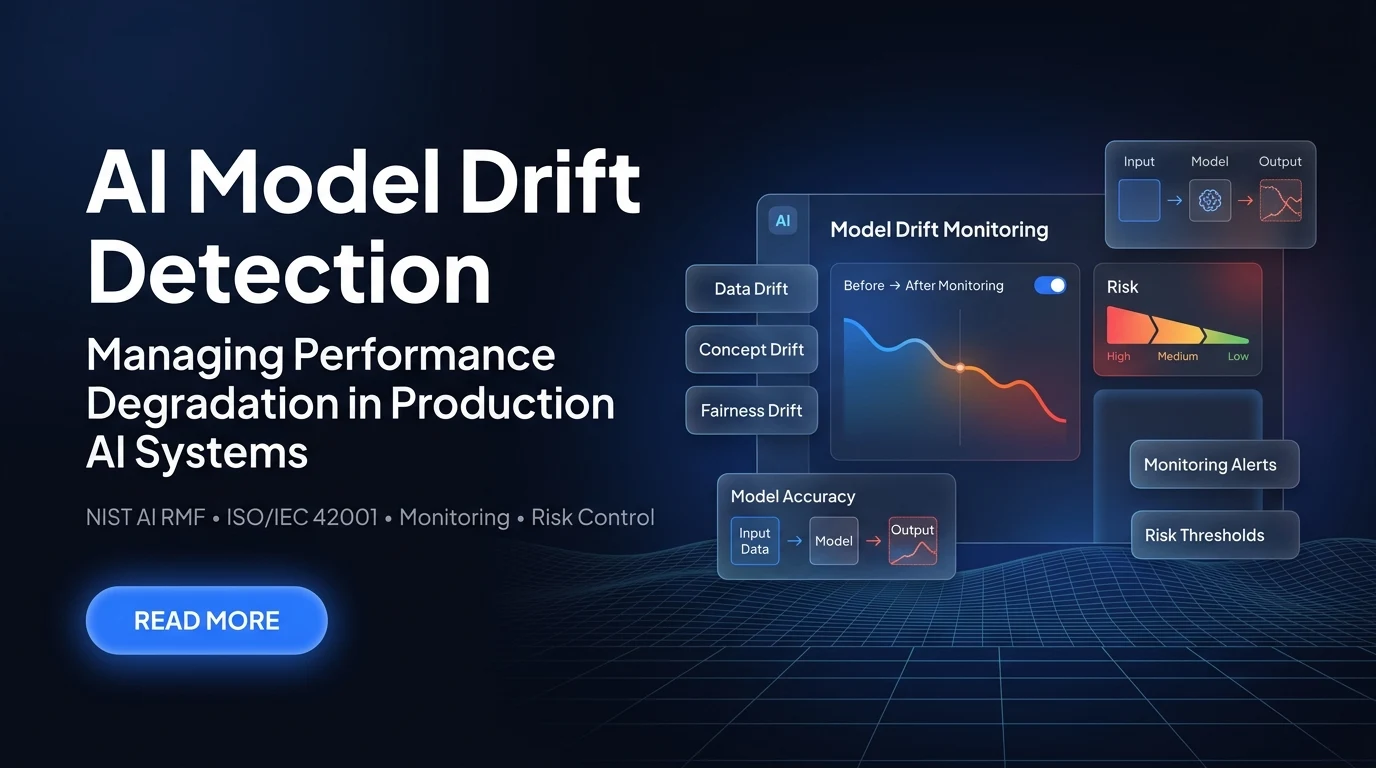
40% of companies experience noticeable AI performance degradation within the first year. Drift produces no error messages, only silently worsening decisions. Here is how to catch it before the business consequences compound.
A McKinsey survey found that 40% of companies deploying AI models experienced noticeable performance degradation within the first year due to drift. Unlike a server crash or a broken API endpoint, model drift produces no error message. The system keeps running. Predictions keep flowing. But the accuracy erodes gradually until the business consequences become impossible to ignore: a credit risk model approves loans it should decline, a fraud detection system misses patterns it once caught, a healthcare algorithm underestimates risk for patients whose demographics have shifted since training. IBM has noted that accuracy can degrade within days of deployment when production data diverges from training data. This article explains the types of drift, the business and regulatory consequences, the detection methods that work in practice, and how to build a monitoring and governance program aligned with ISO/IEC 42001 and the NIST AI RMF.
What Model Drift Actually Is (and Why It Happens Silently)
Model drift refers to the degradation of a machine learning model’s predictive accuracy over time due to changes in data, in the relationships between variables, or in the real-world conditions the model was designed to represent. The defining characteristic is silence. Unlike traditional software bugs that throw exceptions and halt execution, a drifted model continues producing outputs that look structurally correct but are progressively less reliable.
Drift happens for a fundamental reason: machine learning models are statistical snapshots. They capture the patterns that existed in the training data at a specific point in time. The real world does not hold still. Customer behavior changes. Economic conditions shift. Competitive landscapes evolve. Every one of these changes can invalidate the assumptions encoded in a model’s parameters.
The silent failure problem: A bank trained a credit risk model on 2021-2023 data with 95% default detection accuracy. By September 2024, the same model only caught 87% of defaults. No code changed. No errors fired. Economic conditions simply shifted beyond what the training data captured.
The Five Types of Drift That Affect AI Systems
1. Data Drift (Covariate Shift)
Input feature distributions change while the underlying input-output relationship stays the same. The model receives inputs it was not calibrated for. A retail recommendation engine trained when 60% of customers were aged 25-40 will degrade if the customer base shifts to include a larger share of users over 50.
2. Concept Drift
The fundamental relationship between inputs and outputs changes. This is the most dangerous type. During COVID-19, fraud detection models experienced massive concept drift because consumer spending patterns shifted overnight. Models that identified sudden online purchase increases as anomalous generated enormous false positive volumes because “normal” had redefined itself.
3. Label Drift
The distribution of the target variable changes without a change in the feature-target relationship. A loan default model trained when the default rate was 3% will be poorly calibrated if economic conditions push the actual rate to 7%.
4. Fairness Drift
A 2025 study in the Journal of the American Medical Informatics Association documented that fairness metrics can degrade over time even when overall accuracy stays stable. Over 11 years of clinical data, demographic subgroup performance diverged progressively. A model can maintain acceptable aggregate accuracy while becoming increasingly unfair to specific populations, invisible without subgroup monitoring.
5. Upstream Data Quality Drift
Sometimes what looks like model drift is actually a data pipeline problem. A source changes its schema, a feature starts returning nulls, an API modifies its format. These upstream changes mimic drift but have a different root cause and require different remediation. Monitoring data quality independently from model performance is essential.
The Business and Regulatory Consequences of Unmanaged Drift
Financial losses. A drifted credit scoring model increases default rates. A drifted pricing model leaves revenue on the table. In financial services, the Federal Reserve’s SR 11-7 guidance explicitly requires ongoing model performance monitoring, treating drift management as a core supervisory expectation.
Compliance exposure. ISO/IEC 42001 Clause 9.1 requires monitoring and measurement. Clause 8.2 requires ongoing risk assessments reflecting current conditions. The NIST AI RMF Measure function requires ongoing performance measurement. The EU AI Act requires post-market monitoring for high-risk systems.
Operational inefficiency. Drifted models need more manual oversight, more human overrides, and more exception handling. The automation benefit that justified the AI investment erodes.
Erosion of trust. When stakeholders lose confidence in model outputs, they stop using them or routinely override them. Rebuilding trust after visible failure costs significantly more than prevention.
Drift Types at a Glance
| Drift Type | What Changes | Example | Detection Method |
|---|---|---|---|
| Data Drift | Input feature distributions | Customer demographics shift | PSI, KS test, chi-square |
| Concept Drift | Input-output relationships | Fraud patterns change post-crisis | Performance tracking with ground truth |
| Label Drift | Target variable distribution | Default rates shift with economy | Target distribution monitoring |
| Fairness Drift | Subgroup performance gaps | Accuracy diverges across racial groups | Subgroup fairness metrics over time |
| Upstream Quality | Data pipeline or source changes | Feature starts returning nulls | Schema validation, data quality checks |
How to Detect Model Drift: Methods That Work in Production
Statistical Distribution Monitoring
Population Stability Index (PSI) compares feature distributions in production against training. PSI below 0.10 = negligible drift. PSI 0.10-0.25 = investigate. PSI above 0.25 = significant drift requiring action.
Kolmogorov-Smirnov (KS) test measures the maximum difference between two cumulative distribution functions. Effective for continuous features.
Chi-square test detects distribution changes in categorical features by comparing observed and expected frequencies.
Performance Metric Monitoring
Track accuracy, precision, recall, F1, and AUC against deployment baselines on rolling windows (daily, weekly). Alert when metrics cross thresholds. For regression, track RMSE, MAE, and prediction bias.
Subgroup Performance Monitoring
Monitor metrics separately for each relevant demographic and business segment. Aggregate metrics mask localized drift. A model might maintain 92% overall accuracy while dropping from 91% to 78% for a specific age group.
Shadow Model Comparison
Run challenger models alongside production to benchmark on live data. When a shadow model consistently outperforms the champion, it signals drift requiring retraining or replacement.
Threshold calibration: Start conservative. Alert on sustained trends (e.g., 0.5% accuracy decline per week for four consecutive weeks) rather than single-point deviations. Escalate to retraining when absolute performance drops below minimum acceptable levels.
How ISO/IEC 42001 and NIST AI RMF Address Model Drift
ISO/IEC 42001 Clause 9.1 requires determining what to monitor, the methods, when to measure, and when to analyze results. This directly implies drift monitoring with defined metrics, frequency, and evaluation criteria.
Clause 8.2 requires ongoing AI risk assessments reflecting current operational conditions. An assessment from deployment that is never updated does not satisfy this if performance has changed.
Annex A Control A.10 covers AI system operation and monitoring, including performance tracking and anomaly detection. Annex C risk source C.3.4 identifies ML-specific risks including behavior changes over time.
NIST AI RMF Measure 2.6 addresses validity and reliability assessment. Manage 4.1 covers mechanisms for monitoring risks over time.
Federal Reserve SR 11-7 requires ongoing model performance monitoring including tracking outputs against outcomes, back-testing, and benchmarking for U.S. financial institutions.
Building an AI Performance Monitoring Program
- Establish performance baselines at deployment. Document accuracy metrics, fairness metrics across protected groups, calibration scores, and feature distributions. These baselines become all future reference points.
- Deploy automated monitoring pipelines. Compute PSI and KS on features daily/weekly. Track performance against ground truth. Monitor subgroup metrics. Use AWS SageMaker Model Monitor, Vertex AI, or open-source tools like Evidently AI, NannyML, or WhyLabs.
- Define tiered alert thresholds. Tier 1 (informational): minor shifts within normal variation. Tier 2 (investigate): sustained degradation crossing warning thresholds. Tier 3 (action required): drops below minimum acceptable levels triggering retraining, rollback, or human override.
- Build retraining pipelines with governance gates. Automated retraining must not bypass validation, fairness testing, and approval workflows. ISO 42001 Clause 6.3 requires planned change management.
- Implement fallback mechanisms. Every production AI system needs a defined fallback: a simpler model, rules-based system, or human decision-maker. Document trigger conditions and test the pathway periodically.
- Conduct periodic model reviews. Quarterly for high-risk models, annually for lower-risk. Catch contextual changes automated systems miss: new regulations, competitive shifts, population changes.
- Document everything for audit readiness. Maintain a model risk register tracking current performance vs. baseline, all alerts and responses, retraining decisions, and rationale for accepted residual gaps.
Common Mistakes in Drift Management
Monitoring aggregate metrics only. A model maintaining 90% overall accuracy can simultaneously drop to 70% for a specific subgroup. Always monitor at the subgroup level.
Relying on periodic manual reviews. A quarterly review cannot catch drift that compounds over days or weeks. Continuous automated monitoring is not optional for production systems.
Retraining without governance controls. Automated retraining that bypasses validation can introduce new risks while fixing old ones. A retrained model might correct performance while introducing fairness regression.
Confusing data quality issues with drift. An upstream schema change mimics drift but has a different root cause. Monitor data quality independently for accurate diagnosis.
Setting thresholds without business context. A 2% accuracy drop in content recommendations is minor. A 2% drop in clinical diagnostics can cause serious harm. Thresholds must reflect consequences.
Drift Management Is Not a Technical Task. It Is a Governance Requirement.
Model drift is one of the few AI risks guaranteed to affect every production system. The question is never whether a model will drift, but when, how fast, and whether the organization detects it before consequences accumulate. The organizations managing this effectively treat drift monitoring with the same rigor they apply to financial controls and cybersecurity.
The most productive first step: identify your highest-risk production AI system, establish baseline metrics, and deploy automated monitoring. That single action reveals more about your AI risk posture than any theoretical assessment.
GAICC offers ISO/IEC 42001 Lead Implementer training that covers AI performance monitoring, model risk management, and the governance structures needed to maintain model integrity over time. Explore the program to build your organization’s approach.
Frequently Asked Questions (FAQs)
1. What is AI model drift?
Model drift is the degradation of a model’s predictive accuracy over time due to changes in input data, variable relationships, or real-world conditions. It occurs silently without errors, making it one of the most dangerous AI operational risks.
2. What is the difference between data drift and concept drift?
Data drift occurs when input feature distributions change while the input-output relationship stays the same. Concept drift occurs when the actual relationship changes. Data drift = different inputs. Concept drift = the world has changed.
3. How quickly can models degrade?
IBM notes accuracy can degrade within days. McKinsey found 40% of companies experienced degradation within the first year. Speed depends on domain: financial models can drift in hours, healthcare models over months.
4. What is fairness drift?
Fairness drift occurs when subgroup fairness metrics degrade over time even while overall accuracy remains stable. A 2025 JAMIA study documented this over 11 years, showing models can appear fine in aggregate while becoming discriminatory for specific populations.
5. How does ISO/IEC 42001 address model drift?
Clause 9.1 requires monitoring and measurement. Clause 8.2 requires ongoing risk assessments reflecting current conditions. Annex A Control A.10 covers operation and monitoring. Annex C C.3.4 identifies ML-specific risks including behavior changes over time.
6. What tools detect model drift?
Cloud: AWS SageMaker Model Monitor, Google Vertex AI, Azure ML. Open-source: Evidently AI, NannyML, WhyLabs, Fiddler. Statistical: Population Stability Index, Kolmogorov-Smirnov tests, chi-square tests.
7. How often should models be retrained?
Retraining should be triggered by monitoring evidence, not arbitrary timelines. High-frequency domains may need weekly or monthly cycles. Stable domains may only need annual retraining unless monitoring detects significant drift.