
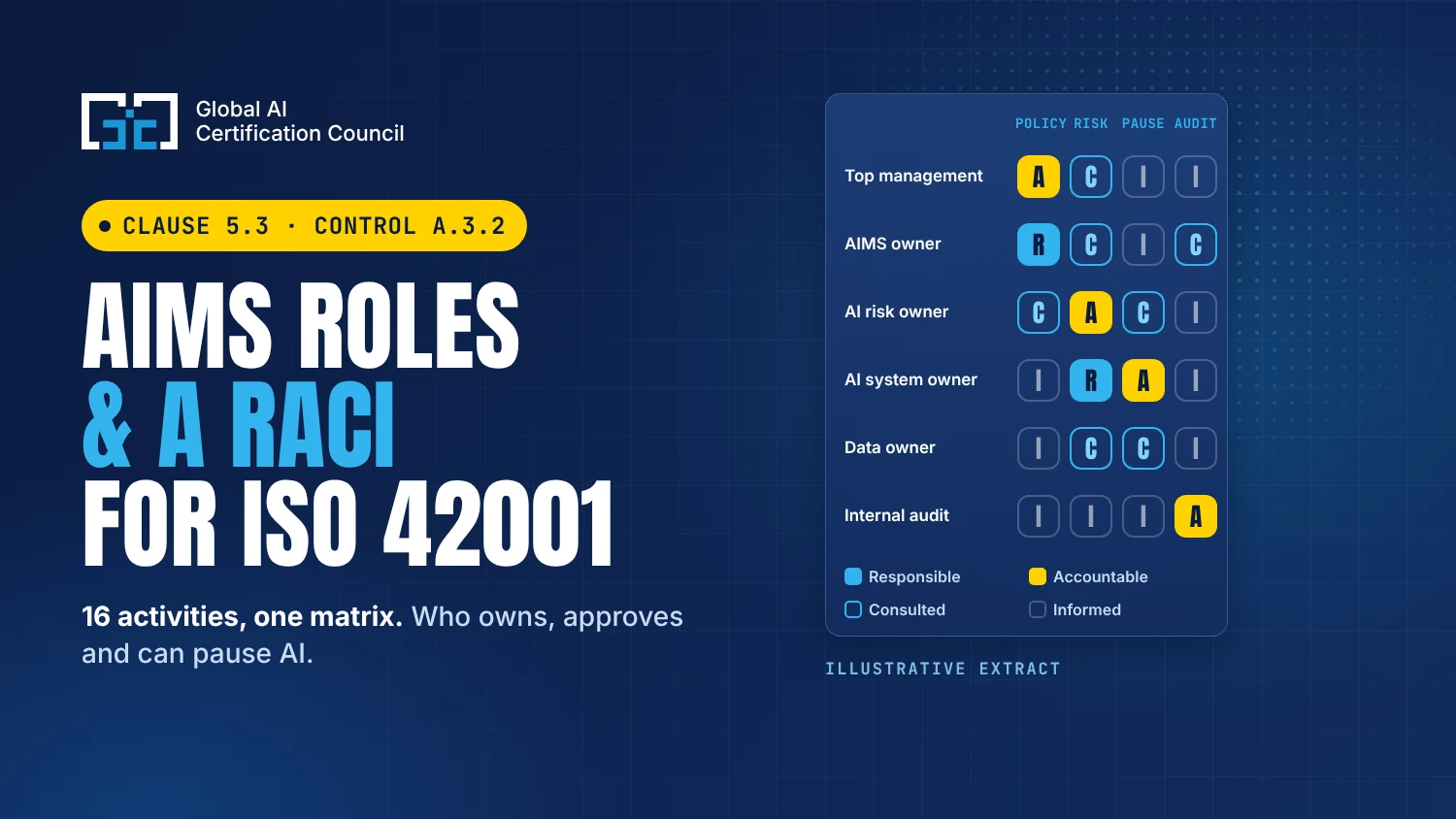
AIMS roles and responsibilities are the duties and decision rights that ISO/IEC 42001 clause 5.3 and Annex A control A.3.2 require an organization to define, assign and communicate. Clause 5.3 puts top management in charge of the assignment. It also names two duties that must go to someone: keeping the AI management system conformant, and reporting its performance to top management. The standard names no job titles. The RACI on this page is therefore GAICC’s editorial model, built on the clause anchors.
Two different ideas share the word “role” in ISO 42001 searches. Clause 4.1 asks the organization to decide its role toward each AI system, such as AI provider, AI producer or AI customer. That choice decides which requirements apply. Clause 5.3 is about people inside the organization and the authority each one holds, which is what the matrix here assigns. For the first idea, start with working out which AI role you hold.
What clauses 5.1 and 5.3 and control A.3.2 require
ISO/IEC 42001 spreads its role requirements across clause 5 and Annex A, and each piece answers a different question. Clause 5.1 says what top management does itself. Clause 5.3 says what it must hand out. Control A.3.2 says the allocation must fit the organization, and A.3.3 adds a reporting role that is easy to leave out. The paraphrases in this section were checked against the published text, and your licensed copy of ISO/IEC 42001:2023 holds the exact wording.
Clause 5.1 duties top management keeps
Clause 5.1 follows the harmonized structure that ISO management system standards share, so ISO/IEC 27001 users will recognize most of it. Top management shows leadership by making sure the AI policy and AI objectives exist and fit the strategic direction. It builds AIMS requirements into normal business processes and makes resources available. It explains why AI management matters and checks that the AIMS achieves what it is meant to achieve. It directs and supports the people doing the work, promotes continual improvement and backs other managers as they show leadership in their own areas of responsibility.
None of these duties can be met by appointing a project manager and stepping away. An auditor tests them through top management’s own records: the signed policy, the funded budget line and the management review minutes.
Clause 5.3 and its two named assignments
Clause 5.3 asks top management to make sure responsibilities and authorities for relevant roles are assigned and communicated. It then names two assignments that cannot stay implicit. Someone must hold the responsibility and authority for keeping the AIMS conformant with ISO/IEC 42001. Someone must hold the responsibility and authority for reporting AIMS performance to top management.
Both duties often land on one person, called the AIMS owner in the matrix later on this page. The word “authority” carries as much weight as “responsibility”. A coordinator who can chase people but cannot require anything is a weak fit for a clause that pairs the two words every time.
Control A.3.2 and the twelve Annex B areas
Control A.3.2, AI roles and responsibilities, asks the organization to define and allocate AI roles according to its needs. Annex B, which is normative implementation guidance, then gives twelve example areas that can need defined roles:
- risk management
- AI system impact assessment
- asset and resource management
- security
- safety
- privacy
- development
- performance
- human oversight
- supplier relationships
- showing that legal requirements are consistently met
- data quality across the life cycle
Treat the list as a coverage check. If no row in your RACI gives one of these areas an owner, an auditor reading B.3.2 can fairly ask why. The note to clause 4.1 also borrows stakeholder terms from ISO/IEC 22989. It lists AI impact assessors and AI governance and oversight professionals among AI producer roles. Impact assessment can therefore be a named job of its own.
Control A.3.3 and the concerns channel
A.3.3, reporting of concerns, needs a process for raising concerns about the organization’s role with an AI system across its life cycle. The guidance in B.3.3 describes features such as confidentiality or anonymity, access for employees and contractors, and qualified staff with powers to investigate. It also covers timely escalation to management, protection from reprisal and timely responses. B.3.3 points to ISO 37002, the 2021 guidelines for whistleblowing management systems.
Give the channel a named owner. A note in B.3.3 allows existing reporting mechanisms to serve, so a US company with an ethics or compliance hotline can extend its intake categories to AI concerns.
Decisions the standard assigns to a management level
Most of ISO/IEC 42001 says “the organization shall”, which leaves the owner open. A few clauses name a management level, and those clauses anchor every sign-off in a RACI.
| Decision | Clause | Level the standard names | Practical holder (GAICC editorial) |
| Establish the AI policy | 5.2 | Top management | CEO or executive committee |
| Assign roles, responsibilities and authorities | 5.3 | Top management | CEO or executive committee |
| Approve the AI risk treatment plan | 6.1.3 | Designated management | AI risk owner, within a written risk limit |
| Accept residual AI risk | 6.1.3 | Designated management | AI risk owner; above the limit, top management |
| Review the AIMS and decide on changes | 9.3 | Top management | Executive committee, at planned intervals |
| Select internal auditors | 9.2.2 | The organization, keeping the audit objective and impartial | Head of internal audit or an external party |
“Designated management” in clause 6.1.3 answers the common question of who signs risk acceptance. The organization chooses the signer, but it must make that choice before the first decision arrives, and recording the choice is exactly what a RACI does.
Three claims AI answers make that the standard does not
Google’s AI Overview for “iso 42001 raci”, captured by GAICC on 5 October 2026, built its own RACI table. No purpose-built RACI page ranked on page one that day. Three of its statements go further than ISO/IEC 42001 does.
- “A.3.2 mandates named individual accountability.” The control asks for roles defined and allocated according to the organization’s needs. Naming a person is sound practice and makes audits faster, but the control text does not require it.
- “Auditors require exactly one Accountable per control.” Single accountability is a convention of the responsibility assignment matrix, a project management technique. ISO/IEC 42001 never uses RACI terms. The rule is still worth keeping, for the reasons given further down.
- “Owners need kill-switch authority.” The standard does not use the term. Human oversight is one of the B.3.2 role areas, and the operation and monitoring of AI systems sits in control A.6.2.6. ISO/IEC 42105, the guidance on human oversight, was still at final draft ballot (stage 50.20) in ISO’s data on 30 September 2026. Stop authority is good design that no clause demands.
A second overview captured that day, for “iso 42001 roles and responsibilities”, led with the clause 4.1 roles such as producer and user. Internal job roles came after. The opening of this page keeps those two ideas apart.
The roles an AIMS needs
An AIMS needs a short list of roles with clear authority, and most can be part-time hats on existing jobs. The table lists twelve. Titles vary by company, so read the authority column first.
| Role | What it holds | Authority it needs | Independence note |
| Top management | AI policy, role assignment, resources, management review (5.1 to 5.3, 9.3) | Budget, and power to direct business units | Demonstrates the 5.1 duties itself |
| AIMS owner | The two 5.3 duties: conformity and performance reporting | To require evidence and corrective action from any unit in scope | Never the internal auditor of the same AIMS |
| AI risk owner | Risk treatment plan approval and residual risk acceptance (6.1.3) | A written risk acceptance limit | Separate from the system owner for high-impact systems |
| AI system owner | One AI system from purpose to retirement | To release, change, pause or withdraw the system | A business role, separate from the model builder |
| AI engineering and operations lead | Build, test, deploy and monitor (A.6.2) | Technical change within approved scope | Executes a pause; does not decide it alone |
| Data owner | Data used to train, test and run a system (A.7) | To approve data use, sourcing and retention | Works with privacy on personal data |
| Impact assessment lead | The 6.1.4 assessment and its repeats under 8.4 | To call any in-scope system in for reassessment | Does not report to the owner of the system assessed |
| Legal and privacy | Legal requirements, PII roles, external disclosures | To block an unlawful use | Consulted on most rows |
| Security | Security of AI assets, adversarial threats, incident response | To block a release on security grounds | Often the existing ISO 27001 owner |
| Procurement | Supplier intake and AI contract terms (A.10) | To hold a purchase until review ends | Usually the first to see undeclared AI |
| Internal audit | The 9.2 audit program | Unrestricted access to records and people | Must not audit work it designed or runs |
| Lead Implementer | Builds and maintains the AIMS: method, documents, training, readiness | Delegated by the AIMS owner | Not the internal auditor for the AIMS it built |
ISO/IEC 42001 does not say which function should own AI governance. Privacy, legal, IT, risk and security teams can all hold the role. The standard asks that the choice is made, communicated and backed with authority.
US teams that also use the NIST AI Risk Management Framework cover the same ground under GOVERN 2.1, on documented roles and lines of communication. GOVERN 2.3 adds that executive leadership takes responsibility for AI risk decisions. One matrix can serve both frameworks.
Governing body versus top management
The governing body and top management are separate layers in ISO/IEC 42001. The standard defines the governing body as the person or group accountable for the organization’s performance and conformance. In a US corporation that is usually the board of directors. Top management directs and controls the organization day to day. Where the AIMS covers only part of a company, such as one business unit, top management means the leaders who direct and control that part.
Board oversight of AI has its own standard. It is the subject of ISO/IEC 38507, a separate governance guidance standard. In a RACI the board is normally Informed of management review outputs and Consulted on risk appetite. It rarely owns an operational row.
The AIMS owner versus the AI system owner
The AIMS owner is accountable for the management system, while each AI system owner is accountable for one AI system in production. Mixing the two leaves open who is accountable when a live AI system causes harm. A YouTube creator pinned that question under a RACI video published in late August 2026, offering business owner, risk or AI governance as options. It had no replies when GAICC reviewed the comments.
GAICC’s answer is the business owner of the system. That person decided the system should exist, owns the outcome it serves and can stop it. Risk and the AIMS owner set rules and check them. They do not run the system, so they cannot carry its accountability without also holding its authority.
The matrix that follows puts those roles to work.
An ISO 42001 RACI matrix for 16 core activities
This matrix assigns Responsible, Accountable, Consulted and Informed for 16 activities that every AIMS runs. Each row cites the clause or control that creates the activity. The assignments are GAICC editorial and illustrative, built from the standard’s structure. Rename the columns to fit your titles, but keep the rules that follow.
Key: TM top management; AO AIMS owner; RO AI risk owner; SO AI system owner; ENG AI engineering and operations; DO data owner; IAL impact assessment lead; LP legal and privacy; SEC security; PRO procurement; IA internal audit; LI Lead Implementer. A/R means the role is both.
| Activity (anchor) | TM | AO | RO | SO | ENG | DO | IAL | LP | SEC | PRO | IA | LI |
| 1. Set AIMS scope and organizational AI role (4.1, 4.3) | A | R | C | C | I | I | I | C | C | I | I | R |
| 2. Approve the AI policy (5.2, A.2) | A | R | C | I | I | I | C | C | C | I | I | R |
| 3. Assign roles and authorities (5.3, A.3.2) | A | R | C | C | I | I | I | C | I | I | I | C |
| 4. Keep the AI system inventory current (4.1, A.4) | I | A | I | R | C | C | I | I | C | R | I | R |
| 5. Run the AI risk assessment (6.1.2, 8.2) | I | C | A | R | C | C | C | C | C | I | I | R |
| 6. Run the AI system impact assessment (6.1.4, 8.4, A.5) | I | A | C | R | C | C | R | C | I | I | I | C |
| 7. Approve treatment plan, accept residual risk (6.1.3) | C | C | A | R | C | I | C | C | C | I | I | R |
| 8. Approve the Statement of Applicability (6.1.3) | I | A | C | I | I | I | I | C | C | I | I | R |
| 9. Release a model or system to production (A.6.2.5) | I | I | C | A | R | C | C | C | C | I | I | I |
| 10. Change a live AI system (A.6.2, 8.4 trigger) | I | I | C | A | R | C | C | C | C | I | I | I |
| 11. Respond to an AI incident (A.8.4, 10.2) | I | C | C | A | R | C | C | C | R | I | I | I |
| 12. Onboard an AI supplier or AI feature (A.10.2, A.10.3) | I | I | C | A | C | C | C | C | C | R | I | I |
| 13. Monitor and measure AIMS performance (9.1) | I | A | C | R | R | I | I | I | C | I | I | R |
| 14. Plan and run internal audits (9.2) | I | C | I | I | I | I | I | I | I | I | A/R | I |
| 15. Hold the management review (9.3) | A | R | C | I | I | I | I | C | C | I | C | R |
| 16. Close nonconformities with corrective action (10.2) | I | A | C | R | R | I | I | I | C | I | C | R |
[TRAINER INSIGHT NEEDED: In GAICC Lead Implementer cohorts, which row of a matrix like this do participants most often fill with two Accountable roles, and how do instructors resolve it?]
Building a matrix of this kind is the subject of the AIMS team roles and RACI module in GAICC’s Lead Implementer course.
Three rows carry choices worth explaining. Row 6 makes the AIMS owner Accountable for the impact assessment and keeps the system owner Responsible. The person who wants a system live should not be the only judge of its harm to people. The method sits on the page about the AI system impact assessment. Row 8 gives the AIMS owner the sign-off on the Statement of Applicability, since that record ties the selected controls to the whole AIMS. Row 12 makes the business owner accountable for a new AI supplier, with procurement doing the work. Procurement can stop a contract, but only the business owner can decide the tool is worth its risk.
Rules that keep the matrix auditable
A RACI survives an audit when every row can be traced to one decision maker who had the power to decide. Seven rules help.
- Give each row one Accountable role. With two, each assumes the other signed, and the record shows nobody did.
- Put the A where the authority is. If a role cannot fund, stop or change the thing, move the A.
- Write the risk limits down. The risk owner accepts within a limit that top management sets. Above it, the decision moves up, which keeps “designated management” in 6.1.3 concrete.
- Keep assessors outside the line they assess, so the impact assessment lead does not report to the owner of the system under review.
- Keep builders away from auditing their own build. Clause 9.2.2 asks that auditors are selected to ensure objectivity and impartiality, and the standard’s definition of internal audit lets an external party run one on the organization’s behalf.
- Name a backup for every Responsible role, because leave, resignations and reorganizations break single points of failure.
- Control the matrix like any other document, with an owner, a version and an approver. Review triggers include a reorganization, a new class of AI system or a management review decision.
Who can stop or pause an AI system
The AI system owner holds the authority to pause or withdraw an AI system, and three other roles should hold a right to demand it. Security can demand a pause for a system under active attack. Legal and privacy can demand one when a system processes data unlawfully. The impact assessment lead can demand one when an assessment finds serious harm to people that existing controls do not cover.
A demand forces a decision from the system owner within a set time, and if the owner declines, the demand goes straight to top management for a ruling. Engineering carries out the pause. Name the person who decides and the person who executes well before any incident starts. Write the stop authority into each role description, then test it in an incident exercise.
Governance forums and the escalation path
Forums give the RACI a place to meet, and GAICC’s model uses three. Small companies can fold all three into one standing meeting. ISO/IEC 42001 requires none of them by name. They are one way to show the planned intervals and documented decisions that clauses 6.1.3, 8.4 and 9.3 expect.
| Forum | Chair | Members | What it decides | Suggested cadence (GAICC editorial) |
| AI governance steering committee | CEO or a delegate from top management | AIMS owner, AI risk owner, legal and privacy, security, business heads | Policy, objectives, risk appetite, escalations, management review outputs | Quarterly, plus when an escalation arrives |
| AIMS working group | AIMS owner | Lead Implementer, system owners, data owners, impact assessment lead, procurement | Assessments due, control status, open corrective actions | Every two to four weeks |
| AI release and change board | Owner of the affected system | Engineering, risk, security, impact assessment lead | Releases and significant changes, and whether an 8.4 reassessment is due | Each release or significant change |
Escalation needs a fixed order so that nobody has to guess where a problem goes next.
- The system owner resolves the issue within the approved risk limit and records the decision.
- Anything beyond that limit goes to the AI risk owner, who can accept, treat or refuse it.
- Anything beyond the risk owner’s limit, and any dispute between owners, goes to the AIMS owner to prepare for the steering committee.
- The steering committee decides. Anything outside the risk appetite delegated to it goes to top management, or to the board where its charter says so.
The concerns channel under A.3.3 sits outside this chain, so a person can bypass their own line. Put a time limit on each step. An escalation with no clock is just a queue.
Evidence an auditor asks for on role assignment
Auditors test clause 5.3 and control A.3.2 in two ways. They ask for records that roles were assigned and communicated, then interview people to see whether they know what they hold. Expect requests for these records:
- the approved responsibility matrix, with a version, a date and the approver’s name
- appointment records for the AIMS owner and the two 5.3 duties, signed by top management
- role descriptions that include AI duties and authorities, stop authority among them
- committee charters, and minutes that show decisions rather than attendance
- risk acceptance records signed within the written limit
- the concerns channel procedure and its intake log
- competence records for each role, which tie the matrix to the competence and awareness requirements in clause 7.2
Interviews matter as much as documents. If a system owner cannot say they may pause their own system, the matrix exists on paper only.
[TRAINER INSIGHT NEEDED: Which role-assignment evidence do GAICC instructors see missing most often when an organization prepares for its Stage 1 audit?]
Keeping ownership alive after the first audit takes more effort than producing these records.
How ownership fails after the matrix is signed
Ownership can fail even when every document is in place. A practitioner in a Reddit AI governance forum summed up a 42001 rollout in September 2026 with “We underestimated ownership more than documentation.” The patterns that follow come from practitioner threads and ranking pages, and the hub on how implementation actually runs covers the wider failure modes.
- A steering committee marked Accountable on every row means no single person ever signs.
- Unassigned tasks drift to whoever is building the AIMS. Every record then carries one name, and the system stalls when that person leaves.
- Approvals stall. An ISO 27001 practitioner described the problem in February 2026, writing that “the documents sit with them for weeks with no movement, which means everything downstream stalls too.” Approval time limits in the RACI and a named delegate fix it.
- System owners exist in name only, and the inventory lists an owner who has never seen the system’s monitoring data.
- Nobody can refuse. A GRC practitioner put the test plainly in September 2026: “someone has to be able to say no.” A risk owner without that right only records decisions others made.
- The matrix drifts after a reorganization. Names change while the matrix stays put, and the first surveillance audit finds approvals signed by people who left.
Where the Lead Implementer sits
The Lead Implementer sits between top management and the people who own AI systems, and the exact seat depends on the organization’s size. The role builds and maintains the AIMS: the method, the documents, the training, the evidence trail and audit readiness. Three placements are common.
- As the AIMS owner. In smaller organizations, top management assigns the two clause 5.3 duties directly to the Lead Implementer. The A entries in the AO column then belong to the Lead Implementer too.
- Under the AIMS owner. In mid-size and large organizations, a head of GRC, risk or AI governance holds the 5.3 duties. The Lead Implementer runs the program under that authority.
- As an outside consultant. A consultant can hold R entries. The A entries should stay with someone inside the organization who will still be there after the engagement ends.
Two things stay fixed in every placement. The Lead Implementer needs a direct line to top management for the 5.3 performance report, and takes no part in auditing the AIMS they built. Professionals weighing this seat can see where implementers end up over a career. Where the 5.3 duties sit with one person, consider Lead Implementer certification for the person who owns the AIMS, a four-day course on clauses 4 to 10 with the exam included.
Role splits by organization size
Small organizations combine roles, which ISO/IEC 42001 does not prohibit, as long as the separations that protect objectivity hold. The table shows a typical split by headcount.
| Role | Under 50 staff | 50 to 500 staff | Over 500 staff |
| Top management | Founders or CEO | Executive team | Executive committee, with board oversight |
| AIMS owner | CTO or COO, often also the Lead Implementer | Head of GRC or AI governance | Head of AI governance or chief AI officer |
| AI risk owner | CEO or COO | Risk lead or CFO | Enterprise risk, with risk owners per business unit |
| AI system owner | Product lead | Business or product owner per system | Business owner per system, federated |
| Impact assessment lead | Product lead with an outside reviewer | Privacy or ethics lead | Dedicated assessment team |
| Internal audit | External party | Second-line function or external party | Internal audit function |
| Forums | One leadership meeting | Steering committee and working group | All three forums, repeated per business unit |
| Must stay separate | Auditor and builder | Auditor and builder; assessor and system owner | All the rules in the matrix section |
A Reddit GRC thread in September 2026 asked whether a company also needs a GRC officer. ISO/IEC 42001 does not require one. It requires the two 5.3 duties to sit with someone who has authority, and whether that person is a new hire depends on the workload.
Where to go next, by role
Pick the row that matches your seat. The matrix rows column points back to the RACI above.
| Seat | Read next | Matrix rows to check first |
| CEO or executive sponsor | The decisions table, then writing the AI policy, the first record you sign | 2, 3 and 15 |
| AIMS owner or builder | The implementation roadmap, so the matrix is placed before risk work starts | All 16, treated as a draft |
| Leader in an organization that mostly buys AI | Assessing AI vendors | 4 and 12 |
| Head of internal audit | The internal audit program | 14, kept free of builders |
| Newcomer to the AIMS idea | The AI management system itself | Return to the matrix afterwards |
Frequently asked questions
Does ISO 42001 require a RACI matrix?
No. Clause 5.3 requires top management to assign and communicate responsibilities and authorities, and control A.3.2 asks for AI roles fitted to the organization’s needs. The standard never uses RACI terms. A RACI is one clear way to show an auditor that the assignment happened, though approved role descriptions can serve too.
Who is accountable for an AI system in production?
GAICC’s answer is the business owner of the system, who chose to deploy it, owns the outcome it serves and can pause it. Risk and the AIMS owner set the rules and check them, while engineering runs the system day to day. The standard itself leaves the choice to the organization.
Does ISO 42001 require a Chief AI Officer?
ISO/IEC 42001 requires no Chief AI Officer or any other title, only that the two clause 5.3 duties sit with someone who has authority. US federal agencies are a different case, because OMB memorandum M-25-21, issued 3 April 2025, required each agency head to retain or designate a CAIO within 60 days. In a company, a CAIO often makes a natural AIMS owner.
Can the Lead Implementer also be the internal auditor?
Not for the AIMS they built. Clause 9.2.2 asks that auditors are selected to ensure the objectivity and impartiality of the audit process. A colleague from another function, a second-line team or an external party acting for the organization can run the audit instead.
Can one person hold several AIMS roles?
Yes, and in small organizations most people do. Three combinations need care. The builder should not audit the build, and the impact assessment lead should not report to the owner of the system under assessment. The system owner should also not accept residual risk above the written limit alone.
How often should the responsibility matrix be reviewed?
ISO/IEC 42001 sets no review frequency for role assignments. Review the matrix whenever the organization reorganizes, adds a new class of AI system or takes a management review decision that moves ownership. Before each surveillance audit, check that every named approver still holds the role.