
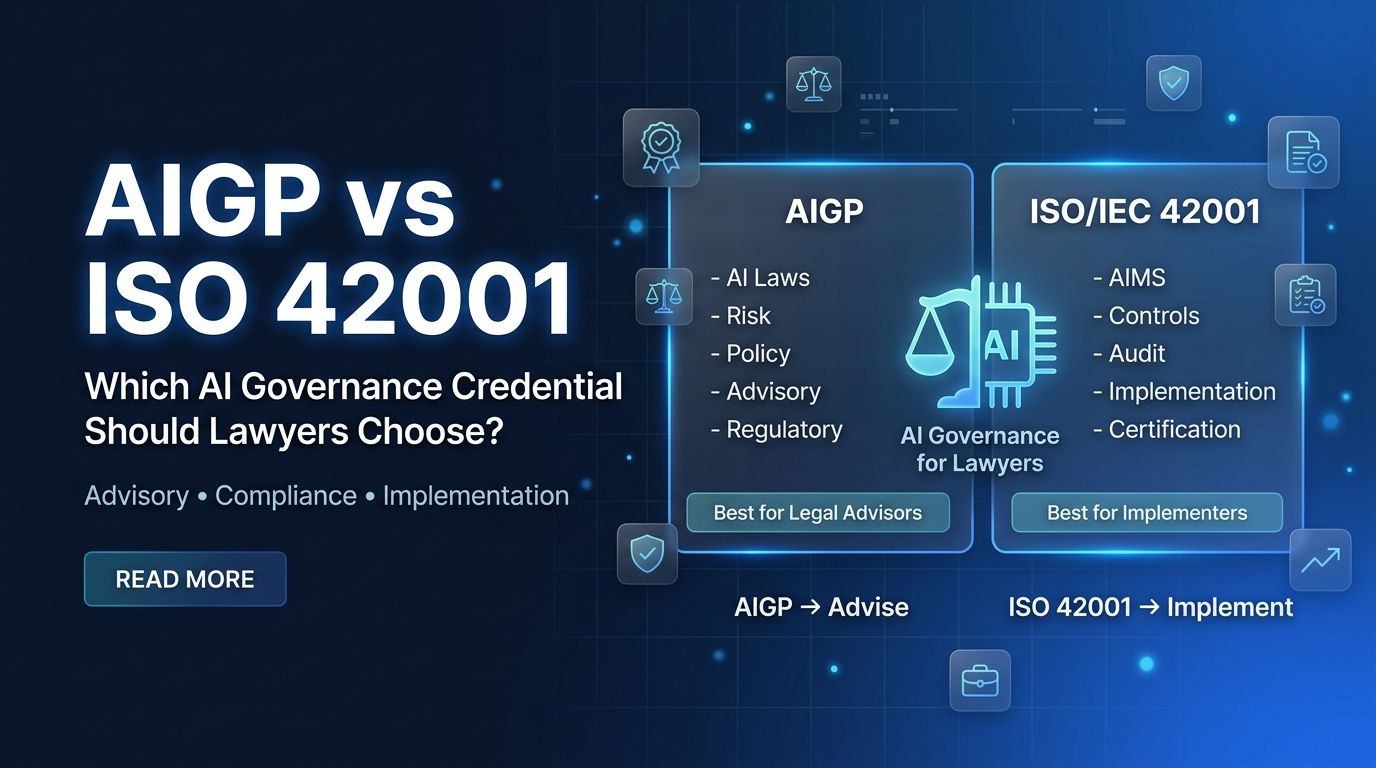
An AI governance certification for lawyers is a personal credential showing that an attorney can advise on, or build, an organization’s controls for AI risk. Most lawyers weigh the IAPP’s AIGP against its CIPP/US or CIPP/E privacy credentials, with an ISO/IEC 42001 Lead Implementer (LI) as a third option built for running a management system. In GAICC’s view, advisers start with the AIGP or a CIPP. Counsel who will run or sign off a company’s AI management system should start with the LI.
GAICC, the Global AI Certification Council, issues one LI credential and quotes its own rules below. Organizations, law firms among them, certify against ISO/IEC 42001, while each person earns a credential from a personnel certification body. GAICC found no US state bar rule that makes any of these credentials a condition of practice.
Four options lawyers compare
Lawyers choose among three professional certifications and a fourth type, the university or executive certificate, and each one proves something different. The figures come from each issuer’s own pages, read on 11 October 2026.
| Attribute | IAPP AIGP | IAPP CIPP/US or CIPP/E | Lead Implementer (GAICC) | University or executive certificate |
| What it shows | How laws, standards and frameworks apply to AI | Privacy and data protection law of one jurisdiction | Competence to plan, build and run an AIMS | Completion of a taught program |
| Issued by | IAPP, a not-for-profit membership association | IAPP | GAICC; other personnel certification bodies run their own 42001 schemes | Law schools and continuing studies units |
| Proctored exam | 100 questions, 165 minutes, a 15-minute break midway | 90 questions, 150 minutes, a 15-minute break midway | 60 items, 90 minutes, no notes allowed | Usually none |
| Exam price | US$649 member, US$799 non-member | US$550 | Exam alone US$149 member, US$249 non-member; course package US$875 | Varies by program |
| Training before the exam | Optional | Optional | 32 contact hours required | The program is the training |
| Keeping it | Two-year term, 20 CPE credits, membership or a US$250 maintenance fee | Same as the AIGP | Three-year term, 40 CPD hours | No renewal |
| ANAB accreditation (ISO/IEC 17024) | Not accredited by ANAB | ANAB-accredited under the 2012 edition | Described as aligned with ISO/IEC 17024; no accrediting body named | Not applicable |
| CLE | Only for activities your state approved; passing the exam is not one | Same as the AIGP | GAICC has not confirmed approval in any state | Ask each program for its state approval |
Read the accreditation row closely before you put a credential in a bio. An earlier version of this page described the AIGP as ANSI-accredited. The IAPP’s own Candidate Handbook (effective 1 June 2026) names the CIPP/US and CIPP/E as ANAB-accredited and the AIGP as outside that accreditation.
Prices come from the IAPP store and the CIPP/US store page. The CIPP/E store page lists the same price and format as the CIPP/US. Confirm both when you book. Every professional certification in the table charges for its proctored exam. Courses and bar CLE sessions can be free, and they end without a certification. The Lead Implementer cost breakdown covers the GAICC prices in full.
Which credential fits your legal role
Your first credential depends on what your legal role produces: advice, documents, or a working management system. GAICC built the matrix from the task lists in each blueprint and from 2026 lawyer forum threads. It assumes a US attorney planning 12 to 24 months ahead.
| Legal role | Start with | Add next | Why |
| In-house privacy counsel | CIPP/US or CIPP/E | AIGP, then LI if the company seeks a certificate | Privacy postings name the CIPP; the AIGP adds AI law |
| Product counsel | AIGP | LI once the product falls inside the certified scope | Launch reviews feed impact assessments and user information |
| Law firm partner advising clients | AIGP | LI for clients who want a certificate | Advice crosses many clients, sectors and statutes |
| Partner or firm GC running the firm’s own program | LI | AIGP | You own the system an outside auditor will test |
| Legal operations | LI | AIGP if the role moves toward advice | Legal ops runs the records and supplier files the system depends on |
| Compliance officer | LI | AIGP | Compliance owns monitoring, internal audit and corrective action |
| Litigator handling AI disputes | AIGP if clients are technology companies | A CLE course on AI evidence | The work needs vocabulary and law, with no system to run |
| JD not practicing, moving into governance | LI for program roles; AIGP for policy roles | The other one, once a role is chosen | Forum advice points JDs toward compliance and governance roles |
Lawyers on forums compare the AIGP with the CIPP far more often than with ISO/IEC 42001. In the 2026 lawyer threads GAICC reviewed, the CIPP was the usual comparison point, and one June post called it “often a line item on job postings.” ISO/IEC 42001 is a single item to understand in the AIGP blueprint. An AIGP holder can therefore explain the standard without having built a conforming system.
The AIGP’s law domain is where lawyers feel at home. It names the EU AI Act, South Korea’s AI Basic Law, and the federal and state AI laws that apply to private-sector organizations. That is the map a partner needs when advising a bank, a hospital and a software company in the same month. Litigators are less sure. An August 2026 thread started by a litigator drew both views: the certifications “do not really offer a true foundation in the underlying technologies,” yet technology clients “DEFINITELY notice the AIGP.”
If your row starts with LI, look at GAICC’s Lead Implementer training open to legal and compliance professionals. Its 16 modules run from leadership under clause 5 and planning the AIMS under clause 6 to certification preparation. Engineers, risk managers and other non-legal readers have their own general AIGP comparison.
Does any of it earn CLE?
None of these exams earns CLE by itself. CLE comes from activities a state approved, and in this field the verified route is attendance at approved events. GAICC rechecked the points below on 11 October 2026.
- The IAPP’s MCLE information page offers credit to legal professionals attending MCLE-eligible conferences. It says nothing about the AIGP exam.
- The American Bar Association accreditation that the IAPP holds covers its Privacy Law Specialist designation for lawyers, which leaves the AIGP outside it.
- GAICC has not confirmed CLE approval for any of its courses in any state, so count that training as CPD toward the LI only.
- For IAPP’s Privacy. Security. Risk. + AI Governance Global 2026 conference, the MCLE form must be in before midnight on Friday 23 October 2026, with up to 23.5 credits possible.
- IAPP does not apply for CLE accreditation of its online or live online certification training, though it will send documentation for lawyers to self-apply.
The IAPP’s state table for its Summit 2026 conference shows how much approvals vary.
| State | Summit 2026 approval (general + ethics) | How the credit is reported |
| Texas | 24 + 1 | IAPP reports for you |
| Illinois | 21.75 + 1 | IAPP reports for you |
| Florida | 29 + 1 | You self-report with IAPP’s documentation |
| Colorado | 29 + 1.2 | You self-report |
| California | No figure listed; IAPP’s note covers it | Eligible by self-reporting |
| New York and New Jersey | IAPP did not apply directly | Eligible by self-reporting; badge scans on entry and exit |
| Hawaii, Rhode Island, West Virginia | IAPP did not apply directly | Check with your bar |
Treat the table as a sample. Your bar’s own CLE search is the record that counts, and approvals for one conference say nothing about the next.
With the credential picked, the standard itself starts to matter in daily legal work.
Where ISO/IEC 42001 shows up in legal work
Counsel meet ISO/IEC 42001 wherever the standard turns a requirement into a document that binds people: contracts, assessments, policies, registers and records. The standard names no legal role; legal work lands wherever top management assigns it under clause 5.3.
| Legal task | Clause or Annex A control | What counsel checks |
| Fixing the organization’s AI role | Clause 4.1 and its note on roles | One recorded role per AI system, matched to the contract and statute labels |
| AI vendor and customer contracts | A.10.2 allocating responsibilities; A.10.3 suppliers; A.10.4 customers | Who acts as provider, who monitors, who reports incidents |
| Impact assessment review | Clauses 6.1.4 and 8.4; Annex A.5 | Affected groups, traced harms, owners, repeat triggers |
| AI policy sign-off | Clause 5.2; Annex A.2 | Commitments an auditor can test |
| Register of legal requirements | Clauses 4.1 and 4.2 | Every statute and contract duty that applies, kept current |
| Notices to users and affected people | Annex A.8 | Transparency statements and user terms match the system |
| Records | Clause 7.5 | Retention and access rules match what contracts and notices promise |
GAICC drew up this mapping; the standard itself assigns no task to lawyers. Check Annex A numbering against a purchased copy before you cite it in a memo.
Fix the AI role first
The organization’s AI role comes first, because every later duty depends on it. A note to clause 4.1 lists roles drawn from ISO/IEC 22989: AI provider, AI producer, AI customer, AI partner, AI subject and relevant authorities. In that note, an “AI deployer” appears as a kind of AI producer, which does not match the legal “deployer” in the EU AI Act. Record both labels for each system, since contracts and statutes use the legal one.
Statutes that feed the register
Article 2 of the EU AI Act, Regulation (EU) 2024/1689, reaches providers that place AI systems on the EU market wherever they are based. It also reaches non-EU providers and deployers whose output is used in the EU. The Digital Omnibus, Regulation (EU) 2026/1744, has been in force since 27 July 2026. Duties for Annex III high-risk systems now begin on 2 December 2027, and Annex I products follow on 2 August 2028. Neither text mentions ISO/IEC 42001, and the gaps are set out in the EU Act comparison.
US statutes name frameworks less often than older memos claim. Colorado SB 26-189, approved on 14 May 2026, replaced the 2024 law’s provisions with rules on automated decision-making technology from 1 January 2027, and it names no framework. Texas HB 149 offers a defense in attorney general actions where an internal review found the violation and the defendant substantially complies with the NIST Generative AI Profile or another recognized framework. ISO/IEC 42001 is not named. GAICC’s reading of US state laws and named frameworks covers each statute.
Reviewing AI vendor contracts against Annex A.10
Annex A.10 of ISO/IEC 42001 covers third-party and customer relationships through three controls: allocating responsibilities, suppliers and customers. The AWS implementation guide (May 2026) uses the same three topics. The drafting points in the table are illustrative and GAICC’s own; adapt every bracketed term to the deal.
| Contract topic | Purpose | Illustrative drafting points | Anchor |
| Role and responsibility split | Each party knows which AIMS duties it carries | Name the provider and the deployer for each system; assign performance monitoring and incident handling | A.10.2 |
| Model and service changes | You learn about changes before they reach your users | Notice of [period] before material model changes; a right to reassess after them | A.10.3 |
| Use of your inputs | Your data stays inside the agreed purpose | Limits on training with your inputs; a list of sub-providers with change notice | A.10.3; A.7 |
| Evidence on request | You can show an auditor how the supplier is controlled | Certificate, its scope statement and issuing body; summaries of the supplier’s own impact assessments | A.10.3 |
| Incident notice | Both sides can meet their own reporting duties | A defined trigger, a notice window of [hours or days], and named contacts | A.8.4 |
| Customer-facing terms | What you promise downstream matches the system | Intended use, known limits, and the evidence you will share | A.10.4; A.8.2 |
Warranties, indemnities, notice periods and termination rights carry those duties into the signed deal, where a breach has a remedy. Certificate scope causes the most friction in vendor reviews. A vendor’s certificate covers the vendor’s own management system and leaves yours untouched. Microsoft’s compliance page for the standard says as much, telling customers they remain responsible for engaging an assessor for their own organization. Before relying on any certificate, read its scope statement and look up the certification body in the accreditation body’s public directory.
Signing off impact assessments, the AI policy and records
Legal sign-off inside an AIMS centers on the AI system impact assessment, the AI policy and the records behind both.
Impact assessment review
An AI system impact assessment under clause 6.1.4 looks at consequences for individuals, groups and societies. The clause 6.1.2 AI risk assessment also weighs consequences for individuals and societies, and it takes the impact results into account. Both resemble a data protection impact assessment, so lawyers often mix them up. A legal review of the impact assessment checks four points.
- The affected groups cover everyone who uses the system or is subject to its outputs.
- Each harm traces to a statute, contract term or public commitment.
- Every planned treatment is recorded with an owner.
- A repeat is scheduled for significant system changes, as clause 8.4 expects, and the trigger for that repeat is written down.
Article 27 of the EU AI Act asks certain deployers for a fundamental rights impact assessment, and counsel who have run one will recognize many of the questions. ISO/IEC 42005:2025 gives guidance on running these assessments. Field-by-field contents of the record are set out in the AI system impact assessment guide.
The AI policy
Clause 5.2 requires top management to set an AI policy, and Annex A.2 covers the supporting policies. Drafting skill is rarely the weak point. Policies fail when they read like a code of conduct and commit to nothing an auditor can test. Tie each commitment to a process, an owner and a record.
Records
Documented information falls under clause 7.5, which asks the organization to control it, including how long it is kept and who can reach it. Counsel’s interest is consistency. Retention periods should match contracts and litigation holds, and access rules should match what the privacy notice promises. The standard does not require a separate AI legal register, so adding AI entries to an existing register is a design choice, provided each entry traces to the AIMS.
Studying for these exams as a lawyer
Lawyers usually know the AIGP’s law domains already. Study time goes to the technical domains and to the closed-book implementer format.
On the AIGP, development governance and deployment governance together supply between 42 and 50 questions out of 100. Both assume you can tell model types and deployment options apart, from retrieval augmented generation to agentic designs. IAPP’s own advice is to plan at least 30 hours of study. A technology lawyer reported in August 2026 that the CIPP/US took two weeks of study against three and a half for the AIGP. A lawyer in IP and contract work who passed in May 2026 reported Domain III as the lowest-scoring domain.
GAICC’s Lead Implementer exam books only after 32 contact hours of training, and you sit it without notes. Litigators used to checking the source text before answering lose that habit here. Learn from memory which clause asks for which record, and expect 15 select-all items that give no partial credit. Domain IV includes a task any transactional attorney will recognize, “Align supplier and third-party practices with AIMS requirements.” Format, resit rules and study hours are set out in the Lead Implementer exam guide.
After the exam, the credential becomes one more continuing education ledger next to your CLE.
Reporting CLE and keeping three ledgers
Lawyers with an AI governance credential keep up to three ledgers, and none of them merges with another automatically. CLE keeps the law license, IAPP CPE keeps the AIGP or CIPP, and GAICC CPD keeps the LI. Claiming CLE for a related event takes four steps.
- Before you enroll, ask the provider in writing for its approval status in your state.
- Confirm that status on your state bar’s CLE search.
- At an IAPP conference, have your badge scanned at each session, and submit a separate MCLE form for each conference. IAPP reports on your behalf in sponsor-reporting states and sends documentation for self-reporting states.
- Log the same hours separately in any IAPP CPE or GAICC CPD record where they also qualify.
| Ledger | Who sets the rules | What it keeps current | Crossover |
| CLE or MCLE | Your state bar or CLE board | Your law license | Only for activities your state approved |
| IAPP CPE | IAPP | AIGP, CIPP and other IAPP credentials | A single credit serves all your IAPP credentials; outside courses are self-submitted, capped at 12 per term |
| GAICC CPD | GAICC | The LI, 40 hours per three-year cycle | Courses, webinars and conferences fall in its Learning category; confirm external activities with GAICC |
The crossover column matters most to lawyers who stack an AIGP on a CIPP. The IAPP CPE policy (version 3.3.1) lets one credit serve both credentials and aligns their terms to the first one earned, so the second credential adds little extra continuing education. IAPP also audits submitted credits each month at random and asks for documentation of non-IAPP activities, so keep attendance certificates for anything you self-submit.
Where counsel sits in an AIMS
Counsel can hold any role in an AIMS that top management assigns under clause 5.3, including the lead. Clause 7.2 then asks the organization to determine the competence each role needs and keep evidence of it, and an LI credential is one piece of that evidence.
| Legal role | Where it sits in the AIMS | Records it signs or owns |
| General counsel or managing partner | Top management, or the person reporting to it | AI policy approval; management review decisions |
| Product counsel | Impact assessment reviewer | Legal review of each assessment under 6.1.4 and 8.4 |
| Commercial counsel | Supplier and customer control owner | Contract terms under A.10 |
| Privacy counsel | Data and notice control owner | Data provenance and user information under A.7 and A.8 |
| Legal operations | Records and supplier file owner | Documented information under 7.5 |
| Lawyer leading the firm’s own AIMS | AIMS lead | Conformity and performance reporting to top management under 5.3 |
The table is GAICC editorial analysis; the standard assigns these tasks to roles, never to professions. A lawyer leading the program needs a named counterpart in IT or security. That person owns the system inventory, data controls and monitoring records day to day, and an auditor will sample them.
Two law firms have published their own certification. K&L Gates announced on 9 March 2026 that its AIMS was certified and credited its “technology, security and information governance teams.” Clayton Utz said on 9 June 2026 that it was the first Australian law firm to achieve ISO/IEC 42001 certification. The K&L Gates case study shows what the system looks like inside a firm.
Describing the credential to clients and employers
Describe each credential by its exact name, issuer and status, because clients and hiring partners read the words literally. GAICC’s Candidate Handbook lets a holder state the certification while it is valid and bars any use that implies accreditation never granted. The credential belongs to the named person and cannot be transferred. A firm therefore cannot present a partner’s LI as a firm certification; it needs its own audited AIMS to say it is ISO/IEC 42001 certified, as both firms above did. On the IAPP side, “ANAB-accredited” fits a CIPP/US or CIPP/E and does not fit the AIGP.
Choosing your next credential
The next credential after your first depends on the work that keeps recurring on your desk. Match the line that fits you.
- Privacy lawyers who hold a CIPP add the AIGP for AI-specific law, and the IAPP CPE crossover keeps the extra upkeep low.
- Lawyers who advise clients across sectors add the LI only when clients ask for help with certification, and can read the governance career path for lawyers for roles and pay.
- Counsel whose firm or company is pursuing certification, and who will run it, take the LI next if they started with the AIGP.
- Legal operations and compliance staff with the LI add the AIGP when their role moves toward advising on statutes.
- Lawyers who review only a few technology contracts a year can skip a second credential and choose a CLE-approved contracting course.
- For a first-hand account of one route, read how one attorney became an AI-first fractional general counsel.
Timing matters for CIPP holders adding the AIGP. Under the IAPP CPE policy, a new IAPP certification takes the end date of your first one. If you earn the AIGP after year one of a term, its 20 credits fall due only from the next term. Earned in year one, the full 20 apply.
If you want the full ladder of ISO/IEC 42001 credentials, from Foundation to implementer and auditor, the GAICC course page compares the levels.
Frequently Asked Questions
Is AIGP certification worth it for lawyers?
The AIGP pays off for a lawyer when AI questions recur across the practice and clients are technology companies. Forum views are split, and one 2026 hiring manager said AIGP-certified candidates could not do the governance tasks the job required. If AI questions arise only a few times a year, a short CLE-approved course may serve better.
Is there a free AI governance certification for lawyers?
Free professional certifications for lawyers in this field did not turn up in GAICC’s checks. The AIGP exam is US$799 (US$649 for IAPP members), and GAICC’s Lead Implementer exam alone is US$249. What you can get free is knowledge: bar CLE sessions and some courses, none of which ends in a certification.
Does a law firm need ISO 42001 certification?
No law GAICC has read makes ISO/IEC 42001 certification compulsory for a law firm. The EU AI Act and the Digital Omnibus never mention the standard, and the US state statutes covered above do not name it. Whether any organization must certify is answered in what the standard solves for US companies, and K&L Gates shows one firm that chose to.
Does ABA guidance require an AI governance certification?
None of the ABA opinions GAICC reviewed asks lawyers to hold such a credential. ABA Formal Opinion 512, issued on 29 July 2024, applies existing duties such as competence, confidentiality, communication, supervision and reasonable fees to lawyers’ use of generative AI tools. A credential can help show competence, but the duty is met through how a lawyer works with the tools.
Will AI tools replace lawyers in AI governance work?
AI tools can draft and sort, but the governance steps that carry legal weight need a person who answers for them. Policy approval, impact assessment sign-off and contract risk allocation all sit with named people in an AIMS. ABA Formal Opinion 512 also keeps duties of competence and supervision with the lawyer who uses the tools.
Do lawyers need a technical background for the Lead Implementer?
The Lead Implementer does not require a technical background. The GAICC exam tests governance, implementation, audit readiness and ethics, and its handbook lists 32 contact hours of training as the formal requirement. Lawyers do need the terms an auditor uses, such as model monitoring, data quality and event logs, plus the owner of those records close at hand.
Which AI governance counsel roles use these credentials?
Postings in 2026 use titles such as AI governance counsel, product or commercial counsel with an AI focus, and privacy and AI compliance counsel. Most name the AIGP or a CIPP as preferred, and treat ISO/IEC 42001 as knowledge the counsel should bring. Pay bands and progression for these roles are covered in GAICC’s career path for lawyers, linked in the next-credential section.