
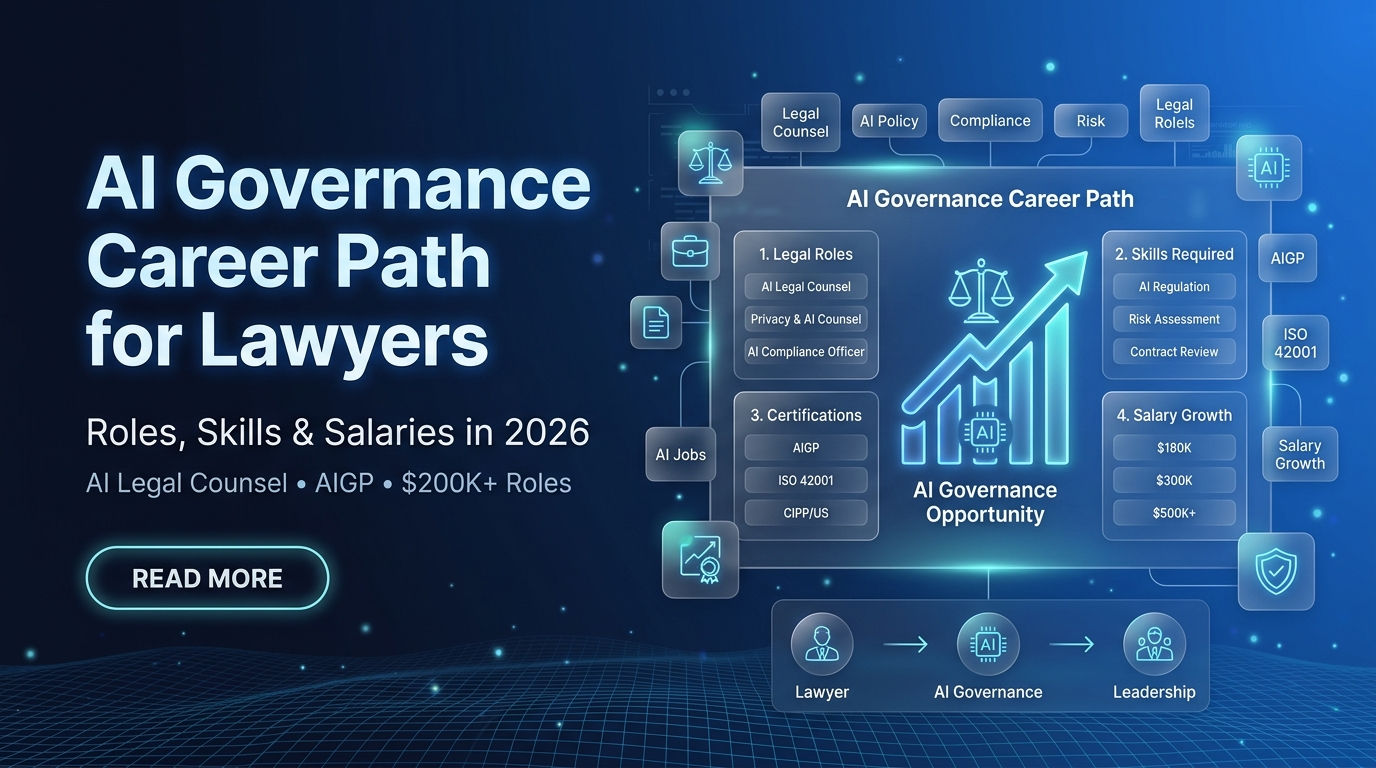
A 2024 Vanderbilt Law panel put it bluntly: the privacy team now leads AI governance inside most major U.S. companies, and every member of that team is a lawyer or works directly with one. That shift has reshaped the job market. The U.S. Bureau of Labor Statistics projects legal occupations to grow 5 percent through 2033, but the subset tied to artificial intelligence, algorithmic accountability, and AI regulation is growing far faster. Job postings mentioning AI governance on Indeed and LinkedIn more than tripled between 2023 and 2025.
For lawyers, this is one of the few areas of legal practice where demand is outpacing supply. The route in is clearer than most career guides suggest, and the compensation reflects the scarcity. This guide covers the specific roles open to attorneys, the skills and certifications that matter, realistic salary ranges in the United States, and the exact sequence most lawyers follow to make the move.
Why AI Governance Is the Fastest-Growing Legal Specialty in 2026
The acceleration has three drivers, and understanding them matters because they determine where the jobs are.
The first is regulation catching up to technology. The Colorado AI Act, effective February 2026, requires developers and deployers of high-risk AI systems to document governance practices and conduct impact assessments. At the federal level, the NIST AI Risk Management Framework has become the de facto baseline, even without binding federal legislation. The EU AI Act’s phased enforcement affects any U.S. company with European customers. Every one of these frameworks requires legal interpretation and internal policy translation, which is lawyer work.
The second driver is litigation exposure. Class actions tied to algorithmic discrimination in hiring, lending, and insurance moved from theoretical to routine between 2023 and 2025. The New York Times copyright lawsuit against OpenAI and Microsoft clarified just how much IP risk sits inside training data. General counsels who once delegated AI to IT departments now treat it as a board-level legal risk.
The third is internal structure. Fortune 500 companies are building AI governance committees, and those committees need a legal owner. At Palo Alto Networks, that owner sits in the privacy team. At NVIDIA, a dedicated “AI and Data Governance Legal Counsel” reports to the Director of Data Governance and Privacy. At McDonald’s, a Sr. Manager, AI Legal Counsel, sits in the corporate legal department. The titles vary. The function is the same: a lawyer translating regulation, risk, and policy into operational controls.
The IAPP’s 2025-26 Salary and Jobs Report surveyed more than 4,000 professionals and found AI governance had the highest year-over-year salary growth of any privacy-adjacent specialty. That number is not a projection. It reflects what the market paid in 2025.
Core AI Governance Roles Open to Lawyers in the U.S.
Most attorneys think AI governance means one job title. It does not. At least five distinct role tracks exist, and each rewards a different mix of legal experience and technical literacy.
AI Legal Counsel. The most common title. You advise product, engineering, and data teams on AI-specific legal risk, review training data licensing, negotiate AI vendor agreements, and translate emerging regulation into internal policy. Expect heavy exposure to contracts, intellectual property, privacy, and consumer protection. Most postings want five or more years of experience in privacy, tech transactions, or IP.
Privacy and AI Governance Counsel. A hybrid role that has grown faster than either standalone privacy or standalone AI counsel positions. Training Camp’s analysis of IAPP data shows professionals covering both disciplines earn a median of $169,700 in 2025, compared to $151,800 for AI governance alone. The premium reflects how often the two domains overlap in practice: any AI system processing personal data is simultaneously a privacy and an AI governance problem.
AI Compliance Officer or AI Governance Manager. Less traditional lawyer work, more program management. You own the internal AI policy, maintain the inventory of AI systems in use, coordinate impact assessments, and run the governance committee. J.D. not always required, but lawyers with a compliance background move into these roles easily and are often preferred when the company faces significant regulatory exposure.
AI Policy Counsel. Public-affairs adjacent. You draft responses to NIST consultations, engage with state attorneys general on AI enforcement priorities, contribute to industry coalition positions, and brief executives on regulatory trajectories. This role concentrates in Washington, D.C., in large tech companies, and in trade associations. It rewards a mix of substantive legal expertise and political literacy.
Chief AI Officer or VP, AI Governance (legal track). The executive path. Usually reached after 10 to 15 years combining privacy, technology transactions, and AI-specific work. The role sets enterprise AI strategy, chairs the AI risk committee, and reports to the general counsel or directly to the CEO. These roles are still being invented at most companies, which creates unusual openings for lawyers willing to define the job themselves.
Role | Typical Experience | Primary Focus | Reports To |
|---|---|---|---|
AI Legal Counsel | 3 to 8 years | Product, contracts, regulation | GC or Deputy GC |
Privacy and AI Governance Counsel | 5 to 10 years | Privacy program plus AI oversight | Chief Privacy Officer |
AI Compliance Officer | 5 to 10 years | Program, audits, documentation | Chief Compliance Officer |
AI Policy Counsel | 5 to 12 years | Regulation, advocacy, strategy | GC or Head of Policy |
Chief AI Officer or VP | 10 to 15+ years | Enterprise AI strategy | GC or CEO |
AI Governance Lawyer Salary in the United States (2026 Data)
Compensation for AI governance lawyers tracks higher than general in-house counsel averages, and the premium widens with seniority.
The IAPP’s 2025 research puts combined privacy and AI governance professionals at a median of $169,700 nationally, with AI-only roles at $151,800. Those medians cover all professionals in the category, including non-lawyers. For J.D. holders specifically, the numbers run higher because most attorneys enter the field with existing compensation benchmarks from law firm or in-house work.
Realistic U.S. salary ranges in 2026:
Role and Level | Base Salary | Total Compensation |
|---|---|---|
AI Legal Counsel, 3 to 5 years | $180,000 to $230,000 | $220,000 to $290,000 |
AI Legal Counsel, 6 to 10 years | $230,000 to $310,000 | $290,000 to $420,000 |
Senior Counsel, Privacy and AI (8 to 12 yrs) | $260,000 to $340,000 | $340,000 to $500,000 |
Managing Counsel / Director, AI Governance | $300,000 to $400,000 | $425,000 to $650,000 |
Chief AI Officer or VP, AI Governance | $350,000 to $500,000+ | $550,000 to $1M+ (heavy equity) |
Three factors drive variance within these bands. Industry is the largest: big tech (NVIDIA, Meta, Google, Microsoft) and AI-native companies (OpenAI, Anthropic, Scale) pay roughly 20 to 40 percent above the median. Financial services and healthcare follow closely because regulatory exposure is acute. Retail and consumer brands sit lower. Geography matters less than it used to because most senior AI counsel roles are hybrid or remote, but San Francisco, New York, Seattle, and D.C. still carry a clear premium. Certifications move the needle by 10 to 15 percent at entry and mid levels and flatten at senior levels where experience dominates.
PwC’s 2025 Global AI Jobs Barometer found that roles requiring AI skills command a 56 percent wage premium over similar roles without AI expertise, up from 25 percent the prior year. That premium applies to lawyers as forcefully as to technical staff.
The AIGP Certification and Other Credentials That Matter
Most lawyers moving into AI governance ask the same question first: which certification should I get? The honest answer is that certifications matter more for lawyers transitioning from unrelated practice areas than for privacy lawyers pivoting laterally. For the first group, a credential is how you signal readiness to a recruiter who has no other evidence you understand the field. For the second, your track record does most of the work.
IAPP Artificial Intelligence Governance Professional (AIGP). The most widely cited credential. Launched in 2023 by the International Association of Privacy Professionals, the AIGP validates knowledge across four domains: foundational AI concepts, applicable laws and standards (including the EU AI Act and NIST AI RMF), governance of AI development, and governance of AI deployment. The exam runs 100 multiple-choice questions over three hours. Cost is $799 for non-members, $649 for IAPP members. IAPP research shows holding one IAPP certification correlates with 13 percent higher salaries, rising to 27 percent for multiple certifications, which is why lawyers with CIPP or CIPM often add AIGP to stack the premium.
GAICC Certified AI Law and Compliance Professional. A newer, lawyer-specific credential from the Global AI Certification Council. Focuses directly on the intersection of AI regulation, compliance frameworks, and legal practice. The curriculum covers ISO/IEC 42001, the EU AI Act, NIST AI RMF, and sector-specific U.S. regulation. Valuable for lawyers who want a governance credential tailored to legal practice rather than to privacy professionals generally.
ISO/IEC 42001 Lead Implementer or Lead Auditor. The ISO/IEC 42001 standard, published in December 2023, is the first international standard for AI management systems. Lead Implementer certification demonstrates you can build an AI Management System (AIMS) inside an organization; Lead Auditor demonstrates you can evaluate one. Lawyers advising multinational clients or working in regulated industries increasingly need to read, interpret, and sometimes build to this standard. GAICC and several other bodies offer accredited programs.
CIPP/US and CIPM. Not AI-specific, but foundational. If you do not already have a privacy credential, the CIPP/US (legal and regulatory focus) is the strongest starting point. CIPM covers privacy program management and pairs well with AIGP for anyone targeting the combined privacy and AI governance track.
A practical sequence for a practicing U.S. lawyer: CIPP/US first if you lack a privacy credential, then AIGP, then ISO/IEC 42001 Lead Implementer if your work touches operational governance. Stacking all three in 18 months is realistic and costs under $5,000 in exam and membership fees.
Skills That Separate AI Governance Lawyers from General Counsel
Credentials get you the interview. What follows separates the lawyers who thrive from those who struggle.
Technical literacy without technical fluency. You do not need to code. You do need to understand the difference between a model, a system, and an application; what training data is and why its provenance matters; how fine-tuning differs from prompting; and what terms like precision, recall, and hallucination mean in context. Stanford’s executive education faculty note that lawyers who can read a model card and ask informed questions about it move faster than those who cannot. Most lawyers get here through structured courses (Stanford CodeX, MIT Professional Education, or dedicated AIGP prep) rather than self-study, because the material is easier to absorb with guided sequencing.
Regulatory fluency across jurisdictions. A working knowledge of the EU AI Act (risk categories, general-purpose AI obligations, timelines), the NIST AI RMF (Govern, Map, Measure, Manage functions), state-level AI statutes (Colorado, California, Illinois BIPA as applied to biometric AI), and sector-specific regulation (FTC enforcement posture, SEC AI disclosure guidance, HIPAA applied to health AI). None of this is optional. All of it changes quarterly.
Impact assessment design and execution. AI impact assessments (AIAs) are becoming the central document of AI governance, the way Data Protection Impact Assessments became central to privacy. You need to know how to scope one, who to interview, what to document, and how to present risk ratings to non-legal stakeholders. This is skill built through practice, not certification.
Cross-functional communication. AI governance work lives or dies on your ability to explain a legal risk to an engineer, a business outcome to an ethicist, and a technical limitation to a board. Lawyers who came up in transactional or compliance roles tend to have this already. Litigators sometimes struggle because the rhythms of adversarial argument do not transfer well to consensus-building.
Contract drafting for AI-specific risk. AI vendor contracts now routinely include model warranties, training data representations, output ownership allocations, indemnification for IP claims tied to training, and audit rights over AI systems. Sample clauses are widely available. Knowing when to push on each one, and what alternative language the other side will accept, is what separates competent from excellent.
Career Paths: How Lawyers Actually Transition Into AI Governance
There are four main entry routes. Each starts from a different place and reaches AI governance through a different bridge.
From privacy practice. The shortest path. If you have five or more years in privacy work (CIPP/US, in-house privacy counsel, or privacy-focused firm practice), the transition is mostly about adding AI-specific knowledge on top of existing regulatory and program management skills. Add AIGP, take on AI-related matters at your current employer, then move to a Privacy and AI Governance Counsel role. Timeline: 12 to 24 months.
From technology transactions or IP. The second shortest path. Tech transactional lawyers already negotiate the contracts that now carry AI-specific terms; IP lawyers already deal with the copyright and trade secret questions that dominate AI disputes. The gap is regulatory fluency. Add NIST AI RMF and EU AI Act knowledge through AIGP or a university certificate, and pitch yourself internally for AI-related work. Timeline: 12 to 30 months.
From regulatory or compliance practice. Slightly longer but very viable. Financial services, healthcare, and FTC regulatory lawyers have the compliance infrastructure thinking that AI governance requires. The gap is technical literacy and often the privacy foundation. A structured path: AIGP plus a privacy credential plus one or two AI-specific matters at your current employer, then laterally move to a role that explicitly includes AI. Timeline: 18 to 36 months.
From litigation or general practice. The longest path, but not closed. The Vanderbilt panelists cited earlier included former litigators who moved into AI policy through congressional staff roles, think tanks, and government service. For private sector AI governance specifically, a litigator usually needs a deliberate retooling: a credential, a secondment or pro bono project, ideally a stint at a government agency with AI oversight (FTC, NIST, state AG offices working on AI enforcement), and then a lateral into in-house work. Timeline: 24 to 48 months.
A pattern holds across all four paths: the lawyers who succeed build public evidence of their AI expertise before making the move. That means publishing on AI governance topics, speaking at bar association AI committees, teaching an AI law CLE, or taking on visible internal AI projects. Sean Perryman, cited in the Vanderbilt panel, framed it directly: “Write the article, speak on the thing, promote yourself in some way, because no one else is going to do that for you.”
Where the Jobs Actually Are: Industries and Employers Hiring in 2026
The concentration is clearer than most job boards suggest.
Big tech and AI-native companies. NVIDIA, Google, Meta, Microsoft, Amazon, Apple, OpenAI, Anthropic, and Scale AI employ the largest dedicated AI legal teams. Postings are consistent and roles often have “AI” directly in the title. Compensation sits at the top of the market. Competition is equally intense.
Financial services. JPMorgan Chase, Morgan Stanley, Goldman Sachs, and the major insurers (AIG, Travelers, MetLife) treat AI governance as a regulatory imperative under existing model risk management rules. Titles usually read “Counsel, AI and Model Risk” or “VP, AI Governance and Compliance.”
Healthcare and life sciences. Kaiser Permanente, UnitedHealth, and the large pharmaceutical companies (Pfizer, Merck, Johnson & Johnson) have been quietly building AI governance legal teams since 2023. Regulatory exposure under HIPAA, FDA guidance on AI-enabled medical devices, and state medical board rules drives the work.
Federal and state government. The Maryland Attorney General’s office posted an AI Strategy and Governance Manager role in 2025. Similar roles exist at the FTC, at NIST, at the Department of Commerce, and in state AG offices in California, New York, Washington, and Texas. Pay is lower than private sector but the experience is disproportionately valuable for later private moves.
Law firms. Wilson Sonsini, Cooley, Fenwick & West, Orrick, Morrison Foerster, DLA Piper, and Baker McKenzie have built AI practice groups. Partner-track positions require a portable book of AI-related matters, which is hard to build from scratch. Senior associate and counsel roles are more accessible.
Consulting firms. Deloitte, PwC, KPMG, EY, and the specialized boutiques (West Monroe, BRG) staff AI governance advisory practices that hire lawyers for their regulatory expertise. These roles move quickly into management-adjacent work, which suits lawyers who want to leave pure legal practice without leaving legal subject matter entirely.
Axial Search’s analysis of 146 AI governance job postings between November 2024 and January 2025 found California carried 14 percent of U.S. postings, New York 8 percent, and Texas 7 percent, with Washington state, Illinois, and Virginia rounding out the top six. Remote and hybrid roles now account for the majority of postings, which expands access for lawyers outside those markets.
Common Mistakes Lawyers Make When Entering AI Governance
Five mistakes appear again and again. Each is avoidable.
Waiting for the market to mature before entering. The market is already mature enough to pay $200,000+ base salaries for mid-level roles. Lawyers who wait for the field to “settle” are watching others build track records they will have to compete against later.
Over-indexing on technical certifications at the expense of legal substance. An AIGP without strong underlying regulatory and contract experience reads as thin to hiring partners and GCs. The certification is a signal, not the substance.
Treating AI governance as a pure policy exercise. The roles that exist and pay are operational. They require you to get inside actual product decisions, review actual contracts, and sit on actual risk committees. Candidates who pitch themselves as thought leaders without operational experience lose to candidates who can do both.
Ignoring sector regulation in favor of horizontal AI regulation. The EU AI Act and NIST AI RMF matter, but most AI governance lawyers spend more time on sector-specific rules (HIPAA in health, SR 11-7 in banking, FCRA in lending). Lawyers who cannot speak to the relevant sector regulation for their target industry struggle in interviews.
Failing to build public evidence. The AI governance hiring market is still small enough that reputation travels. Publishing, speaking, and visible internal work compound over 18 to 24 months into a signal that recruiters seek out rather than screen.
Conclusion
AI governance is the rare legal specialty where regulation, business demand, and lawyer supply are all moving in the same direction at once. The roles exist. The compensation is real. The entry paths are accessible to privacy lawyers, technology transactional lawyers, regulatory specialists, and, with more deliberate retooling, to litigators. What the market rewards is the combination of legal substance, technical literacy, operational credibility, and visible track record.
The single most useful action a lawyer can take this quarter is to pick one credential (AIGP is the most common starting point), one writing or speaking output, and one AI-related matter inside their current role, and pursue all three in parallel. The lawyers who do this consistently over 12 to 18 months are the ones whose LinkedIn profiles recruiters circle.
If you want a structured path into AI governance with a credential that speaks directly to legal practice, explore the GAICC Certified AI Law and Compliance Professional program and ISO/IEC 42001 training built for lawyers and compliance professionals serious about this specialty.
Frequently Asked Questions (FAQs)
1. Do I need a technical or computer science background to become an AI governance lawyer?
No. The overwhelming majority of AI governance lawyers in the U.S. have no coding background. What you need is enough technical literacy to read a model card, understand the difference between training and inference, and ask informed questions of engineers. Most lawyers reach that level through structured courses like AIGP prep, Stanford’s Executive Education programs, or MIT’s AI for legal professionals offerings within 60 to 90 days of focused study.
2. How much does the AIGP certification cost and is it worth it for a lawyer?
The AIGP exam costs $649 for IAPP members and $799 for non-members, with total investment including study materials typically $900 to $3,500. For lawyers transitioning from unrelated practice areas, it is worth it as a credibility signal and typically pays back within the first salary negotiation. For privacy lawyers with five-plus years of experience, the credential is helpful but not transformative, and your track record will carry more weight.
3. What’s the difference between an AI Legal Counsel and an AI Compliance Officer?
AI Legal Counsel is a legal role: you provide legal advice, interpret regulation, draft contracts, and manage legal risk on AI matters. AI Compliance Officer is a program management role: you own the internal AI policy, run the governance committee, and ensure operational adherence. Lawyers hold both roles, but the counsel role requires bar admission and applies attorney-client privilege to the work. The compliance role is structured as business rather than legal, which changes reporting lines, privilege, and day-to-day activity.
4. Can I move into AI governance from litigation?
Yes, but it is the longest path. Litigators typically need to retool through a credential, visible non-litigation work (publishing, committee service, secondments), and often a government or agency stint before moving to private-sector AI governance. Expect a 24 to 48 month transition. The good news is that litigation skills translate well to enforcement-facing roles at the FTC, state attorneys general, and public-interest organizations doing AI accountability work.
5. What’s the salary difference between U.S. and remote international AI governance roles?
U.S.-based AI governance lawyers in 2026 earn roughly 30 to 50 percent more than equivalent roles in the UK, 60 to 100 percent more than in Australia or Canada, and multiples higher than Asian markets outside Singapore and Hong Kong. For U.S. lawyers, the practical implication is that remote roles with U.S. companies nearly always pay better than relocating abroad, even after cost of living adjustments.
6. How do I signal AI governance expertise if I don’t have the title yet?
Three concrete moves. First, publish one serious piece of analysis on a current AI regulation question (the Colorado AI Act, the EU AI Act implementation timeline, FTC AI enforcement) on LinkedIn, a firm blog, or a bar association publication. Second, take a visible role in an AI-related bar committee or industry working group. Third, negotiate into an AI-adjacent matter at your current firm or company, even pro bono, so you can speak to real facts in interviews. These three steps, done over six to twelve months, shift how recruiters read your profile.
7. Which industries pay AI governance lawyers the most in 2026?
Big tech and AI-native companies pay at the top, followed by financial services (particularly investment banks and quantitative funds), then healthcare (large integrated health systems and pharmaceutical companies). Consulting firms offer compressed compensation but faster advancement. Government pays 30 to 50 percent below the private-sector median but offers experience that commands a premium on later private moves.