
By mid-2026, the EU AI Act will hit full enforcement for high-risk systems, Colorado’s AI Act takes effect on February 1, 2026, and Texas, California, and New York already have AI-specific laws on the books. For lawyers in the United States, this is no longer a theoretical governance problem. Clients are asking hard questions about AI procurement, deployment, and liability, and firms are being asked to certify their own AI management practices.
Two credentials keep surfacing in that conversation: the IAPP’s AIGP (Artificial Intelligence Governance Professional) and certifications tied to ISO/IEC 42001, the international standard for AI management systems. They are not the same thing, they do not serve the same purpose, and picking the wrong one will cost a lawyer time, money, and positioning. This guide settles the question.
The Short Answer
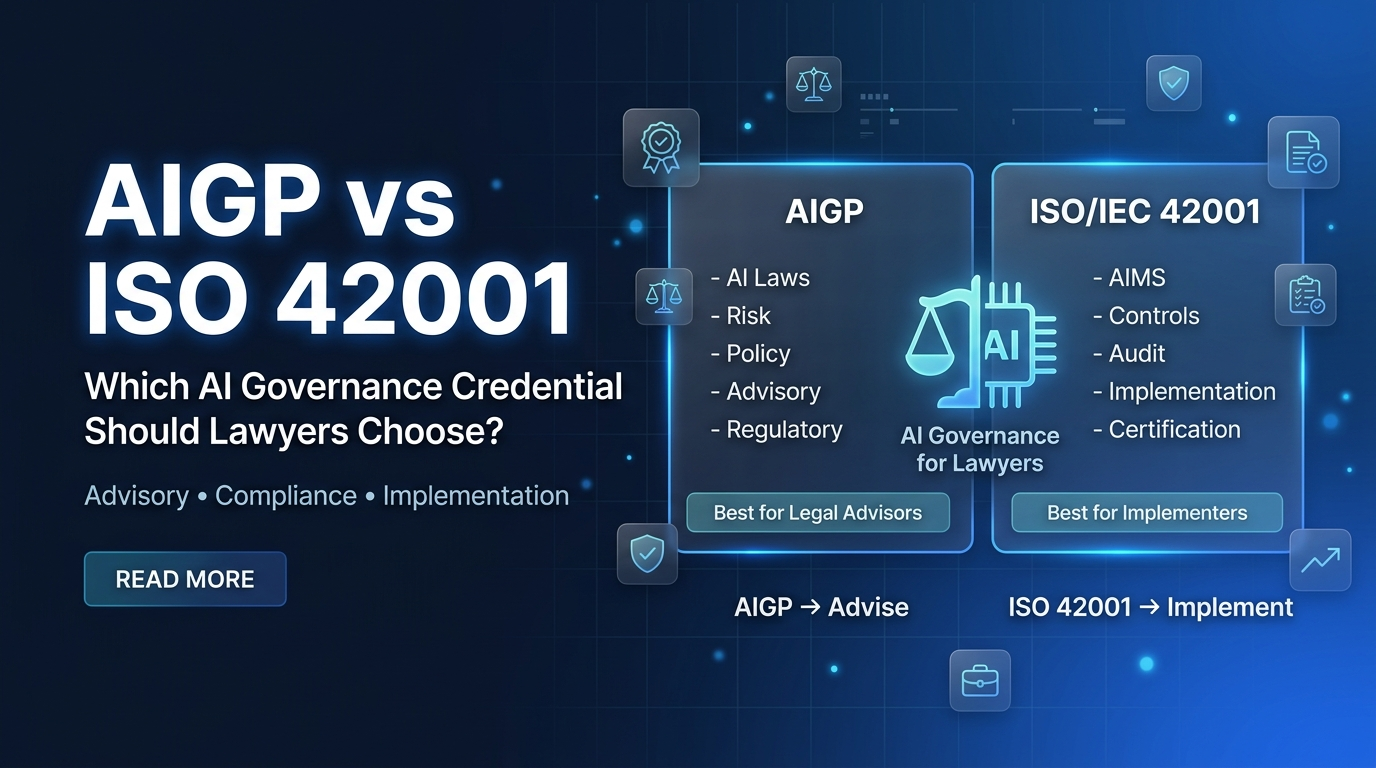
If you are a lawyer who advises clients on AI, the AIGP is almost always the first credential to pursue. It is built around laws, regulatory frameworks, and risk, which is the work lawyers actually do. ISO/IEC 42001 certifications, including Lead Implementer and Lead Auditor, become essential the moment you step into an operational role: building an AI management system inside a law firm, advising corporate clients on certification, or auditing AIMS programs for third parties.
| The honest split AIGP teaches you to advise. ISO/IEC 42001 teaches you to implement. The strongest lawyers in this field will hold both within 24 months, but the order matters, and so does the ROI on each. |
What AIGP and ISO/IEC 42001 Actually Are
Before comparing them, it helps to be precise about what each one is, because the two are often discussed as if they occupy the same shelf. They do not.
AIGP: A personal credential for governance advisors
The Artificial Intelligence Governance Professional certification is issued by the International Association of Privacy Professionals (IAPP), launched in March 2024. It is accredited under ISO 17024, meaning it is a recognized personal competency certification. The exam tests four domains: AI foundations, laws and standards (including the EU AI Act, NIST AI RMF, and ISO/IEC 42001 itself), governing AI development, and governing AI deployment.
There are no formal prerequisites. The exam runs 100 questions over three hours, priced at $550 for IAPP members and $750 for non-members. Certification lasts two years and requires 20 CPE credits for renewal. The audience is explicitly cross-disciplinary, but IAPP’s own materials name privacy officers, compliance teams, and legal professionals as core targets.
ISO/IEC 42001: A standard, plus a family of related credentials
ISO/IEC 42001:2023 is not a certification you sit for. It is an international standard published by ISO and IEC in December 2023 that specifies how an organization builds an AI Management System (AIMS). Think of it as the AI-specific sibling of ISO 27001 for information security or ISO 9001 for quality. The standard itself applies to organizations, not individuals.
What individuals get certified in are the roles that implement and audit an AIMS: Foundation, Lead Implementer, Internal Auditor, and Lead Auditor being the most common tiers. Training typically runs 4 days for Lead Implementer level, with 32 CPD hours and a 90-minute exam. Validity is usually three years with continuing education required for renewal.
In April 2026, K&L Gates became one of the first major law firms to achieve ISO/IEC 42001:2023 organizational certification, following earlier certifications of legal tech vendors like Jus Mundi and top.legal. The market for lawyers who can guide firms and clients through that process is real and still shallow.
AIGP vs ISO/IEC 42001: Side-by-Side
Comparisons tend to treat these as competing options. They are not. But the differences matter, and this is the clearest way to see them.
| Dimension | AIGP (IAPP) | ISO/IEC 42001 Lead Implementer |
|---|---|---|
| What it certifies | Individual competence in AI governance principles, laws, and frameworks | Individual competence to implement an AIMS in an organization per ISO/IEC 42001 |
| Issuing body | IAPP (ANSI/ISO 17024 accredited) | Various accredited training bodies, including GAICC, PECB, DNV, SGS |
| Primary orientation | Advisory and regulatory | Operational and implementation |
| Prerequisites | None | Typically a degree and 1–3 years of relevant experience |
| Exam format | 100 MCQs, 3 hours, online or Pearson VUE | 60–80 MCQs and scenarios, 90 minutes, online proctored |
| Typical cost (USD) | $550 member / $750 non-member | $299–$875 exam; training often $1,500–$3,500 |
| Study time | 40–60 hours self-study or 13-hour IAPP course | 30–40 hours plus 4-day instructor-led training |
| Validity | 2 years (20 CPE credits to renew) | 3 years (40 CPD hours to renew) |
| Best fit for lawyers | GC, privacy counsel, AI policy advisors, outside counsel advising on AI | In-house AI compliance leads, firm AIMS owners, legal-tech consultants |
The sharpest distinction: AIGP teaches you the regulatory map. Lead Implementer teaches you how to build the machine that keeps an organization compliant with that map. A general counsel rarely needs the second. A head of AI compliance at a Fortune 500 almost certainly does.
Why Lawyers Specifically Are Asking This Question
A few years ago, AI governance sat at the fringes of the legal profession. That has changed fast. Three pressures are pushing lawyers toward formal credentials, and understanding them changes how you should think about certification ROI.
Client demand is sharper than the statistics suggest
In-house legal teams are now being asked to evaluate AI vendors under procurement frameworks that did not exist in 2023. Microsoft’s SSPA program now requires ISO/IEC 42001 certification for AI systems in Sensitive Use categories. Enterprise clients increasingly use ISO/IEC 42001 compliance as a screening criterion during legal-tech selection. If you cannot speak fluently about what a Statement of Applicability looks like under Annex A, you will lose that conversation to someone who can.
The ABA’s duty of competence applies to AI
ABA Formal Opinion 512, issued in July 2024, put the duty of technological competence squarely on generative AI use by lawyers. A growing number of state bars, including California, Florida, and New York, have issued parallel guidance. The underlying principle: if you practice AI law or use AI in legal work, you are obligated to understand it well enough to manage the risks.
Neither AIGP nor ISO/IEC 42001 is required to meet this duty. But both are the most concrete way a lawyer can demonstrate that competence in writing.
US regulation is fragmenting, fast
The federal picture is still sparse, but states are not waiting. Colorado’s AI Act takes effect February 1, 2026, creating specific obligations for developers and deployers of high-risk AI. Texas HB 149 imposes similar requirements. California SB 942 (AI Transparency Act) and New York’s automated employment decision tool law are already live. A lawyer who understands the NIST AI RMF and ISO/IEC 42001 has the vocabulary to harmonize compliance across all of them. A lawyer who only knows one state’s rules will burn hours reinventing analysis for every new jurisdiction.
AIGP: What It Gives Lawyers
For most US lawyers entering AI governance, AIGP is the first credential worth pursuing. Here is what it actually delivers, beyond the line on a LinkedIn profile.
A working vocabulary across the whole regulatory stack
The AIGP Body of Knowledge covers the EU AI Act, NIST AI RMF, ISO/IEC 42001, and OECD AI Principles in enough depth that you can counsel clients on overlap and conflict between them. When a CTO asks whether complying with NIST automatically satisfies the EU AI Act, the AIGP holder should know the answer is no, and why. That kind of fluency is what wins the engagement.
A credential that travels across client engagements
AIGP is portable in a way ISO credentials are not. An outside counsel advising six clients across finance, healthcare, and SaaS does not implement an AIMS for any of them. What that lawyer needs is a common regulatory framework to apply across all six. AIGP is built for exactly that use case.
Realistic salary and positioning data
The IAPP’s 2025 Salary and Jobs Report puts the US national average for AIGP holders between $141,000 and $170,000, with a median near $151,800. Experienced AI governance professionals report ranges of $150,000 to $250,000. For a mid-career associate or senior counsel, adding AIGP can support a billable rate premium or unlock specialist roles at AmLaw 100 firms. Angela Doughty at Ward and Smith and Harvey Ahn at McNees Wallace & Nurick are among the named examples of attorneys who earned AIGP early and built visible AI governance practices around it.
Who should probably skip it
Transactional lawyers who touch AI only in occasional vendor agreements, and litigators who handle general commercial disputes, will find the AIGP’s depth disproportionate to the work. A CLE on AI basics and Bloomberg Law’s AI tracker will go further for less effort. AIGP pays off when AI governance is a meaningful, repeating part of the practice.
ISO/IEC 42001 Certifications: What They Give Lawyers
Lawyers often assume ISO/IEC 42001 is an engineering concern. That view is outdated. The standard is explicit that AIMS implementation requires a multidisciplinary team, including legal, privacy, risk, and compliance. Certification at Foundation, Lead Implementer, or Lead Auditor level gives lawyers a specific operational role in that work.
Foundation: For lawyers who want to understand what clients are doing
The Foundation-level certification is a lighter, usually 2-day track aimed at understanding the standard’s structure, terminology, and core requirements. For lawyers drafting AI contracts, responding to procurement questionnaires, or advising on M&A transactions involving AI-heavy targets, Foundation gives you enough context to read a Statement of Applicability without calling an engineer. This is often the right starting point after AIGP.
Lead Implementer: For lawyers building the AIMS
Lead Implementer certification is the operational credential. It teaches you how to conduct gap analysis, draft AI policies, map Annex A controls, run AI impact assessments, and prepare an organization for third-party audit. For a general counsel at a firm that wants ISO/IEC 42001 certified status, or for in-house counsel at a company pursuing certification, this is the training that matches the work. K&L Gates did not get certified by luck. Someone inside the firm did the Lead Implementer-level work.
Lead Auditor: For lawyers who want to audit AIMS
Lead Auditor training targets external and internal auditors who assess conformity to the standard. For lawyers, this is a niche but valuable specialization. Boutique AI governance consultancies and audit firms are actively recruiting lawyers with auditor credentials, particularly those who can bring legal judgment to Annex A control assessments. Expect higher fees for this work and a much smaller pool of qualified competitors.
A Decision Framework for US Lawyers
The easiest way to pick is to be honest about the work you expect to do in the next 18 months. Match the credential to the work, not the other way around.
| Your likely work in the next 18 months | Start with | Add next (within 12–24 months) |
|---|---|---|
| Advising corporate clients on EU AI Act, NIST AI RMF, state AI laws | AIGP | ISO/IEC 42001 Foundation |
| Privacy counsel expanding into AI governance | AIGP | ISO/IEC 42001 Foundation or Lead Implementer |
| Leading AI governance inside a law firm or in-house team | ISO/IEC 42001 Lead Implementer | AIGP |
| Building a legal-tech product pursuing ISO/IEC 42001 certification | ISO/IEC 42001 Lead Implementer | AIGP |
| AI-focused M&A or IP diligence work | AIGP | ISO/IEC 42001 Foundation |
| External auditor or AI governance consultant | ISO/IEC 42001 Lead Auditor | AIGP |
| Occasional AI vendor contract review only | Neither; a strong CLE is sufficient | Revisit in 12 months as practice grows |
One scenario worth flagging separately: lawyers who advise on AI procurement from the buy side. Here, AIGP plus Foundation-level ISO/IEC 42001 knowledge is often the best combination. You are not building the AIMS, but you need enough fluency to interrogate a vendor’s Statement of Applicability, evaluate claims of ISO/IEC 42001 conformity, and advise on contractual representations.
Cost, Time, and Realistic ROI
The raw costs are easy to compare. What matters more is the ratio of investment to positioning, because an underused credential is just a line item.
| Path | Direct Cost (USD) | Study / Training Time | Break-even for most lawyers |
|---|---|---|---|
| AIGP only | $750–$1,200 (exam + optional training) | 40–60 hours | 1–2 engagements where the credential shifts the conversation |
| ISO/IEC 42001 Foundation | $600–$1,500 | 16–24 hours | Typically pays back on first AI vendor contract reviewed |
| ISO/IEC 42001 Lead Implementer | $1,500–$3,500 | 30–40 hours plus 4-day course | One serious AIMS implementation project |
| AIGP + Lead Implementer (full stack) | $2,500–$4,500 | 80–100 hours total | A repositioned practice: higher rates, named specialization |
Two qualifiers on ROI. First, certifications price into your rate only if you market them. A lawyer who earns AIGP and never updates the firm bio or pitches AI governance work to existing clients will see no return. Second, timing matters. AI governance is an emerging practice, which means early credential holders get the anchor client relationships that later entrants have to fight for. The IAPP reported over 4,000 professionals in AIGP training within months of launch. The window where the credential itself is differentiating will not stay open forever.
The Stacking Strategy Most Senior Lawyers Follow
The lawyers who have built visible AI governance practices in the US did not pick one credential and stop. The pattern, observed across firms like K&L Gates, Cooley, and Orrick, looks roughly like this:
- AIGP first, usually within 3–6 months of deciding AI governance is a focus area. This builds the regulatory vocabulary.
- ISO/IEC 42001 Foundation or Lead Implementer within the next 12 months, depending on whether the work is advisory or operational.
- Specialization credentials where relevant, such as Lead Auditor for audit-focused practices, or the Certified AI Law & Compliance Professional track for litigation and enforcement work.
- Adjacent standards like ISO/IEC 27001 and ISO/IEC 27701, because most corporate AI governance work sits on top of existing information security and privacy programs.
This stack takes roughly 18–24 months to complete and positions the lawyer as a credible advisor across the full lifecycle: regulatory analysis, AIMS implementation, audit readiness, and incident response.
Mistakes Lawyers Make When Choosing
Having watched the first cohort of US lawyers move through this decision, a few patterns stand out as consistently expensive.
Treating ISO/IEC 42001 as a technical credential
The standard’s language is conservative, not technical. The hardest chapters, Context of the Organization, Risk Assessment, and AI Impact Assessment, are analytically closer to legal work than to engineering. Lawyers who assume they will struggle usually do better on the exam than engineers, because the standard rewards structured reasoning over implementation detail.
Buying the credential before clarifying the target practice
Certification is a tool. Without a defined practice area and a marketing plan, it is a plaque. The lawyers who see measurable ROI spent the first month mapping the two or three client problems they intend to solve before they booked the exam.
Ignoring the employer’s procurement lens
If your firm has clients that are pursuing ISO/IEC 42001 certification, the partner conversation is often easier if you hold a recognized credential tied to that standard. AIGP signals breadth, ISO/IEC 42001 credentials signal depth. Partners running procurement or RFP responses care about both, but for different reasons.
Over-relying on self-study for the ISO track
The Lead Implementer exam expects scenario-based application, and most lawyers benefit from the 4-day instructor-led course. AIGP, by contrast, is more forgiving of structured self-study using the IAPP Body of Knowledge and a good textbook.
Frequently Asked Questions
1. Do US lawyers need AIGP or ISO/IEC 42001 to practice AI law?
A. No. Neither is required by any US bar. Both are professional credentials that signal competence to clients, employers, and referral sources. Their value is market positioning and client trust, not licensure. For lawyers whose practice is moving meaningfully into AI governance, at least one is becoming table stakes.
2. Is AIGP recognized in the United States specifically?
A. Yes. AIGP is issued by the IAPP, a US-headquartered organization, and is ANSI-accredited under ISO 17024. It is the most widely recognized personal AI governance credential in the US market, cited by law firms, Fortune 500 compliance teams, and AmLaw 100 announcements throughout 2024 and 2025.
3. Can a lawyer sit for the ISO/IEC 42001 Lead Implementer exam without a technical background?
A. Yes, and many do. The exam tests understanding of the management system standard, not AI model development. Legal reasoning skills map cleanly to the standard’s structure, particularly Clauses 4–10 and Annex A controls. Lawyers with privacy or compliance backgrounds usually find the material familiar in form.
4. How does ISO/IEC 42001 relate to the EU AI Act and NIST AI RMF?
A. ISO/IEC 42001 provides a certifiable management system framework, the EU AI Act is a binding law with penalties, and the NIST AI RMF is a voluntary US risk framework. Organizations typically use ISO/IEC 42001 to operationalize compliance with the EU AI Act and align with NIST AI RMF principles. AIGP covers how these three interact, which is one of the reasons it is a strong starting credential.
5. Which certification is better for in-house counsel at a tech company?
A. Usually AIGP first, followed by ISO/IEC 42001 Lead Implementer if the company is pursuing certification or has a maturing AI governance program. The combination lets in-house counsel both advise on regulatory obligations and participate meaningfully in AIMS implementation alongside engineering and security teams.
6. How often do these certifications need renewal?
A. AIGP requires renewal every two years with 20 Continuing Privacy Education credits. ISO/IEC 42001 Lead Implementer is typically valid for three years, with 40 CPD hours needed for renewal. Both recertification cycles are lighter than the initial exam effort, but they do require ongoing professional development.
7. Should I get AIGP or wait for something more specifically aimed at lawyers?
A. IAPP launched AIGP specifically to be a cross-disciplinary credential covering legal, compliance, and technical governance. More legal-specific programs exist, including GAICC’s Certified AI Law & Compliance Professional, but AIGP remains the most widely recognized baseline. Waiting rarely pays off in an emerging market.
The Bottom Line
The real question is not AIGP vs ISO/IEC 42001. It is which credential matches the work you actually do for clients in the next 18 months. Advisors should start with AIGP. Implementers and in-house AI governance leads should start with ISO/IEC 42001 Lead Implementer. Everyone serious about this practice should eventually hold both.
The most useful next step is a 60-minute audit of your last ten matters. How many touched AI governance in a material way? If the answer is three or more, the certification math works, and the lawyers who move first will be the ones named in the trade press by 2027.
| Ready to build your AI governance credentials? If ISO/IEC 42001 is the direction that fits your practice, GAICC’s Foundation, Lead Implementer and specialty legal tracks are built specifically for this transition. Explore the training paths to see which stage fits you today. |