
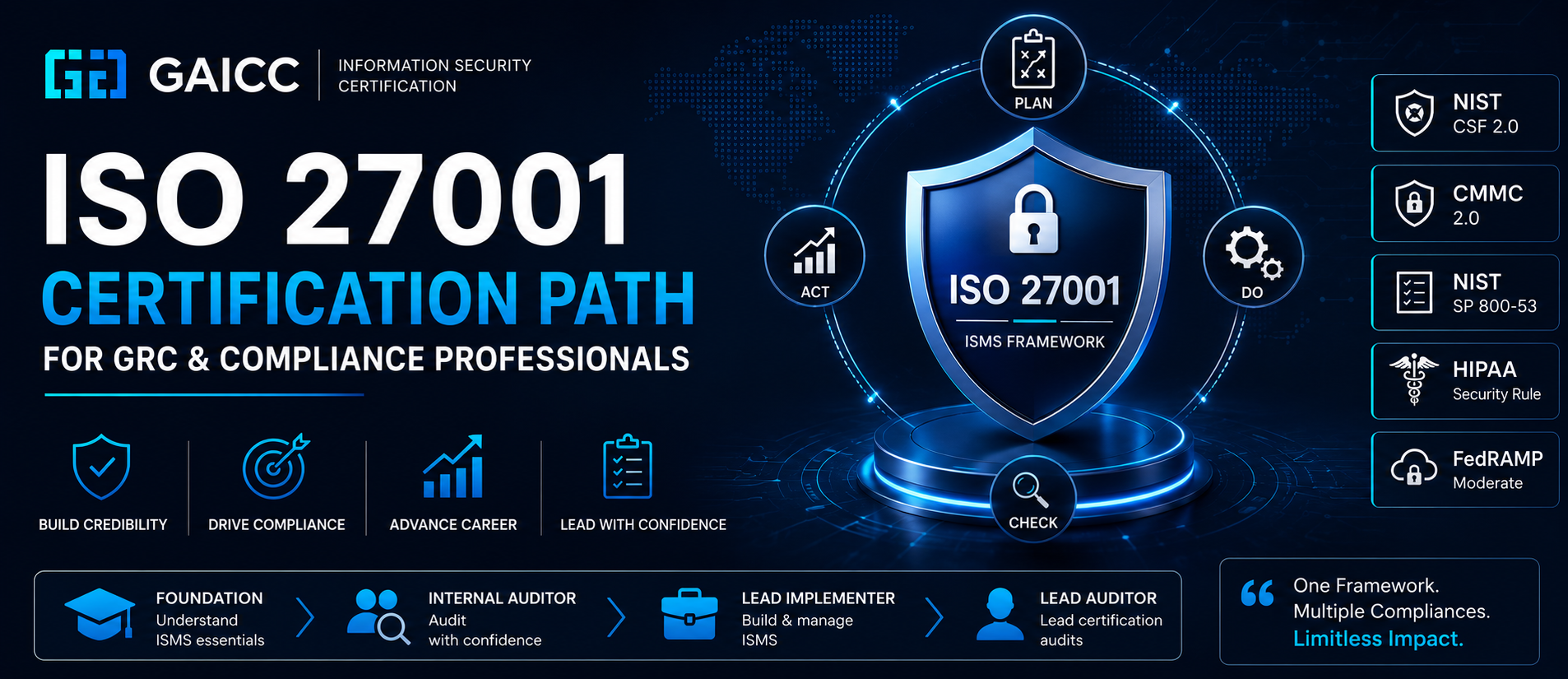
Federal contractors are scrambling. With CMMC 2.0 enforcement now underway and NIST CSF 2.0 reshaping how organizations document risk, compliance teams across the US are realizing that a checklist-based approach to information security no longer holds. ISO 27001:2022 certification has moved from “nice to have” to a credible differentiator and for GRC and compliance professionals, the right credential tier can determine whether you lead that effort or support it from the sidelines.This guide walks through the ISO 27001 certification pathway specifically for US-based GRC, compliance, and information security professionals: which credential fits your role, how the ISMS framework maps to the regulatory landscape you already work in, and what a realistic preparation timeline looks like.
What ISO 27001 Actually Certifies and Why It Matters for GRC Roles
ISO/IEC 27001:2022 is the international standard for Information Security Management Systems (ISMS). Unlike point-in-time security assessments, an ISMS is a living governance framework it defines how an organization identifies information security risks, implements controls, monitors performance, and drives continual improvement through the PDCA (Plan-Do-Check-Act) cycle.
For GRC professionals, this framing is immediately familiar. An ISMS is, at its core, an enterprise risk management structure applied specifically to information security. Clause 6 of ISO 27001 dedicated to risk planning mirrors the risk identification and treatment logic embedded in NIST SP 800-53 and the NIST Cybersecurity Framework. Annex A of the 2022 revision reorganized its 93 controls into four categories: Organizational, People, Physical, and Technological. That restructuring brought it closer in structure to NIST CSF 2.0’s six functions and made cross-framework mapping considerably cleaner.
The practical upshot: ISO 27001 is not a parallel track to the frameworks US compliance teams already use. It is a management system standard that wraps around them. A well-implemented ISMS becomes the governance layer through which NIST, CMMC, HIPAA, and FedRAMP controls are owned, documented, and continuously maintained.
The ISO 27001 Credential Tiers: Matching the Certification to Your Role
The ISO 27001 credential ecosystem follows a three-tier structure that mirrors how security governance actually works inside organizations. Choosing the wrong tier is a common mistake and an expensive one.
| Credential Tier | Core Function | Best Suited For | Exam Format |
|---|---|---|---|
| Foundation | Understand ISMS concepts, clauses, and terminology | Compliance analysts, GRC coordinators, junior auditors | Multiple-choice, 60 min |
| Internal Auditor | Plan and execute internal ISMS audits; assess conformance | Internal audit leads, compliance managers, risk officers | Multiple-choice + scenario-based, 90 min |
| Lead Implementer | Design, implement, and manage a complete ISMS | CISO, security program managers, GRC directors | Scenario-based, 90 min |
| Lead Auditor | Lead Stage 1 and Stage 2 certification audits for third parties | External auditors, certification body professionals | Scenario-based, 90 min |
The Foundation tier is the entry point useful for building shared vocabulary across a compliance team, but not a standalone career credential. The real professional value starts at Internal Auditor level, where the competency shifts from understanding the standard to applying it against real controls.
Lead Implementer is the most common target for senior GRC professionals in the US. The credential validates your ability to conduct a gap analysis, design the ISMS scope and policies, select controls from Annex A, build a Statement of Applicability (SoA), and manage the full PDCA cycle. For anyone whose role involves building or owning a compliance program rather than auditing one this is the appropriate level.
Lead Auditor is a distinct credential aimed at professionals who conduct third-party certification audits. It requires understanding ISO 19011 audit methodology in detail and is typically pursued by consultants or those working within certification bodies.
Compliance professionals evaluating different credential levels can compare the complete ISO 27001 certification path for information security professionals to choose the right certification based on career goals.
How ISO 27001 Maps to the US Regulatory Landscape
One of the most underappreciated aspects of ISO 27001 is how efficiently it creates compliance coverage across multiple US frameworks simultaneously. Organizations that build a conformant ISMS are not starting from zero on NIST, CMMC, or HIPAA they are building a governance structure that accommodates all of them.
| US Framework / Regulation | ISO 27001 Alignment | Key Mapping Points |
|---|---|---|
| NIST CSF 2.0 | High structural overlap | CSF Govern function maps to Clauses 4-6; Identify/Protect/Detect map to Annex A control families |
| NIST SP 800-53 Rev. 5 | Controls-level alignment | Annex A’s 93 controls address the majority of 800-53 control families; gaps in PE and SA controls |
| CMMC 2.0 Level 2 | Strong alignment via NIST 800-171 | ISO 27001 ISMS provides the governance layer; 110 NIST 800-171 practices map well to Annex A |
| HIPAA Security Rule | Partial-to-strong alignment | Annex A controls address administrative, physical, and technical safeguard categories |
| FedRAMP Moderate | Partial alignment | ISO 27001 ISMS framework supports continuous monitoring requirements; FedRAMP has additional specifics |
| SOC 2 Type II | Complementary | ISO 27001 SoA and risk treatment plans serve as evidence for Trust Services Criteria |
This multi-framework efficiency is precisely why ISO 27001-certified GRC professionals command a premium in federal contractor environments, healthcare organizations, and financial services firms. The credential signals not just knowledge of a standard, but the ability to build compliance infrastructure that works across regulatory obligations simultaneously.
CMMC 2.0 deserves specific attention here. For defense contractors pursuing Level 2 certification, an ISO 27001-based ISMS provides the documented management system evidence that CMMC assessors expect to see. The 110 practices from NIST SP 800-171 align closely with Annex A controls, and the ISMS’s risk assessment and treatment methodology directly satisfies CMMC’s requirement for a documented risk management process.
ISO 27001 Lead Implementer: What the Certification Actually Requires
The Lead Implementer credential is where most senior GRC professionals land, and it is worth understanding exactly what the certification tests because the exam is scenario-heavy, not definitional.
The core competency being assessed is your ability to apply ISO 27001’s requirements to realistic organizational scenarios. That means:
Risk assessment and treatment methodology. You need to understand how to conduct an information security risk assessment under ISO 27005, define risk criteria, evaluate risks against those criteria, and select appropriate treatment options (accept, transfer, mitigate, avoid). The exam will present scenarios where you must choose the correct risk treatment approach given organizational context.
Scope definition. Defining the ISMS scope (Clause 4.3) is more nuanced than it appears. Exam scenarios will test whether you understand how to exclude organizational units, systems, or processes from scope and the conditions under which exclusions are valid.
Statement of Applicability. The SoA is the central output of the control selection process. You must know which Annex A controls apply to a given organizational context, how to document applicability decisions, and how to handle controls that are not applicable.
Stage 1 and Stage 2 audit preparation. While Lead Auditor credentials go deeper on audit methodology, Lead Implementers must understand what auditors look for during both stages including the types of nonconformities that generate major versus minor findings.
Continual improvement. Clause 10 requirements particularly nonconformity management and corrective action appear regularly in exam scenarios. The PDCA cycle is not just a concept; you need to demonstrate how improvement cycles function in practice.
| Exam Structure at a GlanceThe GAICC ISO 27001 Lead Implementer exam consists of 60 multiple-choice and scenario-based questions delivered over 90 minutes via the GAICC Online Testing Platform. Passing score is typically 70%. One free retake is available if needed. |
GRC teams responsible for internal compliance checks can strengthen their audit capabilities with the ISO 27001 Internal Auditor Certification and learn how to evaluate ISMS effectiveness.
Realistic Preparation Timeline for Working GRC Professionals
Most candidates who approach this exam with existing GRC or compliance experience need 6-10 weeks of structured preparation not the 3-4 months often cited for candidates without a security background. The difference is context: if you already work with risk registers, control frameworks, and audit evidence, the conceptual overhead is substantially lower.
Here is a realistic preparation breakdown:
| Phase | Duration | Focus Areas | Study Hours |
|---|---|---|---|
| Foundation Building | Weeks 1-2 | ISO 27001 clause structure, PDCA, ISMS scope and context (Clauses 4-6) | 10-12 hrs |
| Core Implementation Competencies | Weeks 3-5 | Risk assessment (ISO 27005), Annex A controls, SoA development, treatment plans (Clauses 6-8) | 18-22 hrs |
| Operations and Performance | Weeks 6-7 | Internal audit planning, performance metrics, nonconformity management (Clauses 9-10) | 12-14 hrs |
| Exam Preparation | Weeks 8-10 | Scenario-based practice questions, cross-framework mapping, mock exams | 14-18 hrs |
A few practical notes from candidates who have completed this process: the scenario-based questions are harder than they look. Many scenarios present two answers that are both technically correct under the standard the question is which is correct given the specific organizational context described. Preparation that focuses only on clause memorization will underperform against exam scenarios that require applied judgment.
US regulatory context actually helps here. GRC professionals who have worked through NIST 800-53 risk assessments or CMMC gap analyses already understand how to evaluate controls against organizational risk profiles. That applied judgment translates well to ISO 27001 exam scenarios.
Credential Stacking: ISO 27001 Alongside CISSP, CISM, and CISA
The credential stacking question comes up constantly in GRC career planning, and the answer depends on what you are trying to demonstrate.
CISSP and CISM are breadth credentials they validate comprehensive knowledge across multiple security domains. ISO 27001 Lead Implementer is a depth credential it validates your ability to implement a specific management system framework. They are not competing credentials; they serve different purposes on a resume and in a role.
The combination that tends to generate the most career leverage in the US market is CISSP or CISM plus ISO 27001 Lead Implementer. The broad credential establishes security credibility; the implementation credential demonstrates you can translate that knowledge into a functioning compliance program. For organizations pursuing ISO 27001 certification, a GRC professional holding both is immediately deployable as the project lead.
CISA holders are a natural fit for ISO 27001 Internal Auditor certification. The audit methodology skills from CISA risk-based audit planning, evidence evaluation, finding classification map directly to what the Internal Auditor credential requires. Adding it creates a clear professional positioning: an auditor who can evaluate ISMS conformance, not just general IT controls.
One important distinction: ISO 27001 certifications are credential-based and do not require annual CPE maintenance in the same way ISACA credentials do. GAICC certifications are valid for three years and renewed through CPD hours a lower maintenance burden than maintaining CISM or CISA annual requirements simultaneously.
Career Trajectory and Salary Impact in the US Market
The salary data on ISO 27001 credentials in the US is harder to isolate than most job boards suggest, because the credential rarely appears alone. What the market actually prices is the combination of experience, seniority, and credentials with ISO 27001 acting as a differentiator at the mid-to-senior level.
That said, current market data reflects consistent salary premiums for roles that list ISO 27001 implementation experience as a requirement:
| Role / Level | Median US Salary | ISO 27001 Premium | Common Industries |
|---|---|---|---|
| GRC Analyst (3-5 yrs) | $85,000 – $105,000 | +$8,000 – $15,000 | Financial services, healthcare, tech |
| Compliance Manager (5-8 yrs) | $110,000 – $140,000 | +$12,000 – $20,000 | Defense contractors, FedRAMP orgs |
| ISMS Lead / Security Program Manager | $130,000 – $165,000 | +$15,000 – $25,000 | Federal agencies, large enterprises |
| CISO / VP Information Security | $180,000 – $240,000+ | Credential expected at this level | All regulated industries |
Defense and federal contracting sectors show the strongest premium. CMMC 2.0 enforcement has created acute demand for professionals who can document and maintain ISMS-level compliance programs, and supply remains limited. Healthcare particularly organizations under OIG scrutiny or preparing for OCR HIPAA audits is the second-strongest market, followed by financial services firms navigating SEC cybersecurity disclosure rules.
Remote work has also shifted the geographic calculus. A GRC professional with ISO 27001 Lead Implementer certification is no longer constrained to metro areas. Remote ISMS management roles at defense contractors and healthcare systems are increasingly common, and the compensation in those roles reflects the same premium as on-site positions.
Common Pitfalls When Pursuing ISO 27001 Certification
Several patterns consistently derail GRC professionals who approach this certification without the right preparation strategy.
Treating Annex A as a checklist. This is the single most common mistake. Annex A’s 93 controls are not a requirements list they are a reference set. The ISMS risk assessment process determines which controls are applicable, and the SoA documents those decisions with justification. Exam scenarios specifically test whether candidates understand this distinction. Candidates who memorize the 93 controls without understanding how they are selected will struggle with scenario questions about control applicability.
Skipping ISO 27005. The risk assessment methodology in ISO 27005 underpins the entire Lead Implementer exam. Many preparation courses focus primarily on the main ISO 27001 clauses and treat risk methodology as secondary content. That is backwards in both the exam and in real ISMS implementation, the risk assessment is where the substantive decisions live.
Underestimating the scope scoping process. Clause 4.3 scope definition is deceptively simple in the standard and deceptively complex in practice. Exam scenarios will test edge cases: what happens when a critical system is outsourced to a third party? When a subsidiary operates in a different jurisdiction? When a cloud service provider processes ISMS-relevant data? Understanding the boundary conditions of ISMS scope is essential exam preparation.
Confusing certification of the ISMS with certification of a product or service. ISO 27001 certifies a management system not a product, not a technology, not a vendor. This distinction matters for exam questions about audit scope and it matters in practice when advising organizational leadership about what certification means to customers and regulators.
GAICC ISO 27001 Certification: Program Structure and Enrollment
GAICC (Global AI Certification Council) offers ISO 27001 certification pathways specifically designed for working professionals structured to accommodate full-time schedules while delivering the depth needed to pass the exam and apply the credential in practice.
The GAICC ISO 27001 Lead Implementer program includes:
32+ CPD/PDU hours of structured training covering all ISO 27001:2022 clauses, Annex A controls, risk assessment methodology under ISO 27005, and audit preparation.
Scenario-based practice exams aligned to the actual exam format not recall questions, but applied scenario questions that mirror the judgment calls the certification expects.
Cross-framework mapping modules covering ISO 27001 alignment with NIST CSF 2.0, NIST SP 800-53, CMMC 2.0, and HIPAA Security Rule particularly relevant for US-market GRC professionals.
GAICC Online Testing Platform with AI-proctored exam delivery, flexible scheduling, and one free retake.
Exam fees: $599 for GAICC members, $875 for non-members. The certification is valid for three years, with renewal requiring 40 CPD/PDU hours distributed across learning, practice, and contribution categories.
Prerequisites for the Lead Implementer credential require at minimum a diploma with three years of relevant experience, or a bachelor’s degree with one year of relevant professional experience. GRC professionals with existing security compliance backgrounds typically satisfy these requirements comfortably.
Frequently Asked Questions
1. Is ISO 27001 certification recognized by US employers and federal agencies?
Yes. ISO 27001 is an internationally recognized standard and is explicitly acknowledged in NIST guidance, FedRAMP documentation, and CMMC assessment frameworks. Federal contractors, healthcare organizations, and financial services firms actively seek professionals with ISO 27001 implementation credentials particularly for roles involving ISMS design and compliance program leadership.
2. Can ISO 27001 Lead Implementer certification substitute for CISSP or CISM?
Not directly they measure different competencies. CISSP and CISM are broad-domain credentials that assess knowledge across security disciplines. ISO 27001 Lead Implementer is a framework-specific implementation credential. The most valuable combination for senior GRC roles is typically a broad credential (CISSP or CISM) plus ISO 27001 Lead Implementer, which together demonstrate both breadth and the ability to build a conformant management system.
3. How does ISO 27001:2022 differ from the 2013 version for exam purposes?
The 2022 revision restructured Annex A from 114 controls across 14 domains to 93 controls across four categories: Organizational, People, Physical, and Technological. It also added 11 new controls covering threat intelligence, cloud security, and data masking. All current certification exams are based on the 2022 version candidates should confirm that any study materials reference ISO/IEC 27001:2022 specifically.
4. How long does it take for an organization to achieve ISO 27001 certification after hiring a Lead Implementer?
Typical implementation timelines for US organizations range from 9 to 18 months, depending on scope size, existing control maturity, and resource availability. Organizations with existing NIST or SOC 2 programs tend toward the lower end. The Stage 1 documentary review and Stage 2 certification audit are conducted by an accredited certification body separate from the ISMS implementation itself.
5. What is the difference between ISO 27001 Internal Auditor and Lead Auditor certifications?
Internal Auditor certification validates the ability to plan and conduct internal ISMS audits within an organization assessing conformance to ISO 27001 requirements and identifying improvement opportunities. Lead Auditor certification validates the ability to lead third-party certification audits on behalf of an accredited certification body, requiring deeper expertise in ISO 19011 audit methodology and certification body procedures.
6. Does ISO 27001 certification help with CMMC 2.0 compliance?
Substantially. An ISO 27001-based ISMS provides the documented management system framework, risk assessment methodology, and continuous monitoring processes that CMMC 2.0 Level 2 assessors expect. The 110 practices in NIST SP 800-171 that underpin CMMC Level 2 align closely with Annex A controls, and ISO 27001’s SoA provides a natural vehicle for documenting CMMC control implementation decisions.
Conclusion
ISO 27001 certification is not a checkbox for GRC professionals in the US market right now it is a structural advantage. As regulatory pressure from CMMC 2.0, HIPAA enforcement, and SEC cybersecurity disclosure rules continues to tighten, organizations need professionals who can build management systems that work across multiple frameworks simultaneously. The Lead Implementer credential is the most direct signal that you can do exactly that.The most actionable next step: assess where you sit in the credential tier structure. If you are already working in a GRC or compliance role with 3-5 years of experience, the Lead Implementer is the appropriate target not the Foundation. Start there, map your existing framework knowledge to the ISO 27001 clause structure, and build your preparation around scenario application rather than clause memorization.
Explore the GAICC ISO 27001 Lead Implementer program to find the credential path that fits your experience level and career goals.