
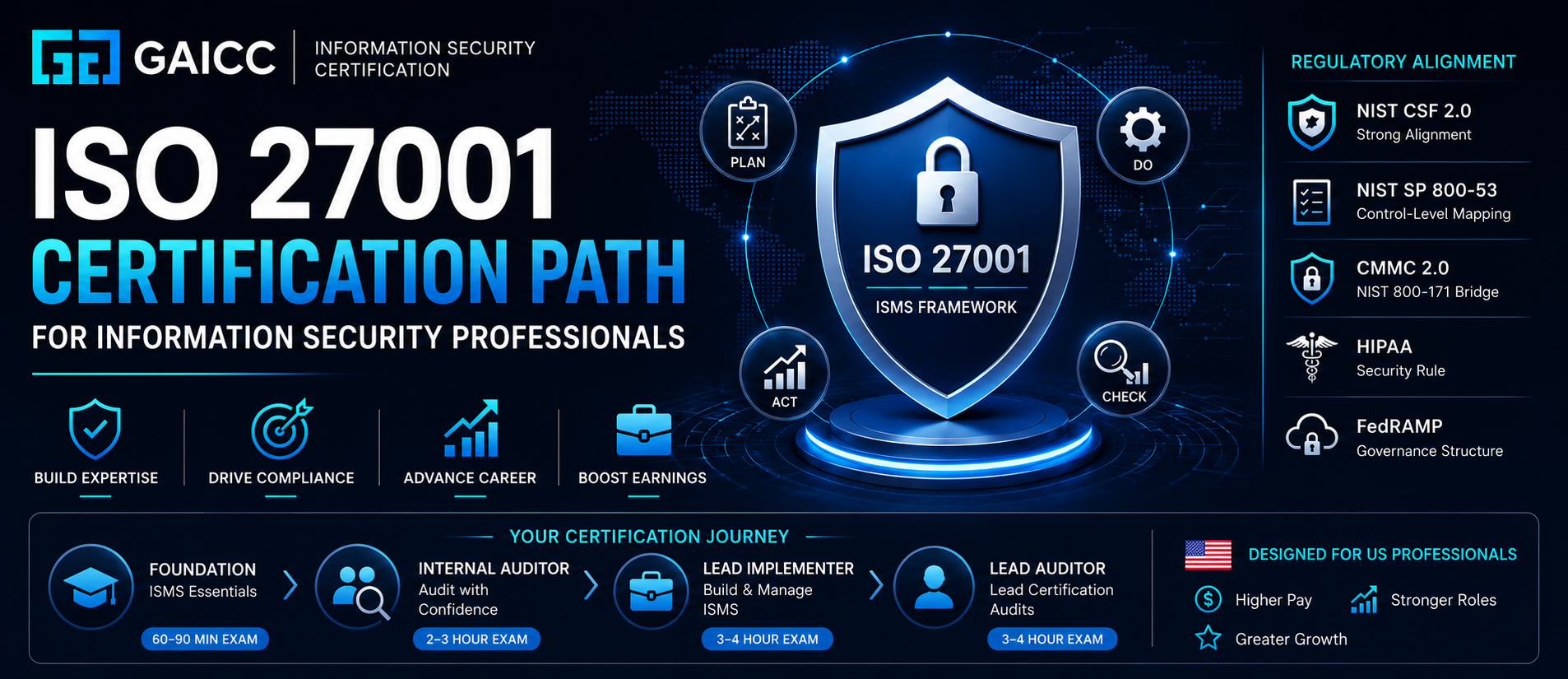
US information security teams are under more regulatory pressure than at any point in the last decade. Between CMMC 2.0 enforcement timelines, NIST CSF 2.0 adoption, and the growing expectation from enterprise clients that vendors hold verifiable security credentials, the question is no longer whether professionals should pursue ISO 27001 certification it is which credential to pursue first and in what order.ISO/IEC 27001:2022 is the internationally recognized standard for Information Security Management Systems (ISMS).
For US-based security and GRC professionals, it maps directly to the frameworks that federal agencies and enterprise procurement teams already require. This guide lays out the full certification path from Foundation through Lead Auditor with the exam details, prerequisites, salary impact, and US regulatory context you need to make the right decision for your career.
What ISO 27001 Certification Actually Proves
Most security credentials test technical knowledge. ISO 27001 certification is different it proves that a professional can build, manage, and audit a systemic approach to information risk. That distinction matters enormously to employers hiring for GRC, compliance, and ISMS leadership roles.The ISO/IEC 27001:2022 standard covers 93 controls across four themes in Annex A: Organizational, People, Physical, and Technological. Its structure is based on Annex SL (now Annex L), which means it follows the same high-level framework as ISO 9001, ISO 14001, and ISO 22301.
A professional who understands ISO 27001 can navigate virtually any other ISO management system standard without starting from zero.For US organizations specifically, ISO 27001 aligns with NIST SP 800-53 at the control level and with NIST CSF 2.0 at the framework level. The ISMS’s Plan-Do-Check-Act (PDCA) cycle maps directly to the Govern, Identify, Protect, Detect, Respond, and Recover functions of the CSF. That structural alignment is why companies pursuing FedRAMP authorization, CMMC Level 2 or 3, or HIPAA security rule compliance increasingly use ISO 27001 as an integration layer.
The ISO 27001 Certification Pathway: Credential Tiers Explained
The ISO 27001 certification path is a tiered progression. Each credential builds on the last, and each one serves a different functional role within an organization or consulting practice.
| Credential | Purpose | Audience | Typical Exam Format |
|---|---|---|---|
| ISO 27001 Foundation | Conceptual grounding in ISMS principles and standard structure | New security analysts, GRC coordinators, IT auditors entering the field | Multiple choice, 40–60 questions, 60–90 minutes |
| ISO 27001 Internal Auditor | Conduct internal ISMS audits against ISO 27001 requirements | Compliance analysts, risk officers, internal audit teams | Multiple choice + scenario-based, 2–3 hours |
| ISO 27001 Lead Implementer | Lead end-to-end ISMS implementation projects | Security managers, ISMS project leads, GRC consultants | Scenario-based, 3–4 hours, 100–150 questions |
| ISO 27001 Lead Auditor | Lead third-party and certification body audits of ISMS | Senior auditors, consultants, certification body staff | Scenario + written case study, 3–4 hours |
The Foundation credential is not universally required before the higher tiers, but skipping it without equivalent experience is a common reason candidates struggle with Lead Implementer or Lead Auditor exams. The Foundation establishes vocabulary, clause structure, and risk-based thinking that the upper-tier exams assume as background knowledge.
Most serious practitioners pursue Lead Implementer and Lead Auditor credentials at some point in their career. The right order depends on your current role. Implementation-focused professionals those building or improving ISMS programs inside organizations typically pursue Lead Implementer first. Professionals working in internal audit, consulting, or third-party assessment work trend toward Lead Auditor.
ISO 27001 Foundation: Where Most Professionals Should Start
The Foundation credential covers the core concepts of the ISO/IEC 27001 standard: the ISMS structure, the purpose of the Statement of Applicability (SoA), the relationship between risk assessment and Annex A control selection, and the PDCA improvement cycle.A typical Foundation exam runs 60 questions in 90 minutes, with a pass mark around 70%. Most providers deliver it online, and preparation time for candidates with a security background is usually 10–15 study hours. For professionals coming from a purely technical background without GRC or compliance exposure, 20–30 hours is more realistic.
The credential is especially useful for two groups. The first is experienced security practitioners who have been implementing security controls for years but have never worked inside a formal management system framework ISO 27001 Foundation gives them the vocabulary to operate effectively in organizations pursuing certification. The second group is GRC analysts and compliance coordinators who need to contribute to ISMS programs but lack the technical security depth for Lead-level credentials.
Professionals new to ISMS concepts can start with the ISO 27001 Foundation Certification to understand the standard structure, risk management principles, and core security controls before moving into advanced roles.
ISO 27001 Internal Auditor: The Most Underrated Credential in the Pathway
Internal Auditor certification sits between Foundation and Lead Auditor in the pathway, and it is frequently skipped by professionals in a rush to reach Lead-level credentials. That is a mistake.The ISO 19011 guidelines for auditing management systems form a core part of the Internal Auditor curriculum. A professional who has genuinely absorbed this content understands audit evidence, nonconformity classification, and audit reporting in ways that make them dramatically more effective in Lead Auditor programs and dramatically more valuable to any organization undergoing Stage 2 certification audits.
For US organizations, internal auditors are the gatekeepers before certification body audits. An ISMS that has been rigorously internally audited reaches Stage 2 in far better condition than one that treated internal audit as a checkbox. Hiring managers in regulated industries healthcare, defense contracting, financial services increasingly distinguish between candidates who list “ISO 27001 knowledge” and those who hold an Internal Auditor credential as evidence they have actually audited an ISMS.
ISO 27001 Lead Implementer: What the Credential Requires and Tests
The Lead Implementer credential is the most operationally demanding in the pathway. It tests whether a professional can take an organization through a full ISMS implementation lifecycle from scoping and gap assessment through risk treatment, Annex A control deployment, documentation, and preparation for Stage 1 and Stage 2 certification audits.Exam content typically covers:
Prerequisites vary by provider, but the general expectation is a minimum of two years of relevant information security or GRC experience, completion of an approved training program (typically 32–40 CPD/PDU hours), and either a Foundation credential or demonstrable equivalent knowledge.For US professionals, the Lead Implementer credential is particularly relevant in organizations pursuing CMMC Level 2 compliance. The CMMC framework draws heavily on NIST SP 800-171, which in turn maps to a significant subset of ISO 27001 Annex A controls. A Lead Implementer who understands both frameworks can support organizations in building ISMS programs that satisfy multiple compliance requirements from a single implementation effort a significant value proposition in the defense supply chain.
- ISMS scope definition and context of the organization (Clause 4)
- Leadership commitment and information security policy development (Clause 5)
- Risk assessment methodology selection and execution, including ISO 27005 alignment
- Statement of Applicability (SoA) construction and control justification
- Annex A control implementation across all 93 controls and four themes
- Operational controls, supplier relationships, and incident management (Clauses 8–10)
- Performance evaluation, internal audit, and management review (Clause 9)
- Corrective action and continual improvement processes (Clause 10)
Security leaders responsible for designing and managing an ISMS can advance their expertise through the ISO 27001 Lead Implementer Certification, focused on practical implementation and governance.
ISO 27001 Lead Auditor: The Senior Credential and Its Career Context
The Lead Auditor certification prepares professionals to plan, lead, and report on full ISMS audits both internal audits on behalf of organizations and external audits on behalf of certification bodies or clients. It is the credential most directly associated with consulting roles and with positions at accredited certification bodies.The exam is the most demanding in the pathway. Expect scenario-based questions that require candidates to diagnose audit findings, classify nonconformities correctly (major vs. minor), and draft audit conclusions with appropriate ISO 19011 language. Some certification body programs add a written case study component, which tests practical audit report writing.
Combine Lead Auditor with Lead Implementer and you have a credential stack that positions you for senior GRC roles, principal consultant positions, and information security management leadership. According to ZipRecruiter data, ISO 27001 professionals in the US earn an average of $106,734 annually, with experienced Lead Auditors at established organizations or consulting firms reaching $135,000 or more. Professionals who pair ISO 27001 Lead Auditor with CISSP or CISM credentials a combination now common in enterprise GRC teams regularly command $140,000 to $160,000 in major US markets.
ISO 27001 and US Regulatory Alignment: NIST, CMMC, FedRAMP, and HIPAA
One reason ISO 27001 certification carries more weight in the US market than it did five years ago is the increasing convergence between the standard and US regulatory frameworks. Understanding these alignments is not just academically useful it is a core competency for any professional operating at the intersection of ISMS implementation and US compliance.
| US Framework | ISO 27001 Alignment | Key Integration Point |
|---|---|---|
| NIST CSF 2.0 | Strong structural alignment | CSF Functions map to PDCA cycle; Govern function aligns with Clauses 4–6 |
| NIST SP 800-53 Rev 5 | Control-level mapping available | ~80% of 800-53 controls have ISO 27001 Annex A counterparts |
| CMMC 2.0 Level 2 | NIST 800-171 bridge | Implementing ISO 27001 Annex A partially satisfies NIST 800-171 practices |
| FedRAMP | Indirect alignment via 800-53 | ISO 27001 ISMS provides governance structure; FedRAMP requires 800-53 controls specifically |
| HIPAA Security Rule | Strong alignment | ISO 27001 risk assessment methodology maps to HIPAA addressable and required safeguards |
For GRC professionals advising clients across multiple regulatory regimes, ISO 27001 serves as a unifying framework a way to build one ISMS that satisfies multiple compliance requirements rather than building separate siloed programs for each regulation. NIST CSF 2.0’s new Govern function, introduced in the 2024 revision, mirrors ISO 27001’s leadership and organizational context requirements almost exactly.This multi-framework utility is one reason ISO 27001 Lead Implementers with NIST fluency are in high demand across healthcare, defense contracting, and financial services. The ability to translate between ISO 27001 clause requirements and the specific control language of CMMC, HIPAA, or FedRAMP is a skill set that significantly expands the scope of roles available to credentialed professionals.
Salary Impact by Certification Tier and Role
The financial return on ISO 27001 certification varies significantly by tier, role, and whether the credential is held alone or stacked with complementary certifications. Here is a realistic picture of the US market.
| Role / Credential Stack | Typical US Salary Range | Key Industries |
|---|---|---|
| ISO 27001 Foundation + GRC Analyst role | $75,000 – $95,000 | Technology, consulting, healthcare |
| ISO 27001 Internal Auditor + Compliance role | $85,000 – $110,000 | Financial services, defense, healthcare |
| ISO 27001 Lead Implementer | $100,000 – $130,000 | Technology, consulting, defense supply chain |
| ISO 27001 Lead Auditor | $100,000 – $135,000 | Consulting firms, certification bodies, large enterprise |
| Lead Implementer + Lead Auditor + CISM/CISSP | $130,000 – $165,000+ | All regulated sectors, CISO pipeline roles |
| CISO with ISO 27001 background | $180,000 – $275,000+ | Enterprise across sectors |
Salary data from Glassdoor and PayScale indicates that Information Security Managers with ISO 27001 skills earn a median of $104,450 in the US, while Information Security Officers at the same skill level earn around $105,966. The upper end of these ranges $150,000 to $160,000 typically requires a Lead-level credential paired with CISM or CISSP and five or more years of ISMS-specific experience.The certification premium is most pronounced in sectors with explicit regulatory requirements. A GRC analyst in defense contracting with ISO 27001 Lead Implementer credentials typically commands 20–30% more than a peer without the credential, because the credential directly reduces employer onboarding costs for CMMC or NIST-related compliance work.
Study Strategy and Exam Preparation by Tier
Preparation requirements vary substantially across the four certification tiers. The strategies that work for Foundation candidates fail at the Lead Auditor level, and vice versa.
Foundation: Official training materials plus the standard text itself. Budget 15–25 study hours. Focus on clause structure, the relationship between risk assessment and Annex A, and the vocabulary of ISMS documentation. Practice multiple-choice questions from multiple providers to see the range of question styles.
Internal Auditor: Study ISO 19011 in depth alongside ISO 27001. The key competency being tested is audit process how to plan, conduct, and report an audit with appropriate evidence. Scenario-based practice questions are essential. Look for questions that ask you to classify a finding as a major nonconformity, minor nonconformity, or observation, and understand the criteria that distinguish each.
Lead Implementer: This is where live project experience matters most. Reading the standard is necessary but not sufficient. Candidates who have worked on real gap assessments, risk registers, and SoA construction pass at significantly higher rates. If you lack that experience, find a study group or training cohort that runs simulation exercises. Budget 40–60 study hours beyond the required training program.
Lead Auditor: The case study component, where present, separates candidates who understand audit principles from those who have simply memorized them. Practice writing audit findings in ISO 19011 language objective evidence, nonconformity statement, requirement violated. Time pressure on this exam is real. Most unsuccessful first-attempt candidates report that audit report writing was where they lost the most points.
Credential Stacking: Building a High-Value ISO 27001 Career Profile
ISO 27001 credentials compound in value when combined strategically. The combinations that consistently produce the highest career returns in the US market are:
ISO 27001 Lead Implementer + CISM: This combination targets senior GRC manager and information security program director roles. CISM’s governance and risk management coverage complements Lead Implementer’s operational implementation depth. Combined median salary: $130,000–$150,000.
ISO 27001 Lead Auditor + CISA: The natural combination for audit-focused careers. CISA covers IT audit broadly; ISO 27001 Lead Auditor adds the ISMS-specific depth that clients in regulated industries specifically require. Combined median salary: $120,000–$145,000.
Lead Implementer + Lead Auditor + CISSP: The full ISO 27001 credential stack alongside CISSP creates a profile suited for principal consultant roles, security practice leadership, and CISO pipeline positions. Professionals with this stack who also carry NIST framework knowledge command the top of the range $150,000 to $175,000 in major US markets.
A word on sequencing: the most common career trajectory for information security professionals is Foundation or Internal Auditor, then Lead Implementer as they take on ISMS program responsibilities, then Lead Auditor as they move into consultancy or senior program leadership. There is no single correct sequence, but attempting Lead Auditor before gaining Lead Implementer knowledge typically produces lower first-attempt pass rates and a shallower understanding of what auditors are actually looking for.
Frequently Asked Questions
1. Do I need ISO 27001 Foundation before pursuing Lead Implementer?
Foundation is not universally required as a formal prerequisite, but most providers expect equivalent knowledge. Candidates who attempt Lead Implementer without Foundation-level understanding of clause structure and ISMS risk assessment methodology struggle significantly more on scenario-based questions. If you have extensive practical ISMS experience, you may be able to demonstrate equivalent knowledge without the Foundation credential.
2. How long does it take to complete the ISO 27001 Lead Implementer certification?
Most candidates complete the required training program in 4–5 days of structured instruction, followed by 40–60 hours of independent study before the exam. From registration to certification, allow 8–12 weeks for candidates with relevant experience, or 3–6 months if you are building foundational knowledge alongside the program.
3. Is ISO 27001 certification recognized in the US, or is NIST-based certification preferred?
ISO 27001 is globally recognized and accepted in the US, particularly in organizations with international clients or supply chains. For purely domestic US federal government work, NIST-specific frameworks and certifications (SP 800-53, CMMC) take precedence. Most enterprise and regulated-sector employers value ISO 27001 alongside NIST credentials, as the frameworks are complementary rather than competing.
4. What is the difference between ISO 27001 Lead Implementer and Lead Auditor?
Lead Implementer certifies your ability to design and deploy an ISMS within an organization. Lead Auditor certifies your ability to independently assess whether an ISMS conforms to ISO 27001 requirements. Many senior professionals hold both. Implementation-focused roles (ISMS Manager, Security Program Director) typically require Lead Implementer; consulting and audit-focused roles (senior auditor, certification body staff) typically require Lead Auditor.
5. How does ISO 27001 certification align with CMMC 2.0 requirements?
ISO 27001 does not directly satisfy CMMC 2.0 requirements, which are based on NIST SP 800-171. However, implementing ISO 27001 builds the ISMS governance structure and many of the security controls that NIST 800-171 requires. Defense supply chain organizations often pursue ISO 27001 first to establish a mature security program, then align that program to NIST 800-171 practices for CMMC assessment purposes.
6. What salary increase can I expect after earning ISO 27001 Lead Implementer certification?
The premium varies by role and industry, but GRC and information security professionals with ISO 27001 Lead Implementer credentials typically earn 15–25% more than comparable roles without it, according to ZipRecruiter and Glassdoor data. In defense contracting and healthcare, where ISMS expertise is directly linked to compliance obligations, the premium can reach 30%. Combining the credential with CISM or CISSP compounds the return further.
7. How often must ISO 27001 professional certifications be renewed?
Most ISO 27001 professional certifications are valid for three years and require renewal through continuing professional development (CPD) hours. GAICC credentials, for example, require 40 CPD/PDU hours per renewal cycle, distributed across learning, practice, and contribution activities. Annual surveillance requirements may also apply depending on the issuing body.
Conclusion
The ISO 27001 certification path gives information security and GRC professionals a structured way to validate expertise that directly addresses what US employers are buying. Foundation builds the vocabulary. Internal Auditor proves audit competence. Lead Implementer demonstrates the ability to build and operate a systematic security program. Lead Auditor closes the loop with independent verification capability.
The professionals who extract the most career value from this pathway treat the credentials not as isolated exams but as a progression that mirrors how security programs actually mature. Start with the tier that matches your current responsibilities, build toward the credentials that align with where your career is heading, and stack complementary frameworks NIST, CISM, CISSP to create a profile that handles the full scope of what regulated US industries need.
Explore GAICC’s ISO 27001 certification programs to find the right credential for your current role and career goals.