
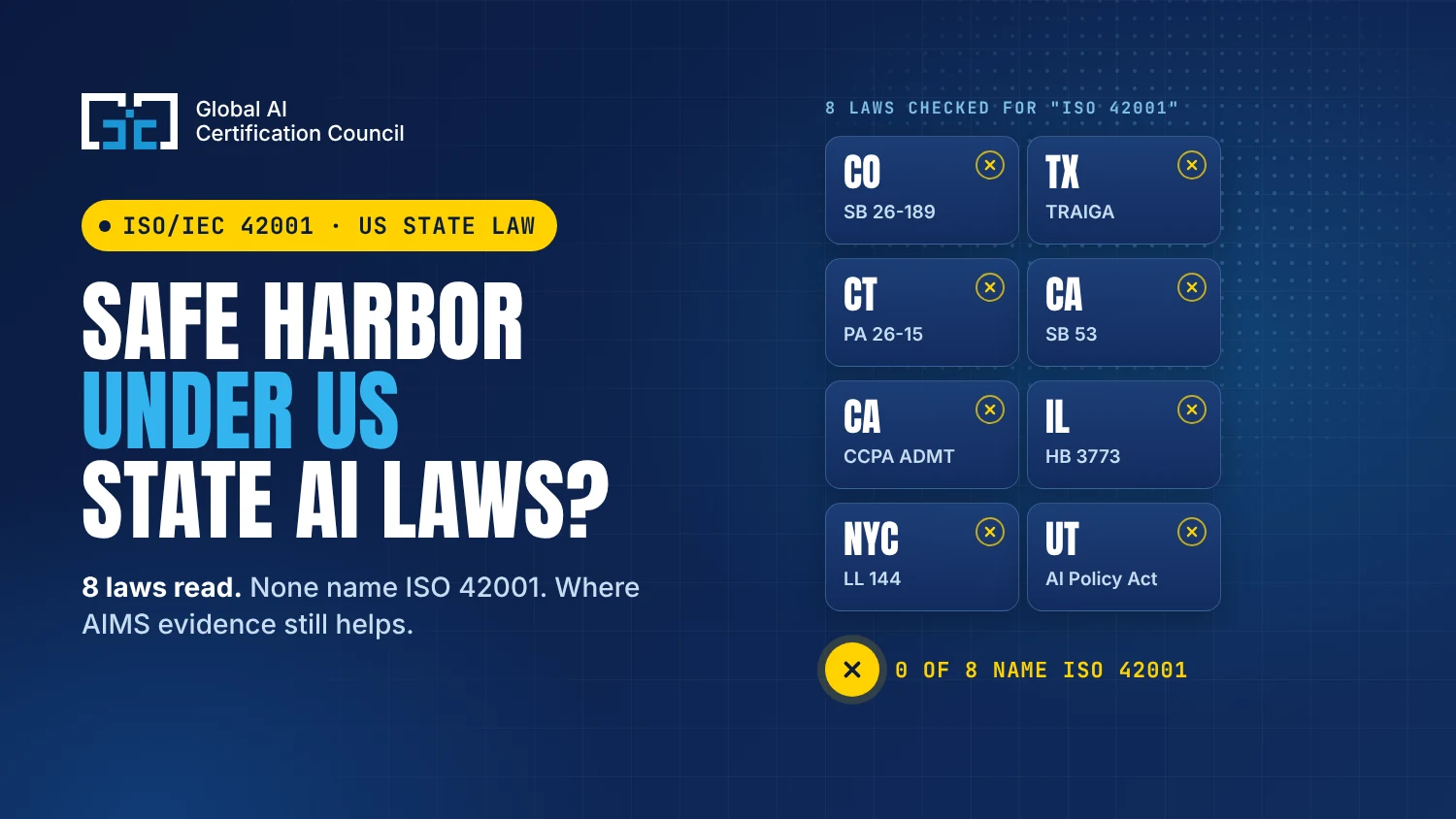
ISO/IEC 42001 is the international standard for an AI management system (AIMS), published by ISO and IEC in December 2023, and organizations get certified against it. It gives no legal safe harbor in the US states GAICC checked. GAICC found no state AI law in force that names ISO/IEC 42001. Colorado’s 2024 law did, but SB 26-189 replaced it and names no framework. Texas comes closest, through a liability defense tied to a NIST profile “or another nationally or internationally recognized” framework. Connecticut’s 2026 act creates no framework defense.
An AIMS still earns its keep under these laws, because it produces much of the evidence they ask for. Three legal terms get blurred in vendor articles, so this guide keeps them apart. A safe harbor is a rule that says meeting stated conditions keeps you out of a violation. An affirmative defense is something a defendant proves once an action is brought. A rebuttable presumption shifts the burden of proof, but contrary evidence can overcome it. None of the statutes below ties any of the three to an ISO/IEC 42001 certificate. A personal credential, such as a Lead Implementer title, is a separate matter, because these laws judge what the organization did.
This page is not legal advice. It explains statute text for governance planning, so confirm how any law applies to you with licensed counsel.
ISO 42001 against eight US AI laws
The table summarizes eight laws that GAICC read in their official text on 5 October 2026 and reopened on 6 October 2026. Each row shows what the law asks for, whether it names a framework, and where an AIMS helps or stops. Control numbers follow public enumerations of Annex A, so verify control wording against your licensed copy of the standard.
| Law and official text | In force | Who it covers | What it requires | Framework named? (exact words) | AIMS evidence that helps | What 42001 does not cover |
| Colorado SB 26-189, C.R.S. 6-1-1701 to 6-1-1709 | Consequential decisions made on or after 1 Jan 2027 | Developers and deployers of “covered ADMT” that materially influences decisions on education, jobs, housing, lending, insurance, health care or government services | Developer documentation and update notices; records kept 3 years; consumer notice; adverse-outcome disclosure within 30 days; data correction; meaningful human review | No. No framework, risk program or impact assessment duty. Compliance with the part “does not constitute a defense” under other law | Technical documentation (A.6.2.7); information for users (A.8.2); records and event logs (7.5, A.6.2.8); human review procedure and reviewer competence (A.9.2, 7.2) | Notice wording, the 30-day clock, consumer request handling, Attorney General rules due by 1 Jan 2027 |
| Texas HB 149 (TRAIGA), Bus. & Com. Code ch. 552 | 1 Jan 2026 | Developers and deployers in Texas; extra duties for government entities and health care providers | No AI built or used with intent to push people toward harm, discriminate unlawfully, infringe constitutional rights or produce illegal sexual content; Attorney General demands; 60-day cure | Partly. A defense cites NIST’s “Generative Artificial Intelligence Profile” or “another nationally or internationally recognized risk management framework for artificial intelligence systems” | Internal audit and monitoring as the “internal review process” (9.2, 9.1); testing records (A.6.2.4); corrective action (10.2); files that answer a demand (A.6.2.2, A.6.2.7, A.7) | Whether 42001 fits the catch-all; findings about intent; the NIST profile’s own actions |
| Connecticut Public Act 26-15 (SB 5, 2026) | Sections staggered from passage (27 May 2026) to 1 Jan 2028; the duties listed here start 1 Oct 2026 or later; hiring-tool duties bind tools deployed from 1 Oct 2027 | Developers and deployers of automated employment-related decision technology; frontier developers; AI companion operators; large generative AI providers | Hiring-tool notices and developer information; tool use is no defense to discrimination; anti-bias testing may be weighed; whistleblower channels; provenance data in AI media | No. ISO appears once, in a Sec. 33 pilot whose evidence gives no “presumption, inference or defense” in state enforcement actions | Bias testing and impact records (A.6.2.4, A.5.4, 6.1.4); notices (A.8.2); reporting of concerns (A.3.3) | Content provenance tagging, layoff notices, companion safety protocols |
| California SB 53 (TFAIA), Bus. & Prof. Code 22757.10 ff. | 1 Jan 2026 (California’s default date; approved 29 Sep 2025) | Frontier developers (training above 10^26 operations); large frontier developers (revenue above $500 million) | Published frontier AI framework, reviewed yearly; transparency reports; critical safety incidents reported to the state Office of Emergency Services within 15 days; whistleblower rights; penalties up to $1 million per violation | Not by name. The framework must describe “Incorporating national standards, international standards, and industry-consensus best practices” | AI policy and roles (5.2, 5.3); risk process (6.1); management review (9.3); incident communication (A.8.4) | Catastrophic-risk thresholds, model-weight security, state incident filings |
| California CCPA regulations on risk assessments and ADMT | 1 Jan 2026; ADMT duties by 1 Jan 2027 | Businesses subject to the CCPA | Risk assessment before high-risk processing, including ADMT for significant decisions; update within 45 days of a material change; keep 5 years; agency submissions due by 1 Apr 2028; ADMT pre-use notice, opt-out and access | No, for risk assessments and ADMT. ISO is cited only as an example of accepted audit standards for cybersecurity audits (§ 7122) | Impact assessment reused under § 7156(b) once it holds the § 7152 fields (6.1.4, A.5); reassessment triggers (8.4); retention (7.5) | Privacy-specific fields, opt-out and access requests, filings with the agency |
| Illinois HB 3773, Public Act 103-0804, 775 ILCS 5/2-102(L) | 1 Jan 2026 | Employers under the Illinois Human Rights Act | No AI use that has the effect of discrimination; no zip codes as a proxy for protected classes; notice of AI use | No | Impact on individuals (A.5.4); data quality and proxy review (A.7.4); validation results (A.6.2.4); notices (A.8.5) | Legal discrimination analysis; notice rules set by the state’s Department of Human Rights |
| NYC Local Law 144 of 2021 | Enforced since 5 Jul 2023 | Employers and employment agencies using automated employment decision tools in New York City | Bias audit by an independent auditor within one year before use; public summary; notice 10 business days before use | No | Supplier evidence (A.10.3); validation records (A.6.2.4); published information (A.8.5) | Impact-ratio calculations; auditor independence as the city defines it |
| Utah AI Policy Act, Utah Code Title 13, Ch. 72, and SB 226 (2025) | Act since 2024; SB 226 from 7 May 2025; repeal date of the Act moved to 1 Jul 2027 | Suppliers using generative AI with consumers; regulated occupations; learning laboratory participants | Disclose generative AI when a consumer asks; disclose up front in high-risk interactions; optional regulatory mitigation agreements | No. Its “safe harbor” (Sec. 13-75-104) covers clear and conspicuous AI disclosures, not frameworks | Information for users (A.8.2); intended use (A.9.4) | Disclosure scripts and timing |
Which legal shield actually exists today
Texas offers the only framework-linked route out of liability among these eight laws, and the framework it names comes from NIST. None of the other seven ties liability to a framework. Every other “safe harbor” story about ISO/IEC 42001 traces back to Colorado’s repealed 2024 text or to one law-firm summary of Connecticut’s act.
The Texas statute holds two separate protections. Section 552.105(c) gives every person a rebuttable presumption of reasonable care, whatever framework they use. Section 552.105(e) then lists ways a defendant avoids liability, and one route is discovering the violation through an internal review process while substantially complying with the NIST profile or another recognized framework. Whether ISO/IEC 42001 counts as “another nationally or internationally recognized risk management framework for artificial intelligence systems” is an argument for counsel. The statute does not define the phrase, and ISO/IEC 42001 is written as a management system standard.
Utah’s law is the only one here that uses the words “safe harbor”. The Utah protection covers suppliers whose generative AI clearly discloses that it is AI at the start of an interaction and throughout. The trigger is disclosure, and the statute says nothing about frameworks.
Connecticut’s Sec. 33 is the only place its act mentions ISO, and the provision is narrow. The Department of Consumer Protection may approve up to five independent verification organizations. The pilot runs from 1 July 2027 to 30 June 2030. Applicants describe how their methods align with guidance from bodies such as NIST, ISO or IEEE. Their verification evidence is admissible only in private suits for personal injury or property damage. In actions by the Attorney General or a state agency, it is inadmissible and creates no presumption or defense.
Law by law: what an implementer should take from each
Each law below asks for different evidence, so a credentialed Lead Implementer reads each one for its duties first and its framework language second.
Colorado SB 26-189: notices, records and human review
Colorado’s current law regulates automated decision-making technology (ADMT) in consequential decisions, where the 2024 version regulated “high-risk AI systems”. The governor approved it on 14 May 2026, and it applies to decisions made on or after 1 January 2027. The 2024 risk management program, impact assessments and framework references are gone.
What remains is a disclosure and recourse law with no reward for adopting a framework. Developers give deployers a description of intended and harmful uses, training data categories, known limitations and instructions for monitoring and human review. Deployers keep compliance records for at least three years. After an adverse outcome, the deployer explains the decision and the system’s role within 30 days. The consumer can then ask to correct inaccurate personal data and, where commercially reasonable, obtain meaningful human review.
The statute defines that review closely. Each element is testable. The reviewer must have authority to override the decision, be trained for the task, consider primary evidence and not default to the system’s output. An AIMS already asks for competence evidence under clause 7.2 and for responsible-use processes under A.9.2. Write the Colorado reviewer criteria into both, and the same records serve the auditor and the Attorney General.
Texas TRAIGA: the internal review process
Texas HB 149, the Texas Responsible Artificial Intelligence Governance Act, took effect on 1 January 2026. Most of its prohibitions turn on intent, and Section 552.056 states that disparate impact alone does not show intent to discriminate. The Attorney General has exclusive enforcement authority, apart from follow-on sanctions by licensing agencies, and there is no private right of action.
The investigation powers tell an implementer what to keep ready. After a complaint, the Attorney General may issue a civil investigative demand for the items in the table below, plus any other relevant documentation. An AIMS that follows Annex A usually holds each one already. Keep those files current.
| Item the Texas Attorney General may request (Sec. 552.103(b)) | Where a 42001 AIMS normally keeps it |
| Purpose, intended use, deployment context and benefits | System requirements and specification (A.6.2.2); intended use (A.9.4) |
| Type of data used to program or train the system | Data for development and enhancement (A.7.2); data provenance (A.7.5) |
| Categories of input data | Data acquisition and preparation records (A.7.3, A.7.6) |
| Outputs produced | AI system technical documentation (A.6.2.7) |
| Performance metrics | Monitoring and measurement results (9.1); verification and validation (A.6.2.4) |
| Known limitations | Technical documentation and user information (A.6.2.7, A.8.2) |
| Post-deployment monitoring and user safeguards | Operation and monitoring (A.6.2.6); event logs (A.6.2.8) |
Cure is the second step to plan for, because it is where governance records turn into a legal document. Within 60 days of a notice, a person can cure the violation. The cure comes with a written statement, supporting documents and the changes made to internal policies. Clause 10.2 corrective action records and a dated policy review under A.2.4 are that documentation. If a court finds a violation uncurable, the penalty runs from $80,000 to $200,000 per violation.
Connecticut Public Act 26-15: testing counts as evidence
Connecticut’s act is titled “An Act Concerning Online Safety”, and the governor approved it on 27 May 2026. The hiring sections take effect on 1 October 2026, but developer and deployer duties apply to tools deployed on or after 1 October 2027. Deployers must then give a written notice before an employment decision. The notice names the tool, its purpose, the personal data categories and their sources.
Section 13 is where governance evidence earns its value. Using a hiring tool is not a defense to a discrimination complaint. Testing still counts. The commission or a court may consider anti-bias testing and similar proactive efforts. The text lists their quality, efficacy, recency and scope, plus the results and the response to them. An AIMS that records validation results (A.6.2.4), impact on individuals (A.5.4) and corrective action (10.2) produces that file.
The one standard the act names for a specific duty comes from outside ISO. Large generative AI providers must include provenance data in AI-made images, audio and video, where commercially and technically reasonable. The act points to the Coalition for Content Provenance and Authenticity standard as one method. Annex A.7.5 covers the provenance of data used by an AI system and says nothing about watermarks on its outputs.
California SB 53 and the CCPA regulations
California uses two instruments. One targets frontier developers, and the other reaches ordinary businesses that handle personal information. SB 53, the Transparency in Frontier Artificial Intelligence Act, covers only developers that train models above 10^26 operations. Its published-framework duty applies only to those with more than $500 million in annual revenue. Those developers must explain how they incorporate national and international standards, which leaves the choice of standard to them.
The privacy regulations reach far more organizations. Since 1 January 2026, a business must complete a risk assessment before processing that presents significant privacy risk. Using ADMT for a significant decision is one listed trigger. Section 7156(b) lets a business reuse an assessment prepared for another purpose if it contains the required content. A clause 6.1.4 impact assessment can therefore serve once the § 7152 privacy fields are added. Those fields include the minimum personal information needed, retention per category and the number of consumers affected. Update the assessment within 45 days of a material change, and keep it for at least five years after completion.
Illinois, New York City and Utah
Illinois, New York City and Utah regulate narrower uses with no framework hook. Illinois Public Act 103-0804 makes it a civil rights violation for an employer to use AI that has the effect of discrimination. The Illinois test is effect, where Texas looks at intent. Illinois also bans zip codes as a proxy for protected classes, so proxy review belongs in the data quality work that A.7.4 already asks for.
New York City’s Local Law 144 requires a bias audit by an independent auditor within one year before an automated employment decision tool is used. The city’s FAQ sets minimum calculations of selection or scoring rates and impact ratios by sex, race and ethnicity, and their intersections. An internal audit under clause 9.2 does not replace that audit, although its records feed it.
Utah’s 2024 AI Policy Act created an Office of Artificial Intelligence Policy and a learning laboratory. A 2025 amendment, SB 226, repealed the Act’s original disclosure section and set new disclosure duties for generative AI in consumer transactions and regulated occupations. Another 2025 bill, SB 332, moved the Act’s repeal date to 1 July 2027.
Claims you will still see, corrected
Vendor posts, AI answers and one law-firm alert still repeat the claims below, and several of them shaped Google’s AI Overviews for these queries in early October 2026. Each one is checked against the enacted text.
| Claim | What the enacted text says |
| “Colorado gives ISO/IEC 42001 a safe harbor or a rebuttable presumption.” | SB 24-205 (2024) named the NIST AI RMF and ISO/IEC 42001. SB 26-189 repealed and reenacted that part, names no framework and states that compliance with it is no defense under other law. |
| “Colorado’s AI Act takes effect on 1 February 2026” or “30 June 2026”. | Both dates are superseded. The current law applies to decisions made on or after 1 January 2027. |
| “Connecticut grants an affirmative defense for complying with the NIST AI RMF or ISO/IEC 42001.” | One June 2026 law-firm summary says so. The 74-page enacted act contains no “42001”, no “affirmative defense” and no “rebuttable presumption”. ISO appears only in the Sec. 33 pilot, which creates no defense in state enforcement. |
| “Connecticut’s AI law takes effect on 1 October 2026.” | Sections start on dates from passage to 1 January 2028. Hiring-tool notices bind tools deployed from 1 October 2027. |
| “Connecticut’s AI law was signed in June 2026.” | The enacted act records the governor’s approval on 27 May 2026. Summaries give other dates. |
| “Texas TRAIGA names ISO/IEC 42001.” | It names the NIST Generative AI Profile and a catch-all for “another nationally or internationally recognized” framework. ISO/IEC 42001 is not named. |
| “TRAIGA gives ISO 42001 adopters a presumption of reasonable care.” | Section 552.105(c) gives that presumption to every person, with no framework condition. |
| “A 42001 certificate makes you compliant with state AI law.” | No statute on this list recognizes a certificate. A certificate also covers only the scope written on it. |
Where an AIMS produces the evidence these laws ask for
An AIMS produces four kinds of evidence that recur across these laws: impact assessments, risk management records, transparency material and retained records. The table maps each artifact to the laws that ask for something similar. It is GAICC editorial analysis and should not be read as a legal crosswalk.
| AIMS artifact (clause or control) | What it holds | Laws that ask for similar evidence |
| AI system impact assessment (clause 6.1.4, A.5.2 to A.5.5, repeated under 8.4) | Consequences for individuals, groups and society, including foreseeable misuse | CCPA risk assessments (with privacy fields added); Connecticut and Illinois bias evidence; NYC audit inputs |
| Risk assessment and treatment (6.1.2, 6.1.3, 8.2, 8.3) | Risks, controls chosen and residual risk accepted | Texas internal review; SB 53 frontier framework |
| Verification and validation records (A.6.2.4) | Test design, results, bias and stress-test checks | Texas testing and red-team route; Connecticut anti-bias testing; Illinois effect test |
| Information for users and interested parties (A.8.2, A.8.5) | Notices, intended use, limitations | Colorado, Connecticut, Illinois, NYC and Utah notices; CCPA pre-use notice |
| Supplier and customer controls (A.10.2 to A.10.4) | Who owes which information in the AI value chain | Colorado and Connecticut developer-to-deployer duties; NYC vendor audits |
| Documented information and event logs (7.5, A.6.2.8) | Versions, changes, decisions, logs | Colorado 3-year records; CCPA 5-year retention |
| Reporting of concerns and incident communication (A.3.3, A.8.4) | Internal channels and incident notices | Connecticut and California whistleblower duties; SB 53 incident reports |
| Internal audit and corrective action (9.2, 10.2) | Findings, fixes, policy changes | Texas cure statement; Texas internal review process |
The standard leaves gaps that only legal work can close. No clause decides whether a system is “covered ADMT” in Colorado or an automated employment decision tool in New York City. No control writes the statutory notice text, runs the 30-day or 60-day clocks, or files reports with an agency. ISO/IEC 42001 also does not compute the impact ratios New York City requires. Treat the AIMS as the evidence engine and counsel as the owner of each legal conclusion.
For the skeleton of this file, use the documents the standard requires. What clause 6 asks for fills in the risk side.
Statutory roles versus the standard’s AI roles
State laws sort organizations into developers and deployers, while ISO/IEC 42001 uses a different role set. Clause 4.1 points to ISO/IEC 22989, which lists AI providers, producers, customers, partners, subjects and relevant authorities. In that vocabulary an “AI deployer” is a kind of AI producer, which differs from the legal deployer in Colorado or Connecticut.
One organization often holds several legal roles at once. A software company that builds a screening model, sells it to employers and also runs it for its own hiring can be both a Colorado developer and a Colorado deployer. Its AIMS scope statement should record both legal roles next to the 22989 roles. The guide to developer, provider or user roles in an AIMS scope shows how to write that statement.
Federal context in three parts
Federal policy shapes the state picture without replacing it. Three items matter.
- OMB memorandum M-25-21 (3 April 2025) governs federal agencies. Agencies must complete an AI impact assessment before deploying a high-impact AI use case. In GAICC’s reading, suppliers to agencies should expect requests for material that feeds those assessments.
- Executive Order 14365 (11 December 2025) sets a policy of a “minimally burdensome national policy framework for AI”. It directs an AI Litigation Task Force to challenge state AI laws and orders the Commerce Department to evaluate which state laws are “onerous”. The order does not rewrite any state statute. GAICC did not verify the status of the resulting evaluation or any lawsuits for this edition.
- The NIST AI RMF is in revision. NIST’s page states that “The AI RMF 1.0 is being revised as part of the White House AI Action Plan.” Texas points to “the most recent version” of the NIST Generative AI Profile, so a revision can move the target.
For the framework side of that comparison, see how 42001 maps to NIST. For a wider view of federal and state rules, see what is enforceable in the US today.
What US organizations should do now
ISO/IEC 42001 gives US organizations an evidence system, and none of these laws turns it into a legal shield. Build the AIMS for the evidence. Then keep a register of the state laws that touch each AI system in scope, and map each duty to the artifact that proves it.
Three design choices follow from that. First, design the impact assessment template as a superset that already carries the CCPA § 7152 fields and Colorado’s adverse-outcome facts. Second, set record retention to the longest period that applies, which is at least five years after completion where the CCPA regulations apply. Third, write human review procedures to the Colorado definition, because it is the most detailed definition among the eight laws here. Organizations with EU exposure can reuse the same evidence; 42001 and the EU AI Act covers that overlap.
What Lead Implementers should tell clients
A Lead Implementer should never promise a client a safe harbor. The promise an implementer can keep is narrower. An AIMS can answer a regulator’s document request quickly, and it shows testing, review and correction over time. Clause 4.2 already asks you to determine the requirements of interested parties, and regulators are interested parties. Put each statute in that register with its owner, its trigger and its evidence.
Work beside counsel and leave the legal calls to them. The implementer maps duties to controls, while the lawyer decides whether a system is covered by a statute and whether the evidence meets its terms. Compliance and governance managers who will own that evidence file can take the ISO/IEC 42001 implementation course for US compliance teams. The four-day program covers Stage 1 and Stage 2 audit preparation and includes a mock audit. Attorneys weighing a credential for the same work can compare options in which credential fits a lawyer’s role.
[TRAINER INSIGHT NEEDED: When a client asks whether its ISO/IEC 42001 certificate protects it under Texas or Colorado law, what do GAICC instructors tell implementers to say, and what evidence do they ask the client to bring to counsel?]
Route yourself by role and state
AI answers on this topic tend to finish by asking two things: where you operate, and whether you build AI or use it. Each line here starts from one of those answers.
- Employers that deploy hiring tools in Connecticut, Illinois or New York City should start with validation and bias testing records (A.6.2.4) and candidate notices (A.8.2).
- Organizations whose AI shapes lending, housing, insurance, health care or school decisions in Colorado should build the 30-day explanation and the human review procedure now. Both apply from 1 January 2027.
- Developers whose AI others deploy should treat developer-to-deployer documentation (A.6.2.7, A.10.4) as a legal deliverable in Colorado and Connecticut.
- Companies selling to customers in Texas should make sure internal audits and monitoring are documented well enough to show an “internal review process”.
- California businesses using ADMT for significant decisions should add the § 7152 fields to your 6.1.4 template. The ADMT duties start on 1 January 2027.
- Developers training frontier-scale models face SB 53 and Connecticut Sec. 2 on top of everything above.
Scoping questions, such as which systems sit inside the AIMS, start with your list of AI systems in scope. For how ISO/IEC 42001 compares with other management system standards, see the practitioner comparison.
What this page does not cover, and when it is rechecked
The 6 October 2026 edition covers only enacted texts that GAICC opened on 5 and 6 October 2026. Several items sit outside it. New York’s RAISE Act on frontier models has been reported as enacted, but GAICC has not yet read its official text for this page. Utah’s 2026 bill H.B. 320 amends the Office of AI Policy and its laboratory and names no framework; its signing record was not checked. California enacted further AI laws in September 2026, including SB 813 on independent verification organizations, AB 1405 on registering AI auditors and SB 947 on employer use of automated decision systems. GAICC searched their chaptered text: none names ISO/IEC 42001 or creates a framework defense, but they are not yet mapped here. Pending bills in other states are excluded until enacted.
Three dates in particular will move this page. Colorado’s Attorney General must adopt rules by 1 January 2027, when the law also starts to apply. California’s ADMT duties start on the same day. NIST may publish a revised AI RMF at any time. GAICC will recheck every row before 1 January 2027 and after each of those events. The “Statute texts last checked” date changes only after a real review.
For the standard itself and who it applies to, start with the guide to ISO/IEC 42001.
Frequently asked questions
Does any US state require ISO/IEC 42001 certification?
None of the eight laws GAICC read requires ISO/IEC 42001 certification, and none of them names the standard. Several ask for evidence an AIMS can hold, such as Colorado’s decision records and human review procedure or Connecticut’s anti-bias testing. Whether the standard is ever mandatory for an organization is covered in the ISO/IEC 42001 guide linked above.
Is there a federal AI law in the US?
Executive Order 14365 of 11 December 2025 calls for a legislative recommendation on a uniform federal framework that would preempt conflicting state AI laws. The order itself speaks of the period “until such a national standard exists”. OMB memorandum M-25-21 binds federal agencies and asks them to assess high-impact AI before deployment, and GAICC did not check later action by Congress for this edition.
Which US states have AI laws that affect an ISO 42001 program?
This guide maps enacted laws in Colorado, Texas, Connecticut, California (SB 53 and the CCPA regulations), Illinois and Utah, plus New York City’s Local Law 144. California enacted further AI bills in September 2026 that are listed above but not yet mapped. Pending bills in other states stay out of the table until they are enacted.
Should we align with the NIST AI RMF instead of ISO 42001 for Texas?
Texas names the most recent version of NIST’s Generative AI Profile and then allows “another nationally or internationally recognized risk management framework for artificial intelligence systems”. The NIST profile is the only framework the statute names, so an ISO/IEC 42001 program would rely on the catch-all, which is an argument for counsel. An AIMS can also carry a mapping to NIST, and the NIST comparison linked above shows how the two line up.
Does a vendor’s ISO 42001 certificate cover our state-law duties?
No statute on this page recognizes a certificate, and a vendor’s certificate covers only the scope written on it. Colorado and Connecticut place separate duties on developers and deployers, so a deployer still needs its own notices, records and review procedures. Microsoft’s compliance page for the standard tells customers they remain responsible for engaging an assessor to evaluate their own controls.
How often should we recheck these laws once the AIMS is running?
Clause 4.2 asks the organization to determine the requirements of interested parties, so the register of statutes needs a review whenever a law or rule changes. Clause 8.4 repeats the AI system impact assessment at planned intervals or when significant changes are proposed, which is a natural point to recheck the laws that apply. For dates, watch the Colorado Attorney General rules and the California ADMT duties due by 1 January 2027, and any revised NIST AI RMF.