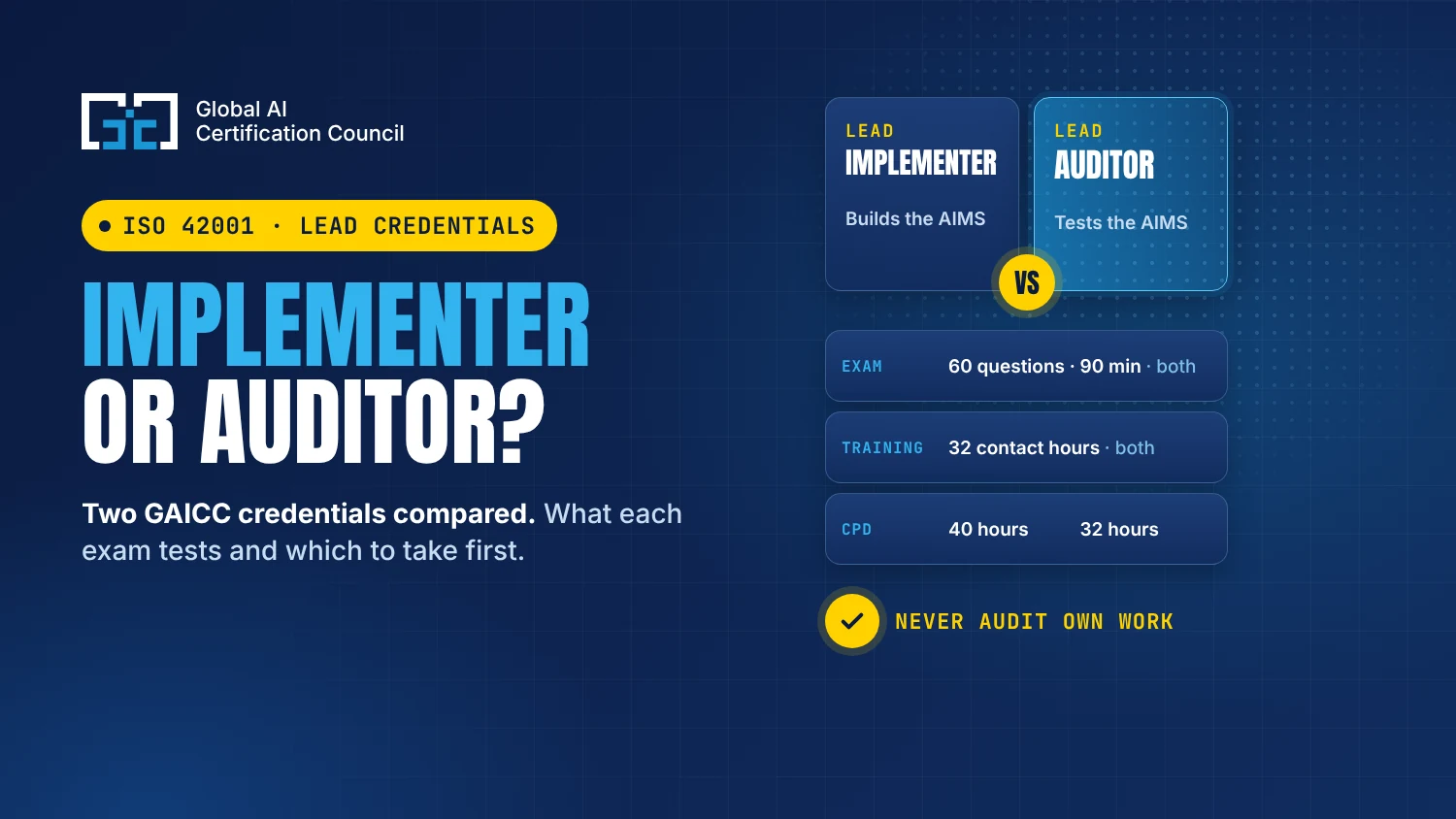
The GAICC ISO/IEC 42001 Lead Implementer is a personnel credential confirming that a person can lead the build of an AI management system (AIMS). Its partner credential, the GAICC Lead Auditor, confirms that a person can lead audits of such a system. Both exams share one format and one domain structure. The difference sits in the verb of every task. The implementer defines and builds; the auditor verifies and judges. On any single AIMS, one person should not hold both roles for the same work.
Both credentials certify people. A company earns ISO/IEC 42001 certification only from a certification body that audits its AIMS, a distinction set out in person versus organization certification. GAICC issues both, and this comparison covers what each one certifies and where the two roles meet on a project. It also sets out the separation rules and the first credential to fund.
Lead Implementer and Lead Auditor at a glance
The Lead Implementer and Lead Auditor credentials differ in purpose, examined standards and renewal hours, but share one exam format. The table draws on the Lead Implementer Candidate Handbook and the Lead Auditor Candidate Handbook (1st edition, June 2026). Where a course page says something different, the Handbooks govern.
| Attribute | Lead Implementer | Lead Auditor |
| What the Handbook says it confirms | Competence to lead an AIMS implementation program: scoping, AI risk and impact assessment, lifecycle controls, operational procedures and audit readiness | Competence to lead second-party and initial third-party AIMS audits at Stage 1 and Stage 2 |
| Core activity | Builds, runs and improves the AIMS | Plans audits, samples evidence, grades findings and reports |
| Who it is for (Handbook) | Professionals leading or supporting an AIMS implementation | Auditors and governance professionals leading AIMS audits |
| Standards examined | ISO/IEC 42001:2023 plus ISO 19011 | ISO/IEC 42001:2023, ISO 19011 and ISO/IEC 17021-1:2015 |
| Exam | 60 questions, 90 minutes, 70% pass mark, closed book | Same |
| Question types | 45 single-answer and 15 multi-answer, no partial credit | Same |
| Domain weights | 25%, 40%, 20%, 15% | 25%, 40%, 20%, 15% |
| Training prerequisite | 32 contact hours of implementation training | 32 contact hours of Lead Auditor training |
| Recommended background | Foundation-level knowledge; implementation experience helps | Foundation-level knowledge and familiarity with auditing |
| Renewal every three years | 40 CPD hours | 32 CPD hours |
Google’s AI Overview for this query, captured on 4 October 2026, said both credentials typically need a five-day, 40-hour accredited course. At GAICC, each needs 32 contact hours. Only the two Senior tiers ask for 40. The Lead Auditor Handbook also names ISO/IEC 17021-1, the standard that governs certification bodies. The implementer paper leaves it out. Exam rules for the build side, from scoring to resits, sit with the Lead Implementer exam questions and pass mark. The audit side has its own Lead Auditor exam guide.
What the two GAICC exam outlines test
GAICC’s two Examination Content Outlines (ECOs) use the same four domains at the same weights, and they pair up task for task. Each outline lists 19 tasks. Every auditor task mirrors an implementer task on the same subject. Side by side, the two outlines read like two columns of one ledger kept by different people. The task names below are shortened from the Lead Implementer ECO and the Lead Auditor ECO.
| Domain and weight | Lead Implementer task | Lead Auditor task |
| Domain I (25%): governance and leadership | Define the AIMS scope and its context | Verify the scope and context definition |
| Develop and approve the AI policy | Assess the policy’s adequacy and alignment | |
| Assign AI governance roles | Confirm the roles were assigned | |
| Integrate AI objectives into strategy | Evaluate how objectives were integrated | |
| Promote leadership accountability | Assess leadership accountability | |
| Domain II (40%): implementation and operations | Perform the AI risk and impact assessments | Evaluate how effective those assessments are |
| Implement data governance and lifecycle controls | Verify those controls were implemented | |
| Ensure resources and competence | Assess resource and competence adequacy | |
| Control documented information | Audit document control | |
| Operate and monitor AI systems | Examine operation and monitoring | |
| Domain III (20%): performance and improvement | Monitor performance against metrics | Assess the monitoring itself |
| Conduct internal audits and management reviews | Verify they happened and worked | |
| Address nonconformities | Evaluate corrective action | |
| Promote continual improvement | Review improvement mechanisms | |
| Maintain certification readiness | Confirm certification readiness | |
| Domain IV (15%): ethics, transparency, engagement | Embed ethical principles | Evaluate how they were embedded |
| Provide transparency and explainability | Verify transparency and explainability | |
| Engage stakeholders on AI impacts | Assess stakeholder engagement | |
| Align suppliers with AIMS requirements | Audit supplier alignment |
Read across any row and the subject stays fixed while the verb flips: define, develop, assign and perform become verify, assess, confirm and evaluate. That verb tells you which job each credential prepares you for. A candidate who sits both exams meets the same clauses twice, once from each side.
Both outlines also test the same three levels of thinking: understanding, application, and analysis and evaluation. At the application level the two papers part ways. The implementer paper asks for practical implementation of controls, while the auditor paper asks for audit methods that weigh evidence and test controls.
One overlap trips people up. The implementer outline includes conducting internal audits and management reviews, so an implementer is expected to run and schedule the internal audit program. That person should not audit what they built. The objectivity rule in clause 9.2.2 and the certification-body rules set that limit.
One AIMS project, seen from both roles
On a single AIMS project, the Lead Implementer creates the evidence and the Lead Auditor decides whether that evidence shows conformity. The mapping below is GAICC editorial analysis, and its clause titles follow the published table of contents of ISO/IEC 42001:2023.
| Project phase | What the implementer produces | What an auditor tests | Independence point |
| Context and scope (4.1 to 4.3) | Scope statement, AI roles held, interested parties | Whether the scope matches the AI systems in actual use | The scope author should not audit it |
| Leadership (5.2, 5.3) | AI policy and the assigned AIMS responsibilities | Whether the policy is approved, communicated and reviewed | Policy ownership stays with top management |
| Planning (6.1.2 to 6.1.4) | Risk assessment, impact assessments, treatment plan, Statement of Applicability | Whether each control choice traces to risk and impact results | Assessors should not grade their own assessments |
| Operation (8.1 to 8.4) | Running controls; repeat risk and impact assessments | Whether records show controls working over time | Sample records the auditor did not create |
| Internal audit (9.2) | The audit program, schedule and auditor selection | Conformity and effectiveness of the whole AIMS | Clause 9.2.2 objectivity applies here |
| Management review (9.3) | Review inputs, decisions and follow-up | Whether reviews took place and drove action | Reviewers and auditors stay separate |
| Certification audit | Evidence index and corrective actions | Stage 1 readiness, then Stage 2 effectiveness | The certification body may not have consulted |
| Surveillance | A maintained, improving system | A sample of processes, at least yearly | Same body, same impartiality rules |
Two rows carry most of the relationship. The internal audit is the first point where the two roles meet inside the organization. A certification body later checks that meeting, because under ISO/IEC 17021-1 its Stage 1 audit checks whether internal audits and management reviews are planned and carried out. Guidance on running an internal audit program covers the design of that program. What the certification body does at each stage is set out in the Stage 1 and Stage 2 certification audit.
The leadership row matters for a different reason. Clause 5.3 asks top management to assign responsibility for AIMS conformity and for reporting AIMS performance. Where those duties sit with the Lead Implementer, that person should not also audit them. A full split of duties appears under AIMS roles and responsibilities.
[TRAINER INSIGHT NEEDED: When GAICC Lead Auditor trainees sample a mock AIMS in class, which implementer outputs fail most often, and what is usually missing from them?]
Independence rules that keep the two roles apart
Independence rules work at three levels: inside the organization, at the certification body, and in each certified person’s code of conduct. Together they explain why the build role and the audit role need different people on the same system.
Internal audit under clause 9.2
ISO/IEC 42001 clause 9.2 requires internal audits at planned intervals. Clause 9.2.2 then asks the organization to select its auditors and run each audit so that the whole process stays objective and impartial. The standard does not mention the implementer by name. In practice, that means nobody audits a procedure, assessment or control they wrote. ISO 19011, the auditing guidance that both GAICC papers draw on, lists independence among its principles of auditing.
The rule weighs most on small teams. A note to the audit definition in clause 3.18 gives them an option, because an external party may run the internal audit on the organization’s behalf.
Certification bodies under ISO/IEC 17021-1 and 42006
Certification bodies work to ISO/IEC 17021-1, which sets requirements for the competence, consistency and impartiality of bodies that certify management systems. ISO/IEC 42006:2025 layers AI-specific rules on top for the bodies that certify AI management systems. Under the published text, a certification body may not consult on management systems for AI, information security, data protection or risk management for its own certification clients. Nor may it run their internal audits, under any label. One activity the standard expressly permits is pre-audit work whose sole purpose is to set the audit scope and check whether the client is ready.
The ban binds the whole certification body, so it cannot help build an AIMS and then certify it, whoever it sends.
The certified person’s code of conduct
Both Candidate Handbooks bind certified people to act with integrity, competence and objectivity, and both outlines add a code of conduct. Its first principle asks holders to work without bias, conflict of interest or misrepresentation of their competence. For an auditor, that rule is tested on every job.
| Audit type | Who audits | Can the AIMS builder audit it? | Rule behind the answer |
| First party (internal) | Staff, or an external party acting for the organization | Not the parts they built | ISO/IEC 42001 clause 9.2.2; clause 3.18 note on external parties |
| Second party (customer audits a supplier) | The customer’s own auditors | Only with no part in the supplier’s AIMS | Contract terms; independence principle in ISO 19011 |
| Third party (certification) | An accredited certification body’s audit team | No, and the body may not consult either | ISO/IEC 17021-1; ISO/IEC 42006 |
Which credential to train or hire first
The first credential to fund depends on where the organization stands in its AIMS cycle. Exam difficulty is a poor guide. Both papers share one format. The table is GAICC guidance for common situations.
| Situation | Train or hire first | Add next | Why |
| Building an AIMS from nothing | Lead Implementer | An internal auditor who did not build it | Every early output is build work |
| Certification audit planned within a year | Lead Implementer for the AIMS owner | Internal Auditor or Lead Auditor, held by someone else | Stage 1 checks that internal audits are planned and performed |
| Internal audits at planned intervals | Internal Auditor | Lead Auditor if the team also audits suppliers | The Internal Auditor credential targets first-party audits |
| Supplier assurance for third-party AI | Lead Auditor | Lead Implementer for whoever fixes findings at home | The Lead Auditor Handbook names second-party audits |
| Consulting firm | Lead Implementer for delivery staff | Lead Auditor for a separate audit team | One consultant cannot audit their own build |
| Certification body | Lead Auditor | Senior Lead Auditor for audit team leaders | The body’s own competence rules also apply |
For the person who will own the system, the ISO 42001 Lead Implementer course supplies the 32 training hours the exam asks for. It runs 16 modules over four days. For an audit seat, the Lead Auditor course does the same on the audit side.
Lead Implementer fees, and what an organization pays for its own certification audit, are set out in how much the credential costs.
The AI Overview captured on 4 October 2026 ends by asking about your background and whether you aim at internal work or third-party consulting. Four routes cover the common answers.
- Coming from project, GRC or product work and expecting to own the AIMS: start with Lead Implementer.
- Already auditing to ISO/IEC 27001 or ISO 9001: Lead Auditor builds on that habit, while Annex A of ISO/IEC 42001 adds new AI subject matter.
- Building or deploying your own AI systems: implementer skill first.
- Mainly buying AI and seeking vendor assurance: the auditor skill pays off sooner.
When one person runs AI governance
A one-person governance function cannot audit its own AIMS with credibility, so it needs a second pair of eyes from somewhere outside the build. Three patterns work. The organization can bring in an external party to run the internal audit, which clause 3.18 allows. It can train someone from another function, such as the ISO/IEC 27001 internal auditor, to audit the AIMS processes they had no hand in. A larger team can also split areas so that nobody audits their own work.
When a consultancy holds both credentials
A consulting firm can deliver implementation for one client and internal audits for another. On the same client, the separation has to be visible in the records: different people, and no auditor sampling work they produced. A firm that is also a certification body faces the stricter rule above and cannot consult on those management systems for its certification clients.
What a certification body checks beyond the credential
A Lead Auditor credential is evidence of competence, but a certification body still has to qualify each auditor against ISO/IEC 42006. The standard lists what an audit team must show. Together, its members must know every Annex A control of ISO/IEC 42001, how each is implemented and the legal obligations that apply to AI. Each auditor needs knowledge of AI, management systems, the principles of auditing and AIMS monitoring. Knowledge of the audited work’s technical side can be shared across the team.
Those rules carry weight in the United States, where the ANAB directory listed 20 accredited certification bodies for ISO/IEC 42001 on 4 October 2026. Each one needs auditors who meet that list. It doubles as a hiring checklist for an internal audit lead.
No GAICC study of US job postings for either credential exists yet. Job titles and entry routes for the build side are covered in roles this credential opens.
For a first-person view of the build route, read one candidate’s Lead Implementer certification journey. If a legal or privacy credential is also on the table, the AIGP and ISO 42001 course comparison puts a third option beside these two.
Six GAICC credentials in two branches
GAICC issues six ISO/IEC 42001 credentials in two branches that grow from one Foundation level. The figures come from the June 2026 Candidate Handbooks.
| Credential | Branch | What the Handbook says it confirms | Exam | Training hours |
| Foundation | Shared entry | Awareness of the AIMS: its purpose, structure and core concepts | 40 questions, 60 minutes | 16 |
| Lead Implementer | Build | Leading an AIMS implementation program | 60 questions, 90 minutes | 32 |
| Senior Lead Implementer | Build | Architecting, leading and governing enterprise-wide implementations | 80 questions, 120 minutes | 40 |
| Internal Auditor | Audit | Planning, performing, documenting and reporting internal audits | 60 questions, 90 minutes | 32 |
| Lead Auditor | Audit | Leading second-party and initial third-party audits | 60 questions, 90 minutes | 32 |
| Senior Lead Auditor | Audit | Leading third-party audits on complex multi-site, multi-standard engagements | 80 questions, 120 minutes | 40 |
The Senior tiers carry experience gates. Senior Lead Implementer expects Lead Implementer competence plus significant implementation or governance experience, and Senior Lead Auditor expects Lead Auditor competence plus significant AIMS or ISMS audit experience. The Internal Auditor credential, a third option, suits staff who audit their own organization and do not plan to lead supplier or certification audits. To see every tier with its course format, compare the course levels.
Holding both credentials
Holding both credentials makes sense for consultants and for audit leads who coach implementers. Choose the order by the work in front of you. Renewal also differs by credential: 40 CPD hours per cycle for Lead Implementer and 32 for Lead Auditor. Ask GAICC how one activity counts across two cycles before you plan your CPD.
[TRAINER INSIGHT NEEDED: In recent GAICC cohorts, what share of Lead Auditor candidates already held the Lead Implementer credential, and did their Domain II results differ from first-time candidates?]
Frequently asked questions
What is an ISO 42001 Lead Implementer?
A Lead Implementer is the person who plans and leads the build of an AI management system to ISO/IEC 42001. GAICC’s Handbook says its Lead Implementer credential confirms competence to lead that program. It names scoping, AI risk and impact assessment, lifecycle controls, operational procedures and audit readiness as the core of the work.
How do I become an ISO 42001 Lead Auditor with GAICC?
Complete at least 32 contact hours of structured ISO/IEC 42001 Lead Auditor training. Then pass a closed-book exam of 60 questions in 90 minutes at the 70 percent mark. The Lead Auditor Handbook recommends Foundation-level knowledge and familiarity with auditing, and the credential renews every three years with 32 CPD hours.
Do I need the Lead Implementer credential before the Lead Auditor?
No, neither Handbook lists the other credential as a prerequisite, since each asks for its own 32 hours of training and recommends Foundation-level knowledge. Pick the one that matches your current work. For a whole team, the staffing table above suggests an order.
Can the person who implemented the AIMS also audit it?
Not for the parts they built, because clause 9.2.2 requires internal audits that stay objective and impartial. An implementer may manage the audit program but should not audit their own procedures, assessments or controls. The note to clause 3.18 also lets an external party run the internal audit instead.
Does a Lead Auditor credential qualify me to audit for a certification body?
Not on its own, since a certification body must still check each auditor against its own criteria under ISO/IEC 42006. Those criteria cover AI, the audited activity, management systems, auditing principles and AIMS monitoring. The audit team as a whole must also know every Annex A control and the legal obligations that apply to AI.
Do the two credentials renew the same way?
Both last three years and both require you to reaffirm the GAICC Code of Ethics, but the hours differ. The Lead Implementer Handbook asks for 40 CPD hours per cycle, split 15, 15, 5 and 5. The Lead Auditor Handbook asks for 32, split 11, 11, 5 and 5 across learning, practice, contribution and elective activity.