
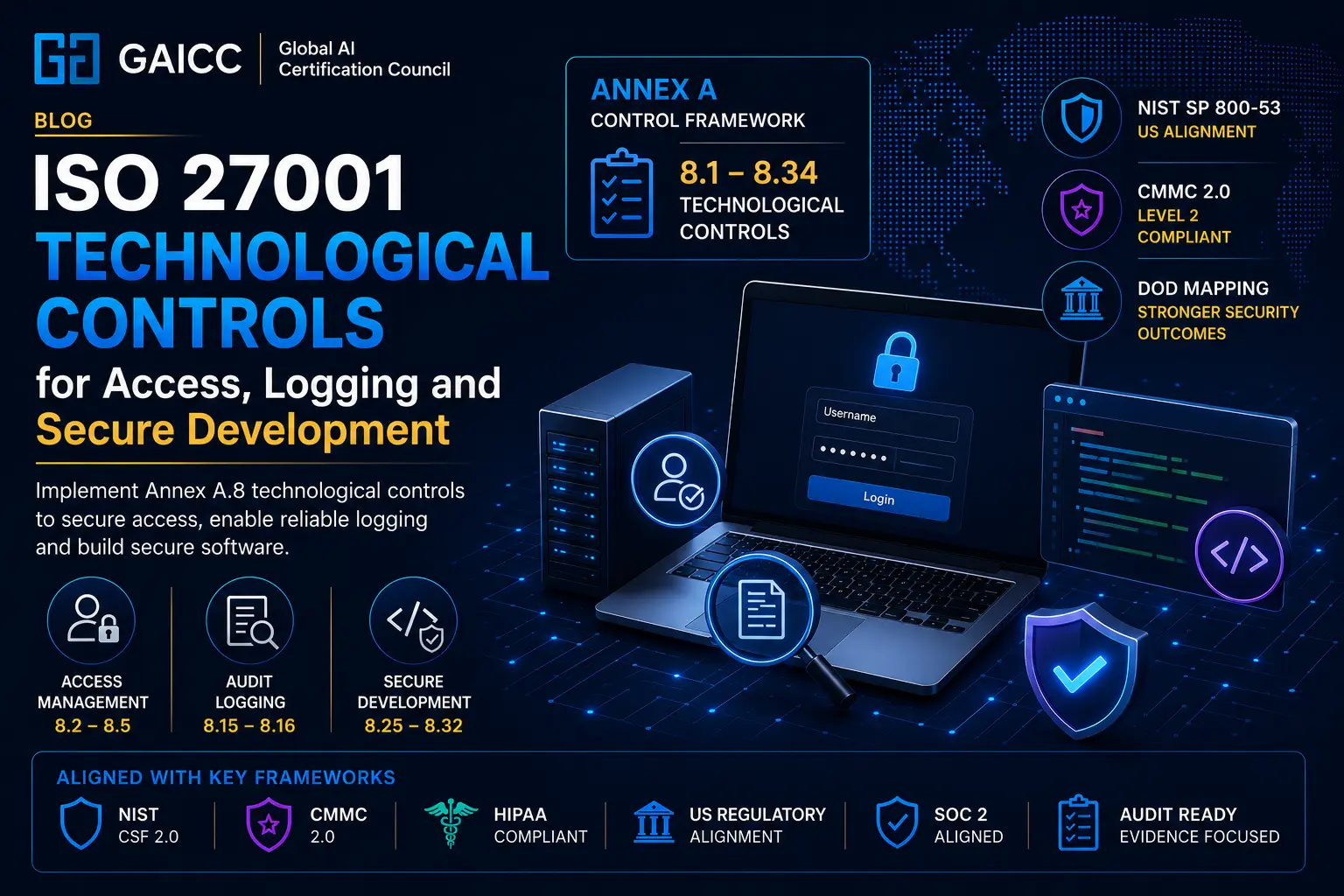
ISO 27001:2022 reorganized its control landscape significantly. The 2013 version carried 114 controls across 14 categories; the 2022 revision consolidated and expanded this into 93 controls across four themes: organizational, people, physical, and technological. The technological controls Annex A clauses 8.1 through 8.34 represent the largest single category, covering 34 controls that govern how organizations secure information through technical means.
Three of those 34 controls draw disproportionate audit attention: access management (8.2–8.5), audit logging (8.15–8.16), and secure development (8.25–8.32). Together, they account for roughly 40% of the technological control set and align directly with the domains most scrutinized by US regulators under NIST SP 800-53, CMMC 2.0, and HIPAA’s technical safeguard requirements.
Understanding why these three clusters matter more than others requires looking at what data breaches actually look like. According to IBM’s 2023 Cost of a Data Breach Report, compromised credentials account for the most common initial attack vector at 19% of incidents, inadequate logging means most breaches go undetected for an average of 204 days, and insecure code introduced during development creates vulnerabilities that are 6x more expensive to remediate post-production than pre-deployment. ISO 27001’s technological controls are structured precisely around these three failure patterns.
Access Management Controls: Beyond Username and Password
Access management under ISO 27001:2022 spans controls 8.2 through 8.5, covering privileged access rights, information access restriction, authentication, and access control implementation. What makes these controls distinct from earlier ISMS frameworks is their explicit alignment with zero trust principles a shift that mirrors the trajectory of US federal security guidance under NIST SP 800-207.
Control 8.2 (Privileged Access Rights) requires organizations to maintain a process for allocating, reviewing, and revoking elevated permissions. The key phrase in the standard is “on a need-to-use basis” not “need-to-know,” which governs data classification, but need-to-use, which governs runtime access to systems. In practice, this means implementing just-in-time (JIT) privileged access workflows rather than standing administrative accounts. Any user with permanent local admin rights on their workstation is, by this control’s intent, a compliance gap.
Control 8.3 (Information Access Restriction) connects to your organization’s information classification scheme. Access permissions must align with the sensitivity labels applied during Annex A clause 5.12 classification. A file tagged “Confidential” should not be accessible to all authenticated users by default role-based access control (RBAC) must enforce boundaries that match the classification hierarchy.
US Regulatory Alignment: Access Controls: ISO 27001 Clause 8.2–8.5 maps directly to NIST SP 800-53 AC-2 (Account Management), AC-3 (Access Enforcement), AC-6 (Least Privilege), and IA-5 (Authenticator Management). For HIPAA-covered entities, these controls satisfy the Technical Safeguard requirements at 45 CFR §164.312(a)(2)(i) and (d).
ISO 27001 Access Controls vs. US Framework Mappings
| ISO 27001:2022 Control | Control Name | NIST SP 800-53 | CMMC 2.0 Practice | HIPAA Technical Safeguard |
|---|---|---|---|---|
| 8.2 | Privileged Access Rights | AC-6, AC-2 | AC.L2-3.1.6 | §164.312(a)(2)(i) |
| 8.3 | Information Access Restriction | AC-3, AC-16 | AC.L1-3.1.1 | §164.312(a)(1) |
| 8.4 | Access to Source Code | CM-2, SA-10 | CM.L2-3.4.1 | N/A |
| 8.5 | Secure Authentication | IA-2, IA-5 | IA.L2-3.5.3 | §164.312(d) |
Authentication and Identity: What the Standard Actually Requires
Control 8.4 (Access to Source Code) and 8.5 (Secure Authentication) address two different dimensions of identity assurance. On source code access specifically: the standard requires organizations to restrict modification rights to development environments, implement version control with access audit trails, and separate development from production access. This matters because supply chain attacks increasingly target developer credentials the SolarWinds compromise, the Codecov incident, and the recent GitHub Actions vulnerabilities all exploited this exact gap.
For secure authentication (8.5), the standard avoids mandating specific technologies but requires that authentication mechanisms match the risk level of the assets being protected. For US organizations, this aligns with NIST SP 800-63B’s authenticator assurance levels:
Translating this for practical implementation: any system processing sensitive business information should require at minimum AAL2 (phishing-resistant MFA such as FIDO2 or PIV). Systems in scope for CMMC 2.0 Level 2 must meet the corresponding NIST SP 800-171 requirement 3.5.3, which mandates multi-factor authentication for privileged and non-privileged accounts accessing Controlled Unclassified Information (CUI).
Audit Logging Controls: Building a Forensic Evidence Chain
Logging is one of those controls that organizations implement then fail to implement well. Having logs and having useful logs are not the same thing. ISO 27001:2022 addresses this through two related controls: 8.15 (Logging) and 8.16 (Monitoring Activities), with supporting requirements in 8.17 (Clock Synchronization).
Control 8.15 specifies that logs must capture user activities, exceptions, faults, and information security events. More specifically, each log entry must include the user identifier, the type of event, the date and time, the device or location identifier, and the success or failure of the activity. This is more prescriptive than many organizations realize a log that records “user logged in” without the source IP, timestamp, and outcome fails the control’s requirements.
The “protected” aspect of 8.15 is equally important. Log integrity must be maintained such that logs cannot be modified or deleted by the same users whose activities they record. This means administrative staff should not have write or delete access to the security event logs generated by systems they manage. Technically, this is solved through log forwarding to a separate SIEM or centralized log management platform where access controls are distinct from the source systems. For US defense contractors, this requirement aligns with CMMC 2.0 practice AU.L2-3.3.1 and AU.L2-3.3.2.
Common Audit Finding: Incomplete Log Coverage: ISO 27001 auditors consistently flag two logging gaps: (1) cloud service logs not forwarded to the central SIEM SaaS platforms like Microsoft 365 and Salesforce generate audit logs that most organizations never collect; (2) privileged user activity logs stored in locations accessible to those same privileged users, which breaks the integrity requirement of 8.15.
What to Log, How Long to Keep It and Why SIEM Architecture Matters
Control 8.16 (Monitoring Activities) requires organizations to monitor networks, systems, and applications for anomalous behavior. The practical implication is that logging without monitoring is incomplete compliance. Your ISMS must document not just what you log but how those logs are reviewed automated detection rules, alert thresholds, review cadences, and escalation procedures.
Retention periods are not specified in the standard itself (unlike some US regulations), which means your Statement of Applicability and risk assessment must define them based on legal, regulatory, and operational requirements. For US organizations:
HIPAA requires audit log retention for six years from creation or last effective date. CMMC 2.0 follows NIST SP 800-171’s guidance of at least 90 days for online retention with longer archival periods. SEC Rule 17a-4 requires broker-dealers to retain electronic records for 3–6 years depending on record type. FedRAMP Moderate baseline requires 90-day online retention with one-year archival.
Clock synchronization (8.17) is often overlooked until the first forensic investigation reveals that logs from three different systems show timestamps that diverge by 47 minutes. NTP synchronization to a reliable time source, with monitoring to detect drift, is the baseline implementation requirement.
Secure Development Controls: Where Code Meets Compliance
The secure development cluster in ISO 27001:2022 spans controls 8.25 through 8.32 and represents the most substantial expansion from the 2013 standard. The 2013 version had a single control for development security (A.12.5.1); the 2022 revision now dedicates eight controls to the software development lifecycle. This reflects the shift in where breaches originate increasingly, attackers target code, not just credentials.
Control 8.25 (Secure Development Life Cycle) requires organizations to establish rules for secure software development that apply throughout the entire lifecycle, from requirements gathering to decommissioning. The standard explicitly requires that security requirements be defined at the requirements phase, not retrofitted during testing. For US organizations aligning with NIST SP 800-53, this corresponds to the SA (System and Services Acquisition) and SA-15 (Development Process, Standards, and Tools) controls.
GAICC ISO 27001 Lead Implementer: Secure Development Track: The GAICC ISO/IEC 27001 Lead Implementer certification includes a dedicated module on technological controls covering the 8.25–8.32 secure development cluster, with practical exercises on security requirements definition, SAST/DAST tool selection, and environment separation architecture.
ISO 27001:2022 Secure Development Controls Reference
| Control | Name | Key Requirement | NIST SP 800-53 Mapping |
|---|---|---|---|
| 8.25 | Secure Development Life Cycle | Security integrated at requirements phase | SA-3, SA-8 |
| 8.26 | Application Security Requirements | Security requirements documented before design | SA-4, SA-15 |
| 8.27 | Secure System Architecture & Engineering Principles | Security-by-design applied throughout | SA-8, SC-3 |
| 8.28 | Secure Coding | Coding standards address OWASP Top 10 | SA-11, SI-10 |
| 8.29 | Security Testing in Development | Testing integrated, documented, acceptance criteria set | SA-11, CA-2 |
| 8.30 | Outsourced Development | Third-party security requirements contractually defined | SA-9, SA-12 |
| 8.31 | Separation of Environments | Dev/test/prod separated; production data controls | CM-2, SC-3 |
| 8.32 | Change Management | Security impact assessed before changes deployed | CM-3, CM-4 |
If you want to understand how technological controls fit within the overall framework, explore the ISO 27001 Annex A controls list covering all four control themes introduced in ISO/IEC 27001:2022
Application Security Testing: What 8.29 Actually Requires
Control 8.29 (Security Testing in Development and Acceptance) requires that security testing be integrated into the development process. The standard lists several testing approaches without mandating specific tools: security requirement testing, vulnerability scanning, penetration testing, code review, and configuration verification.
The distinction that auditors focus on is whether testing is documented, repeatable, and tied to acceptance criteria. A penetration test conducted once at project launch, with no remediation verification, does not satisfy 8.29. What does satisfy it: a security testing plan that specifies which tests apply to which system types, defined pass/fail criteria for acceptance, documented test results, and evidence that identified vulnerabilities were tracked to closure.
For web applications in scope for PCI DSS, this aligns directly with Requirement 6.2.4 (web application security testing) and 11.3 (penetration testing). Many organizations find that implementing 8.29 systematically positions them for PCI DSS compliance as a secondary benefit.
Supply Chain and Third-Party Code: Control 8.30 and 8.31
Two controls that receive minimal attention but carry significant risk: 8.30 (Outsourced Development) and 8.31 (Separation of Development, Test and Production Environments).
On outsourced development: when third parties write code that runs in your environment, you inherit their security practices or lack thereof. Control 8.30 requires that your contractual arrangements with outsourced development partners include security requirements equivalent to those you apply internally, audit rights, and delivery standards that include security documentation. This is directly relevant to organizations using offshore development teams, open-source components with custom modifications, or SaaS platforms where vendor-managed code runs in your ISMS scope.
Environment separation (8.31) prohibits production data in development environments. This is more commonly violated than organizations realize developers who need “real data” to reproduce a bug often copy production records directly into dev environments, bypassing the access controls and data protection measures that apply in production. The control requires documented procedures for data transfer between environments, with sensitive data either anonymized or synthetically generated for development use.
Implementing These Controls: A Practical Sequence for US Organizations
Implementing 34 technological controls simultaneously is not realistic. Organizations that attempt a wholesale rollout typically produce policy documents that sit on SharePoint and controls that exist on paper only. The more effective approach sequences implementation by risk priority and regulatory deadline.
Start with access management specifically privileged access. The reason: privileged credential compromise is both the most common initial access vector and the one with the highest blast radius. Deploying a privileged access management (PAM) solution or implementing JIT access through Azure AD PIM, AWS IAM Identity Center, or CyberArk establishes the foundation that the rest of the access control stack builds on. Configure audit logging for privileged sessions as part of this deployment you get partial credit on 8.15 while completing 8.2.
Second priority: centralized logging architecture. Before you can satisfy 8.15 and 8.16 in a meaningful way, you need a SIEM or centralized log management platform that aggregates logs from network devices, servers, cloud services, and endpoints. Budget this carefully log ingestion costs at scale are significant, and poorly scoped SIEM deployments create ongoing cost overruns. Define what you must log (regulatory minimums) versus what you should log (risk-based additions) versus what you could log (operational nice-to-have) before signing a SIEM contract.
Third priority: secure development process. This is the longest runway to implement because it requires behavioral change across engineering teams, not just technology deployment. The sequence within this cluster: establish secure coding standards first (8.28), then integrate SAST tooling into the CI/CD pipeline (8.29), then address environment separation (8.31), then formalize security requirements for new projects (8.25–8.26). Each step builds on the previous one, and each produces artifacts coding standards, pipeline configurations, test reports that serve as audit evidence.
Implementation Timeline Benchmark: Based on typical US mid-market organizations (500–5,000 employees), the access management cluster requires 2–3 months to implement with tooling already in place; 4–6 months if PAM tooling must be procured and deployed. Centralized logging: 1–2 months for on-premises systems, 3–4 months when cloud services are in scope. Secure development process: 6–12 months for full lifecycle integration, depending on development team size and existing maturity.
Documenting Technological Controls in Your Statement of Applicability
The Statement of Applicability (SoA) is the single most important document in an ISO 27001 certification audit. For technological controls, the SoA must document three things per control: whether the control is applicable, if it is applicable how it is implemented and if any control is excluded the documented justification.
A common error: marking technological controls as “not applicable” without adequate justification. Access management controls (8.2–8.5) are rarely genuinely inapplicable auditors will challenge exclusions here. The circumstances where a control might legitimately not apply are narrow: a startup with two co-founders and no external staff could plausibly exclude privileged access management controls, but even then, the justification must be documented and defensible.
For each applicable technological control, the SoA should reference the specific policy, procedure, or technical implementation that satisfies it. “We have an access control policy” is not sufficient. “Privileged access rights are governed by our Privileged Access Management Policy (REF: POL-003), implemented through CyberArk Enterprise Password Vault (EPV), with quarterly access reviews documented in our Access Review Procedure (REF: PROC-018)” is what auditors need to see.
US organizations seeking SOC 2 Type II alongside ISO 27001 certification benefit significantly from this documentation discipline. The SOC 2 CC6 (Logical and Physical Access) and CC7 (System Operations) Common Criteria map closely to the ISO 27001 technological controls a well-documented SoA for ISO 27001 substantially reduces the evidence burden for SOC 2 auditors.
Technological controls are most effective when supported by strong ISO 27001 organizational controls that establish governance, risk ownership, supplier management, and security policies.
Continuous Monitoring: Keeping Technological Controls Effective Over Time
ISO 27001 certification is not a one-time achievement it requires annual surveillance audits and a three-year recertification cycle. Technological controls, more than any other category, degrade over time if not actively maintained. Access rights accumulate as employees change roles. Log sources get added without being connected to the SIEM. Secure coding standards become outdated as new vulnerability classes emerge.
Three processes keep technological controls audit-ready between surveillance visits:
Access rights reviews: Control 8.2 requires that privileged access rights be reviewed at regular intervals. “Regular intervals” should be defined in your access management policy quarterly is the standard for privileged accounts, annually for standard user accounts. These reviews must be documented, with evidence that inappropriate access was actually revoked, not just flagged.
Log review and alerting: Control 8.16 requires monitoring, which requires someone to actually review alerts. A SIEM with no one responding to alerts is security theater. Define response procedures for common alert types, set SLAs for triage, and document that alerts are being reviewed through regular operational reports.
Security testing cadence: Control 8.29 requires ongoing security testing, not a one-time assessment. Establish an annual penetration testing program for critical systems, quarterly vulnerability scanning for internet-facing assets, and SAST/DAST scanning for each significant release. The documentation trail from each testing cycle becomes your audit evidence.
For US organizations in regulated industries, this continuous monitoring posture also satisfies the monitoring requirements embedded in HIPAA’s ongoing compliance obligations, CMMC 2.0’s assessment methodology for Practice AC.L2-3.1.6, and the SEC’s 2023 cybersecurity disclosure rules that require material incident reporting within four business days.
Frequently Asked Questions
How do ISO 27001:2022 technological controls differ from the 2013 version?
The 2022 revision added 11 new technological controls that did not exist in the 2013 standard, including controls for data masking (8.11), data leakage prevention (8.12), monitoring activities (8.16), and web filtering (8.23). The secure development cluster expanded from one control to eight. Organizations certified under ISO 27001:2013 had until October 2025 to transition to the 2022 version.
Which ISO 27001 technological controls are most commonly cited in audit non-conformities?
Based on published audit findings, the most frequently cited technological control non-conformities are: incomplete log coverage (8.15), absence of monitoring procedures for log review (8.16), standing privileged access without periodic review (8.2), and missing security testing documentation (8.29). These four controls together account for a disproportionate share of audit findings.
Does ISO 27001 Annex A require a specific SIEM or logging tool?
No. ISO 27001 is technology-neutral and does not mandate specific products. Control 8.15 specifies functional requirements what must be logged, how logs must be protected but leaves tool selection to the organization. Commercial SIEM platforms (Splunk, Microsoft Sentinel, IBM QRadar) and open-source alternatives (Elastic SIEM, Wazuh) all satisfy the standard’s requirements when properly configured.
How does ISO 27001’s secure development framework compare to NIST SSDF?
The NIST Secure Software Development Framework (SSDF, SP 800-218) and ISO 27001’s 8.25–8.32 cluster cover similar ground but differ in depth. SSDF provides more prescriptive implementation guidance for software producers; ISO 27001’s controls are broader and apply to organizations that develop software for internal use as well as external distribution. They are complementary SSDF satisfies many of the ‘how’ questions that ISO 27001 raises at the ‘what’ level.
Are the ISO 27001 technological controls mandatory for certification?
Controls can be excluded from your ISMS scope if they are genuinely not applicable to your organization, provided the exclusion is documented and justified in the Statement of Applicability. However, most technological controls are broadly applicable, and auditors scrutinize exclusions carefully. Excluding access management or logging controls without a compelling, documented business or technical reason would likely result in an audit finding.
How should US healthcare organizations approach ISO 27001 technological controls alongside HIPAA?
The ISO 27001 technological controls and HIPAA Technical Safeguards (45 CFR §164.312) have significant overlap. HIPAA’s access control requirement maps to 8.2-8.5; audit controls map to 8.15–8.16; transmission security maps to 8.24 (encryption in transit). A well-scoped ISO 27001 implementation that addresses the technological controls will satisfy or substantially advance HIPAA compliance in the technical domain, though HIPAA’s administrative and physical safeguard requirements remain separately addressed.
Conclusion
The technological controls in ISO 27001:2022 are not abstract policy requirements they are a structured response to how information security incidents actually occur. Compromised credentials, undetected breaches, and exploited code vulnerabilities are the three most measurable failure patterns in modern security, and controls 8.2–8.5, 8.15–8.17, and 8.25–8.32 are designed precisely to address them.
For US organizations, the alignment between these controls and existing regulatory frameworks NIST SP 800-53, CMMC 2.0, HIPAA Technical Safeguards, SOC 2 CC6/CC7 means implementation work is never single-purpose. Investing in a robust privileged access management architecture and a mature centralized logging program satisfies ISO 27001 requirements while simultaneously advancing compliance across your entire regulatory landscape.
If your organization is pursuing ISO/IEC 27001 certification or preparing for a surveillance audit, the GAICC ISO/IEC 27001 Lead Implementer certification provides structured training on all 93 Annex A controls, with dedicated coverage of the technological control cluster and hands-on implementation exercises.