
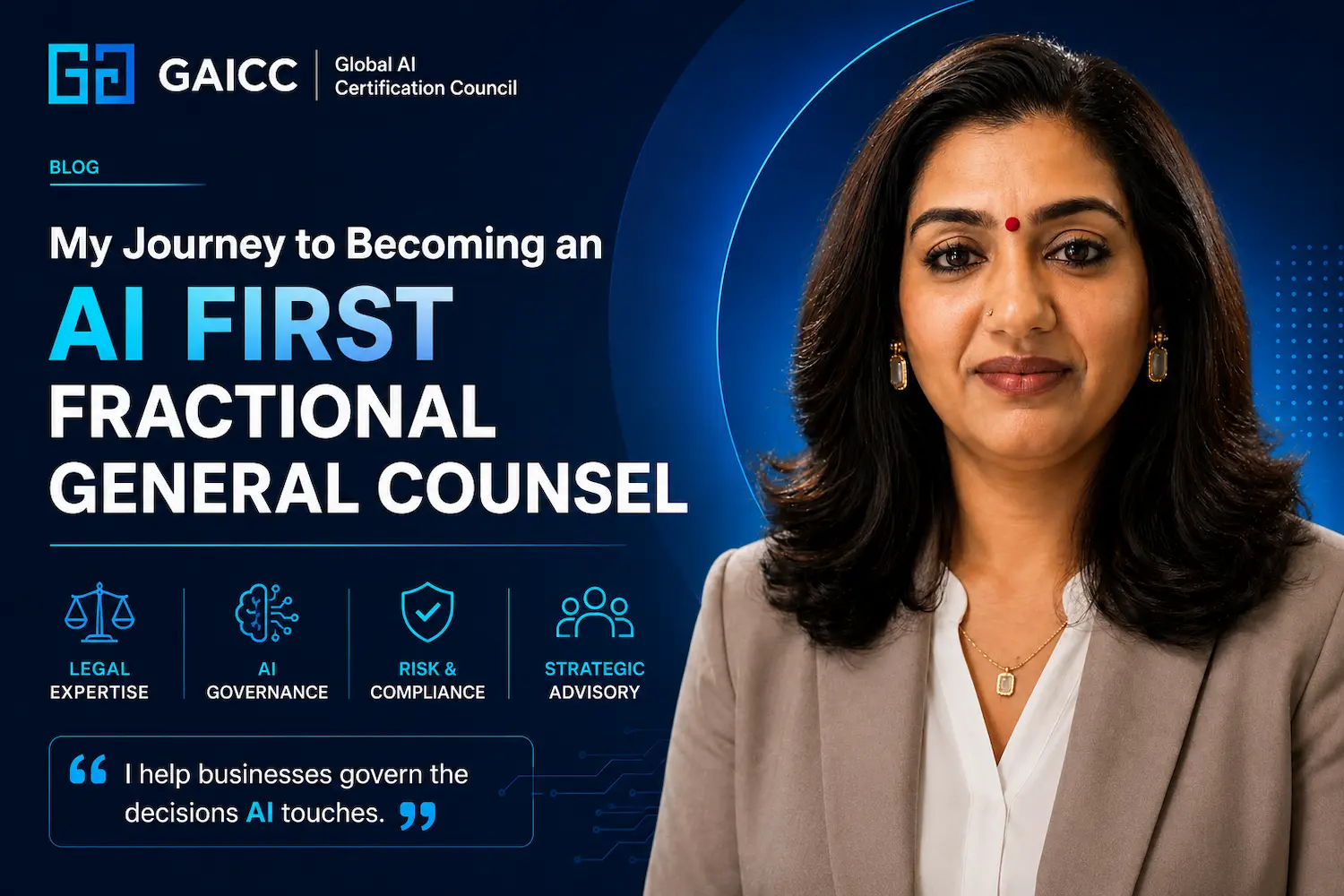
People often ask me why I call myself an AI First Fractional General Counsel.
The answer did not begin with AI.
It began with contracts.
Looking back, I realise that contracts became my gateway into AI Governance. That journey eventually changed not just what I do, but how I think about practising law.
The Question That Led Me From Contracts to AI Governance
About a year ago, the company I was working for encouraged everyone to start using Generative AI tools like ChatGPT to improve productivity.
Like everyone else, I was fascinated.
For the first time, I could question what felt like a cross domain expert. I could explore unfamiliar subjects in minutes instead of hours. It was exciting to watch how quickly people embraced the technology.
But while everyone around me was asking, “How can AI make us faster?” I found myself asking a different question.
“How do we protect ourselves if adoption moves faster than accountability?”
Perhaps that is simply how lawyers are wired.
We are trained to think about consequences before they become disputes.
That question changed the direction of my career.
When AI Started Changing Business Decisions Everywhere
Initially, I assumed AI would remain a technology initiative.
It did not.
It quietly found its way into every part of the business.
HR was using it to draft policies. Marketing was using it to generate campaigns. Finance teams were questioning contractual terms with AI. Lawyers were using it to understand HR processes.
Leadership teams were discussing AI as part of business strategy.
What fascinated me was not the technology itself. It was the way AI was influencing decisions.
The problem was not AI. The problem was not the people enthusiastically adopting it either.
The question was much simpler: Where were the boundaries?
What businesses really need is not another buzzword. They need clarity around responsibility, accountability, and ownership.
That is when I realised AI Governance is not really about governing artificial intelligence. It is about governing the human decisions that artificial intelligence influences.
How Contract Reviews Revealed Hidden AI Governance Risks
I have spent more than twenty years working across litigation, legal process outsourcing, enterprise legal leadership, technology contracting, and a startup co-founding journey.
Contracts have always been at the centre of my practice.
So when AI entered businesses, it entered my contracts first.
A founder wanted a SaaS agreement reviewed. A vendor agreement arrived for negotiation. An IP assignment landed on my desk.
The customer agreement never addressed AI generated outputs.
The vendor could potentially train models using customer information.
The liability clause assumed software remained static when AI systems continue to evolve after deployment.
The IP assignment never contemplated ownership of models or AI assisted work products.
I often summarise my journey this way:
“I was not looking for AI Governance. AI Governance found me inside the contracts I was already reviewing.”
People rarely approach me asking for AI Governance. They ask me to review agreements. The governance questions emerge from there.
A missing clause often reveals a missing business decision. An undefined responsibility usually points to an undefined owner.
The contract becomes the first place where business decisions about AI become legally visible.
Building AI Governance Expertise Beyond Traditional Legal Skills
AIGP gave structure to the questions I was already asking.
From there I pursued ISO/IEC 42001 Lead Implementer, followed by ISO/IEC 27701, and I am currently pursuing ISO/IEC 27001.
Along the way I immersed myself in the NIST AI Risk Management Framework, ISO/IEC 23894, and ISO 31000.
One framework always led to another.
One question uncovered ten more.
The learning never really stops.
As legal professionals move into AI advisory roles, structured programs like the AI Law and Compliance Professional certification help build practical knowledge around AI regulations, liability, governance frameworks, and responsible AI adoption.
Why I Moved From Legal Leadership to AI Governance Advisory
The more I learnt, the more I realised that AI was not simply changing legal work.
It was changing the way businesses were being built, operated, and scaled.
At the time, I was a VP and leading Legal and Compliance within an organisation, watching these changes unfold from the inside.
It was a role I genuinely enjoyed, but I also found myself wanting to be closer to where these decisions were being made.
I did not want to wait until an issue reached Legal.
I wanted to be part of the conversation when products were being designed, vendors were being selected, customers were being onboarded, and founders were making strategic decisions about AI.
That led me to make one of the biggest decisions of my career.
I stepped away from employment to build my own practice.
Not because I wanted to practise less law.
Because I wanted to practise it differently.
The Fractional General Counsel model gave me exactly that opportunity.
It allowed me to embed with businesses, understand how they operate, and help shape decisions before they became contracts, disputes, or regulatory issues.
Looking back, that transition feels like a natural extension of everything I had been learning.
What AI Governance Taught Me as a Lawyer
When people ask me what skills helped me make this transition, they are often expecting me to talk about certifications.
The certifications certainly helped.
They gave me structure, a common vocabulary, and a way to connect the many moving parts of AI Governance.
But they were not the most important part of the journey.
If anything, they helped me make sense of something I was already beginning to see in practice.
One thing I noticed very quickly was that AI governance gaps rarely announce themselves.
They do not usually appear as glaring legal issues.
They hide in what is missing.
A contract that says nothing about training data.
No clarity on who owns AI generated outputs.
No discussion about what happens if a model changes after deployment.
No obvious owner when an AI assisted decision causes harm.
Over the years, I had learnt to read contracts for what they say.
AI Governance taught me to pay just as much attention to what they do not say.
I also found myself becoming less interested in the technology itself and more interested in how decisions were being made around it.
Someone, somewhere in the organisation, was deciding to use AI, approve a vendor, rely on an output, or accept a risk.
Those decisions did not stop being business decisions simply because AI was involved.
Looking back, I think that is what made this transition feel so natural.
I was not learning an entirely new discipline.
I was applying the same commercial legal instincts I had developed over two decades to a new generation of business problems.
Why I Became an AI First Fractional General Counsel
A Fractional General Counsel describes my delivery model.
AI First describes my lens.
I use AI to eliminate repetitive legal work so that clients pay for judgment, not administration.
More importantly, every business I advise today is influenced by AI in some way.
AI is reshaping business decisions.
That means legal advice must evolve too.
How I Help Clients Today With AI Governance and Legal Strategy
My work still begins where it always has, with contracts.
Contracts remain my entry point.
They are what I am well known in the market for.
AI Governance is what they reveal.
My role is not to own governance for my clients.
It is to convene the right people, ask the uncomfortable questions, and ensure accountability sits with the function best placed to own it.
I do not govern AI.
I help businesses govern the decisions AI touches.
Looking Back
I never went looking for AI Governance.
I simply kept following the questions my contracts were asking.
Those questions led me to governance.
Governance led me to founders.
Working with founders led me to rethink what a modern General Counsel should look like.
That is how contracts became my gateway to AI Governance.
And that is why I call myself an AI First Fractional General Counsel.