
A single RFP can now ask for ISO/IEC 42001 evidence in the same breath as SOC 2 and HIPAA. That shift, happening quietly across US enterprise procurement through late 2025 and into 2026, is the real reason AI governance leads are suddenly knee-deep in documentation. The standard itself runs to roughly 40 pages, but the paper trail it demands is where most implementations stall.
ISO/IEC 42001:2023 is a certifiable international standard for an AI Management System (AIMS), and it treats documented information as the connective tissue of governance, not an administrative afterthought. This guide walks through every document the standard requires, what US auditors inspect during a two-stage certification audit, and how the paperwork maps to the NIST AI Risk Management Framework that many American organizations already use.
What Documented Information Actually Means in ISO/IEC 42001
ISO drops the word document in favor of a broader term: documented information. The distinction matters more than it looks.
Documented information covers two categories. Documents describe what your organization intends to do, such as policies, procedures, scope statements, and methodologies. Records provide evidence that the intended thing happened, such as audit reports, risk assessment outputs, training logs, and impact assessment results. Both fall under the standard’s documentation requirements, and auditors treat them differently.
The standard uses specific verbal cues to signal when something must be written down. When ISO/IEC 42001 says shall retain documented information, it means a record. When it says shall be available as documented information, it means a living document. When a clause says shall be documented, you need both the artifact and a control around it. Miss these cues and you will miss half the documentation set.
One clarification worth making early: ISO/IEC 42001 requires all Annex A controls to be documented, which is a departure from ISO 27001’s selective approach. Any control marked as applicable in the Statement of Applicability needs its own documentation trail, even if the implementation is minimal. This single rule accounts for roughly half the volume of a typical AIMS documentation library.
Why Documentation Is the Backbone of a Trustworthy AIMS
Trustworthy AI is a phrase that gets thrown around until it loses meaning. In ISO/IEC 42001, it has a concrete definition: an AI system whose governance is evidenced, not assumed. Documentation is how that evidence exists.
Consider what an external auditor cannot verify without paperwork: that a risk assessment happened before a model went to production, that the executive team actually reviewed AIMS performance, that engineers completed AI ethics training before deploying customer-facing models, that nonconformities were logged and corrected. Every one of these is a compliance failure waiting to surface if the record is missing or inconsistent.
The 2024 Gartner analysis of AI governance maturity found that organizations with structured documentation programs moved through certification 40% faster than those relying on ad-hoc evidence collection. The reason is less about efficiency and more about coherence. Auditors can triangulate documented claims across policy, procedure, and record in a way that ad-hoc notes never allow.
There is a second, less discussed benefit. Good documentation forces the uncomfortable conversations. Writing your AI policy in a way that survives legal review means someone, somewhere, has to decide how the company feels about using customer data for model training. Writing a risk methodology means agreeing on what unacceptable risk means in your context. These documents become decision-forcing instruments, not just compliance artifacts.
The Complete Document List, Clause by Clause
ISO/IEC 42001’s documentation requirements are distributed across clauses 4 through 10 and Annex A. Here is the inventory a US-based organization needs to prepare before a stage one audit.
Clause 4 Context and Scope
Three documented outputs anchor the earliest stage of AIMS design.
AIMS Scope Document. Defines the organizational boundaries of the AI Management System: which business units, which AI systems, which geographies, which roles in AI (developer, provider, user, deployer). Auditors will test the scope against your actual operations and flag any AI activity that has been quietly left out. For US multinationals, the scope document typically also references applicable regulations including emerging state AI laws like Colorado’s AI Act and the EU AI Act where extraterritorial reach applies.
Context and Stakeholder Analysis. A written account of internal and external issues influencing the AIMS, relevant stakeholders, and their requirements. This is where many teams underwrite their work. Auditors expect traceability from stakeholder requirements through to specific controls.
Interested Parties Register. A list of customers, regulators, investors, employees, affected communities, and suppliers with a clear statement of what each expects from the AIMS.
Clause 5 Leadership and Policy
AI Policy. The top-level policy document signed by executive leadership. It states the organization’s commitments on responsible AI, fairness, transparency, and accountability, and it references the AIMS objectives. Auditors read this closely because it sets the ceiling for every other document. A weak policy makes every downstream control look optional.
Roles, Responsibilities, and Authorities. A documented RACI or equivalent showing who owns the AIMS, who approves risk decisions, and who signs off on AI impact assessments.
Clause 6 Planning, Risk, and Impact Assessment
This is the documentation-heavy clause, and where ISO/IEC 42001 diverges most sharply from ISO 27001.
AI Risk Assessment Methodology. A documented method for identifying and evaluating AI-specific risks, including risks to individuals and society, not only risks to the organization. This dual lens is specific to ISO 42001.
AI Risk Assessment Results. The records produced by applying the methodology. Each risk assessment must capture threat sources, likelihood, impact, and existing controls.
AI Risk Treatment Plan. For each risk retained, a documented plan stating which Annex A controls will address it, who owns the treatment, and what the residual risk looks like.
Statement of Applicability (SoA). The cornerstone document of the entire AIMS. Every Annex A control is listed with one of three statuses: applied, partially applied, or excluded. Every entry requires a written justification. Advisera’s audit data shows that unjustified SoA exclusions are the single most common nonconformity cited in ISO/IEC 42001 certification audits.
AI System Impact Assessment. Unique to ISO 42001 and not found in ISO 27001. An impact assessment evaluates potential consequences of an AI system on individuals, groups, and society. It must cover the full lifecycle: design, data, training, deployment, and retirement. The AI Impact Assessment is often confused with the risk assessment. They overlap but are not the same. Risk assessment protects the organization. Impact assessment protects the people the AI touches.
AIMS Objectives. Measurable objectives derived from the AI policy, documented with owners, timelines, and review cadence.
Clause 7 Support, Competence, and Communication
Competence Records. Training records, qualifications, and evidence that people performing AIMS-related work are competent. This includes ML engineers, risk officers, and executive reviewers.
Awareness Program Documentation. Evidence that relevant personnel are aware of the AI policy, their contribution to the AIMS, and the consequences of nonconformance.
Communication Plan. A documented plan for internal and external AIMS-related communication, covering who communicates what, when, and to whom.
Document Control Procedure. A procedure for creating, approving, updating, and retiring documented information. It is the meta-document that governs all the other documents.
Clause 8 Operations and AI Lifecycle
Operational Planning and Control Records. Evidence that the organization plans, implements, and controls the processes needed to meet AIMS requirements, and that changes to AI systems are managed.
AI System Lifecycle Documentation. Records across design, development, deployment, operation, monitoring, and decommissioning for each AI system in scope. This is the most voluminous documentation set in a typical AIMS.
Data Governance Documentation. Records covering data acquisition, quality assurance, integrity, and security. ISO/IEC 42001 explicitly treats AI data as a governance concern, not only a security concern, and requires documented procedures.
Third-Party and Supplier Documentation. Contracts, SLAs, and due diligence records for any third parties providing AI components, data, or services.
Clause 9 Performance Evaluation
Monitoring, Measurement, Analysis, and Evaluation Records. Evidence that the AIMS is monitored against its objectives.
Internal Audit Programme and Results. A documented audit programme covering the full AIMS at planned intervals, plus records of every audit conducted.
Management Review Records. Minutes, inputs, and outputs of leadership reviews of the AIMS. Auditors inspect these carefully. A thin or missing management review record signals that executives are not actively governing the AIMS.
Clause 10 Improvement
Nonconformity and Corrective Action Records. Documented evidence of every identified nonconformity, its root cause analysis, corrective action, and verification of effectiveness.
Continual Improvement Evidence. Records showing that improvement opportunities are being captured and acted on across the AIMS.
The Four Cornerstone Documents Every AIMS Revolves Around
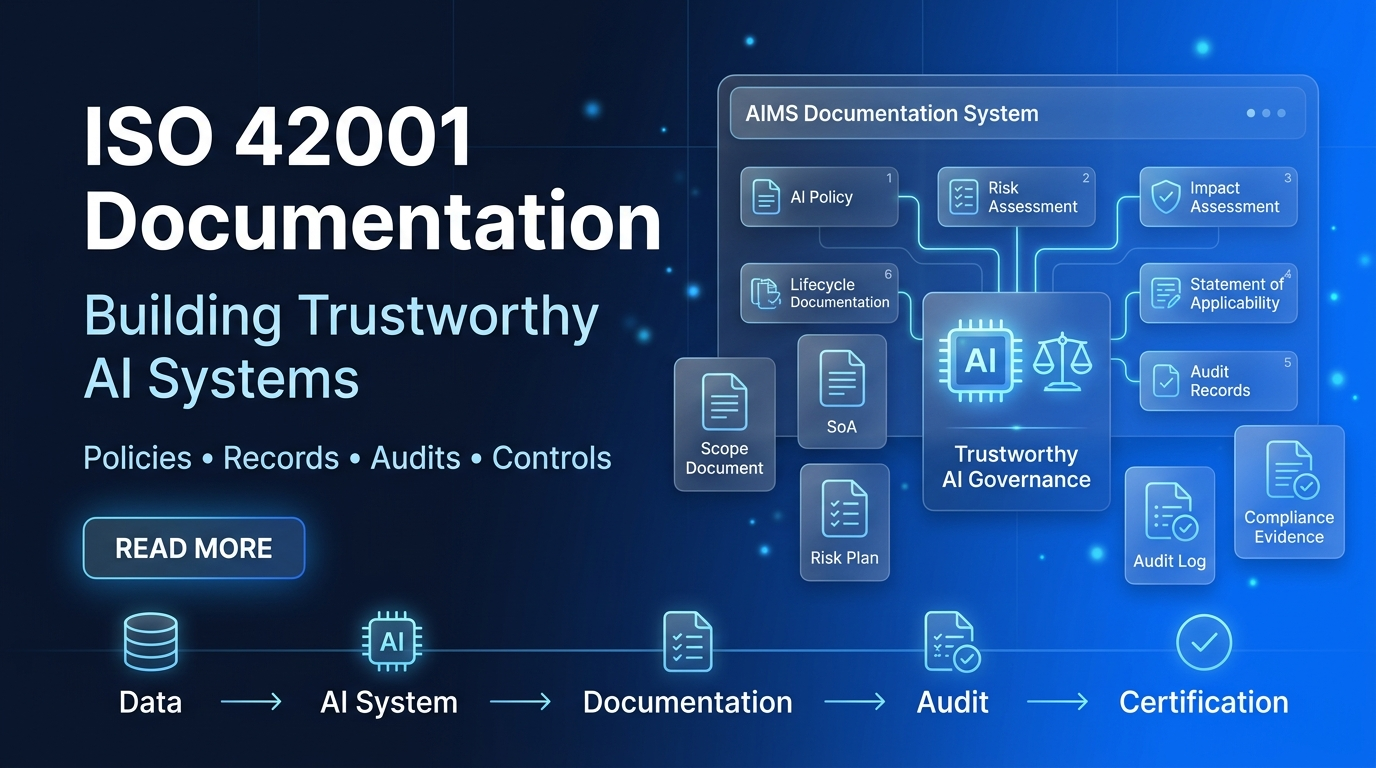
Not every document carries equal weight. Four artifacts function as the load-bearing structure of an ISO/IEC 42001 implementation, and auditors typically examine them first.
The AI Policy. This is the document most commonly written last and regretted most. A generic AI policy pulled from a template will not survive a stage two audit. The policy has to reflect the organization’s actual AI posture, cite specific regulations that apply, and set commitments that the rest of the AIMS can implement.
The AIMS Scope Document. Scope disputes kill more certifications than technical deficiencies. If the scope excludes AI systems that clearly fall within the organization’s operations, the auditor will challenge it. If the scope is too broad, the organization cannot demonstrate control over everything claimed.
The Statement of Applicability. The SoA is the single most inspected document in any ISO/IEC 42001 audit. Every Annex A control needs inclusion or exclusion with a written justification. The reason the SoA carries so much weight is practical. It is the auditor’s map for the entire rest of the audit.
The AI System Impact Assessment. This document is where ISO/IEC 42001 differentiates itself philosophically. A technically sound AIMS with a weak impact assessment will still fail the standard’s trustworthy AI test. US organizations working in consumer lending, healthcare, hiring, and public sector contracting should treat impact assessments as the differentiator, not the checkbox.
Annex A The Control-Level Documentation Most Teams Underestimate
Annex A of ISO/IEC 42001 contains 38 controls organized into nine objectives. Unlike ISO 27001, where controls are selective, every applicable control in ISO 42001 requires documentation. This single rule reshapes the documentation workload.
The nine Annex A objectives, and what each requires in practice:
| Annex A Objective | Documentation Focus |
|---|---|
| A.2 Policies related to AI | AI-specific policies supplementing the top-level AI policy |
| A.3 Internal organization | Defined responsibilities and reporting lines for AI |
| A.4 Resources for AI systems | Records of computing, data, tooling, and human resources allocated to AI |
| A.5 Assessing impacts of AI systems | Impact assessment procedures and results |
| A.6 AI system lifecycle | Design, development, deployment, operation, and retirement documentation |
| A.7 Data for AI systems | Data quality, provenance, and governance records |
| A.8 Information for interested parties | External-facing documentation on AI system behavior and limitations |
| A.9 Use of AI systems | Usage policies, acceptable use, and monitoring records |
| A.10 Third-party and customer relationships | Supplier due diligence and customer obligation records |
Teams underestimate the documentation effort here because Annex A looks like a checklist. In practice, each control requires a statement of how the organization implements it, evidence that the implementation is operational, and references from the SoA and risk treatment plan. A lean but complete Annex A documentation set for a mid-sized organization typically runs 30 to 50 individual artifacts.
AI Impact Assessments – The Document Unique to ISO/IEC 42001
If one document sets ISO/IEC 42001 apart from every other management system standard, it is the AI system impact assessment. It has no equivalent in ISO 27001, ISO 9001, or ISO 31000.
The assessment evaluates the potential consequences of an AI system on three populations: individuals, groups, and society at large. It must consider foreseeable misuse, the sensitivity of decisions being automated, the reversibility of outcomes, and the populations most likely to be affected. A 2025 OECD review of AI governance practices found that well-executed impact assessments surfaced risks in 68% of cases that traditional risk assessments had missed entirely.
The assessment typically includes:
- AI system description and purpose
- Intended use and foreseeable misuse
- Affected individuals, groups, and communities
- Categorization of potential harms (financial, physical, psychological, societal)
- Mitigation measures linked to specific Annex A controls
- Residual impact and acceptance criteria
- Review triggers (model updates, regulatory change, incident occurrence)
In the US context, impact assessments often double as evidence for state-level AI laws. Colorado’s AI Act and the New York City bias audit requirements both expect documentation that resembles an ISO 42001 impact assessment in substance. Writing one well means writing less overall.
How ISO/IEC 42001 Documentation Maps to NIST AI RMF
Most US organizations pursuing ISO/IEC 42001 have already implemented, or are implementing, the NIST AI Risk Management Framework. The frameworks overlap heavily, and the documentation can be unified rather than duplicated.
NIST AI RMF organizes around four functions: Govern, Map, Measure, and Manage. Each maps cleanly to ISO/IEC 42001 clauses and documents:
| NIST AI RMF Function | ISO/IEC 42001 Document Equivalent |
|---|---|
| Govern | AI Policy, Roles and Responsibilities, Management Review Records |
| Map | AIMS Scope, Context Analysis, AI System Inventory, Impact Assessments |
| Measure | Risk Assessment Methodology, Risk Assessment Results, Monitoring Records |
| Manage | Risk Treatment Plan, Statement of Applicability, Nonconformity Records |
The practical implication: an organization already running NIST AI RMF has 40 to 60% of the documentation substrate for ISO/IEC 42001 in place. The gaps tend to concentrate around the Statement of Applicability, the impact assessment format, and the formal internal audit and management review records that NIST AI RMF does not explicitly require.
The reverse is also true. An organization pursuing ISO/IEC 42001 first gains NIST AI RMF alignment almost for free, which matters for US federal contractors where NIST recognition is increasingly an expectation. NIST AI RMF is voluntary in the United States, but federal agencies and prime contractors increasingly reference it in procurement language, and several sector regulators including the OCC and FDA have issued guidance that aligns with NIST’s risk taxonomy.
What Auditors Actually Inspect (and Where Teams Lose Points)
Certification audits under ISO/IEC 42001 are conducted by accredited certification bodies and follow a two-stage model: a stage one readiness review and a stage two full audit. Having attended or prepared dozens of these audits, certain patterns repeat.
Coherence across documents. Auditors triangulate. If the AI policy commits to fairness testing, the risk methodology should address bias, the SoA should reflect relevant controls, and the impact assessment should evidence fairness analysis for specific systems. Any break in that chain produces findings.
Evidence of operation, not just existence. A documented procedure is not enough. Auditors will ask for records demonstrating the procedure has been followed, at least three instances, typically spanning different quarters.
Executive engagement. Management review records are scrutinized for signs of genuine governance versus rubber-stamping. Decisions, action items, resource reallocations, and risk acceptances carry weight. Meeting minutes that read AIMS performance was reviewed and found satisfactory almost always draw follow-up.
SoA justifications. Excluded controls need real justifications. Not applicable without context is the single most common audit finding in ISO/IEC 42001 certifications to date, according to published audit summaries from certification bodies operating in North America.
Impact assessment depth. A template filled with generic language fails. Auditors expect specific, system-by-system analysis with identified stakeholders, quantified or qualified harms, and mitigation links to actual controls.
Where teams lose the most points is rarely in missing documents. It is in documents that exist but do not connect to each other, to the AI systems they govern, or to the operational records that should evidence them.
A Phased Approach to Building Your AIMS Documentation
Trying to write 25+ documents in parallel guarantees inconsistency. A phased sequence produces better documentation faster.
Phase 1 – Foundation (weeks 1 to 4). Write the AIMS scope, AI policy, roles and responsibilities, document control procedure, and interested parties register. These establish the operating ground for everything else.
Phase 2 – Risk and impact (weeks 5 to 10). Develop the risk assessment methodology first, then apply it to produce actual risk assessment records. Build the AI system impact assessment template, then apply it to in-scope systems. Draft the first version of the Statement of Applicability, knowing it will iterate.
Phase 3 – Operations and Annex A (weeks 10 to 18). Work through Annex A controls in order of applicability, documenting implementation for each. Build the AI system lifecycle documentation in parallel. Capture data governance records.
Phase 4 – Performance and improvement (weeks 18 to 24). Establish the internal audit programme, conduct at least one internal audit cycle, and produce management review records. Start capturing nonconformity and corrective action records as issues surface.
Phase 5 – Certification readiness (weeks 24+). Close gaps surfaced by internal audit. Refine the SoA. Confirm that every documented claim has at least three operational records evidencing it. Book the stage one audit.
This sequence reflects the order a seasoned ISO/IEC 42001 Lead Implementer follows, and it aligns with the phased competence path that the GAICC Lead Implementer curriculum builds toward.
Frequently Asked Questions
1. How many mandatory documents does ISO/IEC 42001 require?
ISO/IEC 42001 requires approximately 19 mandatory documents across clauses 4 through 10, plus documentation for every applicable Annex A control. In practice, a mid-sized organization produces between 40 and 80 individual artifacts once Annex A documentation is included. The exact number depends on AIMS scope and the number of AI systems in production.
2. What is the Statement of Applicability in ISO/IEC 42001?
The Statement of Applicability (SoA) is a document listing every Annex A control with its applicability status: applied, partially applied, or excluded. Each status requires written justification. It is the most inspected document in any certification audit because it serves as the auditor’s navigation map across the entire AIMS.
3. Is ISO/IEC 42001 certification mandatory for US organizations?
No, ISO/IEC 42001 certification is currently voluntary in the United States. However, procurement teams at US enterprises, federal prime contractors, and multinationals increasingly list it in due diligence questionnaires. Organizations operating under the EU AI Act’s extraterritorial reach treat ISO/IEC 42001 as a practical compliance pathway.
4. How does ISO/IEC 42001 documentation differ from ISO 27001?
ISO 27001 requires selective control documentation based on the Statement of Applicability. ISO/IEC 42001 requires all applicable Annex A controls to be documented, adds a mandatory AI system impact assessment that has no ISO 27001 equivalent, and expands risk assessment to cover impact on individuals and society, not only organizational assets.
5. Can I reuse NIST AI RMF documentation for ISO/IEC 42001?
Yes, substantially. NIST AI RMF’s Govern, Map, Measure, and Manage outputs map directly to ISO/IEC 42001 documentation. Organizations running NIST AI RMF typically need to add a formal Statement of Applicability, standardize the impact assessment format, and establish internal audit and management review records to close the gap.
6. What happens if documentation is incomplete at the stage two audit?
Incomplete documentation generates nonconformities, which the certification body categorizes as major or minor. Major nonconformities must be closed before certification is granted. Minor nonconformities can often be addressed through a corrective action plan post-audit. Missing cornerstone documents like the SoA or impact assessment almost always produce major findings.
Conclusion
ISO/IEC 42001 documentation is not a compliance tax. It is the mechanism that turns a set of intentions about responsible AI into a governable system that an auditor, a customer, or a regulator can inspect and trust. The organizations that treat documentation as decision-forcing, not paperwork, are the ones whose certifications hold up under scrutiny and whose AI systems earn real operational trust.
The practical next step for any US-based team starting this work: draft the AIMS scope and AI policy first, then invest in the risk methodology and impact assessment template. Those four artifacts make every other document easier to write.
If you are building the skill set to lead an AIMS implementation end to end, the GAICC ISO/IEC 42001 Lead Implementer training covers every documentation requirement described above, with practical exercises against real audit scenarios.