GAICC AI Conference & Awards 2026 "Governing the Future – Building Responsible, Safe and Human-centric AI"


GAICC Engineering AI Governance Professional (GAICC-EAIGP)

Safe, accountable AI for physical engineered systems, from regulatory route mapping and functional safety to verification, OT cybersecurity and agentic engineering workflows.
Last Updated: 2026
4 Days (32 Contact Hours)
English
Certification Trusted by Professionals at:

AI Certification Council

4.8 / 5.0 Rating
27,143+

Students

Our training programs are CPD Accredited by CPDSO

GAICC Engineering AI Governance Professional

Exam Content Outline (ECO)

Download the GAICC-EAIGP Exam Content Outline for all 8 domains and 44 tasks, the knowledge statements, the reference frameworks and sample questions. The Candidate Handbook covers booking, exam-day rules, fees and renewal.

Career Opportunities

The GAICC-EAIGP prepares you for senior roles where AI meets functional safety, product compliance and engineering sign-off.

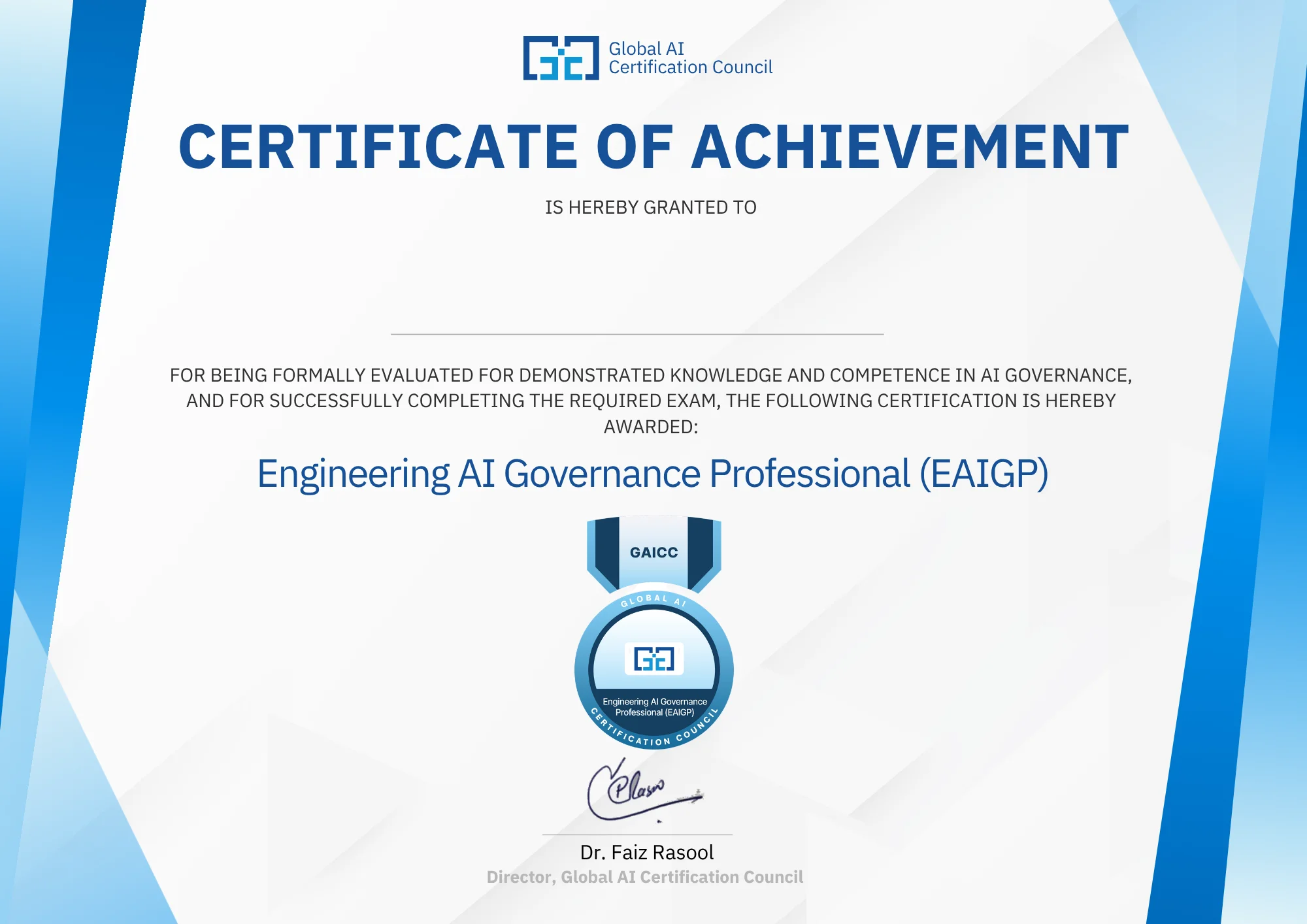
GAICC-EAIGP Certification

Issued By Global AI Certification Council

Prepare for your EAIGP Certification with this course

GAICC-EAIGP Certification

AI now sits inside machines, vehicles, robots, process plants and networks, and inside the tools engineers use to design and verify them. When it fails, the harm can be physical and irreversible, and the engineer remains accountable. The GAICC EAIGP programme connects AI governance to the disciplines engineering organisations already run: functional safety, SOTIF, systems engineering, configuration management, verification and validation, OT cybersecurity and quality management. It serves OEMs, Tier 1 suppliers, manufacturers, utilities, infrastructure and construction firms, semiconductor and telecom companies, and the digital engineering and IT services firms that build and validate AI for them.

The course runs over four days and 32 contact hours, in 19 modules plus a capstone across 8 domains. It moves from accountability and product regulation to safety engineering and lifecycle control, then assurance and cyber resilience, and finally oversight, agents and physical AI. Every module is built around cases from automotive, aerospace, machinery and robotics, process industries, utilities, infrastructure, semiconductors and telecom, and learners leave with a 12-template working toolkit.

Practical Outcomes You'll Achieve

By the end of this course, you will be able to:

Who Is This Certification For?

Designed for professionals who govern AI in physical engineered systems

Course Modules

Day 1

Accountability and Product Regulation (8 Hours)

Module 1
Engineering AI Landscape and Professional Duty

Workshop Exercise

A chartered structural engineer is asked to sign off a generative design for a pedestrian bridge. Decide what independent checks, records and limitations must exist before signature.

Workshop Exercise

Build an inventory entry and decision-rights matrix for a predictive maintenance model at a utility, then review a supply contract for AI liability gaps.

Workshop Exercise

Classify six systems, including a lift monitoring function, an AI quality inspection camera, a grid balancing optimiser and a dosing controller, and justify each route and date.

Day 2

safety Engineering and Lifecycle (8 Hours)

Module 6
Hazard Analysis and Operational Design Domain

Workshop Exercise

Run an STPA on an autonomous mobile robot in a semiconductor fab and specify its ODD, including lighting, floor and crowding conditions.

Workshop Exercise

Decompose a pedestrian detection function into an ML channel and an independent monitor, allocate ASILs and list SOTIF triggering conditions.

Workshop Exercise

Draft and peer-challenge a safety case fragment for a predictive maintenance model after a false negative on a critical pump.

Workshop Exercise

Write a dataset specification and AIBOM for a weld inspection model trained partly on synthetic images.

Workshop Exercise

Decide whether an OTA update of a perception model under R156 needs approval extension, and what the safety case must show before release.

Day 3

Assurance and Cyber Resilience (8 Hours)

Module 11
V&V Planning, Simulation and Digital Twins

Workshop Exercise

Review a V&V plan for a plant control surrogate model and identify where digital twin evidence exceeds its validated range.

Workshop Exercise

Design a run-time monitor that places an AI-guided crane into a safe state when model uncertainty or ODD conditions breach limits.

Workshop Exercise

An AI coding agent writes regression tests for chip validation against a digital twin. Sample the tests, find oracles that mirror the twin, and set acceptance conditions.

Workshop Exercise

Threat model a cloud-trained anomaly detection model feeding setpoint advice to a water treatment SCADA system, and redesign its conduits.

Workshop Exercise

In a timed exercise, prepare the 24-hour early warning and 72-hour notification for an actively exploited model poisoning vulnerability in an industrial gateway.

Day 4

Oversight, Agents and Capstone (8 Hours)

Module 16
Human Oversight, Ethics and Societal Impact

Workshop Exercise

Assess an AI-assisted flood gate control scheme for oversight timing, operator interface, fail-safe behaviour and engagement with mana whenua.

GAICC Differentiator

Hands-on controls for AI agents that touch PLC logic, SCADA and design release: verification levels by integrity level, least privilege, approval gates, kill switches and an agent registry.

Workshop Exercise

Build a control matrix for an agent that proposes PLC logic changes and releases design packages, deciding which actions need human approval.

Exam Domain Weighting

80 scenario-based questions across 8 domains

Most questions present a realistic sector scenario and ask for the most appropriate action, judgement or control. Recall of clause numbers is not tested.

Domain Weight Scored Items
I. Engineering AI Landscape and Professional Accountability
10%
~7
II. Product Regulation and Liability for AI-Enabled Systems
14%
~10
III. AI Safety Engineering and Functional Safety Integration
16%
~11
IV. Data, Model Lifecycle and Configuration Management
12%
~8
V. Verification, Validation and Robustness Assurance
14%
~10
VI. Cybersecurity and Resilience of AI-Enabled Systems
11%
~8
VII. Human Oversight, Ethics and Societal Impact
10%
~7
VIII. Generative, Agentic and Physical AI in Practice
13%
~9
4.8 / 5.0 Rating

Trusted by Professionals Across AI, GRC & Legal Industries

James Anderson

⭐⭐⭐⭐⭐

“This course changed how I approach AI safety and accountability. The practical sessions on risk assessment, functional safety, and regulatory compliance gave me a clearer framework for evaluating AI risks and managing complex engineering projects.”

Isha

⭐⭐⭐⭐⭐

“The regulatory frameworks and real-world case studies made complex AI governance concepts easier to understand. I gained practical insights into product liability, professional accountability, and building stronger compliance processes for AI-driven engineering projects.”

Stephen

⭐⭐⭐⭐⭐

“The practical exercises were the highlight of this programme. Working through safety cases, autonomous systems, and model validation helped me understand how to identify failures, evaluate risks, and strengthen oversight throughout the AI lifecycle.”

Steve Matthew

⭐⭐⭐⭐⭐

“This programme combines technical knowledge with practical governance. The modules on validation, cybersecurity, and operational resilience helped me understand how to manage AI risks and establish stronger assurance processes in safety-critical engineering environments.”

Diana Roberts

⭐⭐⭐⭐⭐

“The sections on robotics, physical AI, and industrial cybersecurity were especially relevant to my work. The practical examples helped me understand emerging risks and develop safer approaches to deploying intelligent systems in industrial environments.”

Rebecca Wilson

⭐⭐⭐⭐⭐

“I appreciated the comprehensive approach to AI governance, from safety and ethics to lifecycle management and agentic AI. The capstone brought everything together and strengthened my understanding of responsible AI adoption in engineering.”

This Course Includes: 32 Total Learning Hours

Engineering AI Governance Professional

Issued by Global AI Certification Council

What's included?

Member Price

US$898

Full Price

US$1075

US$99 is included in the above member price.

Certification Renewal (Members / 3-yr) – $69

Certification Renewal (Non-Members / 3-yr) – $119

Have Questions?

Frequently asked question.

The Engineering AI Governance Professional is a senior, sector-specialist credential. It confirms that you can govern AI across the engineering lifecycle and produce the evidence that regulators, notified bodies, clients and signing engineers need before AI-enabled products, plants and infrastructure are released.
No. The only eligibility requirement is 32 contact hours of EAIGP training completed before the exam. Five years in engineering, safety, verification, quality, cybersecurity or product compliance roles is recommended but never used to refuse a candidate. CPAIG, or equivalent foundational knowledge, is recommended but not required.
The course runs over four days and 32 contact hours:
  • Day 1: Accountability and Product Regulation
  • Day 2: Safety Engineering and Lifecycle
  • Day 3: Assurance and Cyber Resilience
  • Day 4: Oversight, Agents and Capstone
It is available in person, live online, or self-paced.
The exam has 80 scenario-based multiple-choice questions (70 scored + 10 unscored pilot) in 120 minutes. It is closed book and delivered online with AI-assisted proctoring, 24/7. The pass mark is 70%, a scaled 350 on a 100–500 scale, and there is no negative marking.
Automotive, aerospace, machinery and robotics, process industries, utilities, infrastructure and construction, semiconductors and telecom, plus the digital engineering and IT services firms that build and validate AI for them.
No. The course teaches how machine learning fits into safety lifecycles, safety cases and V&V, so it suits ML engineers, compliance leads, cybersecurity specialists and quality managers as well as safety engineers.
Yes. Domain VIII covers AI coding agents and generative design tools that produce safety-critical artefacts, agents that touch PLC or SCADA systems, and collaborative robots, mobile robots and humanoids.
The certification is valid for 3 years. Renewal requires 60 CPD hours per cycle (Technology 27, Humanity 12, Strategy 21), reaffirming the Code of Ethics and paying the renewal fee. A three-month grace period applies after expiry.
certify(at)gaicc(dot)org · support(at)gaicc(dot)org · www(dot)gaicc(dot)org
Instructor

Dr Faiz Rasool

Director at the Global AI Certification Council (GAICC) and PM Training School

A globally certified instructor in ISO/IEC, PMI®, TOGAF®, SAFe®, and Scrum.org disciplines. With over three years’ hands-on experience in ISO/IEC 42001 AI governance, he delivers training and consulting across New Zealand, Australia, Malaysia, the Philippines, and the UAE, combining high-end credentials with practical, real-world expertise and global reach.

Other GAICC ISO/IEC 42001 Courses

Best Selling
⭐ 4.8
29,899+
Best Selling
⭐ 4.8
23,357+
Best Selling
⭐ 4.8
25,183+

Start Your 'Engineering AI Governance Professional (GAICC-EAIGP)' Today

4.8 / 5.0 Rating

Self-Paced Course (Certification Exam included)

Member Price

US$898

Full Price

US$1075

GAICC Annual Membership US$99 is included in the above member price.

Trusted by 24,000+ Professionals

Ready to Become an Engineering AI Governance Professional?

AI Governance Job Insights 2026