
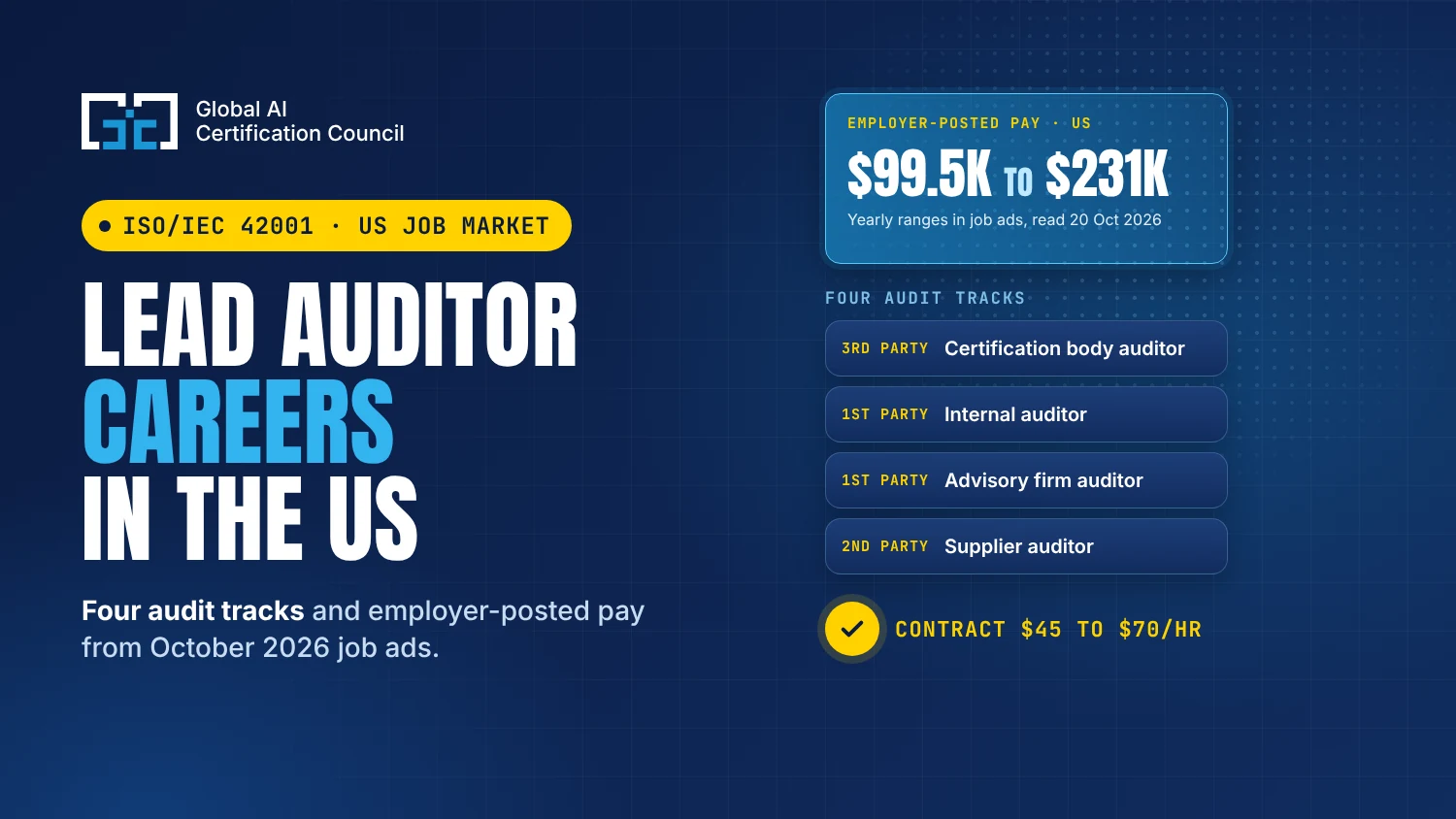
An ISO 42001 Lead Auditor career in the US is audit work on AI management systems (AIMS) built to ISO/IEC 42001:2023. Most of that work sits in four places: certification bodies, internal audit teams, advisory firms and supplier audit programmes. On 20 October 2026 the US ads that named the Lead Auditor credential listed it as one preferred option among several. Employer-posted pay ranges on the US ads GAICC read that named ISO/IEC 42001 audit or governance work ran from US$99,500 to US$231,000 a year.
The Lead Auditor is a personnel credential, and the Global AI Certification Council (GAICC) issues its version under a scheme developed in alignment with ISO/IEC 17024. Holding it does not make you a certification body auditor. Each certification body approves its own auditors against ISO/IEC 17021-1 and ISO/IEC 42006. The career therefore has two gates, the credential you earn and the approval an employer gives.
Four kinds of Lead Auditor work in the US
Lead Auditor work in the US splits into four tracks, and each one audits a different organization against different criteria. The credential’s own scope already spans them. GAICC’s examination content outline covers “first-, second- and third-party audits of AIMS implementations”, and the Handbook names second-party and initial third-party audits at Stage 1 and Stage 2.
| Track | Who employs you | What you audit | Audit criteria you work to | What decides whether you lead |
| Certification body auditor (third party) | An accredited certification body, as staff or as a contracted auditor | Client organizations seeking or holding ISO/IEC 42001 certification | ISO/IEC 42001; ISO/IEC 17021-1 and ISO/IEC 42006 for how the body runs audits | The body’s own competence evaluation and authorization |
| Internal auditor (first party) | Your employer’s internal audit or GRC function | Your employer’s own AIMS under clause 9.2 | ISO/IEC 42001, the organization’s audit programme, ISO 19011:2026 | Your employer, under clauses 7.2 and 9.2.2 |
| Advisory and audit firm (first party for a client) | Consultancies and professional services firms | A client’s AIMS, as an external party acting for the client | Same as internal audit, plus the engagement letter | The firm’s own methodology and the client |
| Supplier auditor (second party) | A buyer of AI products or services | The supplier’s AI system and its controls | Contract terms, the buyer’s requirements, ISO/IEC 42001 Annex A where agreed | The buyer’s audit programme |
ISO/IEC 42001 allows the advisory track directly. Its definition of an audit lets an internal audit be run by the organization itself or by an external party acting for it. That note is what lets advisory firms carry out first-party audits for clients.
Independence rules shape every track. A certification body should not assign an auditor to a client they consulted for in the past two years, the safeguard ISO/IEC 17021-1 recognizes, and an internal auditor must not audit their own work. The credential that opens all four is explained in how the GAICC Lead Auditor exam and levels work. The third-party route has a separate guide on what a certification body checks before approving an auditor.
The term “AI auditor” stretches wider than these four tracks. Model testing and bias auditing are separate jobs with separate criteria, laid out in the three meanings of AI auditor.
What US job ads showed on 20 October 2026
US demand for ISO 42001 auditors is real but thin, and most of it hides inside wider audit and governance titles. GAICC read one large US technology job board on 20 October 2026. Its keyword search counts give the scale, though they are keyword matches and not role counts.
| Search on the board, 20 October 2026 | Results |
| “42001” | About 90 |
| “42001 auditor” | 4 |
| “42001 lead auditor” | 3 |
| “ISO lead auditor” (any standard) | 17 |
Of the first 34 ads returned for “42001”, 30 contained the string in the ad text. No US government series counts this work, and the Bureau of Labor Statistics has no occupation for AI auditors or ISO 42001 auditors.
The ads that named the credential used it as a signal. A consulting firm’s IT audit manager ad listed “ISO/IEC 42001 Lead Auditor” next to a privacy body’s AI governance credential as valued AI credentials. A hardware maker’s AI governance manager ad put a “42001 Lead Implementer/Auditor” credential on its list of preferred certifications. A software company’s IT internal audit director ad asked for “ISO Lead Auditor certification or similar experience” to lead audit work on its ISO/IEC 27001 and 42001 certifications. None of these ads made the 42001 credential mandatory.
Certification firms hire too, and they write the standard into the duties. An accounting and advisory firm whose certification arm is one of the 20 bodies ANAB lists for ISO/IEC 42001 posted a remote “Senior Associate, ISO” role in late September 2026. The role was to “Lead ISO Certification and Internal Audits” for ISO/IEC 27001, 27701 and 42001. It wanted two years of external audit work with exposure to SOC or ISO engagements, and “AI or ISO Lead Auditor Certifications” were listed as preferred.
Read those ads as a pattern. Few hire for 42001 alone. The ads paired ISO/IEC 42001 with ISO/IEC 27001, SOC 2 and the NIST AI Risk Management Framework. An auditor who can test all of them on one engagement is the profile they describe.
Building audit experience before the first audit job
Audit experience comes from audits you take part in, so start a log at the first one and keep it current. GAICC’s rule is unusual in one way. The Lead Auditor content outline says experience “is measured in months, not by number of audits or projects”, and it asks for no audit-hour total.
GAICC records that experience in its candidate portal, with the organization, your role, the project and the start and end dates of each engagement. The outline adds that the work must involve “direct participation in the assessment, evaluation, or audit”. Academic study does not count. Certification bodies and other schemes may ask for more detail, so keep a second column for each entry. Note which clauses and Annex A controls you covered, how many audit days you spent, and who supervised you.
Four kinds of engagement build that log, and the first two are open to most people already in a job.
| Engagement | How to get in | What it proves |
| Internal audits under clause 9.2 | Volunteer for your employer’s AIMS or ISMS audit programme | You can plan against criteria, sample evidence and write findings |
| Supplier audits | Join procurement or third-party risk reviews of AI vendors | You can audit a second party against contract terms and Annex A controls |
| Trainee audits at a certification body | Apply as an auditor in training; ISO/IEC 17021-1 lets trainees take part when an auditor acts as evaluator | You have worked inside a certification audit under supervision |
| Observer roles | Ask to sit in on audits your employer receives, with the auditee’s agreement | You know how Stage 1 and Stage 2 run from the inside |
Certification bodies set a further bar for AIMS auditors. Clause 7.2.2.2 of ISO/IEC 42006:2025 expects earlier management system audits done “under the supervision and evaluation of a more experienced auditor”. It also sets a floor of 24 training hours covering how to audit an AIMS and how to manage an audit. The certification body guide sets out those floors in full.
The method you practise in each engagement comes from ISO 19011:2026, the fourth edition of the auditing guideline, published on 27 May 2026. Practise one clause at a time with the auditor’s clause-by-clause checklist, and log every audit you join that same week.
Resume lines for ISO 42001 audit roles
An audit resume should show what you audited, in what role and against which criteria, because those are the facts a certification body checks. Give the credential’s exact name and issuer. The GAICC Handbook bars using it “to imply accreditation that has not been granted”, so describe it as a GAICC credential and leave accreditation words out.
| Resume section | What it should show | Example line (illustrative) |
| Summary | Audit role plus the standards you audit | “IT auditor adding ISO/IEC 42001: internal audits of AI controls alongside ISO/IEC 27001 and SOC 2 work.” |
| Audit experience | Engagements by role, standard and scope | “Audit team member, two internal AIMS audits (clauses 6.1 to 9.3), under a lead auditor’s supervision, 2026.” |
| Findings work | What you wrote, without client detail | “Drafted nonconformity statements and follow-up checks for an AI impact assessment process.” |
| Methods | Terms the ads use | ISO 19011:2026; risk-based sampling; audit programme; objective evidence; Statement of Applicability review |
| Credentials | Name, issuer, year | “GAICC ISO/IEC 42001 Lead Auditor, Global AI Certification Council (GAICC), 2026” |
Replace every example with your own facts. Keep the dates. Never name a client or quote a finding from a real audit, since confidentiality binds every auditor. A trainee or observer role is still worth listing, as long as you label it as such. The credential itself is earned through the ISO 42001 Lead Auditor training course, which carries 32 contact hours.
Interview questions for Lead Auditor roles
Interviews for audit roles test judgement on a case, so expect the interviewer to hand you a fact pattern and ask what you would do. The bank below is grouped by clause. The banding is GAICC editorial analysis, and the questions are illustrative.
| Clause band | Question | What they test | What a strong answer covers |
| 4.3 Scope | The scope leaves out the client’s customer chatbot. What do you check at Stage 1? | Scope judgement | Whether the exclusion is justified and documented, and whether the chatbot affects the AIMS outcomes |
| 6.1.3 SoA | An Annex A control is marked “not applicable” with no reason. What follows? | Statement of Applicability testing | A justification is required; trace it to the risk assessment before grading anything |
| 6.1.4 | The organization runs 40 AI systems. How many impact assessments do you sample? | Risk-based sampling | Sampling by risk and change, a stated rationale, and a record of what was not sampled |
| 8 and A.6 | A model was retrained last month. Which records do you ask for? | Life cycle evidence | Change records, verification and validation results, a fresh impact assessment where the change is significant |
| A.10 | The client says its model supplier owns all the risk. Your response? | Third-party controls | Responsibility allocation and supplier monitoring stay with the client’s AIMS |
| 9.2 | The client shows a signed internal audit report. Is that enough? | Audit programme effectiveness | Criteria, auditor independence, coverage over time, and action on findings |
| 10.2 | The auditee fixed the problem during your visit. Do you still raise it? | Correction versus corrective action | Record the finding; correction is not root cause analysis |
| Grading | You found three minor gaps against one requirement. What now? | Grading under ISO/IEC 17021-1 | Several minors on one requirement can show a systemic failure, and so a major |
| Conduct | The auditee disputes a finding at the closing meeting. How do you respond? | Evidence discipline | Return to the requirement and the evidence; record unresolved views |
| Independence | You helped design this client’s AI policy last year. Can you audit it? | ISO 19011 independence | Decline the assignment or disclose and be reassigned |
Rehearse out loud. Name one piece of evidence in every answer, because an interviewer who audits for a living listens for the record you would ask to see. Finding grades and wording are covered in how auditors write and grade nonconformities.
What US employers post for ISO 42001 audit roles
Employer-posted pay ranges on US ads that name ISO/IEC 42001 audit work ran from US$99,500 to US$231,000 a year on 20 October 2026. GAICC reopened each ad that day. These are single ads on one board, so treat each row as a data point and not a market rate.
| Role as posted (sector, US location) | How the ad uses ISO/IEC 42001 | Employer-posted pay range | Posted |
| Manager, IT Auditor (consulting firm, Atlanta) | Names the 42001 Lead Auditor among valued AI governance credentials | US$99,500 to US$119,500 | 21 Sep 2026 |
| Manager, AI Governance Programs (hardware maker, North Carolina) | Lists a 42001 Lead Implementer or Auditor credential as preferred | US$127,100 to US$194,925 | 9 Oct 2026 |
| Principal, cybersecurity audit, risk and governance architect, AI (telecom, Virginia) | Leads internal and external audits; AI risk framework aligned with 42001 | US$120,500 to US$231,000 | 2 Oct 2026 |
| Director, IT Internal Audit (software firm, Florida) | Leads audit work supporting the employer’s 27001 and 42001 certifications | US$163,900 to US$225,000 | 16 Oct 2026 |
| AI Governance Analyst (insurance software, remote) | Policies aligned with 42001; security audit credentials preferred | US$100,000 to US$122,000 | 18 Sep 2026 |
| Contract GRC and AI governance roles (three ads) | Name ISO/IEC 42001 among the frameworks the role supports | US$45 to US$70 an hour | Oct 2026 |
Three readings follow from the table. None of the ads that named the credential was an entry-level role. Pay tracks seniority more than the standard, with the analyst and IT audit manager ads lowest and the director and principal ads highest. The certification firm’s ad GAICC read published no range, so no US certification body figure appears here.
GAICC does not publish a salary average for this work. The sample is too small, and a median from six ads would mislead. What the credential costs to earn and hold is set out in Lead Auditor fees and renewal costs.
Progression after the first audit role
A Lead Auditor grows by leading larger audits, and the next GAICC level, the Senior Lead Auditor, is built for that step. GAICC’s Senior Lead Auditor Handbook (June 2026) aims the credential at third-party audits on “complex multi-site, multi-standard engagements.”
| Step | Typical US titles | What changes | GAICC level and rules (June 2026 documents) |
| Team member | Associate, IT auditor, GRC analyst | You audit assigned clauses under a lead’s direction | Internal Auditor or Lead Auditor; 32 contact hours each |
| Audit lead | Senior associate, audit manager | You plan the audit, lead the team and sign the report | Lead Auditor; 3-year validity, 32 CPD hours per cycle |
| Senior lead and programme owner | Audit director, principal, head of AI assurance | Multi-site and multi-standard audits; review of other auditors’ reports | Senior Lead Auditor: 40 contact hours; 80-question exam; renewal with 40 CPD hours |
The Senior Lead Auditor content outline lists the experience. It is five years with a diploma, including two in auditing or assurance roles, or three years with a bachelor’s degree. That experience must include “leadership or coordination of audit teams, preparation of audit reports”. Lead Auditor holders automatically meet its knowledge prerequisite.
Two other moves are open. Some auditors join a certification body. There the ladder climbs from auditor through team leader to technical reviewer, and the body approves each step itself. Others cross to the build side, and the implementer’s US career path covers that route. Readers outside the US can compare local roles in Lead Auditor careers in Australia.
Moving into certification body work
Moving into a certification body means passing that body’s own approval process, which starts after the credential. On 20 October 2026, 20 bodies held ANAB accreditation for ISO/IEC 42001, and ANAB’s accredited body directory shows the current list.
The body evaluates your competence before you audit alone. ISO/IEC 17021-1 requires an observed audit as part of that first evaluation. ISO/IEC 42006:2025 then adds AI-specific floors for each auditor and for team leaders. Expect a competence review, supervised or witnessed audits, an impartiality declaration and approval for named technical areas. A former consultant is normally kept off a past client for two years.
Bring three things. The log, the credential and two people who saw you audit will carry more weight than a course certificate on its own. The full sequence, from first application to team leader, is in the certification body guide linked above.
Frequently Asked Questions
Is the ISO 42001 Lead Auditor credential required for US audit jobs?
Not in the ads GAICC read on 20 October 2026. Each one that named it listed it as preferred or valued, next to IT audit, security and privacy credentials. Employers asked first for audit experience, often with ISO/IEC 27001 or SOC 2. The credential helps most when it sits on top of that experience, and certification bodies apply their own approval on top of both.
Can I get an ISO 42001 audit job without prior audit experience?
Getting one is hard, and the realistic first step is a role that builds experience. Internal audit teams, GRC analyst roles and supplier risk reviews let you join audits as a team member. Certification bodies take auditors in training under an evaluator. GAICC’s Lead Auditor exam has no audit-count rule, but the content outline still lists recommended months of relevant experience.
Do ISO 42001 auditors in the US travel?
Travel depends on the employer and the audit plan. The certification firm’s ad GAICC read was remote but tied to client work. ISO 19011:2026 expanded its guidance on remote audit methods and virtual locations. ISO/IEC 42006 adds its own clause on deploying remote audits. Expect a mix of remote document review and on-site interviews, set by each audit plan.
Is an ISO 27001 Lead Auditor background useful for 42001 work?
Yes. Both standards share the harmonized clause structure, so audit programme, internal audit and management review tests carry over. The AI-specific parts do not. You still need to test AI system impact assessments, life cycle records and Annex A controls written for AI. For team leaders, ISO/IEC 42006 lets three ISMS audits stand in for three AIMS audits only during a transition period.
How long does it take to become a working ISO 42001 auditor?
The training takes 32 contact hours, and GAICC’s content outline gives an average of five calendar days to process a complete application. A certification body’s approval takes longer, because it needs supervised audits. ISO/IEC 42006 asks each AIMS auditor for four years of full-time IT or data protection work, plus at least one year related to AI systems.
Does the credential expire?
Yes. The GAICC Lead Auditor credential is valid for three years from certification. Renewal needs 32 hours of continuing professional development across the cycle. GAICC audits CPD claims and accepts employer or client attestation letters that verify your audit participation.