The U.S. Equal Employment Opportunity Commission issued its first AI-related guidance in 2023. The EU AI Act began applying mandatory compliance obligations in 2024. The White House Office of Science and Technology Policy released its Blueprint for an AI Bill of Rights. And yet, across thousands of American enterprises deploying AI in hiring, lending, healthcare triage, and fraud detection, the person responsible for ensuring that AI actually behaves the way it should still does not have a formal job title.
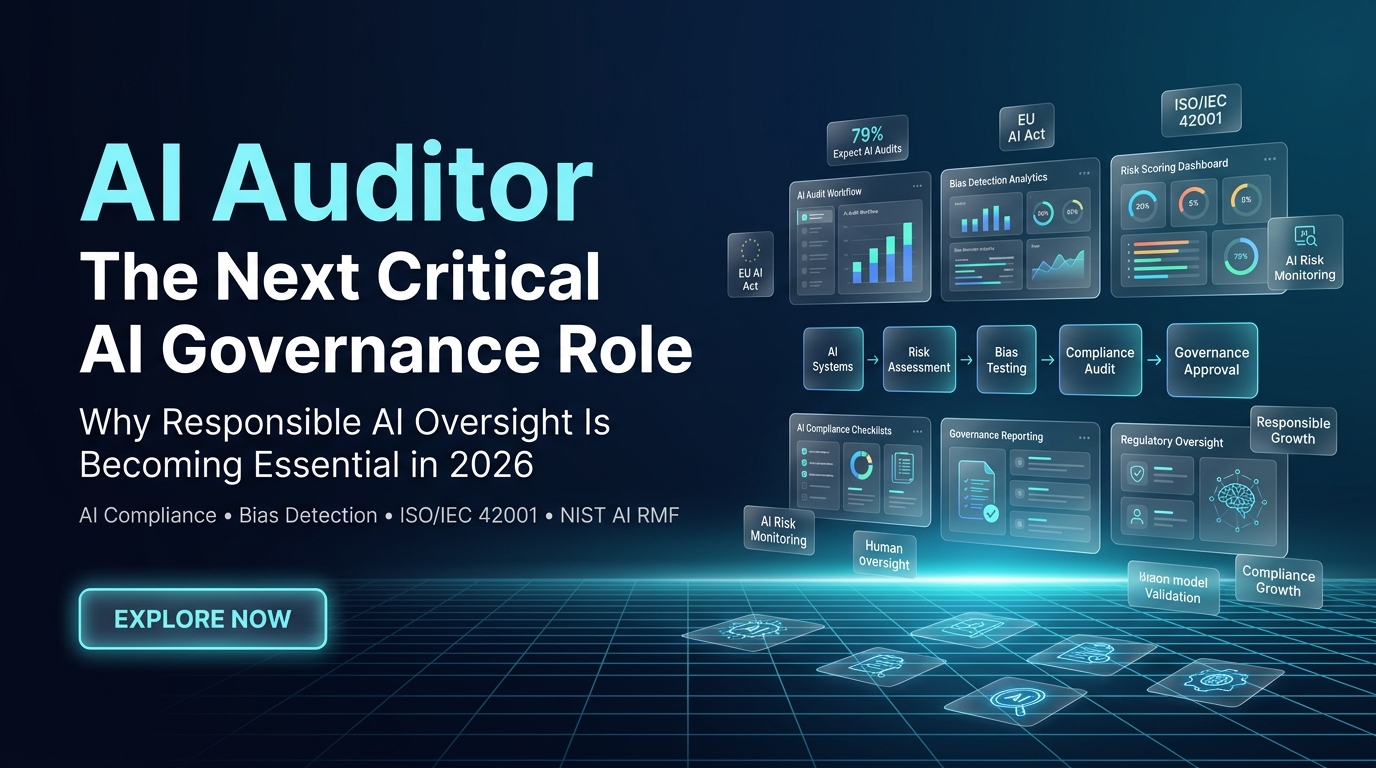
That is changing fast. The AI auditor a professional who independently evaluates AI systems for bias, safety, regulatory compliance, and ethical alignment is emerging from the background as one of the most consequential roles in modern enterprise risk management. This piece covers what AI auditors actually do, why demand is accelerating in the United States, what skills the role requires, and how governance frameworks like ISO/IEC 42001 are turning AI auditing into a structured, certifiable profession.
What Is an AI Auditor?
An AI auditor systematically evaluates AI and machine learning systems to determine whether they operate as intended, comply with applicable laws and standards, and produce outcomes that are fair, transparent, and accountable. The role sits at the intersection of technical AI knowledge, compliance expertise, and risk management.
Traditional IT auditors check whether systems are secure and reliable. Financial auditors verify that numbers are accurate and processes are followed. AI auditors do something more complex: they assess whether an algorithm is making decisions in ways that are defensible, legal, and aligned with organisational values even when the algorithm itself is a black box.
In practice, this means examining training data for demographic imbalances, stress-testing model outputs against adversarial inputs, reviewing the documentation trail required under regulations like the EU AI Act, and evaluating whether human oversight mechanisms are actually functional rather than performative.
Why Demand Is Accelerating in the United States
Three forces are converging to make AI auditing an urgent priority for US organisations.
Regulatory pressure is becoming concrete
Colorado’s SB 21-169, New York City’s Local Law 144 on automated employment decision tools, and the Federal Trade Commission’s ongoing enforcement actions against algorithmic deception have established a clear direction: US regulators at state and federal level expect organisations to be able to demonstrate that their AI systems do not discriminate or mislead. The question is no longer whether AI governance will be legally required, but how soon and at what level of detail. A 2024 Gartner survey found that 79% of AI governance leaders at US enterprises expected mandatory external AI audits within three years.
High-profile failures have made the stakes visible
Amazon’s internal resume-screening tool, which was found to systematically downgrade applications from women, became a case study in AI bias that every board-level risk conversation now references. The Department of Housing and Urban Development’s fair lending investigations into algorithmic mortgage tools, and the health algorithm controversy documented in a 2019 Science paper showing that a widely used clinical tool underestimated the health needs of Black patients established that AI bias is not a hypothetical edge case. It causes measurable, documentable harm. Each new incident sharpens corporate appetite for someone who can catch these problems before they reach the press.
Investors and boards are asking harder questions
ESG frameworks are increasingly incorporating AI governance metrics. Institutional investors including several of the largest US pension funds have begun asking portfolio companies to disclose their AI risk management practices. When a company cannot answer a board member’s question about whether its AI hiring tool complies with EEOC guidance, it reveals a governance gap that creates liability. AI auditors close that gap.
The Core Responsibilities of an AI Auditor
The scope varies by organisation and sector, but these five areas appear across virtually every AI auditing engagement.
| Responsibility | What It Involves |
| Bias and Fairness Evaluation | Testing model outputs across demographic subgroups; reviewing training data for representation gaps; applying statistical parity and equitable odds frameworks. |
| Regulatory Compliance Assessment | Mapping AI system characteristics against applicable laws (EEOC guidance, NYC LL144, EU AI Act extraterritorial scope, sector-specific rules like HIPAA or FCRA). |
| Model Documentation Review | Auditing model cards, datasheets for datasets, system cards, and impact assessments for completeness, accuracy, and accessibility to non-technical stakeholders. |
| Human Oversight Verification | Confirming that human-in-the-loop mechanisms are operational and not cosmetic; evaluating escalation protocols; checking override capabilities. |
| Incident Reporting and Remediation | Investigating AI-related failures or complaints; producing audit findings; tracking remediation actions through to closure. |
The Skill Set: What Separates Good AI Auditors from Great Ones
The role does not belong neatly to any single discipline. The best practitioners draw on three knowledge domains simultaneously.
Technical literacy is necessary but not sufficient. An AI auditor needs enough fluency with machine learning concepts to evaluate a model’s architecture, understand the significance of a confusion matrix, and ask the right questions about training data provenance. They do not need to be the person who built the model. They need to be the person who can critically examine it.
Regulatory and legal knowledge is equally critical. In the United States, this means understanding how Title VII applies to AI-assisted hiring decisions, what the FTC’s algorithmic accountability guidance requires, how state-level AI laws interact with federal frameworks, and how sector regulators the OCC for banking, CMS for healthcare, the SEC for financial services are approaching AI risk.
The third domain is professional audit methodology. The CISA and CISM credentials from ISACA provide foundational audit frameworks. ISO/IEC 42001 the international standard for AI Management Systems provides a structured basis for what a complete AI governance audit looks like. Professionals who hold the ISO/IEC 42001 Lead Auditor certification demonstrate that they can execute an audit against a recognised international standard, which is increasingly what enterprise procurement and regulatory compliance teams want to see.
Communication skills matter more than most job descriptions acknowledge. An AI auditor who can identify a demographic parity violation but cannot explain its business and legal implications to a CFO or general counsel is only half effective. The audit report is not the product the change it produces is.
How ISO/IEC 42001 Is Structuring the AI Auditing Profession
Before ISO/IEC 42001 was published in 2023, AI governance was largely improvised. Individual organisations developed internal frameworks of varying quality. Third-party AI ethics assessments followed no consistent methodology. Audit findings were difficult to compare across organisations or over time.
ISO/IEC 42001 changed the foundation. The standard establishes requirements for an Artificial Intelligence Management System (AIMS) a structured framework covering governance, risk management, transparency, human oversight, and continuous improvement. Critically for auditors, it provides a baseline against which AI systems and organisational processes can be independently measured.
This is analogous to how ISO 27001 transformed information security auditing. Before the standard, information security audits were unstructured and provider-dependent. After it, organisations could seek certification against a recognised benchmark, and auditors could execute assessments with a consistent methodology.
For AI auditors, ISO/IEC 42001 certification particularly at the Lead Auditor level provides something that was previously unavailable: portable, verifiable proof that you can conduct an AI governance audit against an internationally recognised standard. For US organisations preparing for regulatory scrutiny, this is exactly the kind of evidence their boards, insurers, and regulators want to see.
Internal vs. External AI Auditors: Two Different Career Paths
The AI auditing profession is bifurcating into two distinct tracks, and understanding the difference matters for career planning.
Internal AI auditors sit within an organisation’s risk, compliance, or internal audit function. They have ongoing access to systems, documentation, and personnel. Their mandate is continuous monitoring rather than point-in-time assessment. The advantage is depth they understand the organisation’s specific AI use cases intimately. The limitation is independence they report up through the same organisational structure they are auditing, which creates structural conflicts that governance professionals must actively manage.
External AI auditors work for consulting firms, specialist AI governance firms, or as independent practitioners. They provide the independence that internal teams cannot. For organisations seeking ISO/IEC 42001 certification, third-party certification bodies conduct external audits as a formal requirement. The external track typically requires stronger credentials and documented experience, since clients are paying for verified expertise rather than organisational knowledge.
Both tracks are growing. The Deloitte AI Institute reported in 2025 that enterprise demand for AI assurance services encompassing both internal capability-building and external audit engagements had grown more than 200% year-over-year in the US market.
AI Auditor Salaries in the United States
Compensation data for the AI auditor role is still maturing, because the job title itself is new. However, combining data from LinkedIn Salary, Glassdoor, and industry surveys produces a clear picture.
| Level | Salary Range (USD) | Typical Context |
| Entry-level AI Auditor | $75,000 – $100,000 | Internal audit or risk teams; 1–3 years’ experience |
| Mid-level AI Auditor | $100,000 – $145,000 | Specialist AI/tech audit role; ISO 42001 certified |
| Senior AI Auditor / Lead | $145,000 – $190,000 | Cross-functional leadership; regulatory liaison |
| Director of AI Assurance | $190,000 – $250,000+ | Enterprise governance function head |
| External / Consulting Track | $140,000 – $220,000+ | Third-party firm or independent practitioner |
Geography adds significant variance. AI auditors in San Francisco, New York, and Seattle earn approximately 25–35% above the national median. Remote roles have moderated this premium somewhat, but not eliminated it. Sector also matters: financial services and healthcare both under intense AI regulatory scrutiny pay at the upper end of these ranges.
The Sectors Hiring AI Auditors Most Aggressively
Not every industry is at the same point in AI audit maturity, but several sectors are moving faster than the general market.
Financial services leads hiring volume. Banks, insurance carriers, and fintechs use AI extensively in credit scoring, fraud detection, and customer communication. The OCC’s guidance on model risk management (SR 11-7) has long required independent model validation, and AI auditing is the logical extension of that discipline. At major US banks, the model risk management function already employs dozens of specialists AI-specific auditing is being layered on top of this existing infrastructure.
Healthcare is close behind. The FDA’s Software as a Medical Device (SaMD) framework, CMS reimbursement audits touching algorithmic triage tools, and HIPAA’s application to AI-processed patient data create a multi-agency compliance landscape that demands dedicated oversight. Several major health systems including those in the Mayo Clinic system and Kaiser Permanente network — have created formal AI governance committees with auditing authority.
Federal government and defence contractors represent a fast-growing category. Executive Order 14110 on AI safety, the NIST AI Risk Management Framework, and DoD’s Responsible AI guidelines create compliance obligations that flow down to contractors. Prime contractors with federal AI contracts are actively building internal audit capability to satisfy both performance requirements and anticipated oversight scrutiny.
Technology companies themselves are also hiring, driven partly by regulation but also by reputational risk management. For a hyperscaler whose cloud AI products are used by thousands of downstream enterprises, demonstrating that its own AI governance is audited and certified is increasingly a competitive differentiator in enterprise procurement.
What Most AI Auditing Guides Get Wrong About the Role
The prevalent framing positions AI auditing as primarily a technical discipline hire a data scientist with an ethics interest and you are covered. This misses the most important dimension of the role.
AI auditing is fundamentally an institutional challenge, not a technical one. The hardest problems are not detecting bias in a model bias detection tools like IBM’s AI Fairness 360 and Microsoft’s Fairlearn make the technical analysis increasingly accessible. The hard problems are organisational: getting the AI development team to produce documentation they did not budget time for, establishing escalation pathways that senior management will actually use, ensuring that remediation actions survive the business pressure to ship fast, and maintaining auditor independence inside an organisation where AI systems generate revenue.
The most effective AI auditors combine enough technical knowledge to not be deceived by reassuring but hollow technical explanations, with enough organisational authority and communication skill to actually change behaviour. Credentials like ISO/IEC 42001 Lead Auditor are valuable not just because they signal technical knowledge, but because they provide the institutional legitimacy that makes an auditor’s findings harder to dismiss.
Building a Career as an AI Auditor: A Practical Pathway
The most common entry point is adjacent experience. Professionals with backgrounds in IT audit (CISA), internal audit (CIA), information security (CISSP or CISM), data science, or legal/compliance are well-positioned to pivot. The transition requires adding AI governance knowledge on top of an existing methodological foundation.
A practical four-stage pathway:
- Build technical AI literacy. Courses like those from Fast.ai, Google’s Machine Learning Crash Course, or MIT OpenCourseWare provide sufficient depth to understand ML system architecture without requiring a computer science background.
- Obtain foundational AI governance certification. The GAICC ISO/IEC 42001 Foundation course establishes grounding in the international standard that is increasingly the benchmark for AI governance audits.
- Progress to Lead Auditor certification. The GAICC ISO/IEC 42001 Lead Auditor programme covers audit methodology, evidence collection, non-conformity reporting, and closing meeting practices against the 42001 standard. This is the credential that signals readiness to lead an independent AI governance audit.
- Build a portfolio. Document participation in AI risk assessments, bias evaluations, governance gap analyses, or internal audit projects. Volunteer for AI ethics committee work. The profession values demonstrated experience over credentials alone.
Frequently Asked Questions
1. Is AI auditing a regulated profession in the United States?
Not yet at the federal level. Several states have enacted AI-related laws requiring impact assessments or audits of specific AI applications, but there is no unified federal licensing requirement for AI auditors. This is expected to change as federal AI legislation advances. Professionals building this career now are positioning ahead of the regulatory curve.
2. Do I need a computer science degree to become an AI auditor?
No. Many effective AI auditors come from audit, risk, legal, or policy backgrounds. What the role requires is sufficient technical literacy to evaluate AI systems critically understanding model inputs, outputs, and failure modes combined with strong knowledge of governance frameworks and regulatory requirements. That can be acquired through targeted learning rather than a full technical degree.
3. How is AI auditing different from AI ethics review?
Ethics review is typically advisory and internal a team or committee evaluating whether an AI system aligns with stated organisational values. AI auditing is systematic, evidence-based, and increasingly conducted against formal standards like ISO/IEC 42001. Audits produce findings, non-conformities, and corrective action requirements. Ethics reviews produce recommendations. The distinction matters for regulatory purposes: regulators want audits.
4. Which industries are most likely to require external AI audits first?
Financial services and healthcare are furthest along. The financial sector already has robust model validation infrastructure that AI auditing extends. Healthcare’s FDA and CMS oversight creates strong compliance incentives. Federal contractors working on AI-enabled systems face increasing oversight requirements under NIST AI RMF-aligned acquisition standards. These sectors are the most likely entry points for mandatory external auditing requirements.
5. What is the relationship between ISO/IEC 42001 and the NIST AI Risk Management Framework?
Both address AI governance but from different origins. ISO/IEC 42001 is a certifiable management system standard organisations can be audited and certified against it. NIST AI RMF is a voluntary framework providing guidance on AI risk management practices. The two are complementary and substantially aligned. Many US organisations use NIST AI RMF as an operational framework while pursuing ISO/IEC 42001 certification as third-party verified evidence of governance maturity.
The Profession Is Being Built Now
AI auditing is not a future-state profession it is being hired for, credentialled, and practised today. The organisations that move earliest are building competitive advantages in regulatory readiness, stakeholder trust, and risk reduction that will compound over time. For professionals, the window to establish credibility in this field before it becomes crowded is right now.
The structural shift is clear: AI is too consequential, and too embedded in high-stakes decisions, for enterprises to keep operating without independent oversight. The AI auditor is the professional who provides that oversight. Every major AI governance framework from ISO/IEC 42001 to the NIST AI RMF to the EU AI Act converges on the same requirement: systematic, documented, independent evaluation of AI systems.
If you are considering this career path, the GAICC ISO/IEC 42001 Lead Auditor certification provides a structured entry point that is recognised internationally and directly applicable to the compliance landscape US organisations are navigating. The role is demanding, genuinely important, and growing faster than most people realise.
Ready to become a certified AI Auditor? Explore the GAICC ISO/IEC 42001 Lead Auditor programme at gaicc.org built specifically for professionals entering the responsible AI governance space.