Third-party breaches now account for more than 60% of all data compromises in the United States, according to the Ponemon Institute’s 2024 Cost of a Data Breach Report. Yet most organizations spend the majority of their security budget on internal controls, leaving the supplier ecosystem as the largest unmonitored attack surface in their environment.
ISO 27001:2022 addresses this directly. Annex A controls 5.19 through 5.22 establish a structured framework for supplier relationship security covering everything from pre-contract risk assessment to ongoing monitoring and exit provisions. For US organizations operating under NIST CSF 2.0, CMMC 2.0 or HIPAA, these controls aren’t optional enhancements. They map directly to regulatory requirements that auditors and assessors actively test.
This guide explains what each control requires, how to translate requirements into enforceable contract language, and how to build a supplier security program that holds up under both ISO 27001 certification audits and US regulatory scrutiny.
What ISO 27001:2022 Requires for Supplier Security
The 2022 revision of ISO 27001 consolidated and significantly strengthened supplier security requirements under Annex A, Theme 5 (Organizational Controls). Four controls form the core of the supplier security framework:
- Annex A 5.19 – Information security in supplier relationships: Organizations must establish and implement a policy covering the protection of information assets accessible to or impacted by suppliers. The policy must address information classification handling by suppliers, minimum security requirements by supplier category, and a process for vetting suppliers before access is granted.
- Annex A 5.20 – Addressing information security within supplier agreements: Every agreement with a supplier who accesses, processes, stores, communicates, or provides IT infrastructure components must contain specific information security requirements. These aren’t boilerplate provisions, the control requires requirements to be proportionate to the risk the supplier relationship represents.
- Annex A 5.21 – Managing information security in the ICT supply chain: This control targets technology suppliers specifically, software vendors, hardware providers, cloud service providers, and managed service providers. It requires organizations to understand the security practices embedded in the products and services they procure, including how suppliers manage their own third-party dependencies.
- Annex A 5.22 – Monitoring, review and change management of supplier services: Supplier security isn’t a one-time contract event. Organizations must establish processes to regularly monitor supplier performance against agreed security requirements, manage changes to supplier arrangements (including re-assessment when scope changes), and maintain records of supplier review activity.
For a complete overview of every Annex A requirement, see our ISO 27001 Annex A Controls List.
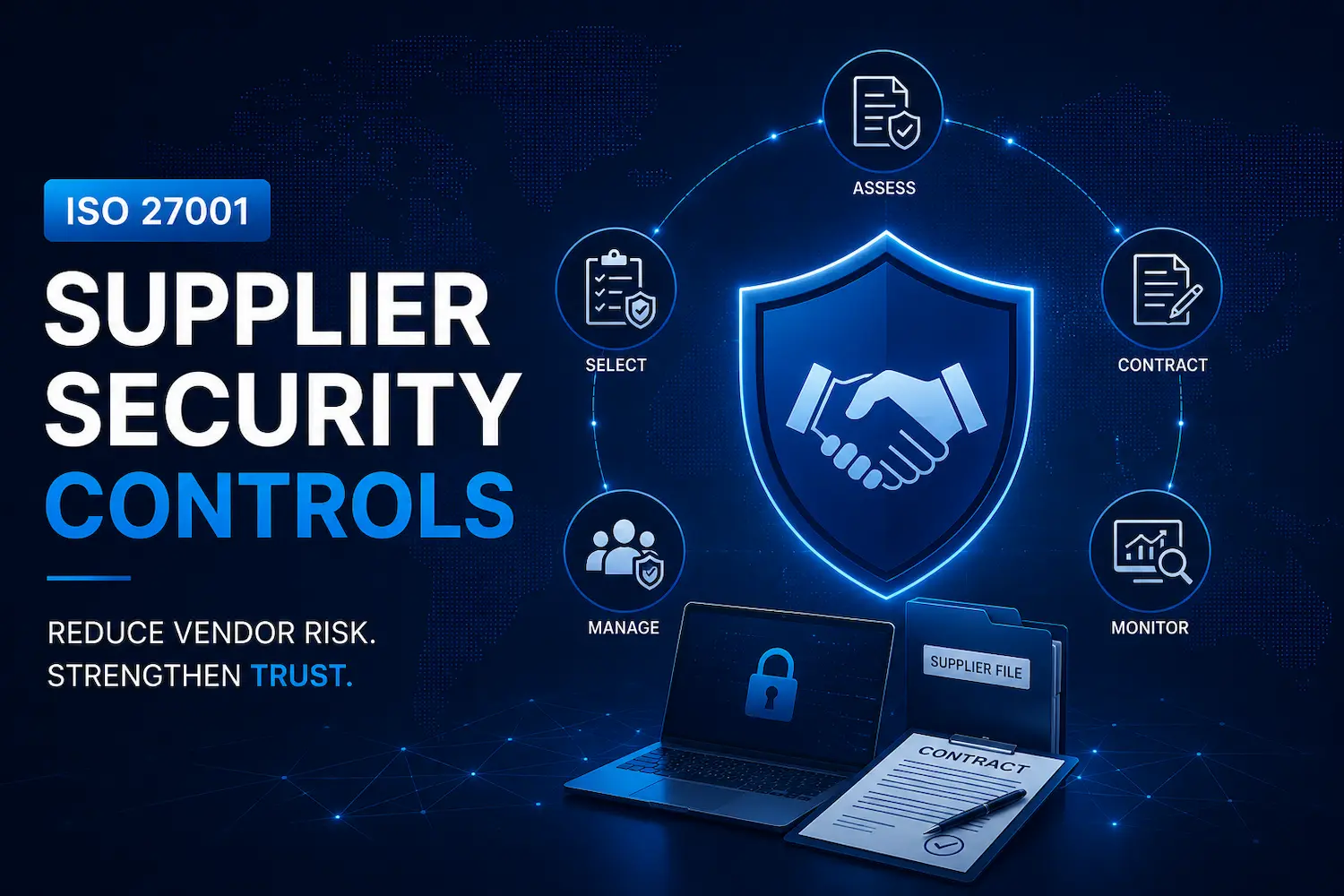
Taken together, these four controls require a lifecycle approach to supplier security: assess before engagement, document in contracts, monitor during the relationship, and manage change systematically. Organizations that treat supplier security as a procurement checkbox rather than an ongoing program will struggle to pass Annex A evidence reviews during certification audits.
Supplier governance forms part of a broader governance framework explained in our ISO 27001 Organizational Controls guide.
ISO 27001:2022 Supplier Security Controls at a Glance
| Control | Reference | Primary Obligation | Evidence Required |
|---|---|---|---|
| Information security in supplier relationships | A.5.19 | Policy + pre-engagement risk assessment | Supplier policy, risk register entries |
| Security within supplier agreements | A.5.20 | Contractual security requirements | Signed agreements with security clauses |
| ICT supply chain security | A.5.21 | Technology supplier vetting | Vendor assessments, SBOM review records |
| Monitoring and change management | A.5.22 | Ongoing review + change control | Review logs, audit reports, change records |
Building a Supplier Risk Classification Framework
Not every supplier deserves the same level of scrutiny. A staffing agency that never touches your systems carries a different risk profile than a cloud provider hosting your customer database. ISO 27001 doesn’t mandate a specific classification model, but it does require that security requirements be proportionate to risk which means you need a systematic way to assess and tier your supplier population.
A workable classification model uses two primary variables: data sensitivity and system access depth.
- Tier 1 – Critical suppliers: These suppliers access, process, or store your most sensitive data (PII, PHI, financial records, intellectual property), or their systems are integrated deeply with your production environment. Cloud IaaS/PaaS providers, managed security service providers, payroll processors, and core ERP system vendors typically fall here. Critical suppliers require full security assessments, comprehensive contractual controls, and quarterly review cycles minimum.
- Tier 2 – High-importance suppliers: Suppliers with access to internal business data, or who provide services that could materially impact your operations if compromised. These include SaaS vendors with employee data access, IT support providers with privileged access, and professional services firms engaged in sensitive projects. High-importance suppliers require documented security assessments, standard contractual controls and annual reviews.
- Tier 3 – Standard suppliers: Suppliers with limited or no access to sensitive data or internal systems. Office supply vendors, facilities management, general professional services. Standard due diligence, basic contractual provisions and periodic review suffice.
The classification decision should be documented in your supplier register with the criteria used clearly recorded. This documentation becomes important evidence during ISO 27001 audits auditors will verify that your security requirements in contracts match the tier assigned, and that your monitoring frequency is proportionate to classification.
One practical point worth making: supplier tiers should be re-evaluated whenever the relationship changes in scope. A marketing agency that starts building an e-commerce integration suddenly has a different risk profile than when they were only managing your social media. Annex A 5.22’s change management requirement exists precisely to catch these transitions.
ISO 27001 Supplier Contract Clauses: What to Include
The gap between “we have supplier contracts” and “our contracts meet ISO 27001 requirements” is wider than most legal and procurement teams realize. Standard commercial contracts drafted by supplier legal teams are optimized for the supplier’s interests, liability limitation, termination flexibility, and payment terms. ISO 27001 requires security clauses that are specifically designed for the customer’s interest in information protection.
Minimum required contract provisions under A.5.20:
- Information security responsibilities: The contract must specify what information the supplier can access, what they can do with it, and what security measures they must maintain. This includes data classification handling requirements aligned with your organization’s classification scheme.
- Confidentiality and non-disclosure obligations: Beyond generic NDA language, specify the minimum standard of protection, for example, “equivalent to the receiving party’s own confidential information protection measures, and no less than ISO 27001-equivalent controls.”
- Incident notification requirements: Define the notification timeline (24 hours for confirmed breaches is now standard in US regulatory frameworks including HIPAA Breach Notification Rule and SEC incident reporting rules), the notification format, and the escalation path. Contracts that only require “prompt” notification create disputes when a supplier waits two weeks.
- Right to audit: Reserve the right to conduct or commission security assessments of the supplier, including penetration testing and compliance audits. Specify notice requirements (typically 30 days) and cost allocation. Without this clause, you cannot fulfill the monitoring obligation in A.5.22.
- Subcontractor controls: Require written approval before the supplier engages subcontractors who will access your information, and require that subcontractors be bound by equivalent security obligations. The SolarWinds attack propagated precisely because subcontractor access wasn’t adequately controlled.
- Data handling on termination: Specify what happens to your data at contract end secure deletion timelines, return procedures, and certification of destruction. In cloud environments, this clause needs to address backup copies and snapshots specifically.
- Business continuity and availability requirements: For critical suppliers, include minimum RTO/RPO requirements and testing obligations. If your critical supplier goes down, you need contractual evidence they’ve planned for recovery.
ISO 27001 Supplier Contract Clause Requirements by Tier
| Clause Type | Tier 1 (Critical) | Tier 2 (High) | Tier 3 (Standard) |
|---|---|---|---|
| Information security responsibilities | Required detailed | Required standard | Basic provisions |
| Incident notification timeline | 24 hours | 48 hours | 72 hours |
| Right to audit | Annual right, no notice | Biennial, 30 days notice | Questionnaire only |
| Subcontractor approval | Written pre-approval required | Written notification required | Contractual flow-down |
| Data deletion on termination | 30-day certified deletion | 60-day deletion | Standard commercial terms |
| Business continuity requirements | RTO/RPO specified and tested | RTO/RPO specified | Not required |
If your suppliers provide cloud services, continue with our guide to ISO 27001 Cloud Security Controls for Annex A 5.23 implementation.
Third-Party Risk Assessment: The ISO 27001 Process
A supplier security assessment is not a questionnaire. That distinction matters because most organizations when they discover ISO 27001 requires supplier assessments default to sending a spreadsheet of 50 questions to the supplier and filing the responses. Questionnaires have their place, but they are not assessments. Suppliers can answer any question optimistically. Evidence-based assessment is what the standard actually requires.
Supplier access should be governed using the principles described in our ISO 27001 access control requirements guide.
A defensible supplier risk assessment under ISO 27001 has four components:
- Documentary review: Request and analyze the supplier’s relevant security documentation their information security policy, most recent penetration test results, ISO 27001 or SOC 2 certification status, and any regulatory compliance reports (HIPAA attestations, CMMC assessment results, FedRAMP authorization packages). Documents establish the baseline claim; the rest of the assessment validates it.
- Questionnaire with evidence requests: Use a structured questionnaire aligned to your control requirements, but require evidence for high-risk responses. If a supplier claims they conduct annual penetration testing, ask for the last report summary. If they claim to have an incident response plan, ask for the table of contents and a policy excerpt.
- Technical validation: For Tier 1 suppliers with system integrations, conduct technical validation of network segregation, access controls, and encryption in transit. This doesn’t require a full penetration test of the supplier it means verifying that the integration points between your environment and theirs are properly controlled on your side and that you have reasonable assurance of controls on theirs.
- Findings, risk rating and remediation tracking: Document assessment findings, assign a risk rating to identified gaps, and establish remediation timelines. For critical suppliers, unacceptable gaps should trigger a contract provision or a supplier replacement decision not just a note in the file.
Assessment frequency should match supplier tier. Critical suppliers warrant annual reassessment plus triggered reassessments for significant events (a supplier breach, a major product update, a change in ownership). High-importance suppliers warrant biennial assessment. Standard suppliers can be managed through periodic questionnaire refreshes.
The assessment record including methodology, findings, and decisions made is a key piece of ISO 27001 audit evidence. Auditors will want to see that assessments were conducted systematically, not just that they happened.
ICT Supply Chain Security and Annex A 5.21
Software doesn’t arrive secure by default. Every commercial software product, every open-source library, every cloud service your organization uses has its own dependency chain a network of components, third-party code and sub-services that extend well beyond the vendor you contracted with. Annex A 5.21 acknowledges this reality and requires organizations to think about security across the entire ICT supply chain, not just the first-tier supplier relationship.
In practice, A.5.21 requires three things:
- Vendor security practice verification: Before procuring significant technology products or services, assess how the vendor manages security in their own development and service delivery. This includes their secure development lifecycle (do they use static analysis? how do they handle dependency vulnerabilities?), their patch and update management practices, and their incident history.
- Software Bill of Materials (SBOM) awareness: For high-risk software procurement, request and review SBOMs. An SBOM identifies the components, libraries, and dependencies within a software product making it possible to assess exposure to known vulnerabilities in third-party components. The US government’s Executive Order 14028 mandated SBOM requirements for federal software procurement in 2021, and this expectation is increasingly moving into commercial procurement for regulated industries.
- Contractual provisions for technology updates and vulnerabilities: Contracts with software vendors should specify notification requirements for security vulnerabilities in the vendor’s products, expected patch timelines, and obligations to notify customers of end-of-life for supported versions.
The SolarWinds breach in 2020 and the Log4j vulnerability in 2021 demonstrated what ICT supply chain risk looks like at scale. In the SolarWinds case, attackers compromised the build pipeline of a widely-used IT monitoring tool and distributed malware to 18,000 customers through a legitimate software update. No amount of internal security controls would have caught this only ICT supply chain controls could have reduced the exposure.
For US organizations, A.5.21 maps directly to NIST SP 800-161r1 (Cybersecurity Supply Chain Risk Management Practices), which provides detailed technical guidance on ICT supply chain risk controls. Organizations pursuing FedRAMP authorization will find these requirements heavily scrutinized.
Supplier Security Monitoring and Ongoing Management
Signing a supplier contract with robust security clauses is the beginning of the control, not the end. Annex A 5.22 requires organizations to establish processes for monitoring, reviewing, and managing supplier services throughout the relationship including when things change.
What “monitoring” means in practice depends on supplier tier, but it must go beyond annual questionnaire refreshes. A functional supplier monitoring program includes:
- Continuous threat intelligence monitoring: Track publicly disclosed incidents, vulnerabilities, and breaches involving your suppliers. Several commercial threat intelligence platforms now provide supplier monitoring capabilities that alert you when a vendor appears in breach disclosures or dark web credential dumps. For critical suppliers, this monitoring should be automated.
- Performance review meetings: Quarterly or biannual security review meetings with Tier 1 suppliers covering incident counts and types, control effectiveness, change notifications, and upcoming technology changes create a governance cadence that makes security a standing agenda item rather than an emergency response.
- Periodic control validation: At least annually, validate that the controls the supplier claimed to have in their assessment are still in place and operating effectively. For suppliers with SOC 2 Type II reports, this means reviewing the annual report when it’s issued. For suppliers without third-party assurance, this may require direct testing or questionnaire refresh.
- Change management triggers: A.5.22 specifically calls out change management. When a supplier announces a major technology change, an acquisition, a data center move, or a significant personnel change in their security team, that event should trigger a re-assessment. Define what change events require notification to you in the contract, and build an internal process to respond when those notifications arrive.
The monitoring record serves two purposes. Operationally, it gives you early warning of supplier security degradation before a breach occurs. For ISO 27001, it provides the audit trail that demonstrates ongoing management rather than a one-time checkbox activity. Auditors will ask to see evidence of supplier reviews, not just contracts.
GAICC Pro Tip: When building your supplier monitoring program, start with your Tier 1 suppliers and work down. A fully documented monitoring process for your five most critical suppliers is more valuable for both security and audit purposes than a superficial process applied to all 200 vendors in your register.
US Regulatory Alignment: NIST, CMMC, HIPAA and FedRAMP
US organizations don’t operate in a regulatory vacuum, and supplier security requirements don’t exist only in ISO 27001. The practical value of implementing the Annex A 5.19-5.22 controls is that they align with and often satisfy multiple US regulatory frameworks simultaneously.
- NIST CSF 2.0: The 2024 update to the Cybersecurity Framework introduced “Govern” as a sixth function, with explicit requirements for supply chain risk governance. NIST CSF 2.0’s GV.SC subcategory directly mirrors ISO 27001 Annex A 5.19-5.22, requiring organizations to identify, assess, and manage cybersecurity risks in the supply chain. Organizations using ISO 27001 as their primary security framework find that their supplier security program satisfies CSF 2.0 supply chain requirements with minimal additional effort.
- CMMC 2.0: Defense contractors pursuing CMMC Level 2 or Level 3 certification face explicit supply chain security requirements under NIST SP 800-171 practices including 3.1.3 (control flow of CUI), 3.13.16 (protect CUI at rest), and supply chain practices in the NIST SP 800-172 overlay. ISO 27001’s supplier security controls provide the documented framework that CMMC assessors look for.
- HIPAA Business Associate Agreement requirements: Healthcare organizations and their business partners have long operated under a supplier security regime through the Business Associate Agreement (BAA) requirement. HIPAA’s BAA requirements overlap substantially with ISO 27001 A.5.20 both require written agreements specifying security obligations, breach notification timelines, and data handling on termination. Organizations with a mature ISO 27001 supplier security program can streamline their BAA compliance significantly.
- FedRAMP: Cloud service providers pursuing FedRAMP authorization face rigorous supply chain risk management requirements. FedRAMP’s control baseline (derived from NIST SP 800-53) includes SA-12 (Supply Chain Risk Management) and SR family controls that align closely with ISO 27001 A.5.21. Organizations that have implemented A.5.21 controls have a documented foundation to build from.
ISO 27001 Supplier Controls Mapped to US Regulatory Frameworks
| ISO 27001 Control | NIST CSF 2.0 | CMMC 2.0 | HIPAA | FedRAMP/NIST 800-53 |
|---|---|---|---|---|
| A.5.19 – Supplier relationships | GV.SC-01, GV.SC-02 | Practice 3.1.3 | BAA § 164.308(b) | SA-9 |
| A.5.20 – Supplier agreements | GV.SC-06, ID.SC-02 | Practice 3.13.16 | BAA § 164.314(a) | SA-9(3), SR-5 |
| A.5.21 – ICT supply chain | GV.SC-07, ID.SC-03 | NIST 800-172 overlay | N/A (technical) | SA-12, SR-3, SR-4 |
| A.5.22 – Monitoring & change | ID.SC-04, GV.SC-08 | Assessment requirements | BAA monitoring | SR-6, CA-7 |
Statement of Applicability: Documenting Supplier Security Decisions
Every ISO 27001 implementation requires a Statement of Applicability (SoA) a document that records which Annex A controls apply to your organization, whether they are implemented, and the justification for any exclusions. For supplier security controls, the SoA documentation requires particular care because auditors will cross-reference your SoA claims against your actual supplier agreements and processes.
For A.5.19 through A.5.22, your SoA entries should reflect:
- Applicability determination: In almost all cases, these four controls will be applicable. Any organization that uses external suppliers for information processing, IT services or business functions which is essentially every organization has supplier relationships in scope. The only scenario where one might be excluded is a very small organization with zero external dependencies, which is rare in practice.
- Implementation status: For each control, document whether it is fully implemented, partially implemented, or planned. Partial implementation is acceptable at the time of initial certification but should have a remediation plan and timeline attached. Ongoing certification audits will expect to see progress.
- Justification narrative: Briefly explain how the control is implemented and how it reduces information security risk. For A.5.20, for example: “Implemented through the GAICC Supplier Security Standard, incorporated by reference into all supplier agreements with information access scope. Signed agreements maintained in the contract management system.”
The SoA also needs to reference supporting documentation: the supplier security policy, the contract clause library, the assessment methodology, and the supplier register. Auditors will request these documents to verify SoA claims.
One common SoA mistake is claiming controls are implemented when only the policy exists. A.5.20 is not implemented because you have a policy that requires security clauses in contracts. It is implemented when your actual contracts contain those clauses. The gap between policy and practice is exactly what certification audits are designed to find.
Practical Implementation Roadmap for US Organizations
Building a supplier security program from scratch or upgrading an existing one to meet ISO 27001 requirements is achievable in phases. The following roadmap reflects what works in practice for US mid-to-large organizations balancing ISO 27001 certification timelines with operational realities.
Phase 1 – Foundation (Months 1-2):
Inventory your supplier population and classify by tier. Create or update your supplier security policy. Develop your contract clause library with legal review. Establish your supplier register in a format that supports ongoing documentation.
Phase 2 – Assessment and Contracts (Months 3-5):
Conduct baseline assessments of all Tier 1 suppliers. For Tier 2 suppliers, issue questionnaires with evidence requests. Renegotiate or supplement existing critical supplier contracts to incorporate required security clauses. For new contracts, deploy updated templates.
Phase 3 – Monitoring Infrastructure (Months 4-6):
Implement threat intelligence monitoring for Tier 1 suppliers. Establish review meeting cadence. Define change notification requirements with critical suppliers. Build the review and audit log process that will generate ongoing evidence.
Phase 4 – Continuous Improvement:
First-year audit findings typically reveal gaps in change management triggering and monitoring documentation. Build the feedback loop between supplier events and internal process response. Annually review tier classifications and update as supplier relationships evolve.
The most common implementation failure is treating supplier security as a procurement function rather than a security function. Procurement owns the commercial relationship; information security owns the risk assessment and monitoring process. Effective programs establish clear ownership at both levels.
Frequently Asked Questions
Which ISO 27001:2022 controls specifically address supplier security?
Annex A controls 5.19 through 5.22 form the supplier security framework in ISO 27001:2022. They cover information security in supplier relationships (5.19), security requirements within supplier agreements (5.20), ICT supply chain security (5.21), and ongoing monitoring and change management of supplier services (5.22). All four are typically applicable to any organization using external suppliers for information processing or IT services.
What security clauses must be included in supplier contracts under ISO 27001?
ISO 27001 A.5.20 requires supplier contracts to address information security responsibilities, confidentiality obligations, incident notification timelines, right to audit, subcontractor controls, data handling on termination, and business continuity requirements. The specific provisions should be proportionate to the risk classification of the supplier relationship critical suppliers require more detailed and enforceable clauses than standard commercial vendors.
How often should supplier security assessments be conducted?
Assessment frequency should match supplier risk tier. Critical (Tier 1) suppliers require annual assessments plus triggered reassessments when significant changes occur such as a disclosed breach, major technology change, or ownership transfer. High-importance (Tier 2) suppliers typically warrant biennial assessment. Standard suppliers can be managed through periodic questionnaire refreshes. ISO 27001 A.5.22 requires documented evidence of regular monitoring for all suppliers with information security obligations.
How do ISO 27001 supplier controls relate to CMMC 2.0 requirements?
ISO 27001 Annex A 5.19-5.22 aligns with multiple NIST SP 800-171 practices required for CMMC 2.0 Level 2 and Level 3, including practices related to controlling CUI flow to external parties and protecting CUI in outsourced processing environments. Organizations with a documented ISO 27001 supplier security program have a strong foundation for CMMC supply chain risk management requirements, though specific CMMC evidence requirements differ from ISO 27001 audit evidence.
What is a Software Bill of Materials (SBOM) and why does ISO 27001 require awareness of it?
An SBOM is a formal inventory of software components, dependencies, and libraries within a technology product. ISO 27001 A.5.21 (ICT supply chain security) requires organizations to understand the security practices within their technology supply chain, which includes identifying component-level vulnerabilities. US Executive Order 14028 mandated SBOMs for federal software procurement, and regulated industries are increasingly adopting SBOM review as a standard procurement practice for high-risk software.
Can a supplier’s SOC 2 Type II report satisfy ISO 27001 supplier assessment requirements?
A current SOC 2 Type II report is strong evidence for portions of the supplier security assessment, it provides independent verification that specified controls were operating effectively during the audit period. However, it does not fully replace an ISO 27001 supplier assessment. You must verify that the controls tested in the SOC 2 scope align with your specific requirements, review any exceptions or qualifications in the auditor opinion, and confirm currency (most SOC 2 reports cover a 12-month period). Use the SOC 2 report as a primary input, not a complete substitute.
What happens to supplier security obligations when a contract ends?
ISO 27001 A.5.20 requires supplier contracts to specify data handling on termination, including secure deletion timelines, data return procedures, and certification of destruction. Best practice for critical suppliers is a 30-day window for certified deletion with written confirmation. For cloud environments, contracts should specifically address backup copies, snapshots, and data residency. Termination provisions should also address the transition of knowledge and access revocation procedures to ensure clean offboarding.
Conclusion
Supplier security is where information security programs most often fail in practice. Internal controls get rigorous attention; the third-party ecosystem gets a questionnaire and a signature. ISO 27001 Annex A controls 5.19 through 5.22 exist to close that gap providing a structured framework that covers the full supplier relationship lifecycle from pre-engagement assessment through contract requirements, ongoing monitoring, and exit provisions.
For US organizations, the case for implementing these controls is strengthened by their direct alignment with NIST CSF 2.0, CMMC 2.0, HIPAA BAA requirements, and FedRAMP. A supplier security program built on ISO 27001 foundations doesn’t just satisfy one compliance requirement it creates a documented, auditable baseline that addresses multiple regulatory obligations simultaneously.
The practical starting point: classify your supplier population by risk tier, review your most critical supplier contracts against the A.5.20 requirements, and build your assessment and monitoring cadence from there.
| Advance Your ISO 27001 Career with GAICC: The GAICC ISO/IEC 27001 Lead Implementer certification equips security and compliance professionals with the expertise to design, implement, and audit supplier security programs that meet international standards and US regulatory requirements. Join professionals across the US who are building verifiable ISO 27001 competency. Explore ISO 27001 Certifications |