
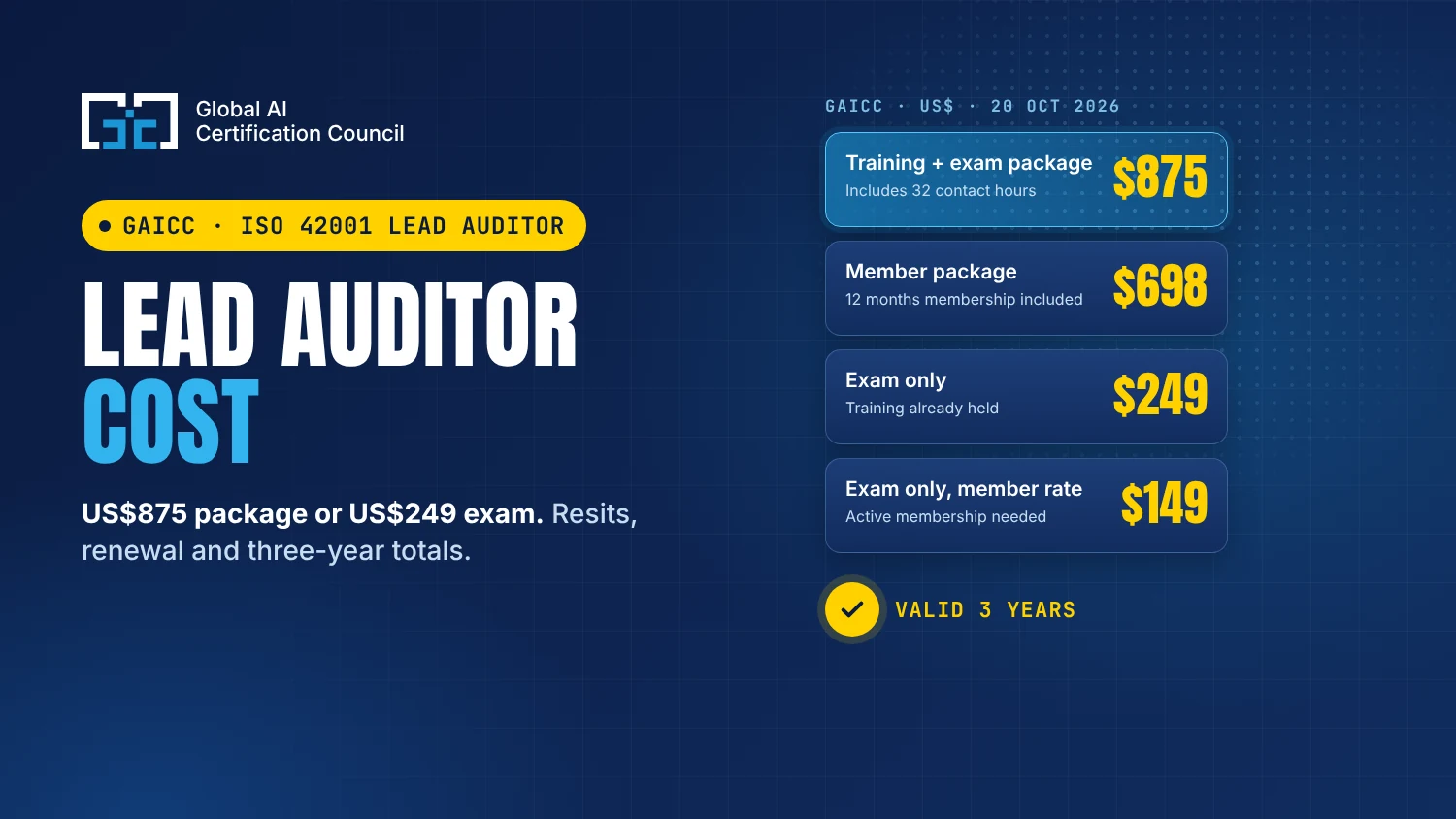
The ISO 42001 Lead Auditor cost is the money and time one person spends to earn and hold an ISO/IEC 42001 Lead Auditor credential. The Global AI Certification Council (GAICC) charges US$875 for its training-plus-exam package, or US$698 when a year of membership is folded in. Candidates who already have the training hours can buy the exam for US$249, or US$149 as members, under the June 2026 Candidate Handbook. Every three years, renewal asks for 32 hours of continuing professional development (CPD) and a fee.
“Lead Auditor” can mean three things, and only one of them carries a price tag. It can mean a personal credential, an auditor whom a certification body has approved, or the person leading an audit team. This page prices the credential first, then the years it takes to become an auditor that a certification body (CB) approves. For the paper itself, read the Lead Auditor exam rules in full. A company’s own certification audit is a separate and larger budget, covered in what a company pays to certify its own AIMS.
What the GAICC Lead Auditor credential costs
GAICC sells the Lead Auditor credential two ways. One is a package with the training and a single exam attempt. The other is the exam alone, for people who can already show the training hours. Package prices sit on the course page, and exam fees sit in section 9 of the handbook GAICC issued to Lead Auditor candidates in June 2026.
| Route | Price in US$ (read 20 October 2026) | What you need before you buy |
| Training and exam package | 875 | Nothing; the course supplies the 32 contact hours |
| Same package, member price | 698, which contains one year of membership worth US$99 | Nothing |
| Exam on its own | 249 | 32 contact hours of Lead Auditor training from an authorized or recognized provider |
| Exam on its own, member rate | 149 | A membership that is already active, plus the 32 hours |
Every fee is quoted in US dollars and must be paid ahead of the sitting. Under the Handbook, the lower exam rate is for people who are members when they pay. Membership is bought as its own item, so the exam fee never includes it. GAICC’s content outline points to the Handbook and the GAICC website for current fees, so build your budget from the Handbook and confirm the figure at checkout.
The arithmetic favors membership in one case only. Choosing the member package saves US$177 on the full price and hands you a year of membership as well. On the exam-only route, joining first means US$149 plus US$99, or US$248, which is one dollar below the non-member fee. Join for the exam alone only if you will use the membership again within the year, for a resit, a second course or renewal. The membership page also shows a student tier at US$39 a year. Its corporate tier costs US$3,200 a year and covers up to 50 staff.
What the package includes and what it leaves out
GAICC’s package pays for the 32 training hours, one sitting, practice on an exam simulator and a large set of study files. Three costs stay outside: resits, renewal and the standards you will audit against.
| Item | Covered by the package? | What the course page says |
| Training | Yes | Listed as four days, worth 32 CPD/PDU hours on completion |
| Exam | Yes, one attempt | An exam voucher comes with the course |
| Practice | Yes | Exam simulator access |
| Study material | Yes | 300 to 400 pages, mock audit templates, risk registers and case studies |
| Extra resources | Yes | A standards summary, a case study workbook, an AI prompt guide, templates and checklists |
| Course certificate | Yes | A certificate of achievement; the credential certificate and digital badge come only after a pass |
| Membership | Only at US$698 | Runs for 12 months |
| Resits | No | Each one carries a discounted fee |
| Renewal | No | 32 CPD hours and a fee at the end of each cycle |
| Text of ISO/IEC 42001 | No | Sold by ISO and national standards bodies |
| Texts of ISO 19011:2026 and ISO/IEC 17021-1 | No | Separate purchases |
Owning the standards is optional for the exam, since GAICC tests you closed book. Owning them is close to essential for audit work. An auditor compares evidence against the exact wording of each requirement, so buy the text before your first real audit. ISO’s catalogue listed the ISO/IEC 42001:2023 text at CHF 225 for its 51 pages when GAICC checked on 20 October 2026. ISO 19011:2026, ISO’s guideline for auditing management systems, is a second purchase. ISO can change either price at any time.
The course page gives no access period for the Lead Auditor course. Ask GAICC before you enroll if you plan to study slowly around a full-time job.
The package is sold as GAICC’s Lead Auditor training and exam package, and the same page sells the exam-only option.
How Lead Auditor prices differ across the market
When GAICC read sellers’ own pages on 20 October 2026, Lead Auditor prices ran from US$99 for a self-paced course with an exam to more than US$3,000 for some live four-day courses. GAICC’s package falls in the self-paced band. Sellers appear below by type only.
| Format | Range in US$ (other currencies converted) | What the price tends to buy | Check before paying |
| Exam voucher, or a low-cost course bundled with an exam | From 99, usually under 250 | One sitting, occasionally two | Whether any training hours come with it |
| Recorded course with exam | About 400 to 900 | Self-study lessons and one sitting | Who issues the certificate, and the resit terms |
| Live course over four or five days | About 1,000 to more than 3,000 | Teaching days and the exam, at times with a free second sitting | Classroom seats can cost more |
| One large personnel certifier, priced separately | 1,000 for its exam, plus 500 to apply | The exam and the credential application | Training is bought apart |
Three features change what a Lead Auditor price buys, and none of them shows in the headline number.
- Graded titles. Two other schemes give a provisional or associate title after the exam. Their full Lead Auditor grade then needs logged audit activity: 300 hours at one, and 400 hours or more at the other. GAICC’s content outline counts experience in months and sets no audit count, and no GAICC document describes a provisional stage.
- Upkeep fees. One other personnel scheme lists a maintenance charge of €90 a year or €240 for three years, with 90 continuing education credits per cycle. GAICC’s Handbook lists no maintenance charge and asks for 32 CPD hours.
- Who teaches the course. Some certification bodies run training arms that sell another issuer’s Lead Auditor course. Buying that course does not put you on that body’s auditor list.
With the price settled, the next costs arrive while you prepare for and sit the exam.
What preparation costs while you study
Preparing for the GAICC Lead Auditor exam costs mostly time, because the package already carries the study files and the simulator. The real spending choices are the standards, your hours and the room you sit in.
| Preparation cost | What it involves | Cash or time |
| Training hours | 32 contact hours, the formal entry rule in Handbook section 2 | Time; already paid for in the package |
| Extra study | No minimum set by GAICC; depends on your audit background | Time |
| Practice | Simulator included with the course | None beyond the package |
| The standards | Optional for a closed-book paper; needed for real audits | Cash, at ISO’s list price |
| Exam setting | A quiet private room, a stable connection and government-issued photo ID | Usually none |
| Reasonable adjustment | Extra time or assistive technology, requested at booking | No fee listed in the Handbook |
Your background sets the size of the time bill. Someone who already audits ISO 9001 or ISO/IEC 27001 knows the audit method and mainly learns the AI clauses and the Annex A controls. A newcomer to auditing has two subjects to learn at once: the standard and the craft of planning, sampling and grading findings. Budget extra weeks if both are new to you.
Material outside the package is optional, and the content outline helps you choose it. It says exam items reference GAICC guidance and companion standards such as ISO 9001, ISO/IEC 27001 and ISO/IEC 27701. Working knowledge of those helps, though buying all of them for a closed-book paper rarely pays off. Borrow your employer’s licensed copies if it has them.
Paid question banks are one cost worth refusing. The Handbook treats exam content as confidential. Copying or sharing it is misconduct and can lead to an invalidated result and withdrawal of the credential. A product sold as “real exam questions” can therefore cost you the credential itself, on top of its price.
Fees you can meet between booking and the exam
Two fees can show up before you pass: a resit fee after a failed attempt, and a membership fee bought at the wrong moment. The Handbook’s fee table has no application fee and no exam-day fee.
A failed attempt costs a discounted re-examination fee, but the Handbook gives no figure for it and says re-examination fees are published each year at gaicc.org. Check the current amount with GAICC before you rebook, and do not plan on a retake at no charge. Each resit must wait at least 30 days after the previous attempt. You get up to two resits in any 12-month period, then a new registration. There is one exception. The content outline offers a free re-examination when GAICC confirms a technical failure during your session.
Timing decides which exam rate you pay. The member rate needs a membership that is active on the day you pay, and each membership runs 12 months. If you expect a resit or a second course inside that year, join before you book.
The application has a time cost instead of a fee. GAICC’s content outline puts average processing at five calendar days for complete online applications. Some applications are picked for a check of training and experience records, which takes longer. Upload your training certificates with the application to avoid that delay.
Once exam access is issued, fees are generally non-refundable. If your exam date might move, ask GAICC for its refund and transfer policy in writing before you pay.
Getting an employer to fund the credential
Employers fund training more readily when the request links it to work the company must do anyway. Clause 7.2 of ISO/IEC 42001 asks an organization to decide what competence its people need when their work affects AI performance, and to keep evidence of that competence. The standard names no credential, so a credential is one way to show the competence of the people who audit an AI management system (AIMS).
Three points make the case concrete.
- Supplier audits. Domain IV of GAICC’s content outline includes a task to audit how suppliers and third parties align with AIMS requirements. A company that buys AI services can put that skill to work on its vendors.
- A known figure. GAICC lists one price per person, so a manager can sign off a fixed amount with no tender. A team can ask about the corporate tier, which the membership page lists with a 25 percent bulk-staff discount.
- Renewal through work. Eleven of the 32 renewal hours fall in the Practice category, which means applied work in the certified field. So an employer who hands you real audit work is, in effect, also paying for a good part of your renewal.
What to put in a funding request
A short written request gets approved faster than a conversation in the corridor. Include four things.
- The figure: US$875, or US$698 with a year of membership included. Staff who already hold training hours need only the US$249 exam.
- The schedule: the 32 training hours, your exam month, and the 30-day wait that applies if a resit is needed.
- The return: the internal or supplier audits you will run in the next year, named by process or vendor.
- The upkeep: 32 CPD hours over three years and a renewal fee, much of it earned through the audits in point 3.
Under the Handbook, the credential is tied to you by name and cannot pass to anyone else. Some firms ask staff who resign soon after training to pay the cost back. That is a matter for your employment contract, since no GAICC rule covers it.
Once you pass, the costs shift from earning the credential to keeping it.
Renewal and CPD costs
Renewing the GAICC Lead Auditor credential takes 32 CPD hours spread over three years, plus a renewal fee. The Handbook says renewal fees are “published annually at www.gaicc.org” and gives no figure.
| Renewal item | GAICC rule or figure |
| How long the credential lasts | Three years from your certification date |
| CPD per cycle | 32 hours: Learning 11, Practice 11, Contribution 5, Elective 5 |
| Ethics | The GAICC Code of Ethics is reaffirmed at each renewal |
| Renewal fee | Published each year by GAICC, says the Handbook, which prints no amount; confirm it before your cycle ends |
| How you apply | A renewal application in the GAICC Certification Portal, filed before expiry with CPD evidence and the fee |
| Evidence to keep | Attendance certificates, publications, mentoring logs, or employer or client letters that confirm audit work |
| After expiry | Three months of grace, then re-examination, under the Handbook; the content outline instead allows reinstatement within 12 months, so renew before expiry |
| Maintenance charge | None listed |
CPD hours cost time more than money. The 11 Practice hours can come from conducting or leading audits, so a working auditor earns them on the job. Contribution hours can come from mentoring a new auditor or presenting what an audit taught you. GAICC audits CPD claims from time to time, so file the evidence for each activity as you go.
Letting the credential lapse costs the most. Once the grace period ends, the Handbook sends you back to the exam, and you must stop using the credential and the GAICC marks.
What holding the credential costs over three years
One full cycle of the GAICC Lead Auditor credential costs US$249 to US$875 up front, plus membership if you keep it and a renewal fee in year three. The table is illustrative and uses only figures GAICC publishes. The Handbook prints no amount for renewal or resits, so those lines stay open until you confirm them.
| Route (illustrative) | Year 1 | Year 2 | Year 3 | Known three-year cash |
| A. Full-price package, no membership | US$875 | Nothing required | Renewal fee | US$875 plus the renewal fee |
| B. Member package, membership kept every year | US$698, membership included | US$99 membership | US$99 membership and the member renewal fee | US$896 plus the renewal fee |
| C. Exam only, training already held, no membership | US$249 | Nothing required | Renewal fee | US$249 plus the renewal fee |
| D. Exam only at the member rate, membership kept | US$149 plus US$99 membership | US$99 membership | US$99 membership and the member renewal fee | US$446 plus the renewal fee |
| Any route | Each resit adds a discounted fee |
Two patterns stand out. Route B costs US$21 more in known fees than Route A over the cycle, so membership pays off only if its discounts, events or a member renewal rate save you more than that. Routes C and D show the same effect on the exam-only side, where keeping membership adds US$197 to the cycle.
None of the totals include the standards, paid CPD events or your study time. They also leave out travel, which arises only if you pick an approved test center over online proctoring. Ask GAICC for the current renewal and resit fees before you fix a three-year budget.
Moving up to Senior Lead Auditor
Senior Lead Auditor, the next GAICC rung, costs US$1,075 as a package on its course page, or US$898 with membership inside. GAICC’s Senior Lead Auditor Handbook and course page show different exam-only fees, so confirm that figure with GAICC before you book the exam alone.
| Senior Lead Auditor item | GAICC figure |
| Training | 40 contact hours |
| Exam | 80 questions in 120 minutes, closed book, with a provisional 70 percent pass mark |
| Experience the content outline lists | Diploma: five years, two of them in auditing or assurance roles. Bachelor’s degree: three years, including multi-site, multi-standard or cross-border audits |
| What that experience must include | Leading or coordinating audit teams, writing audit reports and judging whether corrective actions worked |
| Renewal | 40 CPD hours per cycle: 14, 14, 7 and 5 |
Lead Auditor holders start ahead. The Senior Lead Auditor content outline says they automatically meet its prerequisite knowledge requirement and may apply for the exam once they show the extra experience. It does not say whether the 40 training hours are also waived, so ask GAICC before you choose between the package and the exam-only fee.
Experience is the larger cost. Years of leading audit teams and writing reports cannot be bought, so plan the step around your audit log.
What becoming a certification-body auditor costs in time
GAICC charges nothing for the step from credential to certification-body auditor. The price is paid in years of experience and supervised audits, and the certification body decides when you qualify.
ISO/IEC 42006:2025 is the standard for bodies that certify AI management systems. It builds on ISO/IEC 17021-1, the general rulebook for management system certification bodies. Clause 7.2.2.2 sets a floor for each auditor: university-level education or equivalent, four years of IT or data protection work including a year on AI systems, a 24-hour course covering AIMS auditing and audit management, and recent supervised audits. Clause 7.2.2.3 sets a higher bar for team leaders. None of these steps carries a GAICC fee, but each one costs time.
| What the CB looks for | Where the rule sits | What it costs you |
| Four years of IT or data protection work | ISO/IEC 42006, 7.2.2.2 | Career time |
| One year of work related to AI systems | ISO/IEC 42006, 7.2.2.2 | Career time |
| 24 hours of training covering AIMS audits and audit management | ISO/IEC 42006, 7.2.2.2 | One course; each CB decides which courses it accepts |
| Supervised audit experience: ten audit days or three management system audits in the last five years | ISO/IEC 42006, 7.2.2.2 | Audit days as auditor or auditor in training |
| To lead the team: all stages of at least three management system audits | ISO/IEC 42006, 7.2.2.3 | More audit days before you lead |
| Audits witnessed by an authorized AIMS auditor, where applicable | ISO/IEC 42006, 7.2.2.1 | Audit days, scheduled by the CB |
| No AI consulting for the CB’s certification clients | ISO/IEC 42006, 5.2.2.1 | Possibly some consulting income |
The consulting rule can carry a real price for consultants. ISO/IEC 42006 bars certification bodies from consulting on AI management systems. A consultant who joins a CB should expect questions about current client work.
Keep your GAICC course syllabus and completion certificate, because a CB may ask how your training maps to its 24-hour rule. On 20 October 2026, ANAB’s register of AIMS certification bodies listed 20 bodies accredited for ISO/IEC 42001. The UKAS category page listed five on the same day. Those bodies hold the accredited third-party AIMS audit work.
The approval steps, from competence review to witnessed audit, are set out in how a certification body approves its AIMS auditors. For what the work pays once you are approved, see US pay and roles for Lead Auditors.
Frequently Asked Questions
Is there a free ISO 42001 Lead Auditor certification?
Some videos promote a free ISO 42001 Lead Auditor certificate. Free training exists, yet a credential still depends on an issuer’s exam and rules. Check who issues the certificate, how an employer verifies it and what renewal needs. At GAICC, the cheapest route is the US$249 exam for people who already hold 32 training hours.
Does GAICC charge an application or annual maintenance fee?
No. The Handbook’s fee table has three lines: annual membership, the exam fee, and one line for the renewal and re-examination fees that GAICC publishes each year. Membership is optional, and the credential runs for its three years without it. Some other schemes charge a yearly fee to keep a credential active, so compare three-year totals before you choose.
Does the Lead Auditor cost the same as the Lead Implementer at GAICC?
The prices match. Both packages cost US$875, or US$698 with membership, and both exams cost US$249, or US$149 for members. Renewal differs, since the Lead Auditor needs 32 CPD hours per cycle and the Lead Implementer needs 40. Candidates who want both credentials pay for each one, because no GAICC Handbook describes a bundle or a credit between them.
Is the Internal Auditor credential cheaper than the Lead Auditor?
No. GAICC prices the Internal Auditor package and exam at the same US$875, US$698, US$249 and US$149, and its renewal also takes 32 CPD hours. What differs is scope: the Internal Auditor covers first-party audits of the organization you work for, while the Lead Auditor extends to audits of other organizations. GAICC’s guide to the Internal Auditor exam sets the two GAICC credentials side by side.
Do the 32 training hours count as CPD for another credential?
GAICC’s course page awards 32 CPD/PDU hours when you finish the course. Whether another body accepts them for its own renewal depends on that body’s rules. Keep the certificate of achievement and the module list, because most bodies ask what an activity covered and how long it lasted.
Will a more expensive course make a certification body more likely to hire me?
A certification body judges your competence against ISO/IEC 17021-1 and ISO/IEC 42006, plus its own criteria. The course price is not one of them. A CB looks for experience, training that covers AIMS audits, witnessed audits and impartiality. Spend on the route that gets you real audit work, since logged audits weigh more than the name on a course invoice.