AI governance is often discussed as a set of policies, review boards, risk assessments, and controls surrounding AI.
ISO/IEC 42001 offers organizations something more useful: a management system for making those activities work together.
That distinction matters.
As organizations move from a handful of AI experiments to AI embedded across products, workflows, decisions, and autonomous agents, governance cannot depend on individual teams remembering what to assess or calling risk and compliance before launch. It needs to become part of how the organization operates.
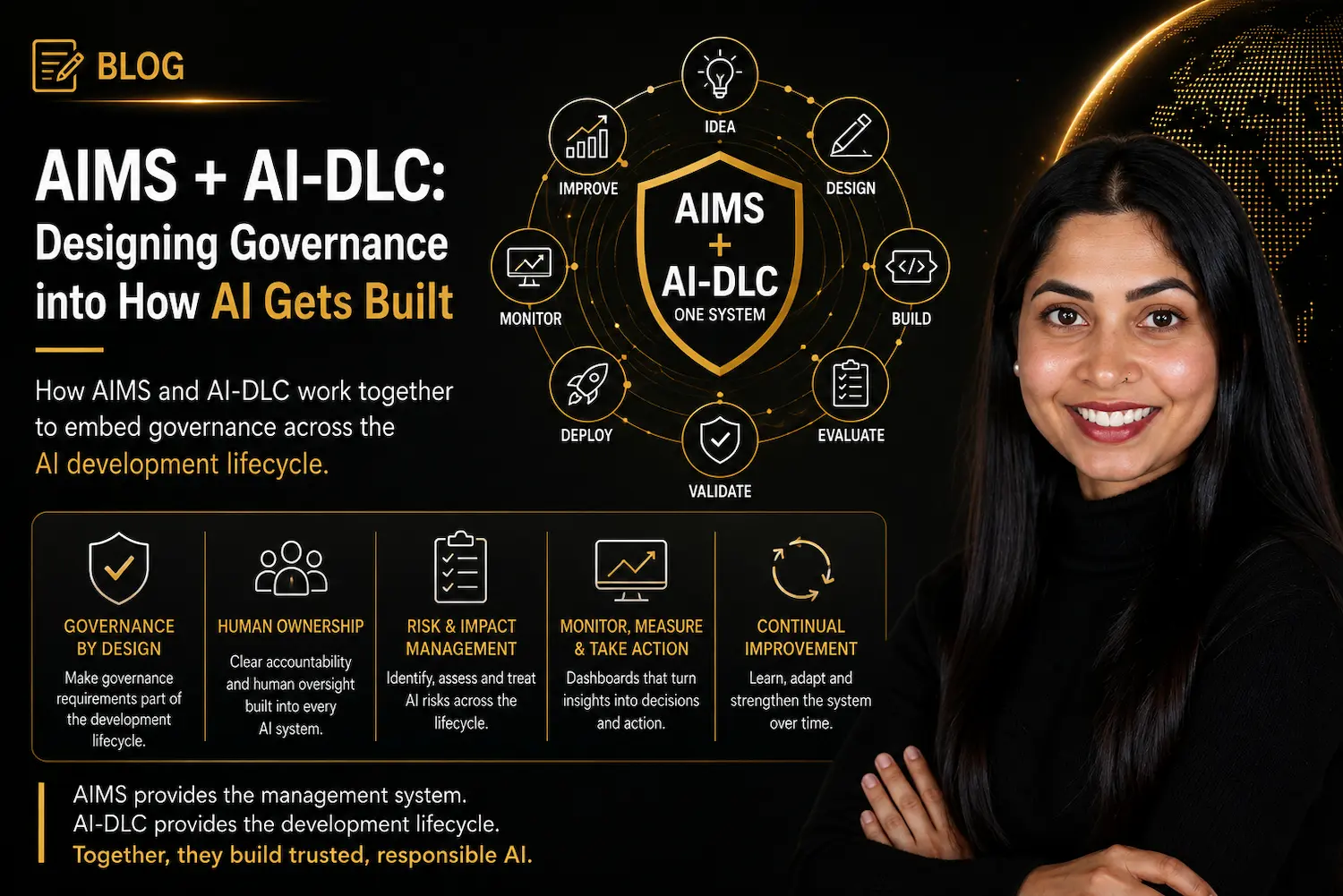
This is where an important opportunity emerges: AIMS provides the management and governance system. AI-DLC provides the development lifecycle. The opportunity now is to design them as one system.
What is an AIMS, and what does a good one actually look like?
An Artificial Intelligence Management System, or AIMS, gives an organization a structured way to govern AI across its lifecycle.
An AIMS Lead Implementer is trained to help organizations establish the systems, standards, processes, controls, accountability, and evidence needed to develop and operate AI responsibly, while also guiding the organization through the ISO/IEC 42001 certification journey.
That can include identifying AI risks, conducting AI System Impact Assessments, establishing accountability and human oversight, defining evaluation and validation practices, managing risks such as bias, hallucination, privacy exposure and data leakage, governing changes, monitoring systems in production, maintaining evidence, and continually improving the management system.
For professionals looking to develop practical skills in this area, the ISO/IEC 42001 Lead Implementer course provides structured training around building, managing, and improving an Artificial Intelligence Management System.
ISO/IEC 42001 is built as a management system standard. It connects organizational context, leadership, planning, resources, operational controls, performance evaluation, and continual improvement into one system. That architecture is important because many organizations already have pieces of AI governance.
We have all at some point in our corporate life have seen problem of fragmentation. One group maintains AI policies. Another performs security reviews. Product teams run evaluations. Legal reviews certain use cases. Data science monitors model performance. Risk teams maintain registers. Individual business units may have their own approval processes.
The problem is rarely the complete absence of governance.
GAICC describes the failure of ad hoc governance clearly: it is difficult to systematize, difficult to audit, and increasingly difficult to scale as the number of AI systems grows. AIMS creates the architecture that connects these activities into repeatable processes with ownership and evidence.
That is also why the role of an AIMS Lead Implementer extends beyond helping an organization prepare for certification. Certification provides independent validation that this system has been implemented. The larger organizational value comes from keeping the system alive after certification.
GAICC makes this distinction throughout the Lead Implementer material. Operationalizing AIMS means establishing criteria, executing controls, retaining evidence, reassessing risks as conditions change, and demonstrating an unbroken evidence chain from risk identification through monitoring and improvement.
What does a good AIMS look like?
A good AIMS should allow an organization to answer some basic questions quickly.
- What have we learned that should change the system?
- What AI systems are we using?
- Why are we using them?
- Who owns them?
- What risks and impacts have been identified?
- What controls were selected?
- What evidence demonstrates those controls are working?
- What changed after approval?
- Is the system still operating within acceptable thresholds?
- What requires leadership attention?
GAICC refers to this traceability as the golden thread. Context connects to risk identification. Risks connect to treatment decisions and controls. Controls connect to impact assessments and evidence. Evidence connects to monitoring. Monitoring connects to management review. Findings and decisions connect to improvement.
That is what transforms governance from documentation into a management system.
Rise of AI-DLC because the way we build products is changing
Traditional SDLC and Agile were built around a relatively stable assumption: humans define requirements, engineers build the system, QA validates expected behavior, and the product is released. AI changes that model. Engineers are now building alongside AI coding agents, while the products themselves increasingly use models and agents that can interpret instructions, choose tools, generate outputs, and take actions.
That means development can no longer rely primarily on PRDs, user stories, and acceptance criteria. Teams increasingly need spec-driven and behavior-driven artifacts that define expected behavior, architecture, permissions, constraints, human oversight, evaluation criteria, failure conditions, and governance requirements in a way both humans and AI can interpret consistently.
The development lifecycle is therefore evolving into something broader, and the final answer may not be enough. The organization may also need visibility into the sequence of decisions and actions that produced it.
Idea → Design → Build → Evaluate → Validate → Deploy → Monitor → Improve
Human ownership becomes more important, not less
As AI performs more of the work, clear human accountability becomes critical. AI can generate code, recommendations, decisions, or actions, but it cannot own the business consequence of those decisions. Humans still need to define what the system is allowed to do, determine acceptable risk, approve important changes, review exceptions, respond to incidents, and decide when the system should be stopped or redesigned.
If that ownership is skipped, responsibility can quickly become ambiguous. A model produces an unexpected result. An agent takes an incorrect action. A coding agent introduces a security weakness. A team assumes another group validated the system. Everyone participated, but nobody clearly owned the outcome. That is where AI risk becomes organizational risk.
Human review should therefore be designed into the lifecycle rather than added only when something goes wrong. The level of human involvement can vary by risk, but the accountability cannot disappear.
This is why governance must move inside AI-DLC. A policy stating that an agent cannot perform a high-risk action without human approval is only the starting point.
That requirement should become:
- a permission in the architecture
- a behavior defined in the specification
- a scenario in the evaluation suite
- a release condition before deployment
- a monitored control in production
- a named human owner when intervention is required
Governance requirements become development requirements, and human accountability becomes part of system design. From an operating model perspective, this also reduces the traditional sequence of product builds, engineering delivers, risk reviews, governance approves.
SDLC managed how software was built. AI-DLC must also manage how intelligent systems behave, decide, change, and remain accountable over time.
That is why AIMS becomes so relevant. It provides the management structure, ownership, controls, monitoring, and continual improvement needed around this new development model.
For teams looking to build this capability formally, the ISO/IEC 42001 Lead Implementer course is directly aligned with the practical work of establishing an AIMS, implementing controls, managing AI risks, and maintaining evidence.
The opportunity is to design AIMS and AI-DLC as one system
This is where the two models become much more powerful together. AIMS should not live beside the development lifecycle. Its requirements should show up inside the lifecycle.
When a use case enters AI-DLC, the AIMS can determine its governance path based on factors such as purpose, affected stakeholders, autonomy, data sensitivity, potential impact, applicable obligations, and risk.
- During design, those requirements become system constraints, human oversight mechanisms, permissions, documentation requirements, and evaluation criteria.
- During build, governance requirements become executable controls and reusable standards.
- During evaluation, risk thresholds become measurable tests.
- During validation, those tests become release criteria.
- During deployment, approvals and evidence become release gates.
- During operation, monitoring determines whether the assumptions used at approval are still valid.
And when conditions change, the AIMS provides the triggers for reassessment. AI risk cannot be assessed once and frozen.
The GAICC material identifies changes such as new data sources, model changes or retraining, incidents, complaints, regulatory changes, and scheduled reviews as reasons to reassess risk. Operational AIMS guidance similarly emphasizes that new risks emerge as systems encounter real users, changing data, new behaviors, and new attack vectors. This creates a very much needed continuous loop because AI systems predict continuously and the output is not deterministic and should be monitored frequently:
Development produces evidence. Governance evaluates the evidence. Production produces new evidence. Monitoring identifies changes. Those changes feed back into development.
That is far more scalable than asking governance teams to manually inspect every AI implementation after it has already been built.
The Governance Dashboard Should Be a Decision System
This combined operating model also changes what an AI governance dashboard should do. A governance dashboard should not become another reporting layer. It should be a decision system.
GAICC’s Performance Evaluation material makes an important distinction here. Monitoring collects and analyzes data. Internal audit independently checks whether the management system is operating as designed. Management review puts that evidence in front of leadership so decisions can be made. Monitoring without action becomes data collection. Review without decisions becomes a meeting.
The dashboard connects those layers.
A useful dashboard might combine AI portfolio visibility, ownership, lifecycle status, risk levels, impact assessment status, evaluation performance, model drift, fairness indicators, incidents, human intervention rates, unresolved risk treatments, control effectiveness, exceptions, upcoming reviews, and changes requiring reassessment.
But the metric itself is only half of the design. A strong monitoring structure asks four additional questions:
What are we measuring? How are we measuring it? How frequently is it monitored? When and how will the result trigger action?
GAICC’s dashboard guidance goes even further. Every meaningful metric should have a defined threshold, status, trend direction, and corresponding action. A metric without a threshold provides information. A metric connected to a threshold can become a control.
This is where governance can begin helping organizations look ahead.
Consider two AI systems that are both currently green. The first has remained stable for six months. The second is still within threshold, but human interventions have increased for four consecutive weeks, evaluation scores are trending downward, and a model update is scheduled. Their current status may look identical. Their risk trajectories are very different. A decision-oriented governance dashboard makes that difference visible before an incident forces the organization to notice it.
Governance becomes increasingly important as AI adoption grows. Organizations will eventually be governing far more AI systems, models, agents, tools, datasets, vendors, evaluations, and automated decisions than a central governance team could manually review.
The answer cannot simply be more governance meetings. Instead, a scalable model is governance infrastructure. Common risk classifications can determine which controls are required. Reusable specifications can carry architecture, security, data, and governance requirements into development. Standard evaluations can be reused across similar systems. Agent skills and approved components can be shared rather than recreated by every team. Evidence can be generated as part of development rather than assembled before an audit. Monitoring thresholds can trigger escalation or reassessment automatically.
Governance dashboards can surface the systems that actually require leadership attention. And lessons from incidents, audits, evaluations, and production monitoring can improve the standards used by the next team. This is also where the Plan, Do, Check, Act structure behind AIMS becomes especially powerful.
Planning establishes context, objectives, risks, resources, and controls. Operations execute them. Performance evaluation determines whether they are working. Continual improvement feeds what was learned back into the next cycle. GAICC describes Clause 10 as the point where AIMS moves from being an assessment system to becoming a self-improving system.
AI-DLC can run inside that same loop and that is the bigger opportunity.
AIMS provides the management and governance system. AI-DLC provides the development lifecycle. Designed together, they create an operating model where governance becomes part of how AI is built, evaluated, deployed, monitored, and improved.
Certification can validate that system. The real value is what the organization can do with it afterward.