
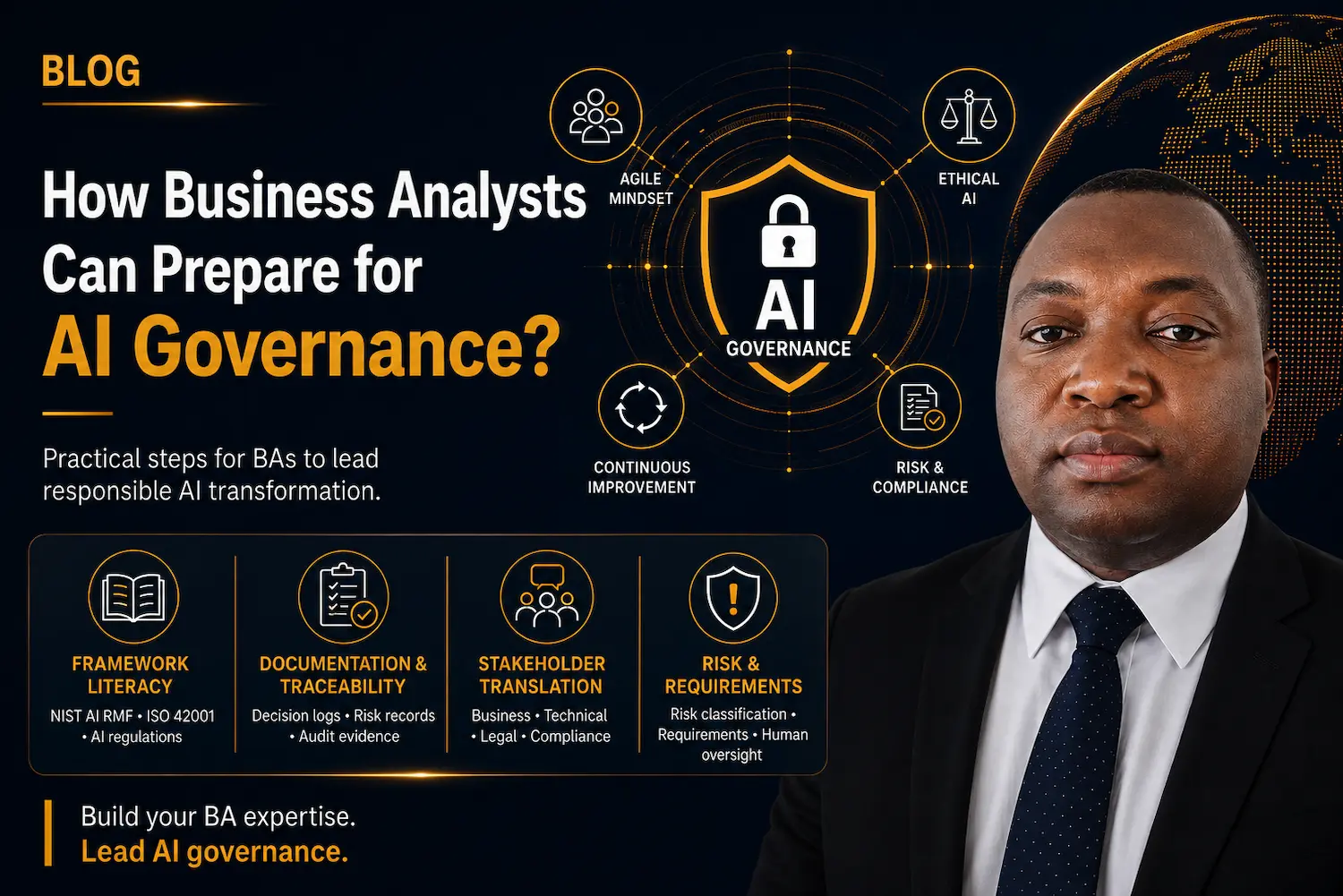
Business Analysts (BAs) are uniquely positioned to become valuable contributors to AI Governance because they already bridge business needs, technology, risk, and stakeholder management. However, AI introduces new considerations such as fairness, transparency, privacy, accountability, and regulatory compliance that require additional knowledge beyond traditional business analysis.
Here is how to prepare:
Build Framework Literacy
Get fluent in the frameworks organizations are adopting, since these are becoming the common language of AI governance:
- NIST AI Risk Management Framework: Its Map, Measure, Manage, and Govern structure aligns closely with BA competencies like context analysis, metric definition, and risk prioritization.
- ISO 42001 (AI management systems): Covers documentation of system objectives, limitations, and oversight structure.
- Relevant regional regulation: Such as the EU AI Act, plus sector-specific rules if you work in a regulated industry.
Strengthen the Documentation and Traceability Skillset
A large share of AI governance work is about creating auditable records such as decision logs, risk assessments, and evaluation summaries, and keeping them current as systems change.
BAs should practice:
- Writing clear decision logs that capture the logic and data inputs behind an AI system’s outputs, not just the outcome.
- Maintaining traceable records of what a system was designed to do, how it was validated, who approved it, and what changed after deployment.
- Standardizing documentation formats so risk assessments and monitoring plans are consistent across use cases.
Own the “Translation” Role
Governance committees need someone who can turn technical model details into digestible insights for executives, legal, and compliance. This is squarely BA territory.
Practically, this looks like:
- Facilitating intake processes for new AI use cases, coordinating stakeholders and gathering risk-relevant details.
- Preparing committee-ready materials that summarize a system’s purpose, risk triggers, and evaluation evidence.
- Communicating governance decisions and required actions back to technical teams clearly.
Get Hands-On with Risk Classification and Requirements Work
Because many AI failures trace back to poor requirements and unclear decision logic rather than pure technical failure, BAs add value by tightening the front end of AI projects, not just the compliance back end.
This means:
- Practicing risk-tiering exercises: classifying AI use cases as high, medium, or low risk based on impact and autonomy.
- Writing requirements that explicitly call out explainability needs, human-in-the-loop checkpoints, and acceptable failure modes.
- Mapping end-to-end processes to spot where automated decisions touch customers or employees and where oversight is legally or ethically required.
Pursue Relevant Certification and Cross-Functional Exposure
Formal credentials signal readiness and fill knowledge gaps in ethics, compliance, and risk methodology that traditional BA training doesn’t always cover.
Beyond certification, seek exposure to:
- Legal and compliance teams’ workflows, since AI governance decisions increasingly require their sign-off.
- Data science basics, not to build models, but to ask informed questions about training data, bias testing, and model limitations.
- Cross-functional governance committees, even in an observer or support capacity, to learn how intake, review and approval function in practice.
Business Analysts looking to build practical expertise in AI governance can develop these skills through the ISO/IEC 42001 Lead Implementer course