
GAICC AI Conference & Awards 2026 "Governing the Future – Building Responsible, Safe and Human-centric AI"
AI for Project Managers. Managing AI Projects.
Learn how to use AI responsibly across every phase of project delivery — and how to scope, deliver and govern AI and machine-learning projects themselves. Build the dual-track fluency that today’s PMOs, sponsors and delivery leads expect.




Students
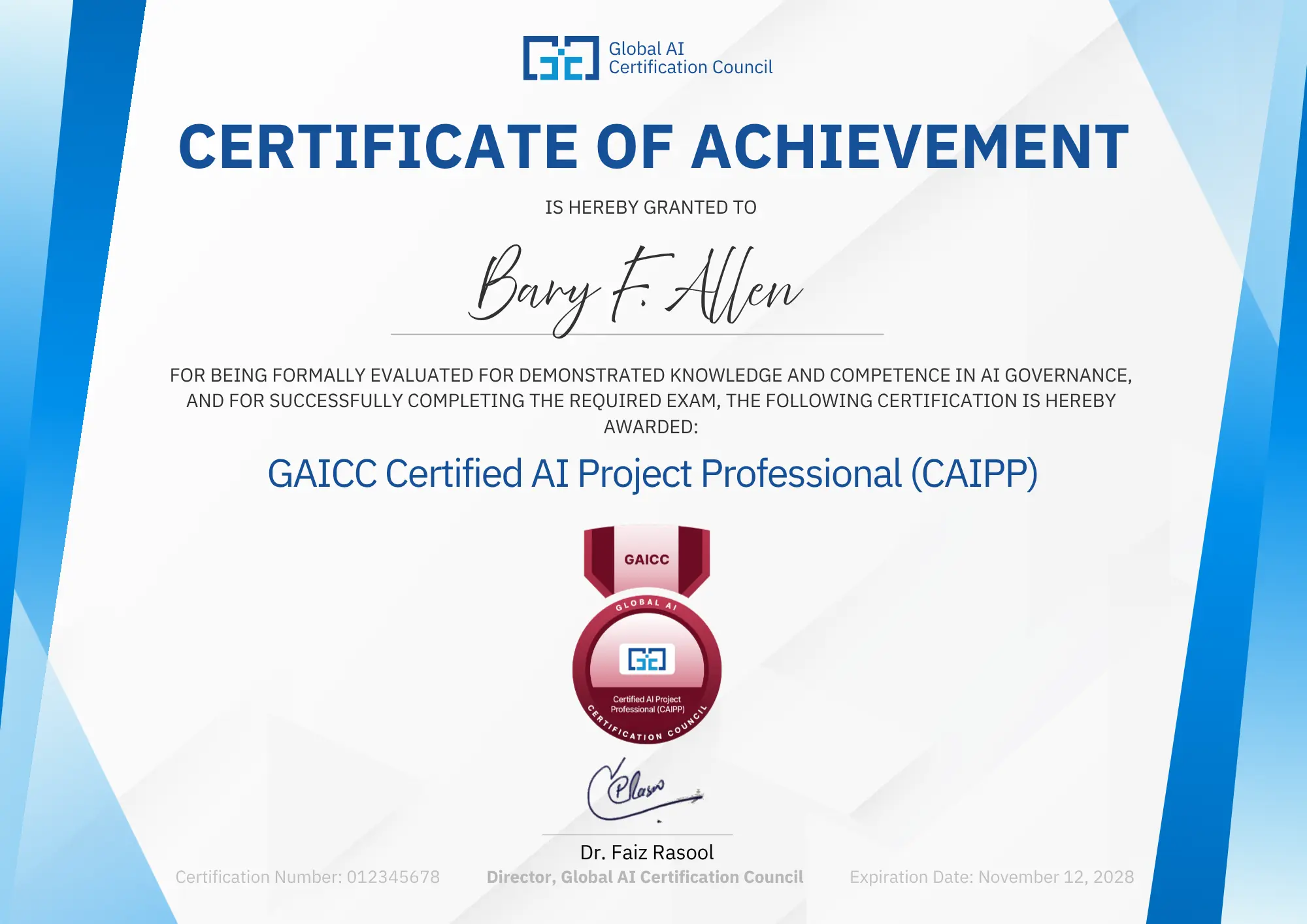

Issued By Global AI Certification Council
The Certified AI Project Professional (CAIPP) is a vendor-neutral, role-anchored credential that prepares project professionals to lead the responsible, defensible adoption of AI in how they deliver projects — and to manage AI and machine-learning projects themselves. It answers a two-part mandate: AI for project managers, and managing AI projects.
Artificial intelligence is reshaping both halves of a project professional’s world. On one side, AI is changing how projects are run — how scope is drafted, estimates built, schedules stress-tested, status reported and stakeholders engaged. On the other, a growing share of the projects themselves are AI and machine-learning initiatives: probabilistic, data-dependent, experiment-driven, and carrying novel ethical, regulatory and delivery risk.
| Academic Qualification | Recommended Project Experience | Status |
|---|---|---|
| Master's degree (Project Management, Business, Engineering, Computing or related) | 2 years | Recommended, not required |
| Bachelor's degree (any discipline) | 3 years | Recommended, not required |
| Associate degree or project-management diploma | 5 years | Recommended, not required |
| Secondary education | 8 years | Recommended, not required |
AI for Project Managers (Days 1–2 · Domains 1–4 · 50%) Using AI to plan, estimate, schedule, execute, monitor, report, and lead stakeholders and teams.
Managing AI Projects (Days 3–4 · Domains 5–8 · 50%) Scoping, business-casing, delivering and governing AI/ML initiatives — lifecycle, data, MLOps, governance, value.
Domain 1 · Weight 10% · Day 1 · 4.0 CPDs
Give every candidate a working, plain-language grasp of AI, machine learning and generative AI, and of the AI tooling now reshaping project work.
By the end, candidates can: explain AI/ML/deep learning/generative AI in plain terms; describe how LLMs and AI agents behave — capabilities, limits, failure modes; map the PM AI landscape (copilots, scheduling, risk analytics, PPM, meeting assistants); apply structured prompting patterns; protect data, privacy and confidentiality when using AI on project information.
Labs: Prompt Clinic · Tool Landscape Map · “Where would AI help, and where would it hurt?” discussion.
Domain 2 · Weight 12% · Day 1 · 4.0 CPDs
Apply AI across the front half of delivery — scope, estimation, scheduling and the plan — while staying accountable for what AI produces.
By the end, candidates can: draft AI-assisted scope, WBS and requirements; produce AI-supported estimates (parametric, analogous, reference-class) with confidence ranges; build and stress-test AI-supported schedules; forecast cost while guarding against false precision; validate an AI-generated plan before committing to it.
Labs: AI Estimate Challenge · Schedule Stress-Test · “The estimate the AI got confidently wrong” case study.
Domain 3 · Weight 13% · Day 2 · 4.0 CPDs
Apply AI to the delivery engine — tracking, control and reporting — so issues surface early and status stays trustworthy.
By the end, candidates can: use AI for progress tracking and earned-value analytics; apply predictive monitoring to detect slippage; support integrated change control with AI impact analysis; produce AI-drafted dashboards and executive summaries with integrity; use meeting assistants while staying accountable for reported numbers.
Labs: Early-Warning Dashboard · Status That Survives Scrutiny · “Dashboard theatre” case study.
Domain 4 · Weight 15% · Day 2 · 4.0 CPDs
Use AI to strengthen — not hollow out — stakeholder engagement, communication and team leadership.
By the end, candidates can: conduct AI-assisted stakeholder analysis and engagement planning; draft and tailor communications and difficult messages with AI and judgement; lead distributed/hybrid teams in the AI era; apply safe, productive personal AI use; build AI fluency across the team.
Labs: Engagement Plan Sprint · The Hard Message · “Disclosure and attribution” discussion.
Domain 5 · Weight 12% · Day 3 · 4.0 CPDs
Recognise what makes an AI/ML initiative different, shape a defensible use case, and build a business case fit for probabilistic, data-dependent work.
By the end, candidates can: explain how AI/ML projects differ (data dependency, uncertainty, experimentation, model lifecycle); identify and feasibility-test AI use cases; build a business case and value hypotheses under uncertainty; define success criteria for probabilistic systems; choose build/buy/partner/fine-tune and align stakeholders at initiation.
Labs: Use-Case Triage · Business Case Under Uncertainty · “The pilot with no data” case study.
Domain 6 · Weight 13% · Day 3 · 4.0 CPDs
Coordinate the AI/ML delivery lifecycle, tailor delivery approach to experimental work, and manage data/MLOps/vendor realities — without being a data scientist.
By the end, candidates can: walk the AI/ML lifecycle end to end; tailor predictive, agile and hybrid approaches; manage data work streams and their schedule impact; coordinate MLOps and deployment at a project level; coordinate specialist teams and run testing/validation/acceptance for non-deterministic results.
Labs: Lifecycle Plan · Data Work-Stream Risk · “Model drift in production” case study.
Domain 7 · Weight 15% · Day 4 · 4.0 CPDs
The defensibility layer of the credential — governance frameworks, ethics, risk practice and regulatory regimes, anchored to ISO/IEC 42001, the NIST AI RMF and the EU AI Act.
By the end, candidates can: apply AI governance frameworks (ISO/IEC 42001, ISO/IEC 23894, NIST AI RMF); interpret EU AI Act risk tiers and delivery-team obligations; manage AI-specific risk (model, data, bias, security, third-party, reputational); apply ethics in delivery (fairness, transparency, human oversight, accountability, contestability); produce responsible-AI documentation and embed governance gates without stalling delivery.
Labs: Risk-Tier Triage · Governance Gate Design · “The model that shipped without an impact assessment” case study.
Domain 8 · Weight 10% · Day 4 · 4.0 CPDs
Close the credential with the disciplines that make AI investment pay back — benefits realisation, change and the AI-era PMO — integrated in a capstone.
By the end, candidates can: design benefits realisation and value tracking for AI, avoiding vanity metrics; lead organisational change and adoption for AI-enabled ways of working; plan transition, handover and sustainment; shape the AI-era PMO (intake, prioritisation, standards, assurance); integrate planning, delivery and governance into a single AI project pack (capstone).
Labs: Benefits Map · Adoption Plan · Capstone — end-to-end integration and presentation.
| Module | Domain | ECO Weight | Day | CPDs |
|---|---|---|---|---|
| M1 | AI and Generative-AI Foundations for Project Professionals | 10% | Day 1 | 4.0 |
| M2 | AI-Augmented Planning, Estimation and Scheduling | 12% | Day 1 | 4.0 |
| M3 | AI for Execution, Monitoring, Control and Reporting | 13% | Day 2 | 4.0 |
| M4 | AI for Stakeholders, Communication, Teams and the AI-Fluent PM | 15% | Day 2 | 4.0 |
| M5 | Scoping, Initiating and Business-Casing AI/ML Projects | 12% | Day 3 | 4.0 |
| M6 | Delivering AI/ML Projects: Lifecycle, Delivery Approaches and Data | 13% | Day 3 | 4.0 |
| M7 | AI Governance, Ethics, Risk and Regulatory Compliance in Delivery | 15% | Day 4 | 4.0 |
| M8 | Value, Benefits Realisation, Change Enablement and the AI-Era PMO | 10% | Day 4 | 4.0 |
| Total | 100% | — | 32.0 |
| Ecosystem Asset | How the CAIPP Connects |
|---|---|
| AI Governance Framework | Develops the Delivery & Operations layer and the People, Functions & Capability spokes. Strengthens the Lifecycle, AI Impact Assessment, Data, Responsible-use and Third-party Control domains, and the Direct → Assess → Operate → Improve governance loop. |
| Implementation Roadmap | CAIPP-certified professionals operationalise Phases 3–6 — Scope & Baseline, Policy & Controls, Embed, and Assure & Certify — applying toolkit templates such as the AI System Inventory Register, AI Impact Assessment, Statement of Applicability, and RACI / Accountability Map on live projects. |
| AI Maturity Model | Advances the Capability & Culture, Lifecycle Control, and Risk, Impact & Trustworthiness dimensions, supporting the journey from AI-enabled to AI-first to AI-native while maintaining governance at every step. |
| Credential Landscape | Joins as an AI Governance Speciality — alongside CAILCP, AICCP and CAIHRP — complementing the AI Governance Core (CPAIG) and the ISO/IEC 42001 / ISO/IEC 27001 credential families. |

⭐⭐⭐⭐⭐

⭐⭐⭐⭐⭐

⭐⭐⭐⭐⭐

⭐⭐⭐⭐⭐

⭐⭐⭐⭐⭐

⭐⭐⭐⭐⭐
4 Days · 32 CPDs
US$898
US$1,075
US$99 is included in the above member price.

Director at the Global AI Certification Council (GAICC) and PM Training School
A globally certified instructor in ISO/IEC, PMI®, TOGAF®, SAFe®, and Scrum.org disciplines. With over three years’ hands-on experience in ISO/IEC 42001 AI governance, he delivers training and consulting across New Zealand, Australia, Malaysia, the Philippines, and the UAE, combining high-end credentials with practical, real-world expertise and global reach.

Self-Paced Course (Certification Exam included)
US$898
US$1,075
Membership Fee US$99 is included in the above member price.