
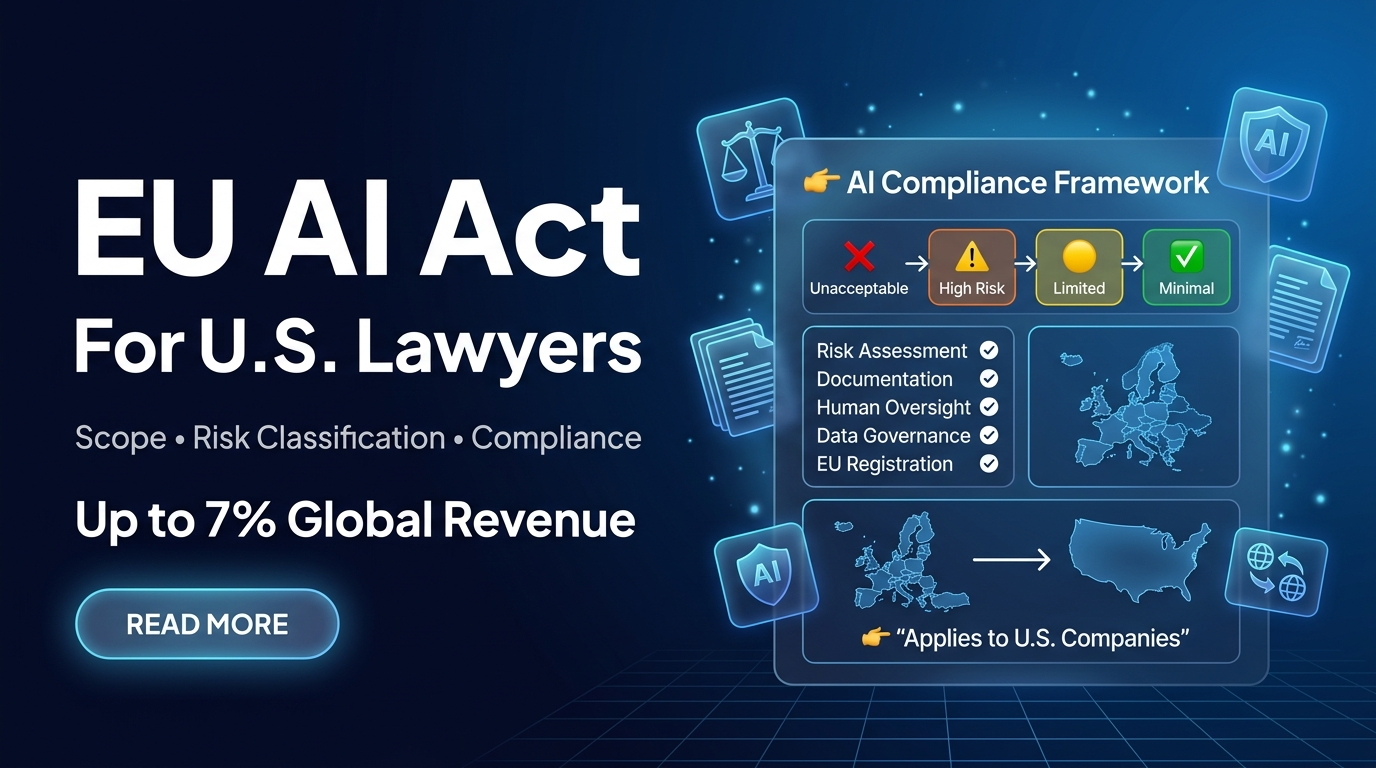
The jurisdictional trigger is use “in the Union,” not corporate domicile. Fines reach 7% of global turnover. High-risk enforcement lands August 2, 2026. Here is the practical playbook for advising U.S. clients with EU exposure.
Penalty exposure for U.S. companies: Prohibited AI violations: up to €35M or 7% of global annual turnover. High-risk non-compliance: up to €15M or 3%. False information to authorities: up to €7.5M or 1%. Calculated on global revenue, not EU revenue. For a $10B U.S. company, maximum exposure reaches $700M. 26 major AI providers signed the GPAI Code of Practice. Meta refused.
The EU AI Act’s jurisdictional trigger is use “in the Union” rather than corporate domicile. A U.S. company using AI for loan approvals that serves European customers is in scope even if models run on Virginia servers. The high-risk deadline lands August 2, 2026. Most U.S. lawyers treating this as a European concern are missing material client exposure. This article provides the framework: how to determine scope, classify risk, navigate conformity assessment, and structure the advisory engagement.
The Scope Test: Which U.S. Clients Are In Scope
Article 2 establishes three categories of non-EU entities. Evaluate each client against all three.
Category 1: Providers placing AI on the EU market. Any U.S. company selling an AI product to EU customers, whether sold, free, or SaaS. A U.S. SaaS platform accessible to EU businesses is placing that system on the EU market. The broadest trigger, capturing most U.S. tech companies with EU customers.
Category 2: Providers whose outputs are used in the EU. U.S. companies whose AI affects EU residents even if the sale happens outside the EU. AI credit scoring for a European bank, AI hiring tools for a U.S. multinational’s EU subsidiary. The test is where the output is used, not where the system runs.
Category 3: Importers and distributors. EU entities importing U.S. AI systems bear compliance obligations and will require contractual assurances. Creates downstream pressure through EU distribution channels.
The practical advisory question: Does any of your client’s AI generate outputs reaching EU residents, serve EU customers, or influence decisions about EU individuals? If yes, the EU AI Act applies regardless of headquarters, server location, or physical EU presence.
For most organizations, this process builds directly on existing GDPR programs, which means the real challenge is not starting from scratch but adapting current compliance systems for AI.
Risk Classification: The Four Tiers
| Tier | What It Covers | U.S. Client Examples | Obligation |
|---|---|---|---|
| Unacceptable (Banned) | Social scoring, manipulative AI, real-time biometric ID, emotion inference in work/school, predictive policing | Scoring for EU public entities. HR emotion detection. Consumer AI exploiting vulnerable groups. | Prohibited. Cease or withdraw. Enforceable since Feb 2025. |
| High-Risk | Employment, credit, education, critical infrastructure, healthcare, law enforcement, elections (Annex III) | AI hiring for EU employers. Credit scoring for EU lenders. Medical diagnostics. Insurance underwriting. | Conformity assessment, documentation, risk management, human oversight, EU registration. Aug 2026. |
| Limited Risk | Chatbots, emotion recognition, deepfakes, synthetic media, content generation | Customer service chatbots. Content platforms. Sentiment analysis tools accessible in EU. | Transparency: disclose AI interaction, label AI content. |
| Minimal Risk | Spam filters, games, inventory, non-safety analytics | Internal analytics, productivity tools, recommendation engines. | No specific obligations. Voluntary good practice. |
The classification exercise is the highest-value early deliverable. A client with 50 AI systems may have only 5 high-risk. Identifying which need full conformity assessment versus transparency disclosure determines budget and timeline.
Misclassifying an AI system or underestimating its risk level can create significant legal exposure, especially as AI-related liability continues to evolve across jurisdictions.
What High-Risk Compliance Requires
Risk management system (Art. 9). Continuous, iterative throughout lifecycle. Identify, estimate, mitigate, monitor, document. ISO 42001 Clause 8.2 maps directly.
Data governance (Art. 10). Training data quality: relevant, representative, error-free. Bias examination. Data lineage. Intersects with GDPR for personal data.
Technical documentation (Art. 11, Annex IV). Design decisions, data lineage, testing, architecture, metrics, limitations, intended use. The most underestimated burden. Model cards and ISO 42001 Annex B satisfy this.
Logging (Art. 12). Automatic operation logging for traceability and monitoring.
Transparency (Art. 13). Deployers must interpret outputs. Instructions must include capabilities, limitations, purpose.
Human oversight (Art. 14). Effective oversight during use. Understand, monitor, intervene, stop.
Accuracy and robustness (Art. 15). Appropriate accuracy, resilience against errors and adversarial attacks.
EU database registration (Art. 71). Register before market placement. Publicly accessible.
Conformity assessment (Art. 43). Most Annex III systems: self-assessment. Some (biometrics, infrastructure): third-party notified body. CE marking required for EU market access.
Authorized representative (Art. 22). Non-EU providers must designate an EU representative. Mandatory, not optional.
GPAI: The Separate Track
Foundation model providers face obligations since August 2025: technical documentation, training data summaries, EU copyright compliance. Systemic risk models: adversarial testing, cybersecurity, energy reporting, incident reporting. For U.S. lawyers: verify client GPAI providers are compliant (26 signed the Code of Practice; Meta did not). Non-compliant providers create inherited gaps.
The Penalty Structure
| Violation | Maximum Fine | $10B U.S. Company Exposure |
|---|---|---|
| Prohibited practices | €35M or 7% global turnover | Up to $700M |
| High-risk non-compliance | €15M or 3% global turnover | Up to $300M |
| False information | €7.5M or 1% global turnover | Up to $100M |
The Advisory Engagement: Five Phases
- Scope determination (2-4 weeks). Inventory all AI. Map against Article 2 categories. Identify systems reaching EU. Deliverable: scope assessment report.
- Risk classification (2-3 weeks). Classify each system into four tiers. Identify Annex III category for high-risk. Check GPAI systemic risk. Deliverable: classification matrix.
- Gap analysis and roadmap (3-6 weeks). Assess against Articles 9-15, Article 50, GPAI obligations. Documentation, technical, governance gaps. Deliverable: gap analysis with remediation roadmap.
- Implementation support (8-20 weeks). Build risk management, documentation, data governance, oversight, logging. Review GPAI vendor contracts. Engage EU authorized representative. ISO 42001 provides the management system architecture.
- Conformity and ongoing (4-8 weeks + ongoing). Internal assessment or notified body coordination. Conformity declaration. EU database registration. Post-market monitoring. Retainer for updates, changes, incidents.
Dual Compliance: EU AI Act + U.S. State Laws
Build a single ISO 42001 governance framework configured for both regimes. The risk assessment, impact assessment, documentation, and monitoring requirements are structurally similar. NIST AI RMF adds U.S. specifics. Texas TRAIGA provides safe harbor for NIST alignment. Colorado requires reasonable care. One program, not two.
The EU AI Act Is Client Exposure, Not a European Concern
Any U.S. client whose AI touches the EU market faces obligations enforceable now or imminently. Extraterritorial reach mirrors GDPR. Penalties exceed GDPR maximums. Documentation requirements exceed anything U.S. regulation demands. U.S. lawyers who can guide scope determination, risk classification, conformity assessment, and dual compliance serve demand growing with every enforcement action.
The practical first step for every U.S. lawyer with clients that have EU exposure: run the scope test. Map every AI system against the three Article 2 categories. The systems that are in scope define the engagement.
GAICC offers ISO/IEC 42001 Lead Implementer training that covers the management system architecture supporting EU AI Act conformity, NIST AI RMF alignment for dual compliance, and the governance structures U.S. companies need to operate AI lawfully in the EU market. Explore the program to build your advisory capability.
Frequently Asked Questions (FAQs)
1. Does the EU AI Act apply to U.S. companies?
Yes, if AI is placed on EU market, outputs used in EU, or decisions affect EU residents. Trigger is use “in the Union,” not domicile. No physical EU presence required.
2. What are the penalties?
Up to €35M or 7% global turnover for prohibited AI. €15M or 3% for high-risk. Calculated on global revenue, not EU revenue. Disproportionately severe for large U.S. companies with small EU operations.
3. When do high-risk requirements take effect?
August 2, 2026 for Annex III systems. Prohibited practices since Feb 2025. GPAI since August 2025. Digital Omnibus could extend some to Dec 2027, but advise to August 2026.
4. Do clients need an EU authorized representative?
Yes. Article 22 mandates non-EU high-risk providers designate an EU representative for market surveillance contact. Mandatory.
5. How does ISO 42001 help?
Maps to Articles 9-14 (risk, documentation, monitoring, oversight). Certification provides third-party evidence. Doesn’t substitute for conformity assessment but provides the infrastructure making it achievable.
6. Can one program handle EU and U.S. compliance?
Yes. Single ISO 42001 framework configured for both. Risk, impact, documentation, monitoring are structurally similar. NIST adds U.S. specifics. Avoids parallel programs.
7. What’s the biggest compliance gap?
Technical documentation (Annex IV). Comprehensive design history, data lineage, testing records. U.S. companies with agile development and minimal docs face the largest retrospective effort.