
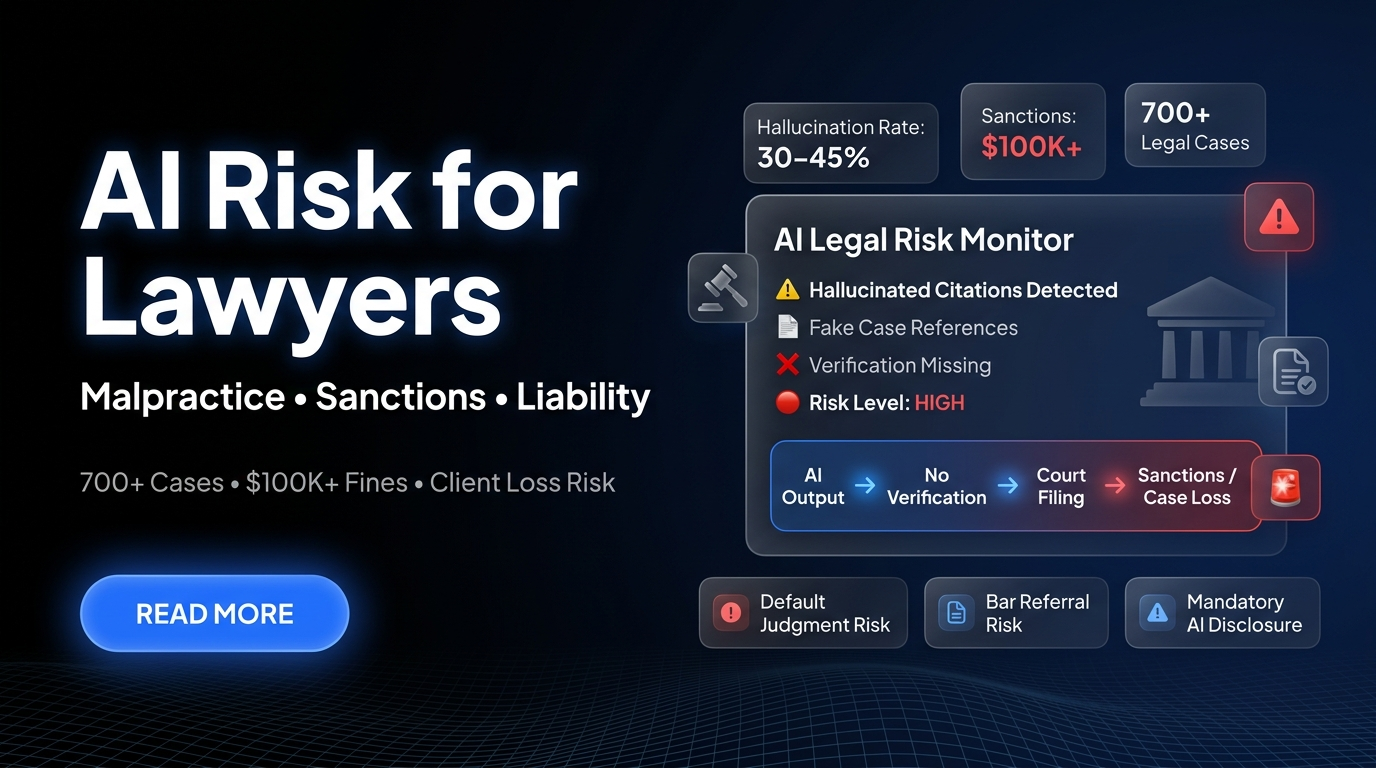
A federal court terminated a client’s entire case because their lawyer filed AI-fabricated citations repeatedly. Over 700 documented hallucination cases. $100K+ sanctions. And a double bind where both AI misuse and failure to use AI create liability.
February 2026 precedent: A federal court issued a default judgment against a client, terminating their entire case, because their lawyer repeatedly filed AI-generated briefs with fabricated citations and refused to verify despite multiple warnings. The court found intentional bad faith: not because of AI use, but because of knowing refusal to check outputs when verification tools were available.
Over 700 court cases now involve AI-generated hallucinations. The rate of new incidents has accelerated to two to five per day. Stanford’s CodeX Center found general-purpose LLMs fabricate citations in 30 to 45% of legal research responses. 79% of lawyers report using AI tools. Malpractice insurers have paid over $50 million in AI-related claims in two years. And a double bind is tightening: lawyers face liability for misusing AI and, increasingly, for failing to use it when it becomes standard practice. This is not a future risk. It is a current professional crisis that every practicing lawyer must understand and manage.
The Sanctions Landscape: What Courts Are Doing in 2026
Courts have moved from warnings to enforcement across five escalating categories.
Monetary sanctions ($2K to $100K+). The Fifth Circuit fined a Texas lawyer $2,500 for unverified AI errors and misleading the court. A South Florida judge sanctioned a lawyer for fabricated authorities across eight cases. Six-figure sanctions are becoming documented, not exceptional.
Brief striking and adverse inferences. In Sanders v. United States, the Court of Federal Claims ruled that citing non-existent cases constitutes an unacceptable abuse of the adversary system. AI hallucinations can lose motions and arguments, not just create embarrassment.
Bar referrals and disqualification. In Johnson v. Dunn (Alabama, 2025), a court disqualified a Nashville firm from the case and referred attorneys to bar associations in every jurisdiction where they held licenses. Your license is at stake.
Terminal sanctions and default judgments. The Affable case (February 2026) established that repeated AI misuse terminates the client’s case entirely. The lawyer’s continuous pattern of filing fabricated citations, combined with refusal to verify despite warnings, warranted default judgment. The client lost their legal rights because of their lawyer’s conduct.
Mandatory AI disclosure requirements. Multiple circuits require AI disclosure in filings. Courts are moving toward mandatory hyperlink rules linking every cited authority to a verified database.
| Sanction Level | Case Example | Lawyer Takeaway |
|---|---|---|
| $2K-$5K fine | Fifth Circuit (Hersh, 2025); Mata v. Avianca ($5K, 2023) | Even first-time, unintentional errors result in financial penalties |
| Brief struck | Sanders v. United States (2025): fabricated citations = abuse of system | AI hallucinations lose arguments and motions |
| Bar referral | Johnson v. Dunn (2025): firm disqualified, multi-jurisdiction bar referral | Your license is at stake across every jurisdiction |
| $100K+ sanctions | Multiple 2025-2026 cases with six-figure penalties | Financial exposure rivals malpractice deductibles |
| Default judgment | Affable (2026): client’s case terminated for repeated AI fabrications | Your client can lose everything because of your AI misuse |
The Double Bind: Liability for Using AI and for Not Using It
Using AI without verification creates malpractice, sanctions, and ethics violations. But the emerging consensus suggests not using AI when it becomes standard may also create liability. Jones Walker frames this as the standard-of-care question: malpractice law compares conduct to peers. As AI becomes standard for research, review, and analysis, the standard of care shifts to include its use.
Three implications. Avoidance is not viable. Refusing AI shifts risk from misuse to non-use as standards evolve. Governance becomes essential. The only defensible position is documented, governed use: policies, verification protocols, audit trails. Competence is continuous. ABA Opinion 512 requires understanding AI capabilities. That understanding must be maintained as tools change.
Malpractice Insurance: The Coverage Gap
Insurers have paid $50M+ in AI claims in two years. Hallucinated advice exposes organizations to third-party claims, regulatory violations, and transaction failures. Three questions for your insurer: Does the policy cover AI-generated work product claims? Does it distinguish governed vs. ungoverned AI use? Does it cover bar referral defense and regulatory investigation costs? Firms with documented AI governance may receive more favorable terms.
These risks are not theoretical. They are already enforceable under existing laws, as we explain in detail in our guide on US AI governance and what lawyers can actually enforce.
The Hallucination Rate Reality
Stanford CodeX: 30-45% fabrication rate for general-purpose LLMs on legal research. Rate increases with complexity. Three hallucination types: citation fabrication (plausible-sounding nonexistent cases), statutory misstatement (invented or conflated provisions), and holding distortion (real cases with misrepresented holdings, the hardest to detect). Legal-specific tools reduce but cannot eliminate risk. The Affable court was explicit: the problem is not AI use, but refusal to verify.
Client Advisory Risks: What You Must Warn Clients About
Regulatory liability. AI credit decisions face CFPB requirements. AI hiring faces EEOC exposure. AI healthcare faces FDA and state obligations. Identify which client AI systems create regulatory exposure.
Vendor liability gaps. Legal accountability stays with the deployer; technical control sits with the vendor (Cleary Gottlieb). Most contracts lack AI-specific provisions.
Board fiduciary risk. Caremark derivative suits for inadequate AI oversight are a documented concern.
State compliance deadlines. Colorado (Feb 2026), California (Jan 2026), Texas (Jan 2026). Impact assessments take months. Lawyers who fail to flag deadlines expose both client and themselves.
The Affable standard: Courts now distinguish between AI use (acceptable) and refusal to verify AI outputs (sanctionable). The question is not whether you used AI. It is whether you verified the output, disclosed your methodology, and maintained a professional standard of care. Governance and verification are the dividing line between acceptable practice and sanctions.
The Verification Framework: Seven Non-Negotiable Practices
- Verify every citation against a primary legal database. Westlaw, Lexis, Bloomberg Law, official repositories. No exceptions. The Affable default occurred because the lawyer had Westlaw access and chose not to use it.
- Verify holdings, not just case existence. AI frequently cites real cases but mischaracterizes holdings. Read the actual opinion.
- Implement a pre-filing AI audit trail. Firms are requiring auditable reports proving pleadings are hallucination-free before signing. Document tools used, outputs generated, verification steps taken.
- Disclose AI use per court requirements and proactively. Multiple jurisdictions require disclosure. Proactive transparency demonstrates good faith. Undisclosed use discovered later draws harsher sanctions.
- Maintain a firm-wide AI governance policy. 80% of AmLaw 100 have governance boards. Classify use cases by risk. Define verification per category. Document compliance for malpractice defense.
- Never use general-purpose AI for final legal research. 30-45% fabrication rate. Legal-specific tools with verified databases and RAG reduce risk. Use the right tool for the task.
- Treat AI competence as ongoing CLE. ABA Opinion 512 requires understanding capabilities and limitations. State bars considering tech specialization. Pursue formal training including ISO/IEC 42001 Lead Implementer for client advisory.
What makes this more critical is that AI regulation is expanding faster than most legal teams anticipate, creating gaps that many lawyers are still missing today.
The Risk Is Personal. The Response Must Be Professional.
AI risk in 2026 is personal to every lawyer who files a brief, advises a client, or reviews a contract. The sanctions are real, malpractice exposure is measurable, and the double bind is tightening. The lawyers who navigate successfully treat AI as a governed professional tool: documented policies, verified outputs, disclosed usage, continuous competence.
The practical starting point: implement the seven-step verification framework in your own practice, review your malpractice coverage for AI gaps, and begin building the governance literacy that both self-protection and client advisory demand.
GAICC offers ISO/IEC 42001 Lead Implementer training for lawyers building AI governance competence. The program covers the management system structure, risk assessment methodology, and compliance frameworks that every lawyer advising on AI risk must understand. Explore the program to protect your practice and serve your clients.
Frequently Asked Questions (FAQs)
1. Can I be sanctioned even if I didn’t know citations were fabricated?
Yes. Courts hold that ignorance is not a defense. Your obligation is to verify before filing. Unintentional reliance on AI does not excuse failure to check. The standard is verification, not intent.
2. Can my client lose their case because I used AI?
Yes. In Affable (Feb 2026), a court issued default judgment terminating the client’s case because the lawyer repeatedly filed fabricated citations and refused to verify. Terminal sanctions are now documented precedent.
3. What is the 30-45% hallucination rate?
Stanford CodeX found general-purpose LLMs fabricate citations in 30-45% of legal research responses. Rate increases with complexity. Legal-specific tools reduce but cannot eliminate risk.
4. Am I liable if I don’t use AI?
Potentially. As AI becomes standard, the care standard may shift to include its use. Failing to use AI when it would have prevented an error creates the same exposure as missing the issue manually. Governed use is the only defensible position.
5. What should I ask my malpractice insurer?
Does the policy cover AI work product claims? Distinguish governed vs. ungoverned use? Cover bar referral defense? Firms with documented governance policies may receive better terms.
6. What does ABA Opinion 512 require?
Competence (understand AI), confidentiality (protect client data), transparency (inform clients), reasonable billing, candor (verify all research). Affirmative obligations, not optional practices.
7. How do I build AI governance competence?
CLE programs. ISO/IEC 42001 Lead Implementer for framework expertise. Hands-on tool familiarity. Personal verification workflow. Firm governance committee. Continuous learning as tools evolve.