
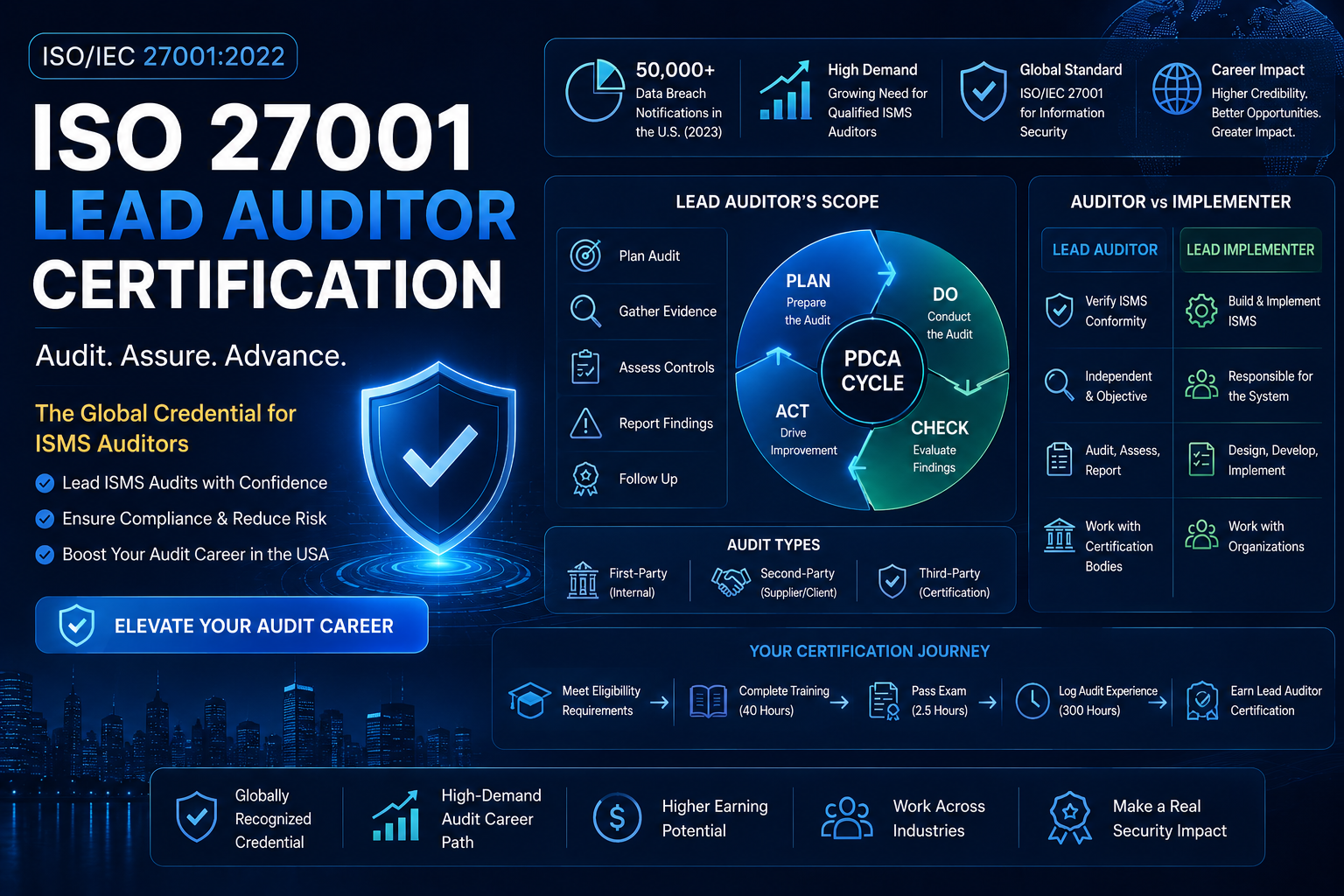
US organizations filed over 50,000 data breach notifications in 2023, the highest volume since federal reporting requirements took effect. Behind every ISO/IEC 27001 certification that keeps those statistics from getting worse is a qualified Lead Auditor who can tell the difference between a documented control and a working one.
The ISO 27001 Lead Auditor certification is the globally recognized credential for professionals who audit Information Security Management Systems (ISMS) against the ISO/IEC 27001 standard. In the US, demand is accelerating as healthcare, finance, defense contractors, and tech companies race to prove ISMS conformity to regulators, clients, and partners.
This guide covers what the certification actually requires, how the exam works, which training paths make sense, and what your career looks like on the other side.
What Is ISO 27001 Lead Auditor Certification?
ISO/IEC 27001 is the international standard for information security management. It specifies requirements for establishing, implementing, maintaining, and continually improving an ISMS within the context of an organization’s overall risks. The 2022 revision (ISO/IEC 27001:2022) brought updated Annex A controls and a restructured control framework that reflects the current threat landscape.
The Lead Auditor certification validates that a professional can plan, lead, and conclude ISMS audits in compliance with three governing standards:
- ISO/IEC 27001:2022 – the ISMS requirements standard being audited
- ISO 19011 – guidelines for auditing management systems
- ISO/IEC 17021-1 – requirements for certification body audits (relevant for external/third-party work)
The credential sits at the top of the ISO 27001 auditing hierarchy. Below it are Internal Auditor certifications, which qualify professionals to conduct first-party audits within their own organization. Lead Auditors can run all three audit types: first-party (internal), second-party (supplier/client), and third-party (certification audits).
Lead Auditor vs. Lead Implementer: The Critical Distinction
These two certifications address opposite sides of the same standard, and conflating them is one of the most common mistakes professionals make when mapping out their ISO 27001 career path.
Attribute | Lead Auditor |
|
Role |
Lead Auditor |
|
Primary function |
Independently verify ISMS conformity against ISO/IEC 27001 |
|
Audit authority |
First, second, and third-party audits |
|
Core activities |
Audit planning, evidence gathering, nonconformity identification, reporting |
|
Independence requirement |
Must maintain objectivity; cannot audit systems they designed |
|
Typical employers |
Certification bodies (ANAB-accredited), consultancies, corporate audit functions |
Attribute | Lead Implementer |
|
Role |
Lead Implementer |
|
Primary function |
Design, build, and deploy a conforming ISMS |
|
Audit authority |
None – conflict of interest prevents auditing own implementations |
|
Core activities |
Gap analysis, control selection, policy development, training, certification readiness |
|
Independence requirement |
Not required – directly responsible for the system |
|
Typical employers |
Organizations seeking ISO 27001 certification, GRC consultancies |
The practical implication: an organization needs both. The Lead Implementer builds the house; the Lead Auditor inspects it. Many experienced professionals hold both credentials, but they are earned and applied separately.
Who Should Pursue This Certification?
The ISO 27001 Lead Auditor credential serves a specific professional profile. The training and exam assume a working knowledge of information security concepts and audit methodology. Starting here without that foundation is expensive and frustrating.
The credential is well-suited for:
- Compliance officers and GRC analysts who conduct or oversee security audits
- IT managers and CISOs responsible for ISMS governance and audit program management
- Information security consultants who support clients through certification audits
- Internal auditors expanding from financial or operational audit into security domains
- Employees of ANAB or IAF-accredited certification bodies who perform third-party audits
- Project managers and IT advisors who need to formally validate ISMS competency
Most training providers require at minimum a foundational understanding of ISO 27001. Several, including PECB, require completion of a Foundation-level exam or equivalent demonstrated knowledge before enrolling in Lead Auditor training. US professionals without prior ISO exposure should plan for a Foundation course first.
Certification Requirements and Eligibility
Requirements vary by provider, but the PECB framework is the most widely recognized internationally and gives a useful benchmark. Most accredited programs follow similar principles.
Education
A bachelor’s degree in any field, or equivalent professional education, is the typical minimum. Some providers accept extensive professional experience in lieu of a degree.
Professional Experience
Candidates generally need a minimum of five years of professional work experience, of which at least two years must be in information security. This is not a certification for recent graduates with no field exposure.
Audit Experience
This is where many candidates underestimate the barrier. PECB, for example, requires a minimum of 300 hours of audit activity to qualify for the full Lead Auditor credential. Candidates who pass the exam but lack audit hours receive a Provisional certificate first, then upgrade to the full credential as they accumulate documented audit experience.
Training Course Completion
All accredited Lead Auditor certifications require completion of an approved training course. These are typically five days in duration and culminate in a written exam. Online delivery options are widely available, which is particularly relevant for US professionals outside major metro areas.
The Training Course: What Five Days Actually Covers
The five-day Lead Auditor training course is structured to move from conceptual grounding through practical audit execution. Understanding the curriculum helps candidates prepare effectively and evaluate providers.
Training Day | Content Focus |
|
Day 1 |
ISMS fundamentals, ISO/IEC 27001:2022 requirements, information security principles (CIA triad), regulatory context relevant to US industries |
|
Day 2 |
Audit principles under ISO 19011, audit types, audit program management, risk-based audit planning |
|
Day 3 |
Audit preparation and initiation: scope definition, documentation review, audit plan development, opening meetings |
|
Day 4 |
On-site audit execution: evidence-based auditing techniques, sampling methods, interviewing, nonconformity classification |
|
Day 5 |
Audit conclusion: reporting, closing meetings, corrective action follow-up, audit program review; exam preparation |
The exam sits on Day 5. It is a three-hour written assessment, typically a mix of essay questions and scenario-based analysis. Candidates who score below the passing threshold (usually 70%) have an option to retake. Providers differ on retake timing and cost.
US Training Providers: How to Choose
Several accredited bodies offer ISO 27001 Lead Auditor training in the United States. The right choice depends on your preferred delivery format, exam body recognition requirements, and budget.
Provider | Key Differentiator | Approx. Cost (USD) |
|
PECB |
Most internationally portable credential; exam aligned to ISO 19011 and 17021; available in-person and online; 5-day format |
$2,800-$4,500 |
|
BSI Group |
UK-based body with strong US presence; widely recognized by certification bodies; classroom-intensive |
$3,000-$4,800 |
|
Certified Information Security (CIS) |
Unique in incorporating ISO 27007 (ISMS auditing) as core curriculum; fully online delivery; CISA/DHS NICCS listed |
$1,800-$2,800 |
|
GSDC |
Competitively priced; self-paced learning options; growing US recognition |
$500-$1,200 |
|
TUV SUD / Bureau Veritas |
Strong with manufacturing and regulated industries; in-person emphasis |
$2,500-$4,000 |
Pricing ranges reflect course-only costs. Full certification (including exam fees, application processing, and annual maintenance) typically adds $300 to $600. US professionals working with organizations that have existing relationships with specific accreditation bodies should confirm their employer or clients recognize the chosen credential before enrolling.
Exam Structure and How to Pass
The PECB exam is the most widely attempted by US candidates and serves as the reference point here. It tests three core competency domains.
Domain | What It Covers | Approximate Weight |
|
Domain 1: Fundamental Principles |
Core ISMS concepts, ISO/IEC 27001:2022 clause requirements, information security risk management, the CIA triad, regulatory frameworks |
~30% |
|
Domain 2: Planning and Conducting Audits |
Audit program development, audit plan creation, sampling techniques, evidence collection, interviewing methods, document review |
~45% |
|
Domain 3: Reporting and Follow-up |
Nonconformity classification (major vs. minor), audit report writing, corrective action verification, audit program management |
~25% |
Questions are scenario-based, not definition recall. The exam presents realistic audit situations and asks candidates to apply audit principles correctly. A candidate who memorized the ISO 27001 clauses but has not worked through practical audit scenarios typically struggles.
Effective preparation approaches:
- Work through the ISO 19011 standard directly, not just course summaries. The exam tests application of its principles.
- Practice classifying nonconformities. The distinction between major nonconformity, minor nonconformity, and observation is a frequent exam focus.
- Review Annex A controls from ISO/IEC 27001:2022 and understand what each control category is intended to achieve, not just its name.
- Complete all practical exercises in the training course. Providers include scenarios specifically calibrated to exam question formats.
- For PECB candidates: the official study guide and mock exam are the most aligned preparation materials available.
Maintaining and Advancing Your Certification
ISO 27001 Lead Auditor certifications are not permanent. Most bodies require annual continuing professional development (CPD) activity and a three-year recertification cycle. For PECB, this means logging CPD hours annually and submitting a renewal application every three years.
The 2022 revision of ISO/IEC 27001 introduced significant changes to Annex A, reducing controls from 114 to 93 and reorganizing them into four themes. Certified professionals who qualified under the 2013 version need to complete transition training. Most providers offered dedicated ISO 27001:2022 transition courses, and the PECB transition exam has been available since 2023.
Credential stacking is common and actively rewarded in the US market. ISO 27001 Lead Auditors who add complementary certifications see the largest salary increases. The combinations that appear most frequently in US job postings above $120,000 are:
- ISO 27001 LA + CISA (Certified Information Systems Auditor) – the most common pairing in enterprise audit roles
- ISO 27001 LA + CISSP – common in senior security architecture and consulting positions
- ISO 27001 LA + CRISC (Certified in Risk and Information Systems Control) – valued in financial services and regulated industries
- ISO 27001 LA + ISO 27001 Lead Implementer – qualifies professionals to work both sides of the certification process
Professionals preparing for third-party audits should first understand internal assessment practices covered in the ISO 27001 Internal Auditor Certification Guide before progressing toward lead auditor responsibilities.
Career Outcomes and Salary in the USA
The US market for ISO 27001 Lead Auditors is measurably strong. According to ZipRecruiter salary data as of 2026, the average annual salary for an ISO 27001 Lead Auditor in the United States is $102,886, with experienced professionals in high-demand markets earning between $118,000 and $132,500.
Salary distribution by experience level in the US market:
Experience Level | Estimated Annual Salary (USD) |
|
Entry (0-2 years post-certification) |
$75,000 – $90,000 |
|
Mid-level (3-5 years) |
$90,000 – $115,000 |
|
Senior (6-10 years) |
$115,000 – $135,000 |
|
Lead/Principal (10+ years, dual credentials) |
$135,000 – $165,000+ |
Salary data from Salary.com places the median for ISO Lead Auditor roles at $77,304 as of April 2026, though this aggregates across all ISO standards. Roles specifically requiring ISO 27001 expertise command a significant premium.
The highest-paying US markets for this credential are California (particularly the Bay Area and San Diego defense corridor), Washington DC/Northern Virginia (federal contracting and defense), New York City (financial services), and Seattle (technology sector). Remote roles with US-based employers increasingly eliminate geographic salary differentials for senior positions.
Beyond base salary, US employers in financial services, healthcare, and defense contracting frequently offer ISO 27001 Lead Auditors certification maintenance stipends, conference attendance budgets, and performance bonuses tied to successful audit program outcomes.
The Bureau of Labor Statistics projects 32% growth in information security analyst employment through 2032, significantly above the average for all occupations. Lead Auditors who can bridge the gap between technical security controls and audit methodology sit directly in the path of that demand.
ISO 27001 Lead Auditor in US Regulated Industries
The certification carries particular weight in sectors where information security compliance is not optional.
Healthcare and HIPAA
HIPAA Security Rule requirements for covered entities and business associates map closely to ISO 27001 controls. Organizations pursuing dual compliance find that ISO 27001 Lead Auditors who understand the relationship between Annex A controls and HIPAA technical safeguards are significantly more efficient to work with than auditors familiar with only one framework. Healthcare system security audit roles explicitly listing ISO 27001 LA in US job postings increased 34% between 2022 and 2024.
Defense and CMMC
The Cybersecurity Maturity Model Certification (CMMC) program, required for Department of Defense contractors, has significant conceptual overlap with ISO 27001. While CMMC has its own certified assessor program, defense contractors pursuing CMMC Level 2 and 3 compliance regularly hire ISO 27001 Lead Auditors to stress-test their controls before formal CMMC assessments. The Northern Virginia and San Diego defense corridors are the highest-concentration US markets for this dual-framework expertise.
Financial Services and SOX
Sarbanes-Oxley compliance requires assessment of IT general controls (ITGCs) that overlap substantially with ISO 27001’s operational and access management controls. Large US financial institutions increasingly prefer auditors who can assess ISMS conformity and provide SOX ITGC commentary simultaneously, particularly as integrated audit programs become the norm for reducing assessment fatigue.
Technology and SOC 2
SOC 2 Type II reports are the de facto information security assurance mechanism for US SaaS companies. ISO 27001 and SOC 2 share significant control territory, and many technology companies pursuing ISO 27001 certification do so as part of a broader compliance program that includes SOC 2. Auditors who understand both frameworks are in active demand from mid-market and enterprise technology companies.
Those who want to build and manage an ISMS before auditing one can explore the ISO 27001 Lead Implementer Certification for implementation-focused expertise.
Frequently Asked Questions
1. How long does it take to get the ISO 27001 Lead Auditor certification?
The training course itself is five days. Adding preparation time, the exam, and administrative processing, most candidates complete the certification within four to eight weeks of starting the training. The full PECB Lead Auditor designation (as opposed to Provisional) requires 300 hours of documented audit experience, which typically accumulates over one to three years of active practice post-exam.
2. Is ISO 27001 Lead Auditor recognized by US employers?
Yes, particularly in industries where ISO 27001 certification is common: technology, financial services, healthcare, and defense contracting. PECB and BSI credentials are the most widely recognized by US certification bodies and enterprise employers. Candidates targeting roles with government-adjacent organizations should confirm that their chosen provider’s credential is accepted by the specific agency or contractor.
3. What is the difference between an ISO 27001 Lead Auditor and a CISA?
CISA (Certified Information Systems Auditor), issued by ISACA, is a broad IT audit credential covering information systems acquisition, development, implementation, and operations. ISO 27001 Lead Auditor is specific to ISMS auditing against the ISO/IEC 27001 standard. CISA carries stronger brand recognition in the US financial sector; ISO 27001 LA is more directly applicable to certification body work and ISMS-specific audit engagements. Many senior US audit professionals hold both.
4. Can I audit ISO 27001 compliance without the Lead Auditor certification?
You can conduct internal ISMS audits without formal certification, though many organizations require it for audit program credibility. Certification body auditors working on behalf of an accredited body (such as BSI, DNV, or Bureau Veritas) must hold a recognized Lead Auditor credential. For second-party supplier audits, requirements vary by organization and contract.
5. How much does ISO 27001 Lead Auditor training cost in the USA?
Training costs in the US range from approximately $500 to $4,800 depending on provider and delivery format. Online self-paced programs sit at the lower end; in-person classroom training from premium providers like BSI or PECB sits at the higher end. Total certification costs including exam fees, application processing, and first-year maintenance typically run $2,500 to $5,500.
6. Does the ISO 27001:2022 revision affect existing certifications?
Professionals certified under ISO 27001:2013 need to complete transition training to remain current with the 2022 standard. Most certification bodies have offered specific transition modules or updated their standard curriculum to reflect the 2022 revision. The changes to Annex A are substantial enough that conducting audits against the 2022 standard without transition training creates real audit risk.
Final Thoughts
The ISO 27001 Lead Auditor certification positions professionals at the intersection of two accelerating trends: the growth of ISO 27001 adoption among US organizations and the tightening scrutiny on information security governance from regulators, clients, and insurers.
The practical path is straightforward: confirm your eligibility, select a provider whose credential is recognized by your target employers, complete the five-day training, and start accumulating documented audit experience. The 300-hour threshold for the full credential sounds substantial, but professionals working in active GRC or audit roles typically reach it within eighteen months.
If you are ready to formalize your ISMS audit expertise, explore the GAICC ISO 27001 Lead Auditor training program to see how the curriculum aligns with the 2022 standard and prepares you for exam success.