
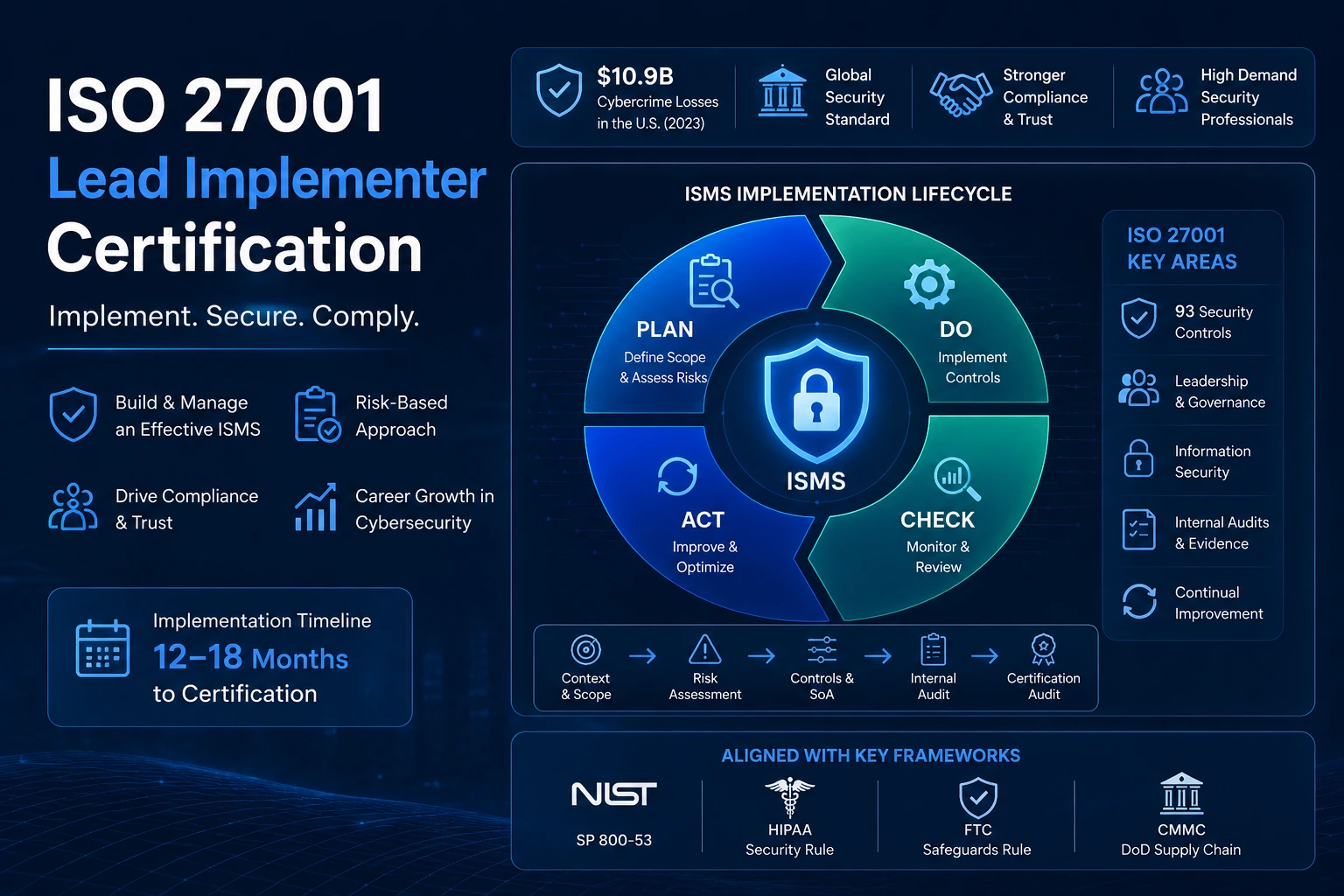
US organizations reported a combined $10.9 billion in cybersecurity losses in 2023 according to the FBI’s Internet Crime Report and the gap between companies with structured information security programs and those without keeps widening. ISO 27001, the international standard for Information Security Management Systems (ISMS), has become the framework that separates organizations that manage risk systematically from those that react to breaches after the fact.
The ISO 27001 Lead Implementer certification validates your ability to plan, build, and manage an ISMS from the ground up. This guide covers what the certification involves, how it maps to real-world ISMS implementation work, what US employers expect, and how to prepare efficiently.
What Is ISO 27001 and Why It Matters for US Organizations
ISO/IEC 27001:2022 is the globally recognized standard for establishing, implementing, maintaining, and continually improving an Information Security Management System. It is published by the International Organization for Standardization (ISO) and the International Electrotechnical Commission (IEC), and it defines the requirements an ISMS must meet to protect information assets systematically.
The standard is built around 93 controls organized into four themes: organizational, people, physical, and technological. At its core is the Plan-Do-Check-Act (PDCA) cycle a continuous improvement methodology that keeps the ISMS aligned with evolving business risk.
For US organizations, ISO 27001 adoption has accelerated sharply. Three forces are driving this:
Regulatory alignment. ISO 27001 controls map directly to frameworks US regulators reference including NIST SP 800-53, HIPAA’s Security Rule, and the FTC Safeguards Rule. A certified ISMS simplifies compliance across multiple requirements simultaneously.
Supply chain security demands. Federal contractors and financial services vendors increasingly receive ISO 27001 certification requirements from their enterprise clients as a condition of doing business. The Department of Defense’s CMMC framework references ISO 27001-aligned practices for protecting Controlled Unclassified Information.
Cyber insurance requirements. Insurers are tightening underwriting criteria, and organizations with documented, audited security management programs consistently receive better terms.
What Does an ISO 27001 Lead Implementer Actually Do?
The title can be misleading. A Lead Implementer is not primarily a technical security architect. The role is closer to a program manager with deep information security knowledge someone who orchestrates cross-functional teams, manages stakeholder communication, and ensures the ISMS meets both ISO 27001 requirements and the organization’s specific risk context.
In practice, the work breaks into five phases:
- Context and scope definition. The implementer works with executive leadership to define the ISMS scope which business units, processes, systems, and locations fall under the management system.
- Risk assessment and treatment. ISO 27001 requires a documented risk assessment methodology. The Lead Implementer designs this process, facilitates risk workshops, and oversees the production of a Statement of Applicability (SoA).
- Policy and control development. The implementer translates risk treatment decisions into documented policies, procedures, and technical controls.
- Internal audit program. The Lead Implementer develops the audit program, trains internal auditors, and reviews audit findings.
- Certification audit support. The Lead Implementer coordinates the external certification audit, preparing evidence packages and managing corrective actions.
IMPLEMENTATION TIMELINEOrganizations pursuing ISO 27001 certification for the first time should expect 12 to 18 months from project kickoff to certification decision. A skilled Lead Implementer compresses this timeline significantly. |
The ISO 27001 Lead Implementer Certification: Structure and Requirements
Several certification bodies offer ISO 27001 Lead Implementer credentials. In the US market, the most commonly recognized include PECB, BSI, and GAICC. While training curricula vary, all credible programs align to the same competency framework defined by ISO 27001:2022.
Eligibility Requirements
- Foundational knowledge of ISO 27001 (Foundation certification or equivalent)
- Relevant professional experience in information security, IT risk management, or ISMS implementation
- Completion of an accredited training course typically 32 to 40 hours
Exam Domain Weighting
Domain | Approximate Weighting |
|---|---|
ISMS Context, Scope, and Governance | 20% |
Risk Assessment and Treatment | 25% |
Control Selection and Implementation | 25% |
Performance Evaluation and Internal Audit | 20% |
Continual Improvement and Corrective Action | 10% |
ISMS Implementation: A Practical Phase-by-Phase Roadmap
Phase 1: Context of the Organization (Clause 4)
ISO 27001 Clause 4 requires the organization to understand its internal and external context before defining the ISMS scope. In practice, this means conducting a stakeholder analysis and a context analysis using tools like PESTLE or a structured issues register. The output is a documented ISMS scope statement approved by top management. Auditors pay close attention to scope documentation; vague boundaries are an immediate red flag.
Phase 2: Leadership and Planning (Clauses 5 and 6)
ISO 27001 places explicit responsibility on top management. Clause 5 requires demonstrable leadership commitment not a signed policy alone, but evidence that executives actively participate in ISMS governance, receive security performance reports, and allocate resources. Clause 6 covers the risk assessment methodology. Common approaches in US organizations include ISO 27005, NIST SP 800-30, and OCTAVE Allegro.
Phase 3: Support and Operation (Clauses 7 and 8)
This phase is where most implementation work happens. The Statement of Applicability (SoA) arguably the most important document in an ISO 27001 ISMS is produced here. It lists all 93 controls, states whether each is applicable or excluded, justifies exclusions, and maps each applicable control to the risk treatment decisions driving it. Certification auditors review the SoA exhaustively.
Phase 4: Performance Evaluation (Clause 9)
Clause 9 requires monitoring, measurement, internal audit, and management review. Internal audits must cover all ISMS requirements and all applicable controls over a defined audit cycle. Management reviews must receive specific inputs including audit results, security incident data, and risk treatment status and produce documented outputs including decisions on ISMS improvements.
Phase 5: Improvement (Clause 10)
Nonconformity management and corrective action sit at the foundation of continual improvement. When an internal audit or incident reveals a gap, the organization must document the nonconformity, conduct root cause analysis, implement corrective action, and verify its effectiveness. This cycle is what transforms a static compliance exercise into a genuinely improving security program.
Annex A Controls: What Lead Implementers Need to Know
ISO 27001:2022 restructured Annex A from 114 controls across 14 domains (2013 version) to 93 controls across four themes. Lead Implementers working on migrations from the 2013 standard need to understand both the new structure and 11 new controls added in the 2022 revision.
- Organizational controls (37 controls) cover policies, roles, responsibilities, asset management, information classification, supplier relationships, and incident management.
- People controls (8 controls) address human risk screening, terms and conditions, security awareness, and disciplinary processes.
- Physical controls (14 controls) cover security of facilities, equipment, and media.
- Technological controls (34 controls) include access control, cryptography, network security, vulnerability management, and data masking.
2022 REVISION: 11 NEW CONTROLSThe 11 new controls in ISO 27001:2022 include threat intelligence, ICT readiness for business continuity, physical security monitoring, configuration management, data deletion, data masking, data leakage prevention, monitoring activities, web filtering, and secure coding. Treat these as high-priority areas auditors expect current-state evidence, not inherited 2013-era boilerplate. |
Risk Assessment Methodology: Getting It Right from the Start
The most common reason US organizations fail their Stage 2 certification audit is an inadequate risk assessment. Auditors look for three things that many first-time implementers miss.
Consistency. The same information asset evaluated by two different people should produce the same risk rating when using your methodology correctly. Subjective judgment without calibration makes risk registers unreliable.
Traceability. Every control in your SoA must trace back to a risk treatment decision. If a control is marked applicable, auditors will ask: what risk is it treating? The answer must exist in your risk register.
Coverage. Your risk assessment must address the scope you’ve defined. If your ISMS scope includes cloud infrastructure but your risk assessment only evaluated on-premises systems, you have a scope-coverage gap that will surface as a nonconformity.
A practical approach for US organizations: use a 5×5 likelihood-impact matrix aligned to NIST SP 800-30 qualitative scales. This communicates naturally with US-based stakeholders familiar with federal risk frameworks and produces documented evidence that satisfies ISO 27001 auditors.
ISO 27001 vs. Other US Frameworks: Where It Fits
US information security professionals often ask how ISO 27001 relates to frameworks they already know.
Framework | Type | Relationship to ISO 27001 |
|---|---|---|
NIST CSF 2.0 | Voluntary framework | Complementary; CSF functions map to ISO 27001 clauses |
NIST SP 800-53 | Control catalog | ISO 27001 Annex A is a subset; 800-53 is more prescriptive |
SOC 2 | Audit standard | Different audit model; ISO 27001 has broader organizational scope |
HIPAA Security Rule | Regulation | ISO 27001 ISMS can serve as the management system for HIPAA compliance |
CMMC | Defense contractor requirement | Tier 3 CMMC draws from ISO 27001-aligned practices |
FedRAMP | Cloud security | ISO 27001 provides underlying management framework; FedRAMP adds controls |
Preparing for the Lead Implementer Exam: What Works
Candidates who pass on their first attempt tend to approach preparation the same way.
- Do not memorize Annex A controls. Exam scenarios test whether you understand why controls exist and how they interrelate not whether you can recite them from memory.
- Work through implementation scenarios. Practice questions presenting organizational situations separate experienced practitioners from classroom-only candidates.
- Understand the 2022 changes. If your study materials are based on ISO 27001:2013, you are studying for the wrong exam.
- Map clauses to implementation activities. Create a table linking each ISO 27001 clause to the evidence you would produce to demonstrate conformance.
Most candidates need 40 to 60 hours of dedicated preparation beyond their training course. That is not a large investment relative to the career and salary impact of the certification.
Professionals deciding between implementation, audit, and foundation-level credentials can review the complete ISO 27001 certification path for GRC and compliance professionals before choosing their next step.
Career Outlook for ISO 27001 Lead Implementers in the USA
Demand for certified ISO 27001 professionals in the US has increased substantially since the 2022 revision. CyberSeek’s 2024 cybersecurity workforce data shows over 660,000 cybersecurity job openings in the US many requiring documented ISMS implementation experience.
Role | US Salary Range (2024) |
|---|---|
Information Security Manager | $110,000 – $155,000 |
ISMS Implementation Consultant | $115,000 – $165,000 |
Chief Information Security Officer (CISO) | $160,000 – $220,000+ |
GRC (Governance, Risk, Compliance) Manager | $105,000 – $150,000 |
Security Compliance Analyst (mid-level) | $85,000 – $120,000 |
Industries with the strongest demand: financial services, healthcare, government contracting, technology, and critical infrastructure.
After mastering ISMS implementation, professionals can expand into audit leadership through the ISO 27001 Lead Auditor Certification pathway.
Frequently Asked Questions
1. What is the difference between ISO 27001 Lead Implementer and Lead Auditor certifications?
A Lead Implementer designs and builds the ISMS the internal program responsible for making an organization conform to ISO 27001. A Lead Auditor evaluates conformance from an independent perspective. Lead Auditors work with certification bodies or as third-party consultants. Some professionals hold both credentials, which is particularly valuable for consultants who advise organizations before external audits.
2. Do I need the ISO 27001 Foundation certification before pursuing Lead Implementer?
Most certification bodies recommend or require foundational knowledge before the Lead Implementer exam. A Foundation certification is the clearest way to document this, but some providers accept equivalent work experience. Check your specific certification body’s eligibility requirements they vary.
3. How long does ISO 27001 ISMS implementation typically take for a US mid-sized organization?
A mid-sized US organization typically 200 to 2,000 employees should plan for 12 to 18 months from project initiation to certification audit. The most time-intensive phases are risk assessment (2 to 4 months) and the internal audit cycle. Organizations with dedicated resources and executive commitment can compress this timeline.
4. Is ISO 27001 certification required by US law or regulation?
ISO 27001 certification is not mandated by US federal law, but it is referenced in sector-specific guidance and commonly required in contractual agreements. Many US organizations pursue it for international business requirements, cyber insurance, and client due diligence particularly in financial services and technology sectors.
5. What is a Statement of Applicability (SoA) and why is it critical?
The SoA lists all 93 ISO 27001:2022 Annex A controls and records which are applicable, which are excluded and why, and how each applicable control is implemented. It is the central document linking your risk assessment results to your control environment. Certification auditors treat the SoA as a key evidence document weak SoAs generate nonconformities.
6. How much does ISO 27001 Lead Implementer certification cost in the US?
Total cost combines training ($2,000 to $4,000 for a 32 to 40 hour course) and exam fees ($400 to $800 depending on the certification body). Employer-sponsored training is common for professionals in GRC and security management roles.
7. Can ISO 27001 ISMS certification help with HIPAA compliance?
Yes, with caveats. An ISO 27001 ISMS addresses many HIPAA Security Rule administrative and technical safeguard requirements. However, HIPAA’s Privacy Rule and Breach Notification Rule extend beyond ISO 27001’s scope. Healthcare organizations typically use an ISO 27001 ISMS as the management system foundation while maintaining a separate HIPAA compliance program for PHI-specific requirements.
8. What are the most common nonconformities found during ISO 27001 Stage 2 audits?
The most frequently identified nonconformities involve: incomplete risk assessments, SoA gaps where controls are marked applicable but lack implementation evidence, inadequate internal audit programs, missing management review records, and supplier security assessments that are absent or not aligned to risk treatment decisions.
Conclusion
ISO 27001 Lead Implementer certification positions you at the intersection of two growing forces in US business: the demand for structured information security governance and the increasing expectation from clients, regulators, and insurers that organizations can demonstrate it. The certification validates practical capability: the ability to scope an ISMS, lead a risk assessment, build a control environment, and guide an organization through certification.
The clearest next step is to assess where you currently sit against the eligibility requirements for your target certification body. If you have the foundational knowledge and experience, a structured training program brings the framework knowledge and exam preparation into focus.
Ready to become a certified ISO 27001 Lead Implementer?Explore GAICC’s ISO 27001 Lead Implementer certification program and start your ISMS implementation career. |