
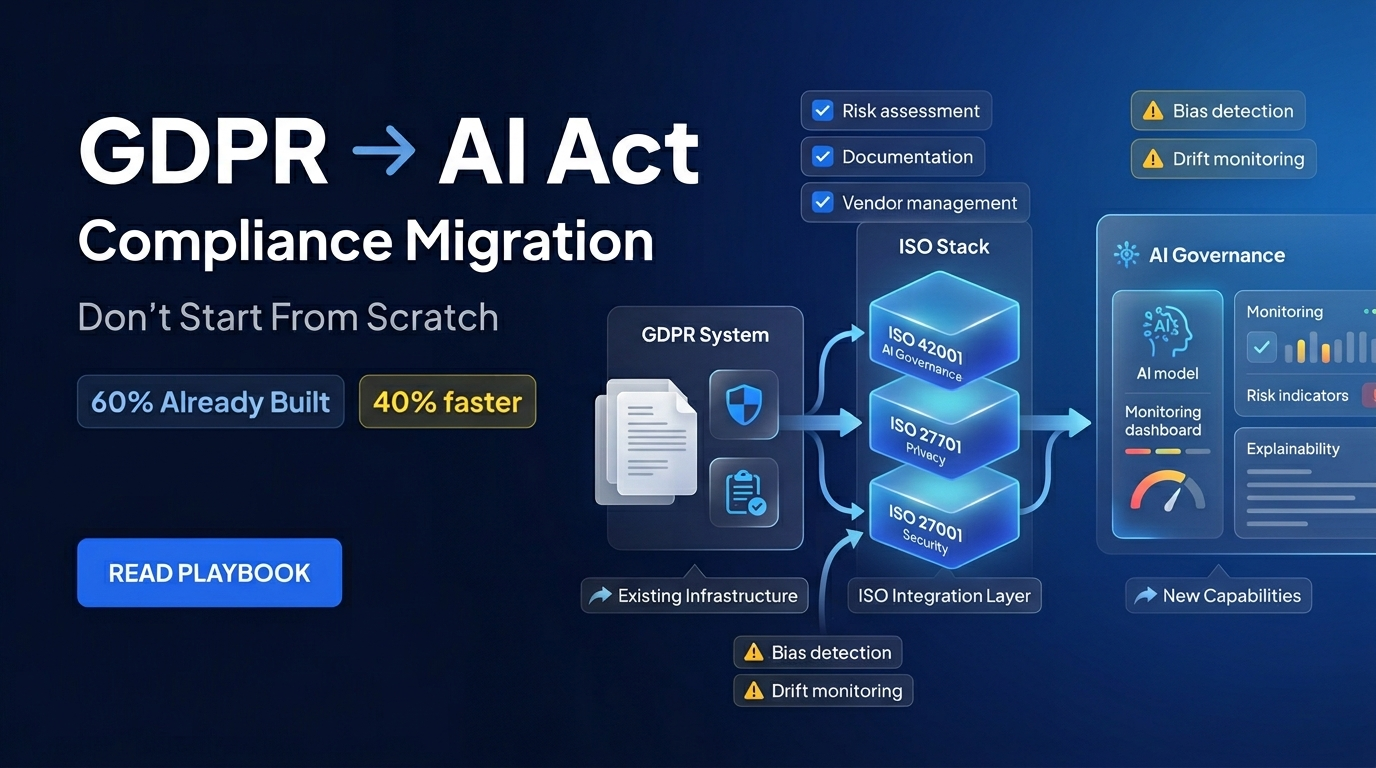
ISO 27001-certified organizations achieve ISO 42001 compliance up to 40% faster. Your GDPR program already built 60% of the infrastructure AI governance needs. Here is the operational migration playbook.
The migration advantage: ISO 27001 + ISO 42001 dual certification up to 40% faster than starting from scratch. ISO 27701:2025 now standalone (no longer requires ISO 27001). All three share the ISO High-Level Structure (Clauses 4-10). Integrated audits across privacy and AI governance possible. GDPR governance structures, risk methodology, documentation, vendor processes, and incident response all transfer.
Organizations that invested in GDPR compliance built substantial governance infrastructure: data inventories, impact assessments, incident response, vendor management, documentation systems, and governance committees. ISO 27001-certified organizations pursuing ISO 42001 achieve compliance up to 40% faster because both share the ISO High-Level Structure. ISO 27701:2025 now operates as a standalone privacy standard sharing the same HLS, enabling integrated audits across privacy and AI governance simultaneously. The question is not whether AI governance requires new investment but how much existing investment transfers and what new capabilities must be built.
What Your GDPR Program Already Built
Governance structure. DPO, privacy board, controller/processor roles, escalation paths. ISO 42001 requires the same pattern: AI management system owner, governance committee, developer/deployer roles. Extend the mandate rather than build a parallel structure.
Risk assessment methodology. DPIAs for high-risk processing. ISO 42001 Clause 8.4 requires AI impact assessments with structurally similar methodology. Extend by adding AI-specific risk dimensions.
Documentation and records. GDPR Article 30 Records of Processing. ISO 42001 requires AI inventories, risk records, treatment plans. The documentation discipline transfers directly.
Vendor management. DPAs with processing, security, breach, and sub-processor provisions. AI governance needs analogous agreements with AI-specific additions. 60% of the vendor infrastructure is in place.
Incident response. 72-hour breach notification. ISO 42001 Clause 10.2 corrective action. Infrastructure transfers with AI-specific scenario extensions (bias, hallucination, adversarial attack).
Training. Privacy awareness programs. ISO 42001 Clause 7.2 competence. Infrastructure transfers; content expands to AI risks.
The Transfer Map
| Capability | GDPR Implementation | AI Governance Equivalent | Migration Effort |
|---|---|---|---|
| Governance | DPO + privacy board | AI system owner + AI committee (Cl. 5.3) | Low: extend mandate, add AI representation |
| Inventory | Records of Processing (Art. 30) | AI system inventory (Cl. 4.3, 8.1) | Medium: add AI fields (model type, training data, autonomy) |
| Impact assessment | DPIA (Art. 35) | AI impact assessment (Cl. 8.4) | Medium: extend with bias, explainability, drift dimensions |
| Risk assessment | Privacy risk analysis | AI risk assessment (Cl. 8.2) | Medium: add Annex C risk sources to register |
| Vendor mgmt | DPAs, processor diligence | AI vendor agreements (Cl. 8.1) | Medium: add AI provisions to DPA templates |
| Incident response | 72-hour notification | AI incident response (Cl. 10.2) | Low: extend playbook with AI scenarios |
| Documentation | Processing records, DPIAs | Model cards, lifecycle docs (Annex B) | Medium: add AI templates to existing system |
| Training | Privacy awareness | AI competence (Cl. 7.2) | Medium: develop AI curriculum |
| Rights mgmt | Data subject rights | Explanation, opt-out, human review | High: new rights, new technical mechanisms |
| Monitoring | Compliance monitoring | Drift, bias, performance monitoring (Cl. 9.1) | High: new tooling and AI-specific metrics |
What AI Governance Requires That GDPR Never Addressed
GDPR governs data processing. AI governance governs system behavior. A GDPR-compliant pipeline can still produce a biased, unexplainable AI system.
Model lifecycle management. Training, validation, deployment, monitoring, retraining, retirement. ISO 42001 Annex B covers design through decommissioning. Entirely new capability.
Bias and fairness assessment. Specific metrics (statistical parity, equalized odds), testing across protected categories, baseline documentation, ongoing monitoring. Requires data science methodology and tooling privacy programs never provided.
Explainability. SHAP, LIME, counterfactuals, model cards, audience-specific communication. CFPB requires specific adverse action explanations GDPR never contemplated.
Drift monitoring. Accuracy degradation, distribution shift, fairness drift, latency. Requires statistical testing infrastructure, alerting, automated retraining triggers.
AI-specific security. Prompt injection, data poisoning, model extraction, adversarial inputs. Requires MITRE ATLAS, OWASP LLM Top 10 methodology beyond traditional infosec.
Expanded risk taxonomy. GDPR: privacy risks. AI governance: reliability, safety, fairness, transparency, accountability, security, environmental, human oversight. ISO 42001 Annex C: 10 categories. NIST AI 600-1: 12 for generative AI. The register must be expanded, not just extended.
The integration architecture: ISO 27001 (security foundation) + ISO 27701 (privacy layer) + ISO 42001 (AI governance layer). All share the High-Level Structure. Single governance committee, single audit program, single management review, single improvement cycle serve all three. An AI credit scoring system requires all three: 27001 securing infrastructure, 27701 governing personal data, 42001 managing AI-specific risks.
To understand why this transition matters, it is important to first look at how the EU AI Act actually structures AI obligations for organizations.
The Migration Playbook: Six Phases
- Gap analysis (Weeks 1-4). Assess GDPR/27001/27701 program against ISO 42001. Use the transfer map. Inventory all AI including shadow AI (Cl. 4.3). Produce the migration roadmap.
- Governance extension (Weeks 3-8). Extend committee mandate. Add data science and AI engineering. Draft AI policy (Cl. 5.2). Define AI roles (Cl. 5.3). Set AI risk appetite.
- Risk and impact extension (Weeks 5-12). Extend DPIA methodology for AI impact (Cl. 8.4). Add Annex C to risk register. Classify systems by tier. Conduct AI risk assessments (Cl. 8.2).
- New capability build (Weeks 8-20). The highest-effort phase. Model lifecycle processes, bias testing tools, explainability framework, drift monitoring, AI security testing. Requires technical implementation, not just policy.
- Documentation and training (Weeks 16-24). AI documentation templates (model cards, lifecycle records). Extend existing systems. AI governance training curriculum. Competence integration (Cl. 7.2).
- Audit and certification (Weeks 20-30). Internal audit with AI criteria. Corrective action via existing processes. ISO 42001 certification, ideally as integrated audit alongside 27001/27701 surveillance to reduce burden and cost.
Common Migration Mistakes
Building a separate AI governance program. Disconnected from existing infosec and privacy programs. Creates duplication and confusion. Integrate using shared HLS.
Assuming GDPR covers AI risk. GDPR governs data. AI governance governs behavior. A compliant pipeline feeding a biased model satisfies one regulation while violating another.
Underestimating the technical gap. GDPR is policy, process, and legal. AI governance requires bias testing, model validation, drift detection, explainability. Plan for upskilling or external expertise.
Treating migration as documentation. Extending templates is necessary but insufficient. AI governance requires operational controls: automated detection, monitoring pipelines, working tooling. Documentation without capability is performative.
Ignoring U.S. state laws. EU AI Act focus may overlook Colorado, California, Texas, NYC, Illinois obligations. The integrated system must address all jurisdictions.
Even outside the EU, similar enforcement expectations are already emerging in the U.S., where lawyers can act on AI-related risks using existing legal frameworks.
Your GDPR Investment Is Your AI Governance Foundation
Organizations with robust GDPR programs have a structural advantage. Governance architecture, risk methodology, documentation, vendor processes, and audit infrastructure transfer directly. The migration is not rebuilding but filling specific gaps: model lifecycle, bias testing, explainability, drift monitoring, and AI security.
The practical first step: conduct a gap analysis comparing your current GDPR/ISO 27001/ISO 27701 program against ISO 42001 requirements using the transfer map in this article. The gaps define your migration roadmap.
GAICC offers ISO/IEC 42001 Lead Implementer training designed for professionals extending existing management systems to include AI governance. The program covers the integration architecture, risk assessment methodology, and the AI-specific controls that complete the migration from GDPR to comprehensive AI governance. Explore the program to accelerate your migration.
Frequently Asked Questions (FAQs)
1. How much of my GDPR program transfers?
~60% of infrastructure: governance, risk methodology, documentation, vendor management, incident response, training. What doesn’t transfer: model lifecycle, bias testing, explainability, drift monitoring, AI security. These require new capability.
2. Can ISO 27001, 27701, and 42001 be audited together?
Yes. All share the High-Level Structure. Integrated audits cover all three simultaneously, reducing cost and disruption. Add ISO 42001 during existing surveillance cycles.
3. How long does migration take?
6-9 months for mature GDPR/ISO 27001 organizations. Up to 40% faster than starting from scratch. Critical path: Phase 4 (new capability build) for bias testing, monitoring, explainability.
4. Does ISO 42001 satisfy the EU AI Act?
Demonstrates governance maturity but doesn’t substitute for legal compliance. EU AI Act requires conformity assessment for high-risk systems. ISO 42001 provides the management system supporting conformity.
5. What about U.S. requirements?
The integrated system serves both. Annex C maps to NIST AI RMF. TRAIGA safe harbor for NIST compliance. Colorado requires reasonable care. Framework approach provides evidence across jurisdictions.
6. Is ISO 27701:2025 required for AI governance?
Only where AI processes personal data (most enterprise AI). 2025 revision is standalone, shares HLS with 42001. The 27701+42001 combination addresses both privacy and AI risk efficiently.
7. What is the biggest migration risk?
Underestimating the technical gap. GDPR teams excel at policy and process. AI governance requires data science expertise: bias testing, validation, drift detection, explainability. Plan for upskilling, hiring, or partnership.