
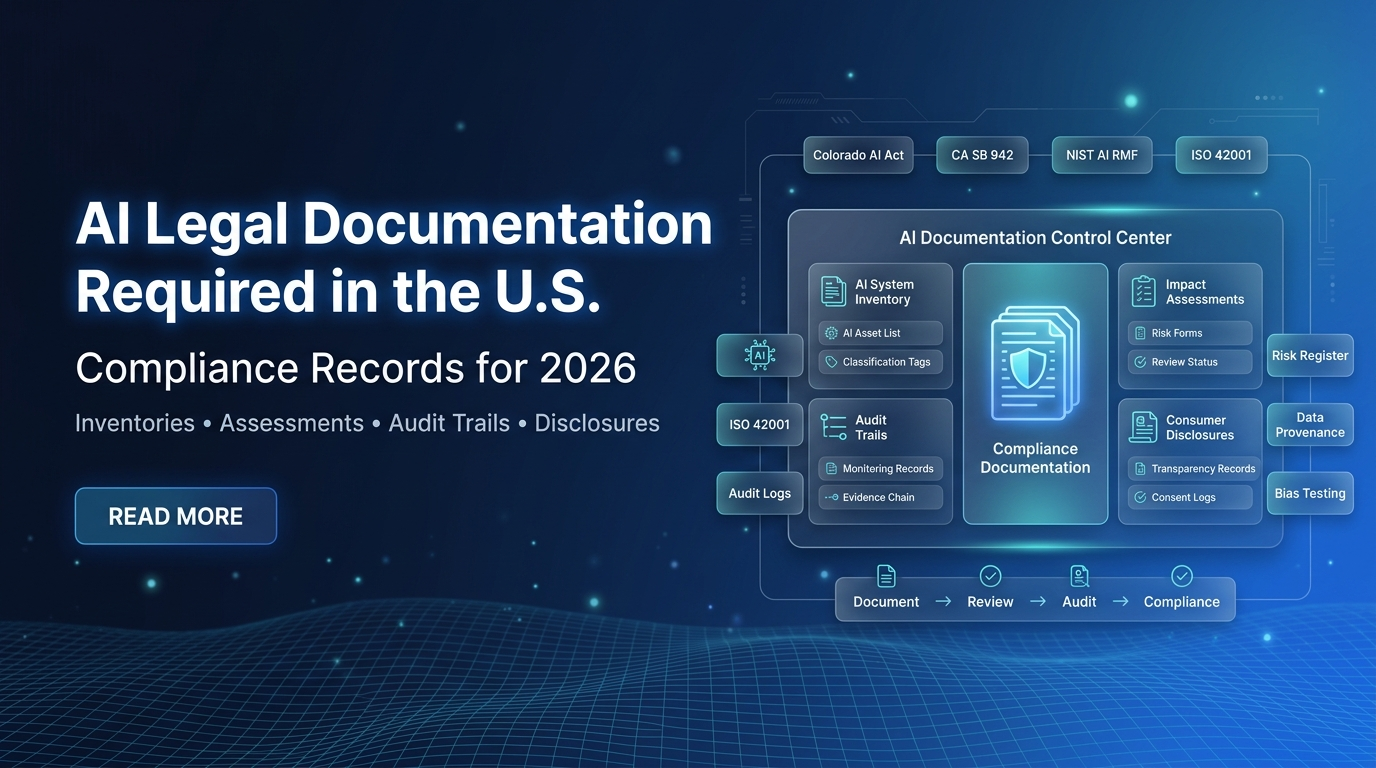
A single missing risk assessment cost one Colorado-based SaaS company $47,000 in penalties before its AI hiring tool had been live for six months. That figure is about to look modest. With the Colorado AI Act enforcement beginning in 2026, California’s suite of AI transparency laws now active, and more than 35 states advancing AI-related bills, the documentation burden on organizations deploying artificial intelligence in the United States has shifted from optional best practice to legal obligation.
This guide maps every document category your organization needs, identifies which laws trigger each requirement, and provides a practical framework for building a compliance-ready documentation program.
The Patchwork Problem: Federal and State AI Regulation in 2026
The United States does not have a single comprehensive federal AI law. That is the first thing every compliance team needs to internalize, because the absence of a unified statute has not meant the absence of enforceable obligations. What exists instead is a layered system: federal executive orders setting policy direction, agency-level enforcement under existing consumer protection and anti-discrimination statutes, and a rapidly expanding body of state legislation imposing specific documentation, disclosure, and impact assessment requirements.
At the federal level, Executive Order 14179 (January 2025) reoriented U.S. AI policy toward promoting innovation by revoking portions of the Biden-era executive order that had emphasized safety testing and reporting. A December 2025 executive order went further, directing the FTC to evaluate whether certain state AI laws should be preempted by federal authority. The practical effect: federal guidance shapes how agencies interpret their regulatory power, but it does not directly regulate private companies. Enforcement under the FTC Act, the EEOC’s anti-discrimination mandates, and sector-specific regulators like the CFPB and FDA continues regardless of which administration holds office.
State legislatures, meanwhile, have been prolific. According to the National Conference of State Legislatures, all 50 states introduced AI-related legislation during 2025, with roughly 100 measures enacted. The most consequential for documentation purposes include the Colorado AI Act (SB 24-205), California’s AI Transparency Act (SB 942), California’s Training Data Transparency Act (AB 2013), the Illinois AI Video Interview Act, and the Texas Responsible AI Governance Act. Each imposes distinct obligations, and organizations operating across state lines face a compliance matrix that demands careful planning.
Core Documentation Categories for AI Systems
Despite the fragmented regulatory environment, a clear pattern emerges when you map the documentation requirements across federal guidance, state law, and voluntary frameworks. Seven categories of documentation appear repeatedly, and building your program around these categories creates a foundation that satisfies multiple obligations simultaneously.
1. AI System Inventory and Registration Records
Before you can document the risks of an AI system, you need to know it exists. That sounds obvious, but the Kiteworks 2026 Data Security and Compliance Risk Forecast found that 78% of organizations cannot validate data before it enters their AI training pipelines. An AI system inventory is the foundational document from which every other compliance activity flows.
Each inventory entry should capture the system’s name and unique identifier, its developer or vendor, the business function it supports, the type of AI technology involved (machine learning, generative AI, rule-based), the data categories it processes, a classification of whether the system is high-risk under any applicable state law, and the designated internal owner responsible for oversight. The Colorado AI Act requires deployers of high-risk AI to maintain and publicly disclose information about the systems they use. The GSA’s federal AI compliance plan mandates that agencies maintain an AI use case inventory with plain-language documentation for high-impact applications.
2. Risk Assessment and Impact Assessment Documentation
Risk assessments are the centerpiece of nearly every AI compliance framework, whether mandated by law or recommended by standards bodies. The Colorado AI Act requires deployers to complete impact assessments before deployment and then annually, with a 90-day window for reassessment following any material modification. These assessments must be retained for three years.
A compliant impact assessment documents the AI system’s purpose and intended use cases, the categories of people affected by its outputs, foreseeable risks of algorithmic discrimination, the data used for training and the steps taken to ensure data quality, mitigation measures implemented to address identified risks, and the metrics used to evaluate the system’s ongoing performance.
ISO/IEC 42001, the international standard for AI Management Systems, defines the AI Impact Assessment as a formal, documented process for evaluating impacts on individuals, groups, and societies. Organizations following this standard evaluate datasets against twenty different data quality dimensions and document the model’s origins, deployment environment, interested parties, and both actual and potential harms. The NIST AI Risk Management Framework provides a complementary, more flexible approach organized around four functions: Govern, Map, Measure, and Manage.
Critical detail: Colorado’s law explicitly provides an affirmative defense for organizations that can demonstrate compliance with the NIST AI RMF or ISO/IEC 42001. This makes framework-aligned documentation not just good practice but a potential legal shield.
3. Algorithmic Discrimination and Bias Testing Records
Several state laws now require documented evidence that AI systems have been tested for discriminatory outcomes. The Colorado AI Act places a duty of reasonable care on deployers to avoid algorithmic discrimination in consequential decisions affecting employment, education, financial services, healthcare, housing, insurance, and legal services.
Documentation in this category should include testing methodology (statistical tests applied, protected classes evaluated), test results with disaggregated performance metrics across demographic groups, remediation actions taken when disparate impact is identified, and a schedule for ongoing monitoring and retesting. New York City’s Local Law 144, which took effect in 2023, provides a useful reference point: it requires annual bias audits by independent auditors for automated employment decision tools, with results published on the employer’s website.
4. Transparency and Consumer Disclosure Documents
Transparency requirements are proliferating across states. California’s AI Transparency Act (SB 942) requires large AI platforms with more than one million monthly users to provide free AI content detection tools and include both manifest and latent watermarks on AI-generated content. The effective date for full compliance was pushed to August 2026.
California’s Training Data Transparency Act (AB 2013) requires developers of generative AI systems to publish high-level summaries of the datasets used for training, including whether those datasets contain copyrighted or personal material. Illinois requires employers to notify job candidates when AI analyzes their video interviews and to obtain consent before any AI-based evaluation occurs.
The documentation package for transparency compliance includes consumer-facing notices that clearly state when AI is being used in decision-making, technical documentation of watermarking and content provenance systems, training data summaries for generative AI systems, and records of consent obtained from individuals subject to AI-based evaluation.
5. Data Governance and Provenance Documentation
Multiple state bills now target the same capability: tracing where AI training data came from and how it was processed. Washington’s HB 1170, Arizona’s SB 1786, California’s SB 1000, Illinois’s Provenance Data Requirements Act (HB 4711), and New York’s companion bills all require attaching provenance metadata to AI-generated or AI-modified content.
When AI-generated content enters healthcare records, legal filings, or regulatory submissions without provenance tagging, organizations face liability exposure that retroactive documentation cannot fix. The compliance implication is straightforward: organizations need documented data lineage and purpose-binding before training begins.
A data governance documentation package covers data collection policies (what data is collected, from whom, under what legal basis), data processing records (cleaning, transformation, augmentation steps), data retention and destruction schedules, data quality assessment results, and data access controls and audit logs.
6. Human Oversight and Accountability Records
The principle that meaningful human control must exist over consequential AI decisions runs through virtually every AI governance framework. Illinois’s Meaningful Human Control of AI Act (HB 4980) addresses who bears responsibility when AI systems make decisions. Multiple states have introduced bills declaring AI nonsentient and prohibiting legal personhood, reinforcing that accountability rests with the humans and organizations deploying these systems.
Documentation for human oversight includes defined escalation procedures specifying when and how a human reviewer intervenes, records of human override decisions and their outcomes, training records for personnel responsible for AI oversight, clear assignment of accountability (who is the designated responsible person for each AI system), and incident response protocols for AI-related failures or unexpected outputs.
7. Vendor and Third-Party AI Documentation
Most organizations do not build their AI systems from scratch. They procure them from vendors, which creates a documentation chain that must extend beyond the organization’s own walls. Enterprise customers now routinely request AI-specific contract provisions addressing data usage, audit rights, transparency, incident response, indemnities, and termination rights tied to safety failures.
Vendor documentation should include contractual restrictions on training models using customer data without express authorization, commitments regarding bias testing and documented evaluation practices, defined incident notification timelines for material AI-related failures, audit or information rights concerning model governance and safety controls, and allocation of liability for AI-generated outputs.
Documentation Requirements Mapped to Key U.S. Laws
| Law / Framework | Jurisdiction | Key Documentation | Effective / Status |
|---|---|---|---|
| Colorado AI Act (SB 24-205) | Colorado | Impact assessments, risk management policies, consumer notices, public disclosure of high-risk AI | February 2026 (enforcement June 2026) |
| CA AI Transparency Act (SB 942) | California | AI content detection tools, watermarking documentation, disclosure records | August 2026 |
| CA Training Data Transparency (AB 2013) | California | Training dataset summaries, copyright/personal data disclosures | January 2026 |
| Illinois AI Video Interview Act | Illinois | Candidate notification records, consent documentation, data retention/destruction logs | Active |
| NYC Local Law 144 | New York City | Annual bias audit reports, published audit summaries | Active (since 2023) |
| Texas RAIGA | Texas | AI system misuse standards, risk documentation | January 2026 |
| NIST AI RMF 1.0 | Federal (voluntary) | Govern, Map, Measure, Manage documentation across 72 subcategories | Active; RMF 1.1 expected 2026 |
| ISO/IEC 42001 | International | AIMS documentation, AI impact assessments per ISO 42005, data quality records | Active (certifiable) |
Industry-Specific Documentation Obligations
Sector-specific regulators add another documentation layer that intersects with general AI legislation. The requirements vary significantly by industry, and organizations in regulated sectors face compound obligations.
Financial Services
The Federal Reserve’s SR 11-7 guidance requires validation, ongoing monitoring, and documented human override for AI models influencing financial decisions. The Gramm-Leach-Bliley Act’s Safeguards Rule (2023 amendments) imposes specific encryption, access control, and audit log requirements for AI accessing nonpublic personal information. The New York Department of Financial Services Part 500 (2023 amendments) explicitly requires AI systems to be included in cybersecurity programs, making it one of the most operationally specific U.S. requirements for AI documentation in the financial sector.
Healthcare
California’s AB 3030 (Health Care Services: Artificial Intelligence Act) requires health care providers using generative AI to generate patient communications to include a disclaimer that the content was AI-generated. California’s AB 489 prohibits AI from falsely claiming healthcare licenses and requires disclosures when AI communicates with patients. HIPAA’s existing requirements for data security and access logging apply fully when AI systems process protected health information, creating documentation obligations that compound with new AI-specific laws.
Employment and Hiring
AI in employment decisions faces the most granular documentation requirements of any sector. Beyond the Illinois AI Video Interview Act and NYC Local Law 144, the EEOC has signaled that Title VII’s prohibition on employment discrimination applies to AI-driven hiring tools. California’s Civil Rights Department regulations restrict discriminatory use of AI in employment decisions. Documentation must cover the entire lifecycle: from the validation testing performed before deployment, through ongoing monitoring for disparate impact, to records of individual candidate notifications and opt-out requests.
Government Contractors and Federal Agencies
Federal agencies must comply with OMB Memorandum M-25-21, which establishes minimum risk management practices for AI systems. The AI Training Act (Public Law 117-207) requires OMB to provide AI training programs for the federal acquisition workforce. FedRAMP authorization is required for cloud-hosted AI tools processing government data. For defense contractors, ITAR compliance creates criminal export control exposure when AI tools process controlled technical data through infrastructure not under U.S.-person control.
Building a Compliance-Ready Documentation Program
Knowing what documents you need is half the challenge. The other half is building a sustainable system for creating, maintaining, and producing those documents when a regulator, auditor, or enterprise customer asks for them.
Step 1: Conduct an AI System Census
Start by identifying every AI system in use across your organization. This includes tools procured from vendors, internally developed models, and AI features embedded in existing software platforms that teams may be using without realizing the AI component. Assign each system a risk classification based on its use case, the population it affects, and the jurisdictions where it operates.
Step 2: Map Applicable Legal Requirements
For each system in your inventory, identify which federal, state, and industry-specific requirements apply. A healthcare AI system used by a California-based hospital serving Colorado patients, for example, must satisfy HIPAA requirements, California’s AI healthcare disclosure laws, and Colorado’s high-risk AI impact assessment obligations if the system influences consequential decisions.
Step 3: Adopt a Unifying Framework
Rather than building separate documentation for each jurisdiction, adopt NIST AI RMF or ISO/IEC 42001 as your baseline framework and then map additional jurisdiction-specific requirements onto it. This approach has a concrete legal benefit: Colorado’s AI Act provides an affirmative defense for organizations demonstrating compliance with either framework.
Step 4: Implement Continuous Documentation Practices
AI documentation is not a one-time exercise. Systems change, data shifts, and performance degrades over time. Build documentation into your development and deployment workflows so that records are generated as a byproduct of normal operations rather than compiled retrospectively when an audit notice arrives. Establish version control for all documentation, and ensure audit logs are consolidated rather than fragmented across multiple platforms. The Kiteworks 2026 report found that 33% of organizations lack audit logs entirely and 61% have logs that are fragmented and not actionable.
Step 5: Prepare for Multi-State Compliance
If your organization operates across state lines, build your documentation to satisfy the most stringent applicable requirement in each category. A document that meets Colorado’s impact assessment standard will typically satisfy less prescriptive requirements in other states. Maintain a regulatory tracking process to monitor new state legislation, since the landscape is changing quarterly.
The Most Dangerous Documentation Gaps in 2026
The gap between what regulators now require and what most organizations can actually produce is substantial. Several areas consistently surface as high-risk blind spots.
Training data provenance. Seventy-seven percent of organizations cannot trace the origins of their AI training data, according to the Kiteworks 2026 report. When provenance legislation takes effect, these organizations will not be able to produce the documentation regulators require.
Audit trail integrity. Fragmented logging across multiple platforms prevents organizations from producing a coherent response when a regulator asks for evidence of AI disclosure compliance. Consolidated, evidence-quality logging is now a compliance prerequisite.
Vendor due diligence records. Organizations routinely deploy AI tools procured from third parties without securing contractual audit rights, data access provisions, or documented bias testing commitments. When the deployer’s obligation under Colorado law is to exercise reasonable care, gaps in vendor documentation become the deployer’s liability.
Consumer notification records. As transparency laws expand, organizations need systematic records showing that affected individuals were notified about AI use, when the notification occurred, and what information was provided. Ad hoc approaches will not survive regulatory scrutiny.
Moving Forward
The documentation landscape for AI systems in the United States is complex, fragmented, and evolving rapidly. But the pattern is clear: transparency, accountability, and documented risk management are becoming baseline legal expectations rather than voluntary best practices. Organizations that build their documentation programs around established frameworks now, rather than scrambling to comply after enforcement actions begin, will hold a significant competitive and legal advantage.
The most effective first step is also the simplest: know what AI systems your organization is using, classify them by risk level, and start documenting. Everything else follows from that foundation.
GAICC offers ISO/IEC 42001 Lead Implementer training that builds the governance infrastructure determining liability outcomes. The program covers risk assessment, documentation standards, and the management system framework that courts and regulators evaluate when deciding who was reasonable and who was negligent. Explore the program to protect your clients before the liability question arrives.
Frequently Asked Questions (FAQs)
1. Is there a federal AI law in the United States?
No. The U.S. does not have a single comprehensive federal AI statute. Federal AI governance currently relies on executive orders, agency enforcement under existing laws (FTC Act, Title VII, HIPAA), and voluntary frameworks like the NIST AI RMF. Congress continues to debate broader legislation, but no omnibus AI bill has passed as of early 2026.
2. Which state has the most comprehensive AI documentation requirements?
Colorado, with the Colorado AI Act (SB 24-205), imposes the broadest documentation obligations for deployers of high-risk AI systems. It requires impact assessments, risk management policies, consumer notices, and public disclosure. California follows closely with multiple targeted transparency and training data disclosure laws.
3. What is the NIST AI Risk Management Framework, and is it mandatory?
The NIST AI RMF is a voluntary, sector-agnostic framework published by the National Institute of Standards and Technology. It organizes AI risk management into four functions: Govern, Map, Measure, and Manage. While not legally mandatory for private companies, it serves as a safe harbor under the Colorado AI Act and is increasingly referenced by federal agencies and enterprise procurement teams.
4. How does ISO/IEC 42001 relate to U.S. AI documentation requirements?
ISO/IEC 42001 is the international standard for AI Management Systems. It provides a certifiable framework for managing AI governance, including detailed AI impact assessment guidance through ISO 42005. The Colorado AI Act recognizes compliance with ISO/IEC 42001 as an affirmative defense, making certification a strategic compliance investment for organizations operating in the U.S.
5. What penalties exist for failing to document AI systems properly?
Penalties vary by jurisdiction and the specific law violated. Colorado’s AI Act penalties are enforced by the state attorney general. California’s AI Transparency Act carries penalties of $5,000 per violation per day. FTC enforcement actions under existing consumer protection authority can result in substantial fines. Sector-specific regulators (NYDFS, CFPB, EEOC) have their own penalty structures that apply when AI-related violations fall within their jurisdiction.
6. Do small businesses need to comply with AI documentation requirements?
It depends on the specific law. The Colorado AI Act applies to any deployer of high-risk AI in the state, regardless of company size. NYC Local Law 144 applies to employers using automated employment decision tools. California’s transparency laws apply based on the scale of the AI platform (one million monthly users) rather than the company’s size. Small businesses should assess whether their specific AI use cases trigger any applicable state requirements.
7. How often should AI documentation be updated?
The Colorado AI Act requires annual impact assessment reviews and reassessment within 90 days of material system modifications. NIST AI RMF recommends continuous monitoring with periodic formal reviews. As a practical matter, documentation should be updated whenever the AI system changes, when new data sources are introduced, when performance metrics shift, or when applicable regulations change.