
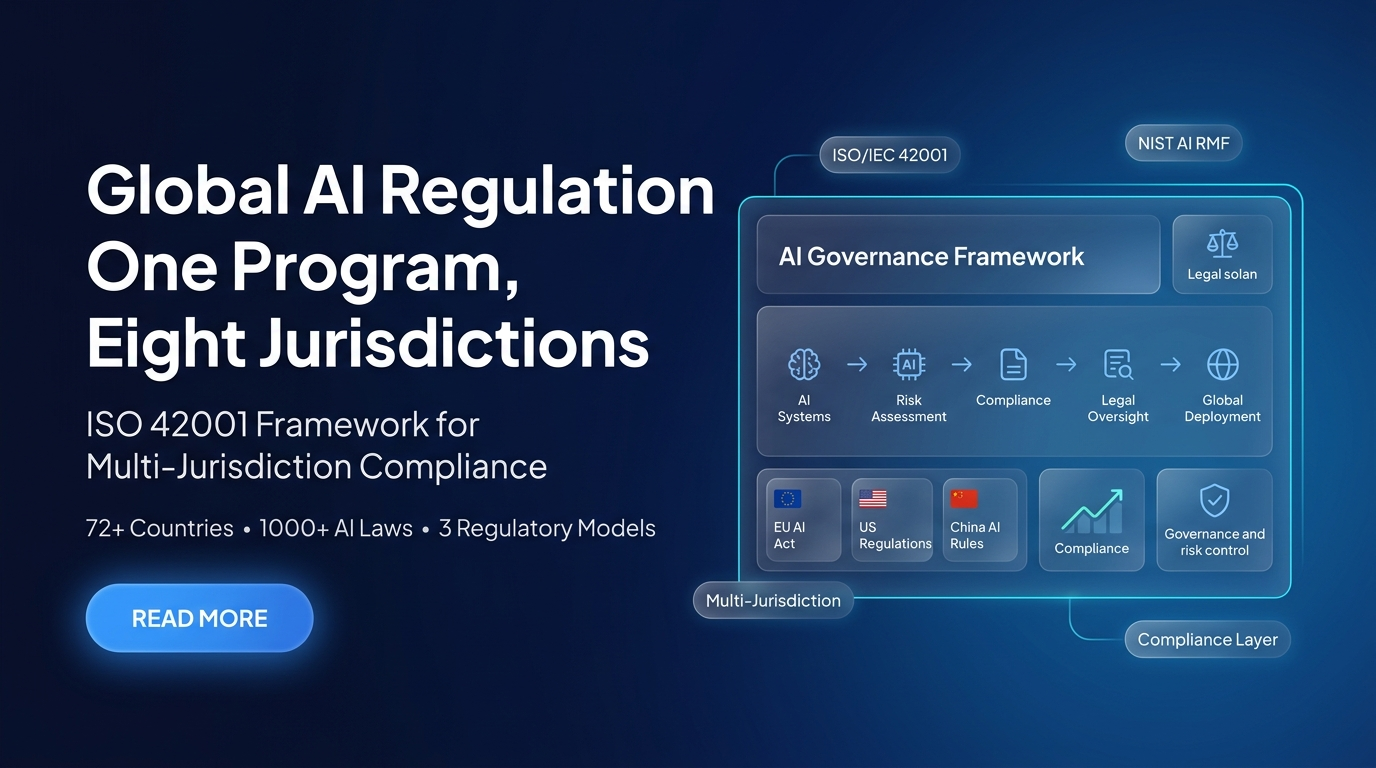
72+ countries, 1,000+ AI policy initiatives, three regulatory philosophies. Here is how to build a single ISO 42001 compliance program serving the EU, U.S., UK, China, India, Brazil, Canada, and Singapore simultaneously.
The global fragmentation: 72+ countries with AI initiatives. Three camps: EU hard law, U.S. existing law + state patchwork, Japan/Singapore soft governance. A multinational with EU customers, India outsourcing, UK exposure, Singapore hub, and Brazilian data faces 8+ simultaneous regimes. Building parallel programs per jurisdiction is unsustainable. One program, eight jurisdictions, zero parallel structures.
Over 72 countries have launched 1,000+ AI policy initiatives by 2026. For lawyers advising multinationals, the question is not which law applies but how to build one governance program satisfying all of them. This article provides the jurisdiction-by-jurisdiction trigger map, a unified control matrix showing convergence and divergence, and practical architecture for one ISO 42001 program serving every major jurisdiction.
Three Regulatory Philosophies
Camp 1: Risk-based hard law (EU, Colorado, South Korea). Comprehensive legislation with risk tiers, conformity assessment, documentation, registration. EU AI Act is the prototype. Highest burden but most predictable.
Camp 2: Existing law + state/sector patchwork (U.S., China). No comprehensive federal law. FTC, CFPB, EEOC apply existing statutes. State laws supplement. China: no single AI law but dedicated regulations (algorithm, deep synthesis, GenAI, labeling) plus mandatory algorithm registration.
Camp 3: Soft governance (UK, Japan, Singapore, India). Voluntary frameworks, existing regulators, principles-based. Singapore AI Verify toolkit. Japan AI Promotion Act (non-binding). India seven sutras. Lowest immediate burden but binding requirements coming.
The Eight-Jurisdiction Trigger Map
| Jurisdiction | Trigger | Key Law | Penalty | Enforcement | Safe Harbor? |
|---|---|---|---|---|---|
| EU | AI on EU market OR outputs in EU OR affects EU residents | EU AI Act (Aug 2026). GDPR. | 7% global or €35M | National + EU AI Office | Harmonized standards |
| U.S. Federal | Commerce (FTC), credit (CFPB), employment (EEOC), securities (SEC) | FTC Act, ECOA, Title VII. No AI law. | Varies. Disgorgement. | FTC, CFPB, EEOC, SEC | None federal |
| U.S. States | Consequential decisions (CO), employment (IL, NYC), prohibited uses (TX) | CO AI Act, TRAIGA, IL HB 3773, LL144 | CO: UDTP. TX: $200K. | AGs. IL: private right. | TX: NIST. CO: ISO 42001. |
| UK | AI in UK market or affecting UK residents | Sector-specific. No AI statute. | Sector-dependent | FCA, ICO, Ofcom, CMA | Sandboxes |
| China | AI services to Chinese users or within China | Algorithm (2022), GenAI (2023), Labeling (2025) | Admin + criminal | CAC. Algo registration. | None. Pre-approval. |
| India | Processing data in India OR services to Indian residents | DPDPA 2023 (May 2027). AI Guidelines. | ~$30M | Data Board. Sectoral. | Outsourcing exemption. |
| Brazil | AI affecting Brazilian residents or processed in Brazil | LGPD (privacy). AI Bill developing. | ~$10M (LGPD) | ANPD. AI regulator proposed. | None yet |
| Singapore | AI in Singapore market or affecting residents | PDPA. Model Framework. AI Verify. | ~$750K (PDPA) | PDPC, IMDA | AI Verify. Sandbox. |
| Canada | AI in federal services or high-impact decisions | Directive on Automated Decisions. AIDA proposed. | ~$18M proposed | Federal agencies | None yet |
Seven Universal Controls
Despite different philosophies, these controls appear across every jurisdiction.
1. AI system inventory. EU: Annex III classification. U.S.: CO/TX mapping. India: DPDPA records. China: algo registration. ISO 42001 Clause 4.3.
2. Risk assessment. EU: Art. 9. U.S.: CO impact assessments, NIST. UK: sectoral. India: guidelines. China: algo assessment. ISO 42001 Clause 8.2.
3. Transparency. EU: Arts. 13, 50. U.S.: CO/IL/CA disclosure. UK/India/Singapore: principles. China: labeling. ISO 42001 Annex A.
4. Bias testing. EU: non-discrimination. U.S.: Title VII, LL144. UK: Equality Act. India: sutra 5. Brazil: LGPD automated rights. ISO 42001 Annex A+C.
5. Human oversight. EU: Art. 14. U.S.: CFPB explanation. India: sutra 7. China: human review. Singapore: framework dimension. ISO 42001 Annex A.
6. Documentation. EU: Art. 11, Annex IV. U.S.: CO assessments, IL retention. India: DPDPA records. China: algo filing. ISO 42001 Annex B.
7. Incident response. EU: post-market monitoring. U.S.: FTC triggers, CO 90-day. India: 72-hour breach. China: CAC reporting. ISO 42001 Clause 10.2.
The convergence insight: Seven controls are universal. ISO 42001 implements all seven through Clauses 4-10, Annexes A, B, C. Build the core once, then add jurisdiction-specific modules. One program, not eight.
Jurisdiction-Specific Divergences
EU only: Conformity assessment, CE marking, EU database registration, authorized representative. No other jurisdiction requires formal market-access conformity.
China only: Mandatory algorithm registration with CAC. Content alignment with state ideology. No international equivalent. Dedicated resources required.
U.S. only: Algorithmic disgorgement (FTC model destruction). No equivalent elsewhere. Data provenance documentation uniquely critical.
India only: Outsourcing exemption (Section 17). Consent-only basis (no legitimate interest). Globally unique provisions.
UK only: Sector-specific regulatory discretion. Each regulator interprets differently. No single checklist covers all sectors.
Singapore only: AI Verify self-assessment toolkit. Government-backed testing tool. No equivalent elsewhere.
The Unified Program Architecture
Core layer: ISO 42001. Governance (Cl. 5), risk (Cl. 8.2), impact (Cl. 8.4), documentation (Annex B), controls (Annex A), monitoring (Cl. 9.1), improvement (Cl. 10). Satisfies seven universal controls. Certification = third-party evidence.
Integration layer: NIST + ISO 27001 + ISO 27701. NIST adds U.S. risk methodology and safe harbors. ISO 27001 = security. ISO 27701 = privacy across GDPR, DPDPA, LGPD, PDPA.
Jurisdiction-specific modules: EU conformity + authorized rep. China algo registration. India exemption mapping + consent architecture. UK sector engagement. Singapore AI Verify. Modules plug into core; no parallel structures.
Five Implementation Steps
- Map jurisdictional exposure. Use the trigger table. Most multinationals face 3-5 simultaneous jurisdictions.
- Implement seven universal controls via ISO 42001. Inventory, risk, transparency, bias testing, oversight, documentation, incident response.
- Add NIST for U.S. safe harbors. Map NIST Govern-Map-Measure-Manage to ISO 42001. Activates TX/CO defenses.
- Add jurisdiction-specific modules. EU conformity. China registration. India exemption. UK sectors. Singapore AI Verify. Incremental additions.
- Certify and maintain. ISO 42001 certification. Integrated audits. Regulatory monitoring across all jurisdictions.
One Program. Every Jurisdiction.
72+ countries, three philosophies, different enforcement. But seven controls converge. ISO 42001 implements them. NIST adds U.S. safe harbors. Jurisdiction modules handle the unique requirements. One program, scalable to every jurisdiction, without parallel structures.
The practical first step: map every client’s jurisdictional exposure using the trigger table. Then build the ISO 42001 core with NIST integration and add jurisdiction-specific modules as exposure requires.
GAICC offers ISO/IEC 42001 Lead Implementer training designed for legal professionals building multi-jurisdictional AI governance programs. The program covers the unified architecture, NIST AI RMF integration, and the jurisdiction-specific modules that complete the global compliance capability. Explore the program to serve clients across every major AI market.
Frequently Asked Questions (FAQs)
1. How many AI regulations exist globally?
72+ countries, 1,000+ initiatives. Three camps: EU hard law, U.S. existing law + state patchwork, Japan/Singapore soft governance. 45 countries have specific initiatives beyond EU members.
2. Can one program serve all jurisdictions?
Yes. Seven controls are universal. ISO 42001 implements them. Jurisdiction-specific add-ons (EU conformity, China registration, India exemption) are modules, not programs. Core stays unified.
3. Which jurisdiction drives design?
Start with the most stringent (EU for EU exposure). If no EU, ISO 42001 + NIST satisfies U.S. safe harbors and signals maturity globally.
4. How does China differ?
Mandatory algorithm registration before providing AI services. Content alignment with state ideology. No international equivalent. Dedicated resources beyond universal controls.
5. What role does ISO 42001 play?
Third-party evidence applicable everywhere. Activates TX/CO safe harbors. Supports EU conformity. Satisfies India/Singapore frameworks. One certification, universal applicability.
6. How to handle regulatory changes?
Regulatory intelligence monitoring all jurisdictions. ISO 42001 provides stable core. Changes update modules, not core. GAICC training covers methodology.
7. Biggest multi-jurisdictional mistake?
Parallel programs per jurisdiction. Creates duplication, cost, confusion. One core, jurisdiction modules. One team, one system, one audit.