
The U.S. federal government opened more than 700 AI-related positions in 2024 alone and that number does not count the thousands of roles in financial services, healthcare, defense contracting and Big Tech. AI governance has moved from a compliance checkbox to a strategic function, and organizations are scrambling to find people who actually understand it.
This guide maps every stage of an AI governance career: what the roles look like, what skills get you hired, which certifications signal real credibility, and how to move from your first position into senior leadership.
What Is AI Governance and Why It Matters in 2025
AI governance refers to the frameworks, policies, processes, and oversight mechanisms that organizations put in place to ensure their AI systems operate responsibly, legally and in alignment with defined values. It is the operational answer to a deceptively simple question: how do you make sure AI does what it is supposed to do and nothing it should not?
The stakes have sharpened considerably. The EU AI Act, which entered into force in August 2024, creates extraterritorial compliance obligations that touch any U.S. company with European customers or operations. The NIST AI Risk Management Framework (AI RMF), published in 2023, has become the de facto reference architecture for federal agencies and increasingly for private sector organizations as well. Executive Order 14110 on Safe, Secure, and Trustworthy AI set reporting requirements and safety standards that reshaped how large technology developers operate.
None of these developments are theoretical. A major U.S. bank paid $185 million in regulatory penalties in 2023 partly related to algorithmic decision-making in credit scoring. A healthcare system in Illinois faced a class-action lawsuit over a patient-triage AI that exhibited documented racial bias. Organizations that lack formal AI governance structures are accumulating legal, reputational, and operational risk at a pace that governance professionals are now hired specifically to reduce.
Three forces are converging that make 2025 a particularly important entry point for governance careers: the regulatory environment is maturing from voluntary guidance to enforceable standards; AI adoption in enterprise settings has reached a scale where informal oversight is no longer viable; and boards and executive teams are demanding the kind of documented accountability that only a structured governance function can provide.
The AI Governance Job Market: Demand, Growth, and Salary Ranges in the USA
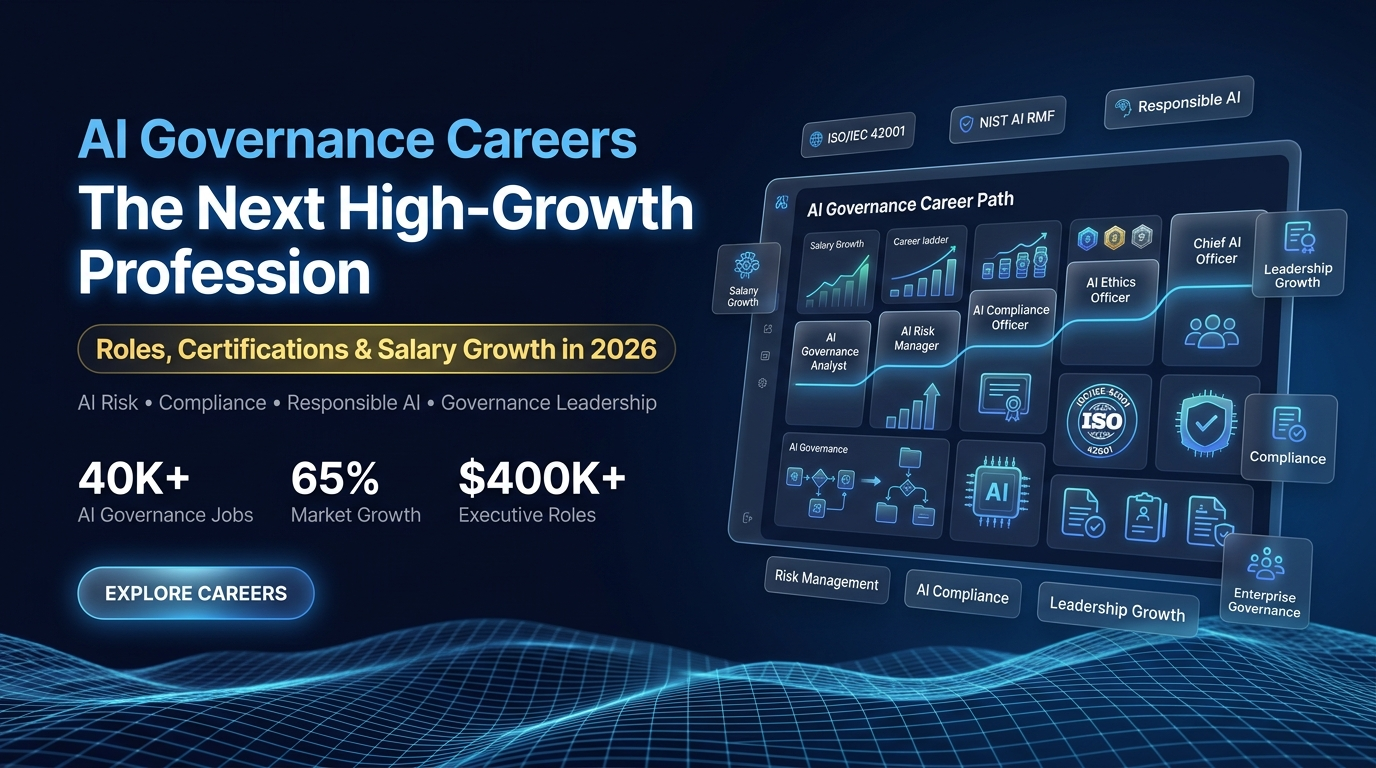
LinkedIn’s 2024 Emerging Jobs Report listed AI governance, AI ethics, and responsible AI roles among the fastest-growing professional categories, with a 65% year-over-year increase in U.S. job postings. Lightcast data shows that AI governance-adjacent roles posted nearly 40,000 open positions in the U.S. in Q4 2024.
Role | Entry-Level (0-3 yrs) | Mid-Level (3-7 yrs) | Senior/Director |
|---|---|---|---|
AI Governance Analyst | $75,000 – $95,000 | $95,000 – $130,000 | $130,000 – $160,000 |
AI Risk Manager | $90,000 – $115,000 | $115,000 – $155,000 | $155,000 – $195,000 |
AI Compliance Officer | $85,000 – $110,000 | $110,000 – $145,000 | $145,000 – $185,000 |
AI Ethics Officer | $95,000 – $120,000 | $120,000 – $160,000 | $160,000 – $210,000 |
Chief AI Officer (CAIO) | N/A | $180,000 – $250,000 | $250,000 – $400,000+ |
Geography matters. San Francisco, New York, Washington D.C., and Seattle consistently pay 20-35% above national averages for governance roles. Remote-friendly positions which now represent roughly 45% of posted AI governance jobs allow candidates in lower cost-of-living markets to capture near-market-rate compensation.
A Gartner survey from late 2024 found that 72% of organizations with more than 1,000 employees planned to create at least one dedicated AI governance role within 18 months. The demand pipeline is structural, not cyclical.
Core AI Governance Roles: From Entry-Level to Executive
Entry and Early-Career Roles
AI Governance Analyst is the most common point of entry. Day-to-day responsibilities include documenting AI systems in a model inventory, conducting initial risk assessments using NIST AI RMF, supporting audit preparation, and monitoring regulatory developments.
AI Policy Coordinator roles focus on translating regulatory requirements into internal policy language, coordinating across legal, IT, and business units. A background in policy, law, or public administration transitions well into this role.
Responsible AI Researcher positions appear most often at technology companies and research institutions. They evaluate models for bias, fairness, and explainability typically requiring familiarity with Python, statistical methods, and fairness metrics.
Mid-Level Roles
AI Risk Manager centers on enterprise risk frameworks, quantitative risk scoring, incident management, and vendor AI risk assessments. Many organizations are building this role out of existing model risk management functions in financial services.
AI Compliance Officer specializes in regulatory alignment across the EU AI Act, U.S. state AI laws, and sector-specific guidance from OCC, CFPB, and HHS. Knowledge of how AI-specific regulations interact with CCPA, CPRA, and HIPAA is a meaningful differentiator.
AI Ethics Officer operates at the intersection of policy, philosophy, and organizational culture embedding ethical reasoning into how AI systems are designed, deployed and evaluated. This role often reports to the Chief Responsibility Officer.
Senior and Executive Roles
AI Governance Director / Head of Responsible AI leads the governance function, manages a team, defines the governance operating model and represents the function to the board. Stakeholder management and executive communication matter as much as technical knowledge at this level.
Chief AI Officer (CAIO) is the fastest-growing C-suite title in the technology sector. The role encompasses AI strategy, governance oversight and organizational AI maturity. The Biden administration mandated CAIOs for major federal agencies in 2024; many corporations followed.
Essential Skills for an AI Governance Career
Technical Foundation (Non-Negotiable at Any Level)
You do not need to build machine learning models, but you do need to understand how they work well enough to ask the right questions.
- Machine learning fundamentals: supervised vs. unsupervised learning, training and inference pipelines, model evaluation metrics (precision, recall, AUC), overfitting, and concept drift.
- Bias and fairness metrics: statistical parity, equalized odds, individual fairness, and demographic parity including how different fairness definitions can conflict with each other.
- Explainability tools: familiarity with SHAP values, LIME, and model cards is increasingly expected even in non-technical governance roles.
- Data governance and lineage: AI governance is downstream of data governance. Data classification, quality frameworks, and lineage tracking are foundational.
Regulatory and Policy Knowledge
- NIST AI RMF (Govern, Map, Measure, Manage): the primary U.S. framework
- ISO/IEC 42001:2023: the international standard for AI management systems
- EU AI Act: critical for any organization with EU exposure
- Sector-specific guidance: OCC SR 11-7, CFPB algorithmic model guidance, HHS AI strategy, EEOC AI employment guidance
Soft Skills That Separate Good from Great
- Stakeholder communication: explaining a model risk assessment to a CFO, a legal opinion to a data scientist, and a compliance concern to a product manager in appropriate terms for each audience.
- Influence without authority: governance roles are typically advisory at entry and mid-levels. Getting engineering teams to change deployment practices requires credibility and persuasion skill.
- Ethical reasoning: practical moral reasoning applied to real decisions not philosophy in the abstract, but the ability to articulate the ethical dimensions of a specific AI deployment and propose actionable alternatives.
AI Governance Certifications That Actually Matter
ISO/IEC 42001 Certifications (GAICC)
The GAICC certification program built around ISO/IEC 42001:2023 is the most rigorous credential currently available in the AI governance space. The standard the first international standard specifically for AI management systems provides the framework that defines what good AI governance looks like at a systemic level.
Certification | Best For | Key Focus |
|---|---|---|
GAICC ISO/IEC 42001 Foundation | Professionals transitioning into governance | Conceptual fluency with the standard |
GAICC Lead Implementer | Mid-level governance professionals | Design, build, and operate an AIMS |
GAICC Lead Auditor | Consulting and audit professionals | Third-party conformance assessments |
GAICC CPAIG | Governance specialists | Professional AI governance practice |
GAICC CAILCP | Legal/compliance professionals | AI law and compliance framework |
Other Recognized Credentials
- ISACA CRISC: Certified in Risk and Information Systems Control establishes enterprise risk management foundations that transfer directly to AI risk roles.
- NIST AI RMF Practitioner Programs: Completion certificates from structured programs demonstrate working knowledge of the primary U.S. governance framework.
- IEEE Certified Ethicist: Recognized in technical governance contexts, particularly for engineers and technical professionals.
Marketing-focused AI ethics courses from general online learning platforms do not carry the same credibility as the credentials above in sophisticated hiring contexts.
Step-by-Step Career Roadmap: Breaking In, Moving Up, and Leading
Stage 1: Foundation Building (0-2 Years)
From a technical background: Your advantage is genuine understanding of AI systems. Fill the policy gap with ISO/IEC 42001 Foundation certification, NIST AI RMF training and regulatory reading. Target roles: AI governance analyst, responsible AI researcher.
From a policy/legal/compliance background: Your advantage is regulatory fluency. Fill the technical gap with ML fundamentals coursework, bias and fairness reading, and hands-on model documentation exposure. Target roles: AI policy coordinator, AI compliance analyst.
From consulting or risk management: Your advantage is structured problem-solving. Fill both gaps simultaneously with the GAICC Lead Implementer program. Target roles: AI risk consultant, AI governance advisory.
Stage 2: Specialization and Credibility Building (2-5 Years)
- Risk-heavy track: Pursue GAICC Lead Implementer or Lead Auditor, deepen NIST AI RMF expertise. Target industries: financial services, insurance, healthcare.
- Policy and compliance track: Pursue GAICC CAILCP, build EU AI Act expertise, develop state AI legislation knowledge. Target employers: large enterprises, law firms, federal agencies.
- Technical governance track: Deepen fairness, explainability, and accountability tooling skills. Target employers: technology companies, AI labs.
Stage 3: Leadership and Influence (5-10 Years)
- From practitioner to builder: Designing the governance operating model, building the team, and defining the framework for the organization.
- From technical advisor to executive communicator: Translating AI governance concerns into financial, reputational, and strategic risk language for board and C-suite audiences.
- Building a public profile: Speaking at industry conferences, publishing in trade publications, and maintaining an active professional network.
Stage 4: Executive and Advisory Roles (10+ Years)
Beyond the CAIO, experienced governance leaders move into: general counsel roles with AI specialization, partner-level consulting positions, board advisory roles, federal agency policy positions (NIST, FTC, CFPB), and academic leadership.
Industries Hiring AI Governance Professionals in the USA
Industry | Primary Focus | Regulatory Driver | Key Roles |
|---|---|---|---|
Financial Services | Model risk, fair lending, fraud detection | OCC SR 11-7, CFPB guidance | AI Risk Manager, Model Validator |
Technology Companies | Responsible AI, platform safety | Executive Order 14110 | AI Ethics Officer, Policy Lead |
Federal Government / Defense | AI safety, national security, clearances | DoD RAISE, agency AI strategies | CAIO, AI Policy Director |
Healthcare / Life Sciences | Clinical AI, patient safety, privacy | FDA SaMD, HIPAA intersection | AI Compliance Officer, Ethics Lead |
Consulting / Advisory | Cross-industry governance programs | Client-driven, multi-framework | AI Risk Consultant, Governance Advisor |
Building Your AI Governance Profile: Portfolio, Network, and Visibility
Build a genuine portfolio. Write a model risk assessment for a publicly available AI system; contribute to open-source governance tooling on Hugging Face or GitHub; produce analysis of a recent regulatory development. Hiring managers consistently report that candidates who can show actual work move through processes faster.
Invest in community. The AI governance community in the U.S. is small enough that personal connections matter significantly. Relevant communities: Partnership on AI, AI Now Institute, ISACA AI working groups, GAICC professional network. Conference attendance at IAPP, MIT AI Policy Forum, and ISACA GRC conferences yields both learning and relationship-building.
Develop a point of view. Pick one area — EU AI Act expertise, algorithmic impact assessments, model cards as a governance tool, fairness measurement — and go deep enough to have a genuine perspective, then document it publicly. Generalists get hired; specialists get sought out.
The governance professionals who entered the field in 2022-2023 are now reaching mid-level positions paying $120,000-$160,000. Those entering now are positioned to reach senior and director-level roles by 2028-2030, when demand for experienced governance leaders is projected to significantly exceed supply.
Conclusion
AI governance is no longer a niche concern for compliance teams it is a board-level function with direct impact on revenue, reputation, and legal liability. The U.S. market is generating thousands of new governance roles annually, paying competitive salaries across every experience level, and consistently promoting professionals who combine genuine technical understanding with policy fluency and organizational credibility.
The clearest next step depends on where you are. If you are exploring the field: complete the GAICC ISO/IEC 42001 Foundation program and read NIST’s AI RMF cover to cover. If you are transitioning into governance: pursue Lead Implementer certification and build one concrete portfolio piece. If you are already in governance and want to advance: pick a specialization, develop a public point of view, and get in front of the governance community in your target sector.
Ready to formalize your AI governance credentials? Explore GAICC’s ISO/IEC 42001 certification pathway at gaicc.org – the most rigorous and internationally recognized credential in the field.
Frequently Asked Questions (FAQs)
1. What background do I need to start an AI governance career?
There is no single required background. Successful AI governance professionals come from technical fields, policy and legal backgrounds, risk management and audit, and management consulting. What matters is the ability to bridge technical and organizational understanding, and a commitment to building the gaps in your current profile.
2. How long does it take to become certified in ISO/IEC 42001?
The GAICC Foundation certification can be prepared for in 2-4 weeks of focused study. The Lead Implementer certification requires completing a 4-day training program followed by a 90-minute exam. Most candidates complete the Foundation-to-Lead-Implementer pathway within 2-3 months.
3. Is AI governance a stable long-term career choice?
The structural drivers increasing regulation, expanding AI deployment, growing board-level accountability are not reversing. Governance professionals who build adaptable skill sets rather than narrow specializations are well-positioned for 20+ year careers.
4. What does a Chief AI Officer actually do day-to-day?
The CAIO sets organizational AI strategy, oversees the AI governance function, represents AI risk and compliance to the board, manages regulator relationships, and makes decisions about AI system deployment at a portfolio level.
5. How important is technical coding ability for AI governance roles?
Python familiarity enough to read model documentation and understand code reviews is a practical asset at mid-level. For policy-heavy and compliance-heavy roles, it is much less relevant. Deep coding ability matters mainly for technical governance specialists.
6. Which U.S. cities have the most AI governance jobs?
Washington D.C., San Francisco Bay Area, New York City, Seattle, and Boston are the highest-concentration markets. Remote or hybrid arrangements now represent roughly 45% of posted governance roles.
7. What is the difference between AI governance and AI ethics?
AI ethics is philosophical and normative concerned with what AI should do and what values it should reflect. AI governance is the operational implementation: the policies, processes, controls, and oversight mechanisms that make ethical AI commitments actionable.
8. Is the EU AI Act relevant for U.S.-based professionals?
Absolutely. Any U.S. company with European customers, employees, or market operations falls under EU AI Act requirements for high-risk AI systems. EU AI Act expertise is a genuine differentiator in the U.S. market precisely because many organizations are scrambling to understand their obligations.