
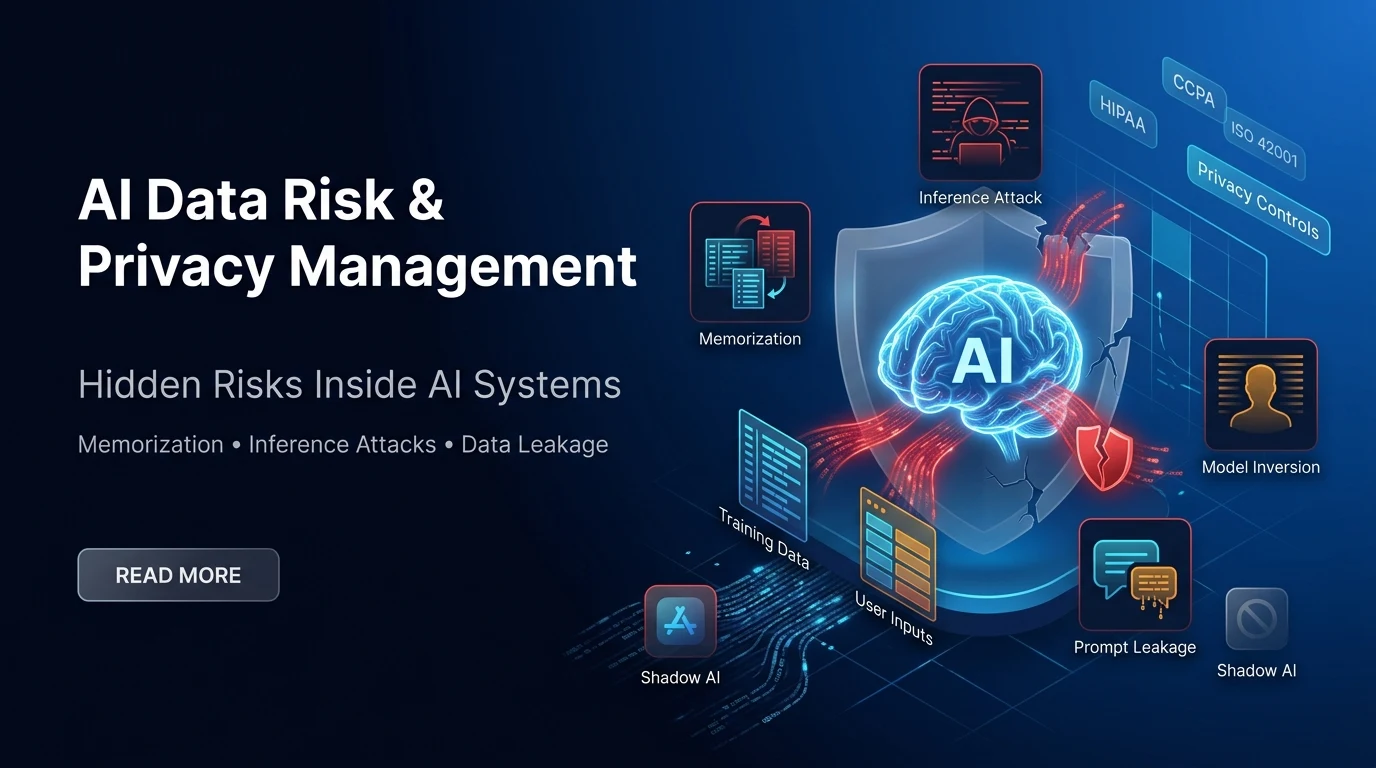
AI systems memorize training data, leak information through prompts, and infer attributes never explicitly collected. Here is how to manage these risks within the frameworks regulators expect.
By the numbers: AI incidents surged 56.4% in 2024 (Stanford AI Index). ~40% of organizations report an AI privacy incident. ~15% of employees have pasted sensitive data into public LLMs. ~70% of adults say they do not trust companies to use AI responsibly.
Stanford’s 2025 AI Index Report documented a 56.4% surge in AI-related incidents in a single year, with 233 reported cases throughout 2024. Approximately 40% of organizations report experiencing an AI-related privacy incident, and around 15% of employees have pasted sensitive data into public large language models. These are not speculative risks. AI systems create data and privacy risks that are fundamentally different from traditional IT risks. Models memorize training data and can reproduce it verbatim. Inference attacks extract personal information from model outputs. Third-party AI services process sensitive data under terms most organizations have not fully evaluated. This article maps those risks, connects them to the U.S. regulatory landscape, and provides the controls framework that ISO/IEC 42001 and the NIST AI RMF expect.
How AI Creates Data Risks That Traditional IT Controls Cannot Address
Traditional data security operates on a straightforward model: data stored in databases, transmitted across networks, accessed by authorized users. AI disrupts this at every level because AI systems do not just process data; they absorb it, learn from it, and can regenerate it in ways the original data owners never intended.
Training Data Memorization
Large language models can memorize specific data points from training sets and reproduce them during inference. Research confirms this memorization occurs early during training and persists across model types and training strategies. Standard anti-overfitting techniques are insufficient to prevent it. A 2025 systematic review found that differential privacy can reduce this risk but introduces accuracy reductions of 5% to 20%, creating a direct trade-off between privacy and performance.
Membership Inference Attacks
An adversary can determine whether a specific individual’s data was in the training set by analyzing model outputs. In healthcare, a successful attack could reveal that a patient’s records were part of a clinical dataset. Models tend to memorize rare or unique data points more readily, meaning minority populations face disproportionate exposure.
Model Inversion and Attribute Inference
Model inversion attacks reconstruct training data from outputs. Attribute inference attacks extract sensitive characteristics never directly provided as inputs. An AI designed to predict creditworthiness might reveal health status or family information through its outputs, turning the system into an unintended disclosure mechanism.
Prompt-Based Data Leakage
Generative AI faces a risk category that did not exist before: users can craft prompts causing the model to reveal training data, system instructions, or other users’ session information. In enterprise RAG settings, a compromised prompt can extract sensitive corporate information the user should not access.
Shadow AI and Ungoverned Data Flows
About 15% of employees have pasted sensitive information into public AI tools without approval. These shadow AI deployments create data flows that bypass every governance control. Proprietary code, customer data, and regulated information leave the organization through a browser tab with no audit trail.
AI Privacy Risks: What Makes Them Different
Consent becomes meaningless at scale. Most AI training data comes from public sources or aggregated datasets. Individuals rarely gave specific consent for AI training. The International AI Safety Report 2026 noted that the principle that individuals remain in control of their data is fundamentally challenged by AI training practices.
Deletion is technically infeasible. Once personal data is absorbed into model parameters, removing it is extraordinarily difficult. Unlike a database record, data in model weights is distributed across billions of parameters. This creates direct tension with CCPA deletion rights and similar state laws. Machine unlearning remains far from production-ready.
Inferences create new personal data. AI systems can infer sensitive attributes never explicitly collected: health conditions, pregnancy status, political affiliation from purchase behavior. These inferences constitute new personal data under many privacy frameworks but exist outside standard data governance processes.
The U.S. Regulatory Landscape for AI Data and Privacy Risk
Federal Regulations
HIPAA governs protected health information in AI systems. Business Associate Agreements are required for third-party AI providers handling PHI. De-identification must follow Safe Harbor or Expert Determination before PHI is used for training.
GLBA and SEC guidance apply to financial services AI. The SEC has scrutinized AI-related disclosures and warned about “AI washing.”
FTC enforcement has targeted companies making deceptive AI privacy claims and has ordered deletion of models trained on improperly collected data, treating the model itself as tainted.
State Privacy Laws
More than 15 states have comprehensive privacy laws in effect as of 2026. California’s CCPA/CPRA provides the strongest consumer rights including automated decision-making provisions. Colorado’s AI Act requires impact assessments for high-risk AI. Virginia, Connecticut, Texas, Oregon, and Montana each impose their own requirements.
Federal Agency Guidance
In May 2025, the FBI, NSA, CISA, and international counterparts jointly published “AI Data Security” guidance with ten best practices including data provenance tracking, integrity verification, digital signatures, and continuous monitoring.
ISO/IEC 42001 integration: The standard addresses data risk through Annex A Control A.7 (data management), Annex C objective C.2.8 (privacy), Clause 6.1.4 (impact assessment), and integrates with ISO 27001 and ISO 27701 for comprehensive information security and privacy coverage.
AI Data and Privacy Risk Categories Mapped to Controls
| Risk Category | ISO 42001 | NIST AI RMF | U.S. Regulation |
|---|---|---|---|
| Training data memorization | A.7, C.3.4 | Map 1.5, Measure 2.10 | HIPAA, CCPA |
| Membership inference attacks | C.2.8, C.2.10 | Measure 2.7, 2.10 | HIPAA, CCPA |
| Model inversion / attribute inference | A.7, A.10 | Measure 2.7 | FTC Act, state laws |
| Prompt-based data leakage | A.10, C.2.10 | Manage 2.3 | FTC Act, HIPAA |
| Shadow AI / ungoverned flows | Clause 4.3, A.3 | Govern 1.6 | All applicable |
| Consent and purpose limitation | C.2.8, Clause 6.1.4 | Map 3.5 | CCPA/CPRA, state laws |
| Data deletion / right to erasure | A.7, C.2.8 | Manage 3.2 | CCPA, state laws |
| Sensitive attribute inference | Clause 6.1.4, C.2.5 | Measure 2.11 | FTC, EEOC, state |
| Third-party AI data processing | Clause 8.1, A.10 | Manage 3.1 | HIPAA BAAs, CCPA |
| Data provenance and lineage | A.7, C.3.4 | Map 1.5, Map 2.1 | FBI/CISA guidance |
Privacy-Enhancing Technologies for AI Systems
Differential privacy adds calibrated noise to prevent memorization of individual records. Google’s RAPPOR and Apple’s on-device learning use it in production. Reduces accuracy by 5-20% depending on privacy budget.
Federated learning trains models across distributed datasets without centralizing data. Particularly valuable for healthcare consortia and financial services with data residency requirements. Model updates can still leak information without additional protections.
Data anonymization and de-identification must account for AI’s ability to re-identify individuals through quasi-identifier combinations that human reviewers would miss. HIPAA requires Safe Harbor or Expert Determination methods.
Input/output filtering and guardrails scan prompts and outputs for sensitive data. Pre-prompt redaction removes PII before it reaches the model. Output filters catch sensitive information in responses. RAG access controls ensure retrieval respects user authorization.
Confidential computing keeps data encrypted during training and inference using hardware enclaves (Intel SGX, ARM TrustZone). Adds 30-40% computational overhead but provides the strongest guarantees for sensitive workloads.
Building an AI Data and Privacy Risk Management Program
- Map all AI data flows. Document what data enters each system, where it goes, and what outputs it produces. Include shadow AI tools employees use without approval.
- Classify data by sensitivity and regulatory coverage. Identify PHI (HIPAA), financial data (GLBA/SEC), children’s data (COPPA), and personal information under state laws. Apply the highest standard.
- Conduct AI-specific data protection impact assessments. Evaluate memorization risk, inference attack exposure, consent gaps, deletion feasibility, and inference of new personal data. Use ISO 42001 Clause 6.1.4 and ISO 42005:2025.
- Implement privacy-enhancing technologies proportional to risk. High-risk systems warrant differential privacy and confidential computing. Lower-risk systems need input/output filtering and access controls. Document rationale.
- Establish governance for third-party AI services. Review contracts for data processing terms, retention policies, training data usage rights, and breach notification. Require BAAs for healthcare AI. Monitor APIs.
- Deploy continuous monitoring for data exposure. Monitor inputs and outputs for PII leakage, detect anomalous access patterns, track data lineage, and alert on violations.
- Train employees on AI data hygiene. Cover risks of pasting sensitive data into AI tools, approved vs. unapproved services, data classification, and incident reporting.
- Formalize through ISO/IEC 42001 certification. Integrate with ISO 27001 and ISO 27701 for comprehensive information security, privacy, and AI governance coverage.
Common Mistakes in AI Data and Privacy Risk Management
Treating AI data risk as a subset of IT data risk. Traditional DLP cannot detect model memorization, inference attacks, or prompt-based extraction. AI requires controls at the model layer, not just network and endpoint.
Ignoring third-party AI data processing. When employees use public LLMs for work, data enters systems governed by the provider’s terms. If the provider uses inputs for training, the organization has contributed proprietary and regulated data to a third-party training set.
Relying on anonymization without accounting for AI capabilities. AI can re-identify individuals from datasets appearing anonymized to humans. Combinations of quasi-identifiers and behavioral patterns can be sufficient for reconstruction.
Assuming public data is risk-free. Internet-scraped data may include personal information published without consent, copyrighted material, and information from vulnerable populations. Public sourcing does not eliminate privacy obligations.
Data and Privacy Risk Are the Foundation of AI Governance
Every other AI risk, bias, reliability, transparency, and accountability, depends on how data is collected, processed, stored, and protected. Organizations that treat AI data risk as an afterthought build their entire governance program on unstable ground.
The clearest starting point is a complete map of AI data flows across your organization, including the shadow AI tools you have not yet accounted for. From that map, every subsequent decision about controls, technologies, contracts, and compliance becomes grounded in evidence.
GAICC offers ISO/IEC 42001 Lead Implementer training that covers AI data governance, privacy risk management, and the integration of ISO 42001 with ISO 27001 and ISO 27701 for comprehensive AI risk management. Explore the program to formalize your approach.
Frequently Asked Questions (FAQs)
1. What are the main data risks specific to AI systems?
Training data memorization (models reproducing sensitive data verbatim), membership inference attacks (determining if records were in training data), model inversion (reconstructing data from outputs), prompt-based data leakage, and shadow AI where employees paste sensitive data into unapproved tools.
2. How does HIPAA apply to AI systems?
AI processing PHI must comply with HIPAA Privacy, Security, and Breach Notification Rules. Third-party AI providers require Business Associate Agreements. Training data must be de-identified using Safe Harbor or Expert Determination. AI used for treatment or coverage decisions faces additional scrutiny.
3. What is differential privacy and when should it be used?
Differential privacy adds mathematically calibrated noise to prevent memorization of individual records. It provides formal guarantees but reduces accuracy by 5-20%. Most appropriate for high-risk applications in healthcare, finance, and regulated domains.
4. How does ISO/IEC 42001 address AI data and privacy risk?
Annex A Control A.7 covers data management including quality, provenance, and lineage. Annex C objective C.2.8 addresses privacy. Clause 6.1.4 requires impact assessments for individuals. Integrates with ISO 27001 and ISO 27701 for comprehensive coverage.
5. What is shadow AI and why is it a privacy risk?
Shadow AI refers to unapproved AI tools employees use for work. About 15% have pasted sensitive data into public LLMs. These bypass all governance controls and create unmonitored data flows with no audit trail.
6. Can personal data be deleted from a trained AI model?
Currently no. Data absorbed during training is distributed across billions of model parameters with no extraction mechanism. Machine unlearning is active research but not production-ready, creating tension with CCPA and state privacy law deletion rights.
7. What did the FBI/NSA/CISA AI Data Security guidance recommend?
Ten best practices published in May 2025: source reliable data, track provenance, verify integrity, employ digital signatures, implement continuous monitoring, enforce access controls, maintain audit logs, and conduct regular security assessments.