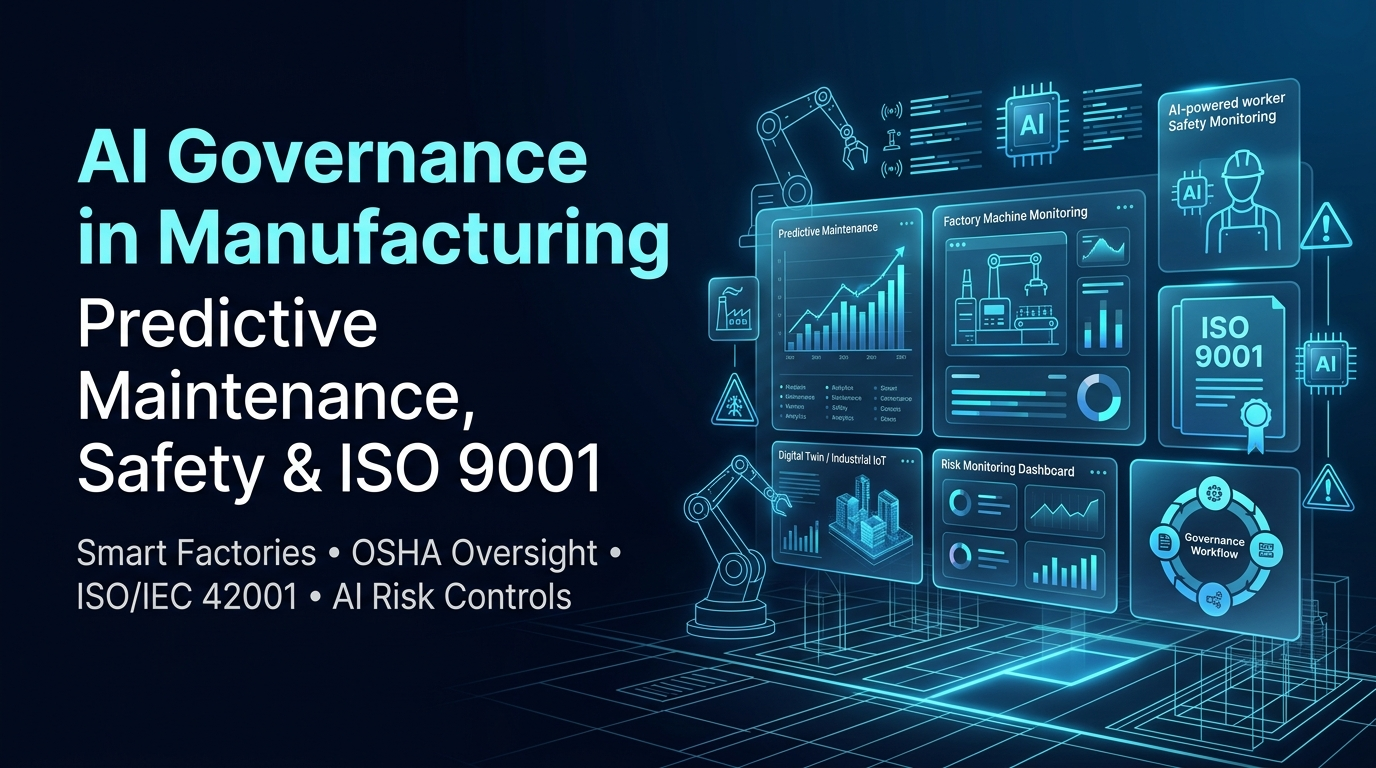
U.S. manufacturers deployed AI-driven predictive maintenance systems at nearly twice the rate of any other sector in 2024, according to Deloitte’s State of AI in Manufacturing report. That acceleration is not slowing down but the governance infrastructure to manage those systems responsibly is lagging far behind. The result: mounting liability exposure, inconsistent safety outcomes, and growing regulatory scrutiny from OSHA, the NIST AI RMF, and quality frameworks like ISO 9001.
This article maps the practical AI governance requirements specific to U.S. manufacturing covering predictive maintenance, worker safety oversight, and how ISO/IEC 42001 maps onto existing ISO 9001 quality management obligations. Whether you are a plant operations director, a compliance manager, or a quality engineer being asked to weigh in on your organization’s first AI system, this is the framework you need.
Why AI Governance Has Become a Manufacturing Priority
The manufacturing sector’s enthusiasm for AI is understandable. Predictive maintenance alone reduces unplanned downtime by an average of 30 to 50 percent, per McKinsey’s 2023 operations benchmarking data. Machine vision systems catch defect rates that human inspectors miss. Demand forecasting models cut inventory carrying costs. The ROI case is not speculative it is documented across thousands of plant implementations.
What those ROI calculations rarely factor in are the governance costs of getting AI wrong. A predictive model trained on historical sensor data that does not account for a shift in raw material suppliers can generate false-negative maintenance alerts. A computer vision safety system that performs well on day-shift conditions and degrades under nighttime lighting creates an asymmetric risk that is invisible without systematic monitoring.
The U.S. regulatory environment is also shifting. OSHA has begun referencing AI-assisted safety monitoring in its enforcement guidance. NIST released its AI Risk Management Framework (AI RMF 1.0) in January 2023, providing a voluntary but increasingly expected benchmark for responsible AI deployment. And for manufacturers already operating under ISO 9001 quality management systems, the question of how AI systems interact with existing QMS obligations has no clear, documented answer in most organizations.
That gap is where AI governance frameworks, particularly ISO/IEC 42001, come in.
Predictive Maintenance AI: The Governance Risks Most Plants Are Not Tracking
Predictive maintenance (PdM) systems operate on a seductively simple premise: feed machine sensor data into a model, and the model tells you when a component is about to fail. In practice, these systems introduce at least four governance challenges that most implementation teams do not formally document.
Model Drift and Retraining Cadence
Predictive maintenance models degrade when the conditions they were trained on change. Equipment aging, vendor substitutions, process modifications, and seasonal temperature variations all shift the statistical distribution of sensor readings. A model trained six months ago on a compressor running at 60 percent utilization will generate unreliable alerts when that compressor is now running at 85 percent due to increased demand. Governance requires defining: What is the maximum acceptable performance degradation threshold before a model must be retrained? Who owns that decision? How is the retraining audit trail documented?
Human Override and Alert Fatigue
PdM systems that generate too many low-confidence alerts create the same problem as car alarms that nobody responds to. Maintenance technicians learn to discount the system. The governance issue here is accountability: when a technician overrides a high-priority alert and a failure occurs, is the organization’s liability framework clear about decision ownership? A 2023 survey by Plant Engineering found that 61 percent of maintenance teams reported regularly overriding AI-generated alerts, yet fewer than 20 percent had a formal policy governing when overrides were acceptable.
Data Provenance and Sensor Integrity
The quality of a PdM model’s output is entirely dependent on the quality of its input data. Sensor miscalibration, data pipeline interruptions, and timestamp errors are common in plant environments and rarely treated as AI governance issues. They are treated as IT or maintenance issues. That siloing is a problem: without data governance policies that explicitly cover AI input quality, model outputs carry unknown reliability a direct ISO 9001 concern when those outputs inform maintenance decisions affecting product quality.
Third-Party Model Accountability
Most mid-sized manufacturers do not build their own PdM models they purchase them through equipment OEM software packages or industrial IoT platform vendors. This creates a vendor accountability gap. When a third-party model generates a flawed recommendation that leads to an unplanned failure or, worse, a safety incident, the plant operator is left with limited visibility into why the model behaved as it did. Effective AI governance requires contractual requirements for model documentation, performance SLAs, and incident notification obligations from all AI vendors.
Manufacturing AI and healthcare AI may operate in different environments, but both involve safety-critical systems where model failure can create real-world harm. Predictive maintenance, machine vision, clinical AI, and device monitoring all require documented controls, performance monitoring, and human escalation paths. The healthcare sector offers a useful comparison through AI governance in healthcare, where safety, privacy, and post-deployment monitoring are already tightly connected.
PdM AI Governance Gaps: Common vs. Best Practice
Governance Area | Common Practice | ISO 42001 Best Practice |
|---|---|---|
Model retraining | Ad hoc, when model ‘seems off’ | Defined performance thresholds with documented review cadence |
Override policy | Informal / technician discretion | Written policy with approval authority and audit trail |
Sensor data quality | IT/OT team responsibility only | Integrated into AI data governance policy |
Vendor model accountability | Covered by general SLA | AI-specific contractual requirements with incident protocols |
AI and Worker Safety: Governance at the Human-Machine Interface
Worker safety applications represent the highest-stakes AI use case in manufacturing and the one where governance failures carry the most direct human cost. The range of applications is broad: computer vision systems monitoring PPE compliance, proximity detection systems on autonomous mobile robots (AMRs), fatigue detection systems on forklift operators, and AI-assisted lockout/tagout verification.
Each of these systems introduces governance obligations that go beyond standard software deployment. Four are worth particular attention in the U.S. regulatory context.
OSHA Compliance Obligations for AI Safety Systems
OSHA’s General Duty Clause requires employers to provide a workplace free from recognized hazards. When an AI safety system is deployed as a primary or supplementary control, OSHA can and does scrutinize whether that system was properly validated, maintained, and monitored. Deploying a computer vision PPE detection system without documented validation against the specific work environment conditions — lighting, worker demographics, PPE variation is a governance gap that creates both safety risk and regulatory exposure.
Algorithmic Bias in Safety System Performance
Computer vision models trained predominantly on certain demographic groups show measurable performance disparities across gender, skin tone, and body size when applied to PPE detection and fatigue monitoring. A safety system that is 95 percent accurate on average but 78 percent accurate for a subset of your workforce is not acceptable from either an ethical or a legal standpoint. ISO/IEC 42001’s requirement for impact assessment directly addresses this: organizations must evaluate AI system performance across the populations it affects, not just aggregate metrics.
Human Oversight Requirements in Safety-Critical Decisions
AI systems should not be the sole decision-maker in safety-critical processes. Governance frameworks must specify the minimum human oversight required before an AI recommendation becomes a safety action. For example: an AMR proximity detection system that autonomously halts movement is a direct control. An AI system that recommends whether a repair-in-progress is safe to proceed requires a human sign-off before that recommendation becomes an action. The governance question is where the boundary sits and documenting it explicitly.
Incident Investigation and AI Root Cause Analysis
When a safety incident occurs in an AI-monitored environment, the investigation process must include AI system behavior review. Was the system active? Did it generate an alert? Was the alert acted on? This requires that AI safety systems generate structured, auditable event logs not just performance dashboards. Current OSHA injury and illness recordkeeping requirements (29 CFR 1904) do not explicitly address AI system data, but incident investigations that omit AI system behavior are increasingly viewed by OSHA inspectors as incomplete.
ISO 9001 and ISO/IEC 42001: A Practical Crosswalk for Manufacturers
Most U.S. manufacturers operating under ISO 9001 quality management systems already have the structural foundation to integrate AI governance they just have not connected the two. The clause mapping below shows where ISO/IEC 42001 obligations naturally extend existing ISO 9001 requirements, rather than adding an entirely separate management system burden.
ISO 9001 to ISO/IEC 42001 Crosswalk
ISO 9001 Clause | QMS Requirement | ISO/IEC 42001 Clause | AI Governance Extension |
|---|---|---|---|
4.1 / 4.2 | Context of the organization; interested parties | 4.1 / 4.2 | Extends to AI-specific risks, AI stakeholder expectations, regulatory context |
6.1 | Actions to address risks and opportunities | 6.1 | AI risk assessment including model performance, bias, data quality, vendor risks |
7.1.6 | Organizational knowledge | 7.2 / 8.4 | AI system documentation, model cards, training data lineage |
7.5 | Documented information | 7.5 / 8.6 | AI system logs, model validation records, override audit trails |
8.4 | Control of externally provided processes | 8.4 | AI vendor contracts with model performance SLAs and transparency requirements |
9.1 | Monitoring, measurement, analysis | 9.1 | AI system performance monitoring with defined KPIs and drift detection |
10.2 | Nonconformity and corrective action | 10.1 | AI incident investigation process including model behavior review |
The strategic implication of this crosswalk is significant: manufacturers do not need to build a parallel AI governance structure from scratch. They need to extend what they already have.
Clause 8.4 of ISO 9001, which covers control of externally provided products and services, is particularly important in this context. Many manufacturers are applying it to software vendors but have not explicitly extended it to AI model vendors. A third-party PdM model that degrades in performance without notification is an externally provided process failure one that ISO 9001 Clause 8.4 already requires you to have controls for, and that ISO/IEC 42001 specifies more precisely.
What ISO/IEC 42001 Actually Requires for Manufacturing AI Systems
ISO/IEC 42001:2023 establishes requirements for an Artificial Intelligence Management System (AIMS). For manufacturing organizations, the most operationally relevant requirements fall into four areas:
AI Policy and Scope Definition
The standard requires a documented AI policy that reflects the organization’s context and intended use of AI systems (Clause 5.2). For a manufacturer, this means explicitly scoping which AI systems are covered predictive maintenance, quality inspection vision systems, demand planning models, safety monitoring and defining the principles governing each category. An AI policy that simply states ‘we use AI responsibly’ does not meet the requirement.
AI Risk Assessment
Clause 6.1 requires a systematic AI risk assessment process. In a manufacturing context, this means evaluating risks across the full AI system lifecycle for each deployed model: training data quality and representativeness, model performance under operational conditions, failure modes and their consequences, potential for bias or discriminatory outcomes, and risks arising from human-AI interaction. The output is not a checkbox it is a documented risk register with assigned owners and treatment plans.
Impact Assessment
ISO/IEC 42001 Clause 8.4 requires an AI impact assessment before deploying AI systems in consequential contexts. For safety-related AI applications in manufacturing, this is not optional. The impact assessment should address: who is affected by the system’s decisions, what harms could result from system errors, how those harms are mitigated, and what monitoring is in place to detect harm emergence over time. This requirement directly supports the OSHA General Duty Clause analysis for AI safety applications.
Continual Improvement
Clause 10 requirements for nonconformity, corrective action, and continual improvement apply directly to AI system performance. A PdM model that generates a false negative resulting in an unplanned failure is a nonconformity. The corrective action process must include root cause analysis of the model’s behavior not just the maintenance process. This is the specific integration point where AI governance and ISO 9001 quality management reinforce each other most directly.
Building an AI Governance Program for a U.S. Manufacturing Organization
Translating framework requirements into operational reality requires a sequenced approach. The following five-phase model is designed specifically for mid-to-large U.S. manufacturers, with an existing ISO 9001 QMS as the baseline.
Phase 1: AI System Inventory
Before you can govern AI systems, you need a complete inventory of what is running. This sounds obvious. It is consistently underestimated. In a typical mid-sized manufacturer, AI-enabled capabilities are embedded in ERP systems, MES platforms, SCADA systems, condition monitoring software, quality inspection tools, and planning applications often deployed by different business units with no central register. The first governance task is building that register, with fields that capture: system name, business function, AI capability type, training data sources, vendor/developer, deployment date, current performance metrics, and risk classification.
Phase 2: Risk Classification
Not all AI systems carry the same governance burden. A demand forecasting model that is wrong by 5 percent costs money. A safety monitoring system that misses a hazard costs lives. A tiered risk classification approach mapping AI systems by their consequence severity and decision autonomy lets organizations prioritize governance resources appropriately. Safety-critical and quality-critical systems warrant full ISO/IEC 42001 compliance treatment. Lower-risk systems can operate under lighter governance controls.
Phase 3: Policy and Documentation Development
This phase produces the documented information required by ISO/IEC 42001: the AI policy, the AI risk assessment methodology, impact assessment templates for high-risk systems, model performance monitoring procedures, override and escalation protocols, and vendor AI accountability requirements. For manufacturers with a mature ISO 9001 document control system, integrating these documents into the existing structure is far more efficient than creating a parallel system.
Phase 4: Operational Controls
Governance documents that do not connect to operational behavior are compliance theater. This phase embeds AI governance controls into day-to-day operations: adding AI model performance review to maintenance planning cadences, incorporating AI impact assessment into the Management of Change (MOC) process for new AI deployments, and adding AI system behavior review to incident investigation procedures.
Phase 5: Monitoring and Audit
An AI governance program that is not monitored is not a program — it is a binder on a shelf. Clause 9.1 of ISO/IEC 42001 requires defined monitoring and measurement of the AIMS. For manufacturers, this translates to: regular model performance reviews with documented results, internal audits that include AI system governance as an audit scope item, and management review agenda items covering AI system performance and governance program effectiveness.
Aligning with NIST AI RMF: What U.S. Manufacturers Need to Know
The NIST AI Risk Management Framework is structured around four core functions: Govern, Map, Measure, and Manage. Its voluntary nature makes it less legally binding than ISO standards, but it is increasingly referenced by U.S. federal procurement requirements and is likely to become more prescriptive as federal AI policy evolves.
The practical alignment between NIST AI RMF and ISO/IEC 42001 is substantial. The Govern function maps to ISO/IEC 42001’s leadership, policy, and organizational context requirements. The Map function aligns with ISO/IEC 42001’s AI risk assessment and impact assessment requirements. Measure corresponds to performance monitoring and evaluation clauses. Manage aligns with the treatment, corrective action, and continual improvement requirements.
For U.S. manufacturers pursuing ISO/IEC 42001 certification, building a NIST AI RMF mapping document alongside the AIMS implementation costs very little additional effort and creates significant value for government contractor relationships and future regulatory alignment.
Frequently Asked Questions
1. Does ISO 9001 certification cover AI governance in manufacturing?
Not fully. ISO 9001 provides the management system structure that AI governance builds on — risk management, documented information, process control, and continual improvement but it does not specifically address AI-specific requirements like model performance monitoring, algorithmic bias assessment, or AI impact assessment. ISO/IEC 42001 fills those gaps and is designed to integrate with ISO 9001 rather than replace it.
2. What are the OSHA requirements for AI-based safety monitoring systems?
OSHA does not yet have specific regulations governing AI safety systems. However, the General Duty Clause requires employers to protect workers from recognized hazards using feasible controls. Deploying an AI safety system without proper validation, bias testing, or performance monitoring creates a recognized hazard, not a control. OSHA inspectors increasingly request AI system documentation during safety investigations at facilities using AI monitoring tools.
3. How does predictive maintenance AI governance differ from traditional equipment maintenance management?
Traditional maintenance management governs human decision-making processes. AI governance adds a layer that governs the model itself: its training data quality, performance over time, failure modes, and the rules governing human interaction with its outputs. The operational procedures are related but distinct. A technician following a maintenance schedule is accountable differently than a technician following (or overriding) an AI-generated alert.
4. Is ISO/IEC 42001 certification required for U.S. manufacturers?
Not currently, though the landscape is shifting. ISO/IEC 42001 certification is voluntary but increasingly expected in regulated industries, government contracting, and customer supply chain requirements. Several major U.S. automotive OEMs are beginning to include AI governance requirements in supplier quality audits. The certification trajectory mirrors how ISO 9001 evolved from voluntary to de facto contractual requirement across manufacturing supply chains over two decades.
5. What is an AI impact assessment and when is it required in manufacturing?
An AI impact assessment is a structured evaluation of the potential consequences of an AI system’s decisions or recommendations on individuals and processes. ISO/IEC 42001 requires it before deploying AI in consequential contexts. In manufacturing, this applies to: safety monitoring systems (consequences for workers), quality inspection AI (consequences for customers and product liability), and HR-related AI applications such as scheduling and performance monitoring (consequences for employees).
Closing Thoughts
The manufacturers who will navigate the next phase of AI adoption most successfully are not necessarily the ones deploying the most advanced models. They are the ones who treat AI systems as managed assets subject to the same rigor documentation, performance monitoring, risk assessment, accountability that they apply to any other critical production process.
Start with your AI system inventory. Every other governance action depends on knowing what you have. From there, the crosswalk between ISO 9001 and ISO/IEC 42001 makes the path forward more manageable than it might initially appear.
If your organization is preparing for ISO/IEC 42001 certification or building out an AI governance capability for the first time, GAICC’s Lead Implementer and Internal Auditor programs provide the structured training and credentials to lead that work. Explore the certification options at gaicc.org