
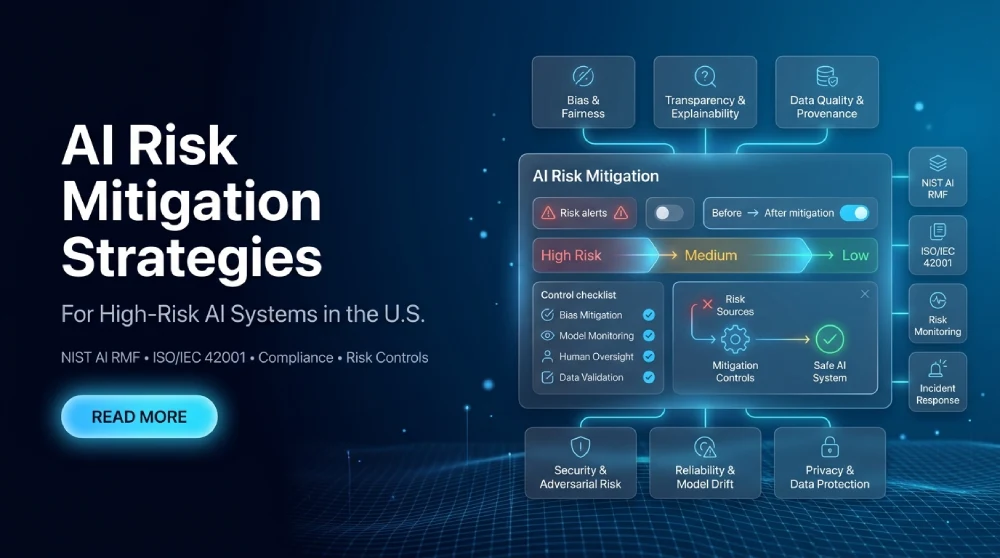
Seventy-three percent of organizations experienced at least one AI-related security incident in 2024, with average remediation costs exceeding $4.5 million per breach. That number sits uncomfortably alongside the fact that AI adoption in business-critical processes has accelerated faster than the governance structures meant to keep it in check. For US organizations deploying high-risk AI systems from automated credit decisioning to clinical diagnostic tools—the gap between capability and control is where real damage happens.
This piece lays out the risk mitigation strategies that matter most for high-risk AI systems in the current US regulatory environment. You will walk away understanding which frameworks apply, how to structure your risk management lifecycle, and where most organizations fall short in practice.
What Makes an AI System “High-Risk”
The label “high-risk” gets thrown around frequently in AI governance circles, but its meaning varies depending on the framework. Under the EU AI Act, which influences US thinking on the subject even without direct enforceability domestically, high-risk AI systems include those used in biometric identification, critical infrastructure, employment decisions, credit scoring, law enforcement, and immigration processing. The NIST AI Risk Management Framework takes a broader approach: any AI system where failure could cause significant harm to individuals, organizations, or society warrants elevated risk management.
At the state level, the Colorado AI Act—set to take effect June 30, 2026—defines high-risk AI systems as those making consequential decisions in areas like employment, education, financial services, healthcare, housing, insurance, and legal services. Colorado’s law specifically focuses on preventing algorithmic discrimination and requires both developers and deployers to exercise reasonable care.
Practical takeaway: If your AI system influences a decision that materially affects someone’s access to employment, credit, healthcare, housing, or legal outcomes, treat it as high-risk regardless of which specific regulation applies. Building your risk mitigation around the most stringent applicable standard protects you against the regulatory uncertainty that currently characterizes the US landscape.
The US Regulatory Environment in 2026: Fragmented but Accelerating
There is no single federal AI law in the United States. Federal AI governance currently comes from executive orders, agency enforcement actions under existing statutes, and voluntary frameworks like the NIST AI RMF. The Trump administration’s Executive Order of December 2025, titled “Ensuring a National Policy Framework for Artificial Intelligence,” signaled a preference for minimal federal regulation and expressed intent to preempt state laws deemed overly burdensome. A DOJ AI Litigation Task Force was established in January 2026 to challenge state AI regulations in federal court.
Meanwhile, states have not waited. In 2025 alone, 38 states adopted or enacted roughly 100 AI-related measures. Several compliance-grade laws now have effective dates in 2026:
| Law | Key Requirements | Effective Date |
|---|---|---|
| California TFAIA (SB 53) | Frontier AI risk frameworks, safety incident reporting, whistleblower protections | Jan 1, 2026 |
| Texas RAIGA | Prohibits restricted AI purposes; affirmative defenses for NIST AI RMF adherence | Jan 1, 2026 |
| Colorado AI Act | Reasonable care for high-risk AI, impact assessments, consumer disclosures | Jun 30, 2026 |
| California SB 942 | Watermarks, detection tools, AI content disclosure | Aug 2, 2026 |
| New York RAISE Act | Safety policies, risk mitigation for high-cost AI models | Jan 1, 2027 |
The federal-state tension creates genuine uncertainty. But the smart play for organizations is to build compliance programs around the strictest applicable requirements rather than betting on preemption outcomes that remain legally unresolved.
The NIST AI Risk Management Framework: Your Starting Point
Released in January 2023 and expanded significantly through 2024 and 2025 with companion playbooks, profiles, and evaluative tools, the NIST AI RMF has become the most influential voluntary AI governance framework in the US. Federal agencies, regulators, and industry bodies increasingly reference it in their compliance standards. The Texas RAIGA explicitly provides affirmative defenses for organizations adhering to the NIST AI RMF.
The framework’s structure centers on four core functions that operate as an iterative cycle:
Govern: Establish organizational policies, define risk tolerance, assign accountability, and create oversight structures that persist across the AI lifecycle. Governance is the backbone. Without visible executive sponsorship, risk prioritization fails.
Map: Identify what an AI system is, how it works, who it affects, and where things can go wrong. Most organizations now maintain AI inventories describing model purpose, data sources, risk exposure, integration points, and human-in-the-loop expectations.
Measure: Evaluate identified risks using defined metrics and assessments. This includes technical testing for accuracy, fairness audits, robustness evaluations, and impact assessments.
Manage: Apply controls to reduce or mitigate risks based on measurement results. This is where mitigation strategies translate into operational action.
The March 2025 update to the AI RMF added emphasis on model provenance, data integrity, and third-party model assessment. This matters because most organizations now rely on external or open-source AI components rather than building everything in-house. Your risk mitigation strategy needs to account for risks you inherit from your supply chain, not just risks you create.
ISO/IEC 42001: Structuring AI Risk Through a Management System
ISO/IEC 42001, published in December 2023, is the first international standard for AI Management Systems (AIMS). Where the NIST AI RMF provides a risk management framework, ISO 42001 wraps that within a formal management system structure using the Plan-Do-Check-Act methodology familiar to organizations already certified to ISO 27001 or ISO 9001.
Clause 6 of ISO 42001 requires organizations to embed risk-based thinking throughout the AI lifecycle—from design and development through deployment and ongoing monitoring. Clause 8 mandates operational controls to mitigate identified risks. Annex A provides a reference set of control objectives, while Annex C outlines the primary sources of AI system risks: environment complexity, lack of transparency, level of automation, machine learning risks, system hardware issues, and lifecycle issues.
For organizations already operating under ISO 27001, the overlap is substantial. Data governance controls, access management policies, and incident response procedures translate directly. The additional lift comes from AI-specific requirements: bias and fairness assessments, explainability documentation, and AI impact assessments for high-risk deployments.
Pursuing ISO 42001 certification is not currently mandated by US legislation. But certification is increasingly expected by international partners and serves as an affirmative demonstration of governance maturity that regulators recognize. Deloitte’s State of Generative AI in the Enterprise survey found that 35% of respondents identified errors with real-world consequences as the biggest obstacle to AI adoption—suggesting market demand for visible governance is accelerating independently of regulation.
Core Risk Mitigation Strategies for High-Risk AI Systems
Knowing the frameworks is necessary but insufficient. What separates organizations with mature AI governance from those with governance documentation gathering dust is execution. Here are the mitigation strategies that matter most for high-risk systems.
Structured Risk Assessment Across the AI Lifecycle
Risk assessment for AI is not a one-time pre-deployment exercise. The Roland Berger AI Risk Mitigation Framework identifies four categories of risk that need continuous evaluation: data risks (bias, privacy breaches, quality degradation), model risks (overfitting, lack of robustness, drift), operational risks (deployment errors, adversarial attacks, integration failures), and societal or ethical risks (discrimination, misuse of generative AI outputs).
Each risk category requires assessment along two dimensions: severity and likelihood. The product of these two factors determines priority. A risk matrix provides the structure, but the real work is in identifying risks that are specific to your deployment context rather than working from a generic checklist. An AI system screening loan applications in a predominantly rural market faces different bias risks than the same model deployed in an urban environment with different demographic distributions.
AI impact assessments (AIIAs) complement baseline risk assessments by focusing on societal, ethical, and legal impacts. ISO 42001 calls for AIIAs specifically in situations where the AI system poses high potential impact to individuals, groups, or society. The output should be a documented report of identified risks, their severity, and a plan for mitigation, oversight, and monitoring.
Human Oversight and Intervention Protocols
The degree of human oversight required scales directly with the risk level of the AI system. For high-risk systems, this means more than having a person nominally “in the loop.” Effective human oversight requires that the human reviewer has sufficient training and context to meaningfully evaluate the AI’s output, the authority and mechanism to override or halt the system, enough time to exercise that judgment without pressure to simply rubber-stamp decisions, and access to information about the AI’s confidence level and reasoning.
Approval workflows should match your risk tolerance. Low-risk models—like internal productivity tools—may need only a quick review. Customer-facing or decision-making systems require full validation before deployment and ongoing oversight during operation. The Colorado AI Act specifically requires deployers to provide meaningful opportunities for consumers to correct errors and appeal adverse decisions made by high-risk AI systems.
Bias Detection and Fairness Assurance
Over 70% of companies admit they are unprepared for incoming AI regulations related to bias and fairness. That statistic reflects a gap between awareness and action. Bias in AI systems can stem from training data that reflects historical inequities, algorithmic design choices that amplify disparities, or deployment contexts where a model trained on one population is applied to another.
Mitigation requires a multi-layered approach. Pre-deployment, this includes auditing training data for representational bias, applying fairness constraints during model training (techniques like sample reweighting can ensure underrepresented groups have fair influence on the model), and conducting disparate impact analysis across protected categories. Post-deployment, regular fairness audits, explainability reports, and immutable audit trails demonstrate due diligence. Tools like IBM’s AI Fairness 360 and the Aequitas bias audit toolkit provide structured approaches to measuring and remediating bias.
NYC’s Local Law 144 already requires employers using automated employment decision systems to conduct annual bias audits and publish results. This model of mandatory external auditing is likely to expand to other jurisdictions and use cases.
Transparency, Explainability, and Documentation
Transparency operates at two levels. The first is organizational: stakeholders need to understand that AI is being used, what decisions it influences, and how those decisions are made. The Colorado AI Act requires deployers to disclose to consumers when high-risk AI is being used to make consequential decisions about them. California’s AI Transparency Act (SB 942) mandates disclosure when content is AI-generated.
The second level is technical explainability: the ability to articulate why a specific AI system produced a specific output for a specific input. For high-risk systems—particularly those affecting creditworthiness, employment, or healthcare—the ability to explain individual decisions is both a regulatory expectation and a practical necessity for appeal and correction processes.
Documentation ties both levels together. ISO 42001 requires comprehensive documentation of AI system design, training data, validation results, deployment conditions, and monitoring outputs. The NIST AI RMF emphasizes that documentation must be maintained throughout the AI lifecycle, not just created at deployment. Organizations with mature AI governance frameworks report 23% faster time-to-market for AI initiatives—partly because thorough documentation reduces rework and accelerates audit readiness.
Continuous Monitoring and Model Governance
AI systems are not static. Models drift. Data distributions shift. Threat landscapes evolve. A model that was fair and accurate at deployment can degrade along both dimensions within months. Continuous monitoring addresses this by tracking model performance, data quality, and security indicators in real time.
Key monitoring metrics for high-risk systems include prediction accuracy across demographic subgroups (not just aggregate accuracy), input data distribution shift relative to training data, output confidence calibration, latency and availability for time-critical applications, and anomaly detection for potential adversarial inputs or data poisoning.
Model governance complements monitoring by establishing version control, change management procedures, and rollback capabilities. Treat AI models with the same discipline you apply to any production software: version them, test outputs regularly, document their behavior, and track usage across the organization. The NIST Cyber AI Profile, released in preliminary draft in December 2025, specifically addresses securing AI systems within broader cybersecurity programs and provides a useful structure for integrating AI monitoring into existing security operations.
Cybersecurity for AI Systems
AI systems face threat vectors that traditional cybersecurity frameworks were not designed to address. Prompt injection attacks target generative AI systems by crafting inputs that cause the model to ignore its instructions or leak sensitive data. Data poisoning attacks corrupt training data to manipulate model behavior. Model theft involves extracting proprietary model weights through systematic querying. Adversarial examples exploit the gap between how AI models and humans perceive inputs.
NIST’s publication AI 100-2, Adversarial Machine Learning: A Taxonomy and Terminology of Attacks and Mitigations, catalogs these threats and corresponding defenses. At the operational level, mitigation requires applying least-privilege access policies around data stores and model endpoints, implementing input sanitization and adversarial testing within the CI/CD pipeline, establishing runtime protection with automated alerting for anomalous behavior, and maintaining secret scanning and credential management for API keys and model access tokens.
NIST is also developing SP 800-53 control overlays specifically for AI systems, adapting existing security controls to address AI-specific concerns like model integrity, data provenance, and adversarial robustness. When finalized, these overlays will provide a direct mapping between established security control frameworks and AI-specific requirements.
Building an AI Risk Management Program: A Phased Approach
Most organizations build an AI risk management program in stages over months or a few years. Trying to implement everything simultaneously leads to governance structures that exist on paper but not in practice. A phased approach aligns investment with organizational readiness.
Phase 1: Discovery and Foundation (Months 1–3)
Run an AI maturity assessment. Document every AI system in use. Form a governance committee with executive sponsorship and cross-functional leads from legal, compliance, IT security, and business operations. Define risk tolerance. Decide which risks your organization will accept and which require mitigation. Establish your AI inventory as a living document.
Phase 2: Framework Alignment and Control Design (Months 3–6)
Map your AI systems against the NIST AI RMF functions. Classify systems by risk level. Design controls for high-risk systems, including human oversight protocols, bias testing schedules, documentation requirements, and monitoring dashboards. If pursuing ISO 42001 certification, conduct a gap assessment against the standard’s requirements.
Phase 3: Implementation and Testing (Months 6–12)
Deploy controls across priority AI systems. Conduct initial bias audits and impact assessments. Test incident response procedures for AI-specific scenarios (model failure, data breach affecting training data, adversarial attack). Train relevant staff on new procedures and escalation paths.
Phase 4: Continuous Improvement (Ongoing)
Establish regular review cycles. Update risk assessments as models change, new regulations take effect, or new threat intelligence emerges. Conduct periodic internal audits. Refine controls based on operational experience. Track regulatory developments and adjust compliance posture accordingly.
Where Most Organizations Fall Short
While 87% of executives claim to have AI governance frameworks, fewer than 25% have fully operationalized their enterprise governance. That gap is not accidental. Several patterns explain why governance programs stall.
The most common failure is treating risk management as a pre-deployment checkbox rather than a continuous process. AI systems evolve after deployment through continuous learning, real-world feedback, and interactions with dynamic environments. A risk assessment completed six months ago has limited relevance to a model that has been retrained twice since then.
Second, organizations often manage AI risk in isolation from broader enterprise risk management. The NIST AI RMF explicitly states that AI risks cannot be managed in isolation and must be integrated into broader enterprise-wide risk management practices, including privacy and cybersecurity. An AI governance program that operates as a separate silo from your existing GRC infrastructure creates gaps and redundancies simultaneously.
Third, there is a persistent tendency to focus on the AI model itself while neglecting the data pipeline, deployment context, and human processes surrounding it. A technically sound model deployed without adequate human oversight, in a context the model was not designed for, or with data that has drifted significantly from training conditions, is still a high-risk system regardless of its test-bench performance.
Bringing It Together
AI risk mitigation for high-risk systems is not a single action but a continuous practice. The frameworks exist: the NIST AI RMF provides the risk management structure, ISO 42001 provides the management system, and state laws provide the compliance floor. The challenge is not knowing what to do but actually doing it—consistently, across every AI system your organization operates.
Start with your AI inventory. Classify your systems by risk level. Align your governance to the NIST AI RMF’s four functions. Build from there, one phase at a time. The organizations that manage AI risk well are not the ones with the most elaborate governance documents. They are the ones that have embedded risk thinking into how they build, deploy, and monitor AI systems every day.
GAICC’s ISO/IEC 42001 Lead Implementer training program provides the structured expertise to build and operationalize an AI Management System that meets these standards. If your organization is ready to move from governance aspiration to governance practice, that’s a strong place to begin.
Frequently Asked Questions (FAQs)
1. Is AI risk management legally required for US organizations?
No single federal law mandates it. However, state laws like the Colorado AI Act impose specific obligations on developers and deployers of high-risk AI systems, and existing federal statutes (enforced by agencies like the EEOC, FTC, and CFPB) apply to AI-mediated decisions. The NIST AI RMF is voluntary but increasingly referenced by regulators and provides affirmative defenses under some state laws.
2. What is the difference between the NIST AI RMF and ISO 42001?
The NIST AI RMF is a risk management framework organized around four functions: Govern, Map, Measure, and Manage. ISO 42001 is a management system standard that encompasses risk management within a broader organizational governance structure using Plan-Do-Check-Act. Organizations often use both: the NIST AI RMF for risk-specific activities and ISO 42001 for the overarching management system.
3. How does the Trump administration’s executive order affect state AI regulations?
The December 2025 Executive Order signals federal intent to preempt state AI laws deemed overly burdensome, but it does not itself repeal or invalidate any state law. The DOJ AI Litigation Task Force can challenge state laws in court, and the Commerce Department’s evaluation (due March 2026) will identify specific laws considered problematic. Until courts rule on preemption questions, state laws remain enforceable.
4. What should organizations prioritize first in AI risk mitigation?
Start with an AI inventory. You cannot manage risks you have not identified. Document every AI system in use, classify each by risk level, and establish governance accountability. This foundation enables all subsequent risk mitigation activities and is a prerequisite for compliance with virtually every AI governance framework.
5. How often should AI risk assessments be updated?
For high-risk systems, risk assessments should be reviewed at minimum quarterly, and updated whenever the model is retrained, the deployment context changes, new regulations take effect, or monitoring reveals performance degradation or unexpected behavior. Continuous monitoring systems should trigger ad hoc reassessment when predefined thresholds are crossed.
6. Does ISO 42001 certification guarantee regulatory compliance?
Certification demonstrates governance maturity and provides a strong foundation for compliance, but it does not guarantee compliance with every regulation in every jurisdiction. ISO 42001 aligns with the NIST AI RMF, supports EU AI Act conformity, and addresses many requirements in state-level AI laws. Organizations should map certification controls against specific regulatory obligations to identify any gaps.