
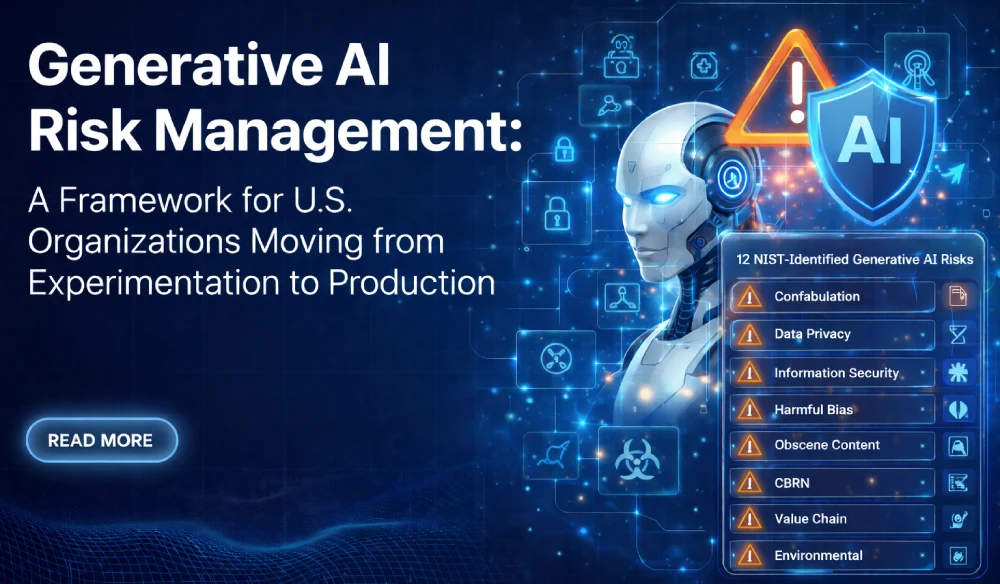
78% of companies use generative AI. Only 19% have governance frameworks. NIST identified 12 risk categories unique to generative systems. Here is how to close the gap between adoption and oversight.
The governance gap: 78% of companies use generative AI (McKinsey). 58% have enterprise-wide AI strategies, up from 26% (Info-Tech 2026). Only 19% have fully implemented governance frameworks. Fewer than 1 in 4 regularly measure AI risk maturity. 63% report skill gaps in AI governance and data literacy.
McKinsey reports that 78% of companies now use generative AI in at least one business function. Info-Tech’s Future of IT 2026 survey found that 58% of organizations have embedded AI within enterprise-wide strategies, up from 26% the prior year. But the governance gap is stark: only 19% have fully implemented AI governance frameworks, and fewer than one in four regularly measure AI risk maturity. NIST recognized the distinctive risk profile of generative AI by publishing AI 600-1, a dedicated Generative AI Profile identifying 12 risk categories that do not exist or are substantially amplified in generative systems compared to traditional AI. The challenge is specific: generative AI systems produce outputs that are non-deterministic, statistically plausible rather than factually guaranteed, and vulnerable to manipulation through natural language. Managing these risks requires controls designed for this technology, not controls borrowed from traditional software or even traditional machine learning.
What Makes Generative AI Risk Fundamentally Different
Traditional AI models are trained for specific, bounded tasks: classifying images, predicting churn, scoring credit. Their outputs are constrained by the problem definition. A credit scoring model produces a number within a defined range. Testing is structured, and failure modes are largely predictable.
Generative AI operates in an open-ended output space. A large language model can produce text on any topic, in any format, with any degree of accuracy or fabrication. The same prompt can yield different outputs across runs. The model’s behavior is shaped not just by training data, but by conversational context, system prompts, retrieved documents, and user inputs.
MIT Sloan researchers recently identified two distinct categories of generative AI risk. Embedded risks are inherent to the technology: training data quality, model behavior, and performance drift from vendor updates. They are not fully within your control. Enacted risks come from your deployment choices: system prompt design, safeguard implementation, permission structures, and agent configuration.
This distinction determines who can mitigate what. Embedded risks require vendor assessment and contractual controls. Enacted risks require internal governance, testing, and operational procedures. A complete program must address both.
The 12 NIST-Identified Generative AI Risk Categories
NIST AI 600-1, released July 2024, catalogs 12 risk categories with over 200 specific suggested actions. These map to the Govern, Map, Measure, and Manage functions of the AI RMF and provide the most authoritative U.S. framework for generative AI risk management.
| # | Risk Category | Description | Framework Mapping |
|---|---|---|---|
| 1 | Confabulation | Generating false content with confident presentation. Inherent to statistical prediction. | NIST Measure 2.5, 2.6. ISO 42001 C.2.2 |
| 2 | Data Privacy | Memorization, inference, and leakage of personal information from training data or prompts. | NIST Measure 2.10. ISO 42001 C.2.8 |
| 3 | Information Security | Prompt injection, data poisoning, model extraction, AI-specific attack surfaces. | NIST Measure 2.7. ISO 42001 C.2.10 |
| 4 | Information Integrity | Deepfakes, synthetic media, AI-generated disinformation at scale. | NIST Measure 2.5. ISO 42001 C.2.3 |
| 5 | Intellectual Property | Training data memorization reproducing copyrighted material. Content similar to protected works. | NIST Govern 1.1. ISO 42001 C.2.9 |
| 6 | Harmful Bias / Homogenization | Systematic unfair outcomes. Output convergence on dominant perspectives, reducing diversity. | NIST Measure 2.11. ISO 42001 C.2.5 |
| 7 | CBRN Information | Facilitating access to chemical, biological, radiological, or nuclear threat information. | NIST Measure 2.7. ISO 42001 C.2.10 |
| 8 | Value Chain / Components | Unvetted third-party datasets, models, APIs. Supply chain risks cascading downstream. | NIST Govern 1.6. ISO 42001 Clause 8.1 |
| 9 | Human-AI Configuration | Misconfiguration causing unintended behavior. Automation bias. Inadequate oversight. | NIST Measure 3.3. ISO 42001 C.2.6 |
| 10 | Environmental | Significant computing resources and carbon emissions from training and deployment. | NIST Govern 1.1. ISO 42001 C.2.7 |
| 11 | Obscene / Abusive Content | Violence, hate speech, stereotyping despite safety alignment. | NIST Measure 2.5. ISO 42001 C.2.4 |
| 12 | Dangerous Recommendations | Outputs inciting or instructing violence or dangerous activities. | NIST Measure 2.5. ISO 42001 C.2.4 |
Confabulation: The Risk That Defines Generative AI
Confabulation is not a bug to be fixed. It is an inherent characteristic of how generative models work. LLMs predict the next token based on statistical patterns. This can produce factually accurate outputs, but it can also produce fabrications presented with total confidence. NIST AI 600-1 specifically notes that confabulations are a natural result of how generative models are designed.
The risk compounds in professional contexts. A confabulated legal citation looks identical to a real one. A fabricated dosage appears no different from an accurate one. Research has shown that legal confabulations are pervasive in current LLMs. Users act on these outputs because the presentation provides no signal about accuracy.
Three approaches reduce confabulation risk. Retrieval-Augmented Generation (RAG) grounds outputs in verified knowledge bases. Structured output validation compares claims against authoritative sources. Human-in-the-loop review requires domain experts to verify outputs before action. None eliminates confabulation entirely. Risk management must account for a residual rate and design controls proportional to the consequence of inaccuracy.
Prompt Injection and Information Security
OWASP’s #1 LLM risk. Generative AI introduces an attack surface that operates through language, invisible to traditional security tools. Direct injection embeds override commands in user inputs. Indirect injection hides instructions in documents or web content processed through RAG.
Prompt obfuscation compounds the problem: Base64 encoding, Unicode homoglyphs, multi-turn erosion strategies. Cisco’s State of AI Security 2026 found open-weight models remain susceptible to jailbreaks over longer conversations.
Defenses operate in layers: input filtering for injection patterns, output filtering for data leakage, least-privilege architecture limiting model access, and regular adversarial testing. NIST Measure 2.7 requires security and resilience evaluation. ISO 42001 Annex C C.2.10 addresses security as an AI-specific objective.
Data Privacy: What Generative AI Remembers, Infers, and Leaks
NIST AI 600-1 identifies three privacy mechanisms. Data memorization: models retain specific data points from training, including PII from few training samples. Data inference: models correctly deduce sensitive information not in training data by connecting disparate sources. Prompt leakage: user inputs containing sensitive data are exposed to the model provider.
Samsung’s incident illustrates the operational risk: engineers pasted proprietary semiconductor designs into ChatGPT across three separate incidents. Privacy controls span data minimization training, retention policies, administrative opt-out configuration, and differential privacy during training.
Harmful Bias and Homogenization
Generative AI adds a dimension beyond traditional bias. Homogenization occurs when outputs converge on dominant perspectives from training data, reducing diversity of thought across all outputs. A biased generative model drafting job descriptions, customer communications, or legal summaries affects every user and every downstream recipient.
Pre-deployment: test across demographic groups and contexts. Measure fairness metrics. Document baselines and known failures. Post-deployment: monitor output distributions for disparities. Track fairness drift. Implement feedback mechanisms. ISO 42001 C.2.5 and NIST Measure 2.11 require regular bias evaluation.
Embedded vs. Enacted risks (MIT Sloan): Embedded risks originate in the foundation model. Govern them through vendor assessment, contractual controls, and monitoring vendor updates. Enacted risks originate in your deployment choices. Govern them through system prompt engineering, safeguard implementation, permission architecture, and human oversight design. A complete program addresses both tracks.
The U.S. Regulatory Landscape for Generative AI Risk
NIST AI 600-1. 12 risk categories, 200+ actions. Maps to AI RMF Govern/Map/Measure/Manage. The 2025 Cyber AI Profile (IR 8596) bridges AI risk with Cybersecurity Framework 2.0.
ISO/IEC 42001:2023. First international certifiable AI management system standard. Annex C maps to generative AI risks. Enterprise customers are beginning to require ISO 42001 certification from AI vendors.
Colorado AI Act (SB 24-205). Effective February 2026. High-risk AI deployers must implement risk management, impact assessments, and consumer disclosures for housing, employment, and lending decisions.
California AB 2013. Effective January 2026. Generative AI developers must publish training data summaries disclosing copyrighted material, PII, or synthetic data. SB 942 requires AI content labeling.
Executive Order framework. EO 14110 (Oct 2023) established reporting requirements. January 2025 rescission rolled back provisions. December 2025 order seeks a national framework to prevent state fragmentation.
Sector regulators. FTC Operation AI Comply targeted deceptive AI marketing. SEC 2026 priorities include AI washing. CFPB requires explainable adverse action notices. Italy fined OpenAI 15M euros for training data practices.
Building a Generative AI Risk Management Program
- Inventory every generative AI instance. Include shadow AI (personal accounts used for work). Document model, provider, data accessed, deployment context, and decision impact. Info-Tech found 58% have enterprise strategies but inventory gaps persist because adoption outpaces approval.
- Classify by risk tier. A customer-facing chatbot making product claims operates at a different level than an internal meeting summarizer. ISO 42001 Clause 8.4 requires impact assessments.
- Map to the NIST 12-risk framework. Assess each high-risk use case against all 12 categories. Not every risk applies to every deployment. A summarization tool faces confabulation and IP risk but low CBRN risk. This mapping drives proportional control selection.
- Implement technical controls. Input/output filtering for injection and leakage. RAG for factual grounding. Content moderation for harmful outputs. Monitoring for confabulation rates, bias drift, and security anomalies. API rate-limiting and full interaction logging.
- Design human oversight workflows. Define which outputs need review and how review is structured. Meaningful oversight requires domain-knowledgeable reviewers with verification tools and genuine override authority. Pro-forma review provides no risk reduction.
- Establish governance structures. ISO 42001 Clause 5.3 requires clear AI governance authority. Assign model owners. Build approval workflows matching depth to risk tier.
- Implement vendor governance for embedded risks. Assess foundation model providers. Require contractual provisions for change notification, bias evidence, and incident reporting. Monitor vendor updates for impact on your use cases.
- Formalize through ISO/IEC 42001 certification. The standard covers all 12 NIST risk categories through Annex A controls and Annex C risk sources. Certification demonstrates governance maturity and integrates with ISO 27001.
Common Mistakes in Generative AI Risk Management
Applying traditional ML governance to generative AI. SR 11-7 was designed for predictive models with bounded outputs and testable metrics. Generative AI has unbounded output spaces and emergent capabilities. NIST AI 600-1 exists because existing frameworks were insufficient.
Blocking instead of governing. Prohibition drives shadow AI. When employees cannot access approved tools, they use personal accounts, creating data exposure with zero visibility. Governance with approved tools and controls beats a ban.
Testing only before deployment. Generative AI behavior changes through vendor updates, input distribution shifts, and environmental changes. ISO 42001 Clause 9.1 requires ongoing monitoring.
Treating confabulation as solvable. Rates can be reduced. They cannot be eliminated. Risk management must design controls proportional to the consequence of inaccuracy in each use case.
Ignoring embedded vs. enacted risk distinction. Focusing only on deployment choices misses foundation model risks. Blaming the vendor for everything misses risks from poor configuration and inappropriate use case selection.
Generative AI Risk Management Is the Price of Admission
Info-Tech’s 2026 report stated it directly: risk management will be the price of admission for AI. The 68% building formal frameworks are responding to a reality where generative AI is no longer experimental. The 19% with full governance have a structural advantage over the 81% still operating without it.
The clearest starting point: apply the NIST AI 600-1 twelve-risk assessment to your highest-risk generative AI deployment. That single exercise surfaces the specific risks, control gaps, and governance decisions your organization needs to address.
GAICC offers ISO/IEC 42001 Lead Implementer training that covers generative AI risk categories, the NIST 600-1 framework alignment, and the management system structures needed to govern AI systems from experimentation through production. Explore the program to build your organization’s generative AI governance capability.
Frequently Asked Questions (FAQs)
1. What is generative AI risk management?
The structured process of identifying, assessing, and mitigating risks specific to generative AI: confabulation, prompt injection, data memorization, IP infringement, content safety, and non-deterministic outputs. NIST AI 600-1 provides the U.S. framework with 12 identified risk categories.
2. What are the 12 NIST generative AI risk categories?
Confabulation, data privacy, information security, information integrity, intellectual property, harmful bias/homogenization, CBRN information, value chain/components, human-AI configuration, environmental, obscene/abusive content, and dangerous recommendations. Each maps to actions in the AI RMF.
3. What is the difference between embedded and enacted risk?
Embedded risks are inherent to the foundation model (training data, model behavior, vendor updates) and not fully in your control. Enacted risks come from your deployment choices (prompts, safeguards, permissions). Both need different governance approaches.
4. How does ISO 42001 apply to generative AI?
Provides the certifiable management system. Annex C risk sources map to GenAI risks. Annex A provides controls. Clauses 8.2 and 9.1 require ongoing evaluation. Integrates with ISO 27001 and complements NIST AI 600-1.
5. Is NIST AI 600-1 mandatory?
No, it’s voluntary. But the FTC, CFPB, SEC, and other regulators reference NIST principles. Federal procurement expects alignment. Enterprise customers use it as a governance maturity benchmark.
6. Can confabulation be eliminated?
No. It’s inherent to statistical prediction. RAG, structured prompting, and output validation reduce rates but cannot eliminate them. Controls must be proportional to consequences of inaccuracy in each use case.
7. What U.S. regulations apply to generative AI in 2026?
Colorado AI Act (Feb 2026), California AB 2013 (Jan 2026), SB 942 content labeling, FTC Section 5, SEC AI washing, CFPB explainability, HIPAA, and state privacy laws. The Dec 2025 executive order seeks a national framework.