
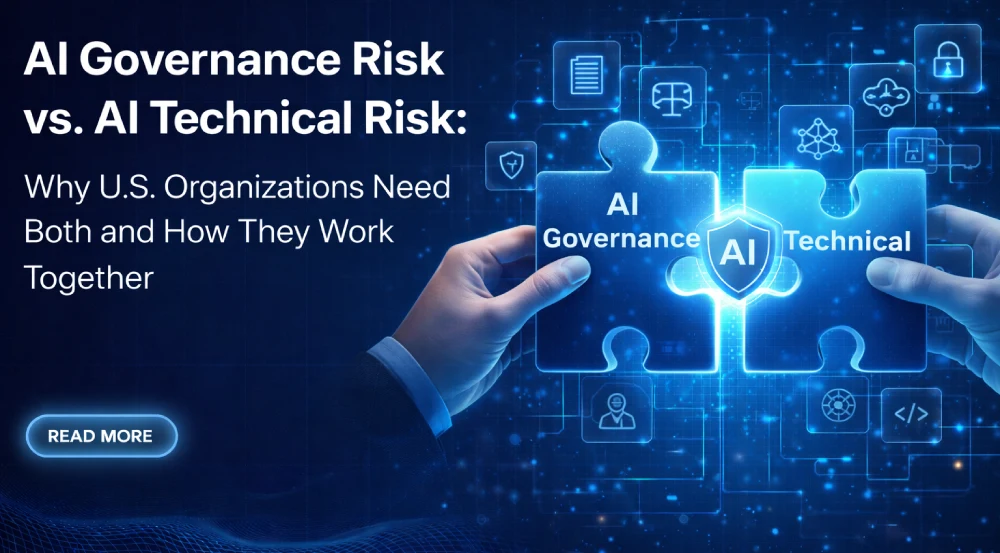
48% predict governance failures will trigger the next AI breach. Only 6% have complete visibility into AI usage. Technical controls without governance have no authority. Governance without technical capability has no teeth. Here is how to integrate both.
The dual gap: 48% predict governance failures (shadow AI, over-permissive access) will trigger the next major AI breach. Only 6% have complete visibility into AI usage. 94% make AI security decisions with incomplete information. 19% have fully implemented governance frameworks. 63% report skill gaps in AI governance. (Netskope 2026, Info-Tech 2026)
The 2026 Netskope AI Risk and Readiness Report found that 48% of cybersecurity professionals predict governance failures will trigger the next major AI breach. Only 6% report complete visibility into AI usage. ISACA’s 2026 guidance states that AI outcomes must not be treated as the responsibility of algorithms, vendors, or technical specialists alone. These data points capture the central tension: technical teams focus on model security, data integrity, and performance. Governance teams focus on policy, accountability, and compliance. When they operate in isolation, organizations that solve technical problems without governance cannot prove their controls work, and organizations with governance frameworks but no technical implementation have policies that exist on paper but not in practice. ISO/IEC 42001 and the NIST AI RMF were designed to bridge this gap.
Defining the Two Risk Categories
AI Technical Risk
Threats from the AI system itself: architecture, data, algorithms, deployment environment, and operational behavior. Requires technical expertise to identify and mitigate.
Model performance risk. Inaccurate, biased, or unreliable outputs. Confabulation in GenAI, prediction errors, statistical bias. NIST Measure 2.5 and 2.6.
Data risk. Biased, incomplete, stale, or contaminated training data. Poisoning, drift, privacy violations through memorization or inference. ISO 42001 Annex B.
Security risk. Prompt injection, model extraction, evasion, jailbreaking, supply chain compromise. OWASP LLM Top 10. NIST Measure 2.7.
Drift and degradation. Performance changes as distributions shift. Silent worsening without monitoring. ISO 42001 Clause 9.1.
Explainability risk. Decision logic that cannot be understood, audited, or communicated. NIST Measure 2.5.
Integration risk. Unintended behaviors from AI interacting with other systems, APIs, and workflows. Compounded by agentic autonomy.
AI Governance Risk
Organizational, procedural, and institutional failures allowing AI to operate outside acceptable boundaries. Requires leadership and organizational design.
Accountability gaps. No clear owner for AI outcomes. Delayed incident response because responsibility is diffused. ISO 42001 Clause 5.3.
Policy absence. 93% acknowledge AI risks, only 19% have governance frameworks (Info-Tech). Without policy, every team negotiates risk independently.
Shadow AI. 75% of workers use GenAI, 78% bring their own tools (Microsoft/LinkedIn). 88% of organizations cannot distinguish personal from corporate AI accounts (Netskope). Data exposure with zero oversight.
Regulatory non-compliance. CFPB, EEOC, Colorado AI Act, California AB 2013, sector regulators. Deloitte found compliance is the top GenAI concern.
Vendor governance failure. Third-party AI without due diligence. Legal accountability stays with the deployer (Cleary Gottlieb). 30% of breaches involve third parties (Verizon DBIR).
Documentation gaps. Cannot demonstrate what systems exist, how they decide, or what controls are in place. Every regulatory inquiry becomes a crisis.
Skills deficit. 63% report governance skill gaps. Only 28% have training programs (Info-Tech). Governance without capability is performative.
Side-by-Side Comparison
| Dimension | AI Technical Risk | AI Governance Risk |
|---|---|---|
| Nature | Threats from the system: model behavior, data quality, security, drift | Organizational failures: absent policies, unclear ownership, compliance gaps, shadow AI |
| Owned by | Data science, ML engineering, security teams | Executive leadership, legal, compliance, risk management, boards |
| Detected through | Technical monitoring: model metrics, drift detection, adversarial testing | Governance assessment: policy reviews, compliance audits, inventory gaps |
| Mitigated through | Technical controls: filters, RAG, bias testing, red-teaming, access controls | Organizational controls: policies, approval workflows, roles, training, documentation |
| Framework ref | NIST Map, Measure. ISO 42001 Annex A/B. OWASP, MITRE ATLAS | NIST Govern, Manage. ISO 42001 Clauses 4-7, 10. ISACA RP-AI |
| Failure mode | Wrong, biased, or manipulated outputs. System compromised. Performance degrades. | Controls exist but nobody ensures they’re applied, monitored, or maintained |
| Example | Credit model develops bias through drift, undetected for 6 months | No policy requiring drift monitoring, no owner, no escalation process |
The Failure Multiplier: How They Interact
Technical and governance risk multiply each other. Strong technical controls with weak governance: excellent bias detection that nobody acts on. Strong governance with weak technical: fairness mandates nobody can execute.
Bias: Technical teams measure bias. But choosing the fairness metric, demographic groups, acceptable threshold, and remediation process are governance decisions. Without governance, bias reports go unread. Without capability, mandates go unexecuted.
Security: Teams deploy filters and red-team (technical). But which systems need testing, how often, what risk threshold, who approves deployment are governance. Netskope found only 9% can stop an agent before a harmful action completes. A technical gap driven by a governance gap.
Drift: Scientists implement detection (technical). But retraining triggers, authorization, response speed, and handling of decisions made during drift are governance.
Explainability: Engineers implement SHAP or LIME (technical). But which models need what explainability, for which audiences, validated how, are governance. The CFPB requires specific reasons, not just any explanation.
Shadow AI: IT detects unauthorized usage (technical). But defining authorized vs. unauthorized, consequences, and providing approved alternatives are governance. Blocking without governing drives usage underground.
The integration principle: SANS 2025 stated the architecture directly: technical controls, governance, and risk-based decision-making must complement each other. ISO 42001 and NIST AI RMF were designed as integrated systems, not separate workstreams for separate teams.
How ISO 42001 and NIST AI RMF Integrate Both
NIST AI RMF: Four Functions
Govern is entirely governance: policies, roles, risk appetite, executive accountability. Map bridges both: organizational context (governance) and technical architecture (technical). Measure is primarily technical: bias testing, accuracy evaluation, security assessment. But what to measure and what thresholds to accept are governance. Manage spans both: technical treatments and organizational processes for escalation, documentation, and improvement.
ISO/IEC 42001: Integrated Architecture
Clauses 4-7: governance infrastructure (context, leadership, policy, planning, support). Clause 8: translates governance into technical implementation (risk assessment 8.2, treatment 8.3, impact assessment 8.4). Clause 9: the feedback loop where technical monitoring informs governance, and governance reviews trigger technical actions (monitoring 9.1, audit 9.2, management review 9.3). Clause 10: when technical monitoring detects a problem, governance determines response, assigns responsibility, and verifies resolution. Annex A: controls spanning both (A.2-A.4 governance, A.5-A.7 technical, A.8-A.10 integrated). Annex C: risk sources including governance (C.2.1 accountability, C.2.6 oversight) and technical (C.2.2 reliability, C.2.5 bias, C.2.10 security) as one landscape.
The Maturity Gap
Most organizations have invested more in technical AI capabilities than governance. Info-Tech: 58% have enterprise AI strategies and 54% use GenAI in development, but only 19% have governance and fewer than 25% have agent monitoring. Netskope: 45% have only partial visibility, 35% see only network patterns, 14% have none. More than a third report fragmented adoption with no shared framework.
ISACA recommends integrating AI governance into existing frameworks (COBIT, ERM, internal controls) rather than creating parallel structures. The maturity path: Level 1 (Ad hoc: shadow AI, invisible governance), Level 2 (Defined: centralized policy, AI council), Level 3 (Managed: automated monitoring, risk-based workflows), Level 4 (Optimized: embedded and continuous, enabling agentic workflows).
Building an Integrated Program
- Establish governance infrastructure first. AI policy, cross-functional governance committee, model owners, risk appetite. ISO 42001 Clauses 5-6. ISACA: business leaders must retain accountability.
- Inventory all AI systems. Include shadow AI. 94% operate with incomplete visibility. ISO 42001 Clause 4.3. You cannot govern or secure what you cannot see.
- Classify by risk tier. ISO 42001 Clause 8.4 impact assessments. High-risk: full governance + technical controls. Medium: standard governance + targeted monitoring. Low: policy compliance + documentation.
- Implement technical controls proportional to tier. Bias testing, drift monitoring, security testing, explainability, input/output filtering. NIST Measure function methodology. Align to governance policy requirements.
- Build the governance-technical feedback loop. Technical monitoring reports to governance. Drift detection triggers governance review. Bias findings go to accountability owners. ISO 42001 Clause 9 creates this through monitoring, audit, management review.
- Document everything. Model cards, risk assessments, control implementations, monitoring results, incident records, decision rationale. Serves both governance (audit trail) and technical (system of record) purposes.
- Train across disciplines. Technical teams need governance literacy. Governance teams need technical literacy. ISO/IEC 42001 Lead Implementer training bridges both domains.
- Formalize through ISO 42001 certification. The only certifiable standard integrating governance (Clauses 4-7, 10) with technical requirements (Clause 8, Annexes A/B) and risk assessment (Annex C).
Common Mistakes
Treating governance as a technical team’s job. When delegated entirely to data science or IT: technically sound controls with no authority, no regulatory alignment, no executive accountability. ISACA: AI outcomes must not be the responsibility of algorithms or technical specialists alone.
Building governance without technical implementation. A bias testing mandate means nothing without tools, methodology, and expertise. Governance outpacing capability produces documentation, not risk reduction.
Solving one category while ignoring the other. Strong security but no AI policy: locks on doors nobody monitors. Comprehensive policies but no monitoring: rules on paper, not in practice.
Creating a separate governance silo. ISACA recommends integration into existing ERM and internal controls. Separate AI governance duplicates effort and struggles for authority.
Assuming technical controls eliminate governance risk. 48% predict governance failures will trigger the next breach. Controls can be in place and still fail if nobody monitors, updates, or acts on alerts.
Neither Alone Is Sufficient. Together They Are the Standard.
SANS stated the architecture: technical controls, governance, and risk-based decision-making must complement each other. Organizations treating AI risk as purely technical will face accountability for governance failures from the SEC, CFPB, and FTC. Organizations treating it as purely governance will have policies that fail to prevent the incidents governance was supposed to address.
The practical first step: map your technical controls (what is deployed) against your governance infrastructure (who is accountable, what policies exist, what processes enforce compliance). The gaps between those two maps define your integrated roadmap.
GAICC offers ISO/IEC 42001 Lead Implementer training that covers both AI governance structures and technical risk controls, bridging the gap between policy and implementation. Explore the program to build your organization’s integrated AI risk management capability.
Frequently Asked Questions (FAQs)
1. What is AI governance risk?
Organizational failures allowing AI to operate outside boundaries: absent policies, unclear ownership, regulatory non-compliance, shadow AI, vendor gaps, documentation failures, skills deficits. Addressed through leadership, policy, and design.
2. What is AI technical risk?
Threats from the AI system itself: model bias, data issues, security vulnerabilities, drift, explainability gaps, integration failures. Requires technical expertise, tools, and methodology to identify and mitigate.
3. Which is more important?
Neither alone. They’re interdependent. Technical controls without governance lack authority and accountability. Governance without technical capability produces policies nobody can implement. ISO 42001 and NIST AI RMF integrate both as essential components.
4. How does ISO 42001 integrate both?
Clauses 4-7: governance structure. Clause 8: translates governance to technical implementation. Clause 9: feedback loop (monitoring informs governance, reviews trigger technical actions). Annex C: catalogs both governance and technical risks as one integrated landscape.
5. How does NIST AI RMF address both?
Govern: governance. Map: both (context + architecture). Measure: primarily technical (testing, evaluation). Manage: both (treatment + process). The four functions form an integrated cycle, not separate workstreams.
6. What is shadow AI?
Employees adopting AI without organizational visibility. 75% of workers use GenAI, 78% bring their own tools. 88% of organizations can’t distinguish personal from corporate accounts. Creates data exposure with zero governance oversight.
7. Where should organizations start?
Governance first: AI policy, governance committee, accountability. Then inventory all AI including shadow AI. Then classify by risk tier. Then implement proportional technical controls. ISO 42001 Lead Implementer training covers both dimensions.