
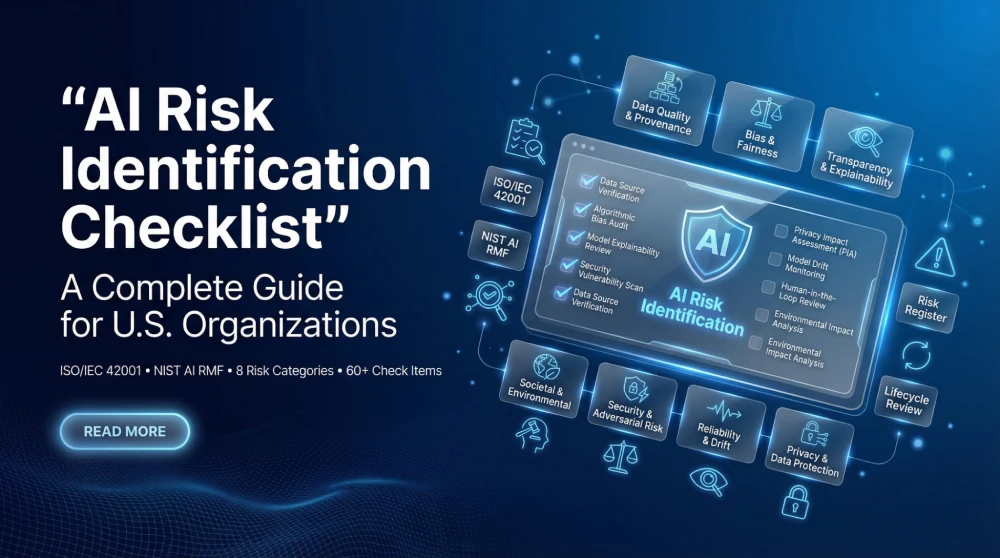
McKinsey reports that 78% of companies now use generative AI in at least one business function. Yet the Infosys Knowledge Institute found that only 2% of enterprises meet responsible AI gold standards. The gap between those two numbers represents organizations deploying AI systems without a systematic process for identifying the risks those systems introduce. Risk identification is the first step in every AI governance framework, from ISO/IEC 42001 to the NIST AI RMF to the EU AI Act. You cannot assess what you have not identified, and you cannot treat what you have not assessed. This article provides a structured, practitioner-tested checklist that U.S. organizations can use to systematically identify AI risks across eight categories, mapped to the standards that auditors and regulators expect.
Why Risk Identification Deserves Its Own Process
Most organizations conflate risk identification with risk assessment. They are distinct activities. Identification asks: what could go wrong? Assessment asks: how likely is it, and how severe? Treatment asks: what are we going to do about it? Collapsing these into a single exercise almost always results in premature filtering, where risks that seem unlikely or manageable get excluded before they are ever documented.
ISO/IEC 42001 recognizes this distinction. Clause 6.1.1 requires organizations to consider internal and external factors that create risks and opportunities. Clause 6.1.2 requires a formal AI risk assessment process. Clause 6.1.4 requires a separate AI system impact assessment focused on consequences for individuals and society. The NIST AI RMF’s Map function focuses specifically on risk identification before the Measure function applies analysis. A dedicated identification step ensures nothing gets lost between the workshop and the risk register.
What a Good AI Risk Identification Process Looks Like
Effective risk identification combines three inputs: a structured checklist of risk categories, domain expertise from cross-functional stakeholders, and evidence gathered from the AI system itself.
- Inventory all AI systems. This includes internally developed models, third-party APIs, embedded AI features in SaaS products, and shadow AI tools employees use without formal approval. For each, document owner, purpose, data sources, deployment context, and affected stakeholders.
- Assemble a cross-functional review team. Include representatives from legal, compliance, product, data science, security, privacy, ethics, and the business unit that owns the AI system. Each perspective catches risks the others miss.
- Walk through the checklist category by category. For each AI system, evaluate every category below. Document every risk, even ones that seem unlikely. Filtering happens during assessment, not identification.
- Document risks in a standardized format. Each risk should include description, category, applicable AI systems, lifecycle stage, and initial evidence. ISO/IEC 42001 requires documented results, so format for audit-readiness from the start.
- Review and validate with system owners. Engineers and product managers will identify risks the team missed and add context to flagged items.
The AI Risk Identification Checklist
This checklist organizes AI risks into eight categories, each with specific items to evaluate and framework references. Use it as a working document for each AI system in your inventory.
Category 1: Data Quality and Provenance
ISO/IEC 42001: Annex C (C.3.4), Annex A (A.7) | NIST AI RMF: Map 1.5, Map 2.1
- Is the training data documented, including source, collection method, date range, and known limitations?
- Has the training data been evaluated for demographic representation across protected classes?
- Are there mechanisms to detect data quality issues (missing values, duplicates, label errors, distributional anomalies)?
- Is the provenance of third-party data verified, including licensing and privacy compliance?
- Are data pipelines monitored for upstream changes that could alter distribution or quality?
- Has the organization assessed whether the data contains proxies for protected characteristics?
- Is there a process for refreshing or revalidating training data as real-world conditions change?
- Are synthetic data methods, if used, validated against real-world distributions?
Category 2: Algorithmic Bias and Fairness
ISO/IEC 42001: Annex C (C.2.5), Clause 6.1.4 | NIST AI RMF: Measure 2.11, Map 3.2
- Has the system been tested for disparate impact across protected demographic groups?
- Has the organization selected and documented which mathematical definition of fairness applies?
- Are fairness metrics computed both pre-deployment and on an ongoing basis in production?
- Has the system been evaluated for intersectional bias (e.g., outcomes for Black women vs. white men)?
- Is there a process for investigating and remediating fairness metric degradation?
- Are affected stakeholders consulted during fairness evaluation design?
- Has the organization documented trade-offs between competing fairness definitions?
Category 3: Transparency and Explainability
ISO/IEC 42001: Annex A (A.9), Annex C (C.2.7) | NIST AI RMF: Measure 2.8, Govern 4.2
- Can the system’s outputs be explained to a non-technical stakeholder in actionable terms?
- Has the use case’s explainability requirement been defined (model-level vs. system-level)?
- Are explanations generated for individual predictions, and are they faithful to the model’s decision process?
- Is there documentation (model cards or equivalent) describing purpose, training data, limitations, and performance?
- Do end users know they are interacting with an AI system?
- Can affected individuals request an explanation of a decision that impacts them?
- Is the AI system’s decision-making process auditable by a third party?
Category 4: Security and Adversarial Robustness
ISO/IEC 42001: Annex C (C.2.10), Annex A (A.10) | NIST AI RMF: Measure 2.7, Manage 2.3
- Has the system been tested against adversarial input attacks?
- Has the training pipeline been evaluated for data poisoning vulnerabilities?
- For LLM-based systems, has it been tested for prompt injection, jailbreak, and output manipulation?
- Has model extraction risk been assessed (replication through API queries)?
- Are model weights, training data, and configs protected with access controls and encryption?
- Is there an AI-specific incident response plan (distinct from general cybersecurity)?
- Has the organization evaluated supply chain risks from third-party models and libraries?
- Are AI systems included in vulnerability management and penetration testing programs?
Category 5: Privacy and Data Protection
ISO/IEC 42001: Annex C (C.2.8), Annex A (A.7) | NIST AI RMF: Measure 2.10, Map 3.5
- Does the AI system process personal data, and is there a documented legal basis?
- Has a data protection impact assessment (DPIA) been conducted for sensitive data processing?
- Has the system been tested for memorization risks (regenerating training data verbatim)?
- Are privacy-enhancing techniques applied where appropriate?
- Can the organization fulfill data subject rights requests for AI training data?
- Has the organization assessed whether the system infers sensitive attributes not explicitly provided?
- Are data retention and deletion policies applied to AI training data?
Category 6: Reliability, Accuracy, and Model Drift
ISO/IEC 42001: Annex C (C.3.4), Clause 8.2 | NIST AI RMF: Measure 2.6, Manage 4.1
- Has accuracy been validated on data representative of the actual deployment population?
- Are accuracy metrics computed for relevant subgroups, not just overall population?
- Is there automated monitoring for model drift (input distribution or output pattern changes)?
- Has the organization defined thresholds that trigger retraining or retirement?
- Are confidence scores or uncertainty estimates available for predictions?
- Has the organization evaluated consequences of model failure?
- Are there fallback mechanisms (human override) for low-confidence predictions?
- Is performance monitored separately across different deployment contexts?
Category 7: Human Oversight and Accountability
ISO/IEC 42001: Annex C (C.2.1), Clause 5.1 | NIST AI RMF: Govern 1.3, Govern 2.1
- Is there a designated human accountable for the AI system’s outcomes?
- Can a human meaningfully override or reverse the AI’s decisions in real time?
- Are human overseers trained on the system’s capabilities, limitations, and failure modes?
- Has automation bias (over-reliance on AI recommendations) been assessed as a risk?
- Are escalation paths defined for unexpected or concerning outputs?
- Is there a documented process for decommissioning the AI system if risks become unacceptable?
- Are governance roles and responsibilities documented and communicated?
Category 8: Societal and Environmental Impact
ISO/IEC 42001: Clause 6.1.4, Annex C (C.2.11) | NIST AI RMF: Map 3.2, Map 5.1
- Has the organization evaluated who could be harmed, including populations not directly served?
- Has the system been assessed for potential to exacerbate existing social inequalities?
- Has the environmental impact of model training and inference been estimated?
- Has economic displacement (job impact) been considered?
- Has potential for misuse beyond intended purpose been assessed?
- Are there mechanisms for external stakeholders to report concerns?
- Has the organization documented intended benefits weighed against identified risks?
How This Checklist Maps to ISO/IEC 42001 and NIST AI RMF
| Checklist Category | ISO/IEC 42001 Reference | NIST AI RMF Reference |
|---|---|---|
| Data Quality & Provenance | Annex C (C.3.4), Annex A (A.7) | Map 1.5, Map 2.1 |
| Algorithmic Bias & Fairness | Annex C (C.2.5), Clause 6.1.4 | Measure 2.11, Map 3.2 |
| Transparency & Explainability | Annex A (A.9), Annex C (C.2.7) | Measure 2.8, Govern 4.2 |
| Security & Adversarial Robustness | Annex C (C.2.10), Annex A (A.10) | Measure 2.7, Manage 2.3 |
| Privacy & Data Protection | Annex C (C.2.8), Annex A (A.7) | Measure 2.10, Map 3.5 |
| Reliability, Accuracy & Drift | Annex C (C.3.4), Clause 8.2 | Measure 2.6, Manage 4.1 |
| Human Oversight & Accountability | Annex C (C.2.1), Clause 5.1 | Govern 1.3, Govern 2.1 |
| Societal & Environmental Impact | Clause 6.1.4, Annex C (C.2.11) | Map 3.2, Map 5.1 |
When and How Often to Run This Checklist
Before any new AI system deployment. No exceptions. The checklist should be a gate in your deployment approval workflow.
Annually for all existing production systems. Even if nothing has changed in the AI system itself, the regulatory landscape, data distributions, and threat environment evolve continuously.
After significant changes. A change in training data sources, a model update, a new deployment context, or a change in served population all warrant a fresh identification pass.
After incidents. Any AI-related incident, including near-misses, should trigger a targeted review of the relevant checklist categories.
Common Mistakes in AI Risk Identification
Limiting scope to internally built systems. Third-party AI APIs, embedded AI in SaaS tools, and open-source models all introduce risks. If a vendor’s model touches your data or customers, it belongs in scope.
Treating identification as a one-time exercise. A checklist completed at deployment and never revisited is a compliance artifact, not a risk management tool. AI systems, regulations, and threats all change continuously.
Excluding non-technical risks. Reputational damage, regulatory exposure, loss of customer trust, and ethical misalignment are real risks that must appear in the risk register even though they do not show up in technical metrics.
Running identification without cross-functional input. Engineers see technical risks. Lawyers see regulatory risks. Product managers see customer impact. Privacy officers see data protection gaps. No single team sees the full picture.
Start with Identification, Build Toward Governance
Risk identification is the foundation that every subsequent governance activity builds on. Assessment, treatment, monitoring, and continuous improvement all depend on a comprehensive, well-documented catalogue of risks. This checklist gives U.S. organizations a structured starting point aligned with the standards and frameworks that regulators and auditors reference.
The most productive first step is to pick your highest-risk AI system, assemble a cross-functional team, and work through all eight categories. Document everything. That single exercise will reveal more about your AI governance gaps than any theoretical planning session.
GAICC offers ISO/IEC 42001 Lead Implementer training that teaches professionals how to build and operate AI risk identification and assessment processes as part of a complete AI Management System. Explore the program to formalize your approach.
Frequently Asked Questions (FAQs)
1. What is the difference between qualitative and quantitative AI risk scoring?
Qualitative scoring assigns descriptive ratings (High, Medium, Low) based on expert judgment. Quantitative scoring computes numerical metrics using mathematical models. Qualitative is broader and faster; quantitative is more precise and repeatable.
2. Which approach do ISO 42001 and NIST AI RMF require?
Both expect a combination. ISO 42001 requires documented risk assessment with reproducible results. NIST AI RMF explicitly calls for quantitative, qualitative, or mixed-method approaches. Demonstrate both qualitative breadth and quantitative depth.
3. What tools exist for quantitative AI risk scoring?
IBM AI Fairness 360 and Microsoft Fairlearn handle bias. IBM’s Adversarial Robustness Toolbox tests security. AI Explainability 360 generates transparency metrics. Stanford’s HELM and TrustLLM evaluate LLM trustworthiness.
4. Can small organizations implement quantitative AI risk scoring?
Yes, starting with open-source toolkits focused on highest-priority dimensions. A lending company should prioritize fairness metrics; a healthcare deployer should prioritize accuracy calibration and subgroup analysis.
5. How often should AI risk scores be updated?
Quantitative metrics should run continuously with automated threshold alerts. Qualitative reassessments should occur quarterly minimum, plus whenever significant changes happen in models, data, regulations, or markets.
6. What is the impossibility theorem in AI fairness?
Proved by Chouldechova in 2017, it shows that certain mathematical fairness definitions cannot be simultaneously satisfied. Organizations must choose which fairness definition applies to each use case based on context and stakeholder needs.
7. How does AI risk scoring relate to the EU AI Act?
Article 9 requires continuous, iterative risk management with estimation and evaluation. Quantitative scoring satisfies these requirements more directly than qualitative ratings alone. U.S. organizations serving European customers need numerical evidence.