
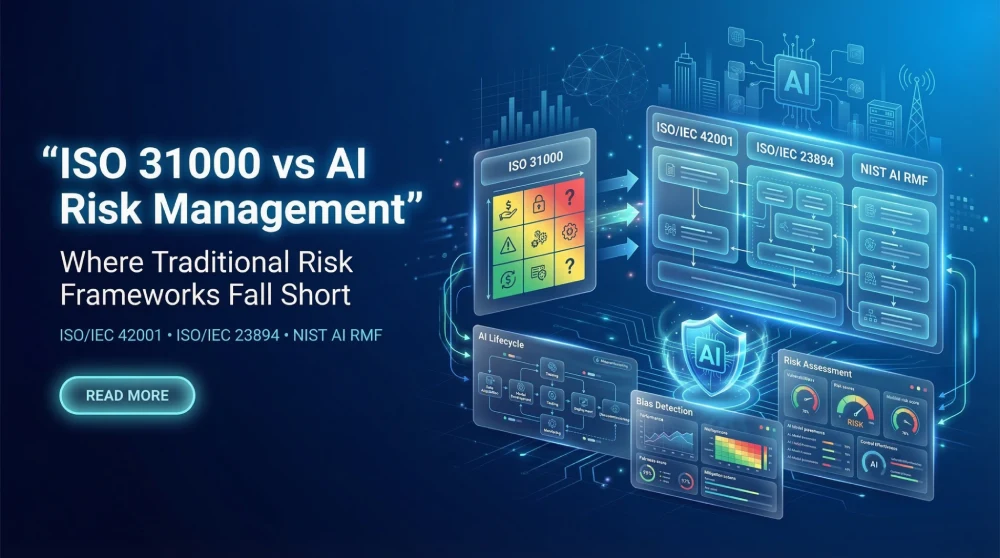
A 2025 study from the Infosys Knowledge Institute found that 95% of enterprises have experienced at least one AI-related incident, yet only 2% meet what researchers classify as responsible AI gold standards. That gap between AI adoption and AI risk maturity is where frameworks matter most. Many U.S. organizations reach for ISO 31000, the established international standard for enterprise risk management, when they start thinking about AI governance. It makes sense on the surface: ISO 31000 provides principles and processes for managing any type of risk. But AI systems introduce risk categories that did not exist when ISO 31000 was last updated in 2018, and the standard was never designed to address them. This article examines exactly where ISO 31000 fits in the AI risk landscape, where it does not, and which purpose-built frameworks fill the gaps for organizations operating in the United States.
What ISO 31000 Actually Covers (and What It Was Built For)
ISO 31000:2018 is a guidance standard published by the International Organization for Standardization. It provides principles, a framework, and a process for managing risk in any organization, regardless of size, industry, or sector. The standard defines risk as the “effect of uncertainty on objectives,” a deliberately broad definition that encompasses both threats and opportunities.
The standard is organized around three components. First, a set of eight principles that describe the characteristics of effective risk management, including integration into organizational activities, structured decision-making, and continuous improvement. Second, a framework that covers leadership commitment, design, implementation, evaluation, and adaptation. Third, a process that walks organizations through communication and consultation, scope and context establishment, risk assessment (identification, analysis, evaluation), risk treatment, monitoring, and reporting.
Two characteristics distinguish ISO 31000 from other frameworks. It is technology-agnostic, meaning it applies equally to financial risk, operational risk, reputational risk, or any domain-specific risk the organization faces. And it is not certifiable. Organizations cannot receive an ISO 31000 certificate from an accredited body. It functions as guidance that informs how risk management processes are designed, not as a requirements standard against which compliance is audited.
This universality has made ISO 31000 one of the most widely adopted risk frameworks globally. KPMG research indicates that while risk management is treated as a high priority in most organizations, only 66% actually build it into strategic planning decisions consistently. ISO 31000 exists to close that gap by giving organizations a common vocabulary, a shared process, and a set of principles to embed risk thinking into every decision.
Why AI Risk Is Fundamentally Different from Traditional Risk
Traditional risk management assumes a relatively static system where risks can be identified, assessed at a point in time, and treated through controls that remain stable until the next review cycle. AI systems violate nearly every one of those assumptions.
AI systems change their own behavior. Unlike a database or a financial model, a machine learning system can shift its outputs over time as it processes new data. This phenomenon, called model drift, means that a system that was fair and accurate at deployment may become biased or unreliable months later without any human intervention. Traditional risk registers do not account for risks that emerge spontaneously from the system itself.
Risk surfaces are opaque. Many AI models, particularly deep learning systems, operate as black boxes. The relationship between inputs and outputs is not directly interpretable by humans. When a traditional IT system fails, you can trace the error to a specific line of code or configuration. When an AI system produces a discriminatory outcome, the cause may be embedded across millions of model parameters, training data distributions, and feature interactions that resist straightforward analysis.
Harm extends beyond the organization. A misconfigured firewall primarily affects the organization that owns it. A biased hiring algorithm affects every applicant who interacts with it. AI risk has a societal dimension that ISO 31000’s framework, which centers on organizational objectives, was not designed to capture.
Third-party dependencies introduce uncontrollable variables. Most U.S. organizations using AI rely on models, APIs, or pre-trained systems from external providers. The organization cannot inspect the training data, audit the model architecture, or control when the provider updates the underlying system.
Adversarial threats target the model itself. AI systems face attack vectors that have no analog in traditional risk: data poisoning during training, adversarial inputs designed to fool the model at inference time, prompt injection in large language models, and model extraction attacks that steal proprietary architectures.
Where ISO 31000 Falls Short for AI Risk Management
ISO 31000 is not a bad framework. It is an incomplete one when applied to artificial intelligence. Here are the specific gaps that matter for U.S. organizations deploying AI systems.
No AI-Specific Risk Taxonomy
ISO 31000 provides a generic process for identifying risks but offers no guidance on which AI-specific risk categories to evaluate. It does not mention algorithmic bias, model drift, training data quality, explainability, adversarial robustness, or any of the risk types unique to machine learning systems.
No Impact Assessment for Affected Populations
The standard’s risk assessment process evaluates consequences through the lens of organizational objectives. It does not require a separate assessment of how an organization’s systems might affect individuals, communities, or society. ISO/IEC 42001 makes this a formal requirement under Clause 6.1.4. ISO 31000 has no equivalent.
No Lifecycle Risk Mapping
AI risk evolves across the system lifecycle. Risks during data collection differ from risks during model training, which differ from risks during deployment. ISO/IEC 23894 and the NIST AI RMF both provide explicit lifecycle-stage mapping that ISO 31000 lacks.
No Certifiability
ISO 31000 is a guidance standard. Organizations cannot be certified against it. ISO/IEC 42001, by contrast, is a certifiable management system standard where accredited bodies conduct formal audits.
No Controls Framework
ISO 31000 tells you to treat risks but does not provide a catalog of controls. ISO/IEC 42001’s Annex A provides 38 AI-specific controls. ISO 31000 provides zero.
ISO 31000 vs. AI-Specific Frameworks: Side-by-Side Comparison
| Capability | ISO 31000 | ISO/IEC 42001 | ISO/IEC 23894 | NIST AI RMF |
|---|---|---|---|---|
| Scope | All risk types | AI management system | AI risk management | AI risk (U.S.) |
| AI-specific guidance | None | Extensive | Extensive | Extensive |
| Risk taxonomy for AI | Generic | Annex C risk sources | AI risk sources | Trustworthiness factors |
| Societal impact assessment | No | Yes (Clause 6.1.4) | Yes | Partial |
| Lifecycle mapping | No | Yes | Yes (Annex C) | Yes |
| Controls catalog | No | 38 controls (Annex A) | No (guidance only) | Profiles/categories |
| Certifiable | No | Yes | No | No |
| Integrates with ISO 31000 | N/A | Yes (Annex SL) | Built on ISO 31000 | Complementary |
The AI-Specific Frameworks That Fill the Gaps
ISO/IEC 42001:2023 (AI Management System)
ISO/IEC 42001 is the world’s first certifiable management system standard for AI. It requires organizations to build an Artificial Intelligence Management System (AIMS) covering governance, risk assessment, risk treatment, impact assessment, operational controls, performance evaluation, and continuous improvement. Its Annex A provides 38 controls spanning the AI lifecycle.
For U.S. organizations that need to demonstrate AI governance maturity to customers or regulators, ISO/IEC 42001 is the primary certification target. It follows the same Annex SL structure as ISO 27001 and ISO 9001, making integration with existing management systems straightforward.
ISO/IEC 23894:2023 (AI Risk Management Guidance)
ISO/IEC 23894 is the bridge between ISO 31000 and AI. It explicitly builds on ISO 31000’s principles, framework, and process, then adds AI-specific guidance at each step. Where ISO 31000 says “identify risks,” ISO/IEC 23894 specifies what AI-specific risk sources to look for: data quality issues, algorithmic bias, opacity and explainability limitations, adversarial vulnerabilities, safety concerns, privacy risks, and environmental impacts.
Peter Deussen, the project leader of ISO/IEC 23894, has described the standard as one that adapts and develops ISO 31000’s guidelines and emphasizes the importance of constantly reviewing, identifying, and preparing for potential risks in AI systems. If your organization already uses ISO 31000, ISO/IEC 23894 is the most natural extension for AI.
NIST AI Risk Management Framework (AI RMF)
The NIST AI RMF is a voluntary U.S.-developed framework organized around four functions: Govern, Map, Measure, and Manage. It provides detailed guidance on trustworthiness characteristics including fairness, explainability, privacy, security, and accountability.
The framework is not certifiable and does not prescribe specific controls, but it offers the most detailed U.S.-centric guidance on responsible AI risk management. Organizations frequently use NIST AI RMF as their risk assessment methodology within an ISO/IEC 42001 management system.
How These Frameworks Work Together (Not Against Each Other)
The relationship between these frameworks is complementary, not competitive.
ISO 31000 as the enterprise foundation. Use ISO 31000 to establish your organization-wide risk management principles, vocabulary, and governance structure. This ensures AI risk management connects to financial, operational, compliance, and strategic risk rather than operating in a silo.
ISO/IEC 23894 as the AI risk bridge. Apply ISO/IEC 23894 to extend ISO 31000’s generic process with AI-specific risk sources, lifecycle mapping, and assessment guidance.
NIST AI RMF as the assessment methodology. Use NIST’s Govern-Map-Measure-Manage functions as your tactical approach to conducting AI risk assessments.
ISO/IEC 42001 as the management system and certification vehicle. Wrap everything in an AIMS that provides governance structure, documentation requirements, audit processes, and continuous improvement for third-party certification.
Layered architecture in practice: AWS has published detailed guidance on this approach, describing a model where ISO/IEC 42001 sits at the top governance layer, ISO 31000 and NIST AI RMF provide risk assessment methodology in the middle layer, and threat modeling tools like STRIDE and PASTA operate at the technical analysis layer.
Choosing the Right Framework: A Decision Guide for U.S. Organizations
If you already use ISO 31000 and want to extend it to AI: adopt ISO/IEC 23894 as your AI risk guidance layer. It builds directly on ISO 31000’s structure.
If you need to demonstrate AI governance to customers, partners, or regulators: pursue ISO/IEC 42001 certification. It is the only certifiable AI management system standard.
If you are in a regulated industry (healthcare, financial services, government contracting): adopt the NIST AI RMF. It has been referenced in executive orders and federal procurement guidance.
If you are starting from scratch: start with the NIST AI RMF for its actionable guidance. As your program matures, layer in ISO/IEC 42001 for certifiability and ISO 31000 for enterprise integration.
The U.S. Regulatory Landscape Demands AI-Specific Approaches
Multiple states have introduced or enacted AI-specific legislation. Colorado’s AI Act requires deployers of high-risk AI systems to conduct risk assessments and implement governance programs. Illinois has enacted the AI Video Interview Act. California has proposed legislation addressing automated decision-making transparency. At the federal level, the FDA has issued guidance on AI/ML-based software as medical devices, the SEC has scrutinized AI-related disclosures, and the FTC has taken enforcement actions against companies making deceptive AI claims.
Each of these regulatory actions expects the kind of AI-specific risk assessment that ISO 31000 alone cannot provide. For organizations serving European customers, the EU AI Act adds mandatory requirements for high-risk AI systems that map directly to ISO/IEC 42001’s clause structure.
Common Mistakes When Applying ISO 31000 to AI Risk
Assuming broad coverage means adequate coverage. ISO 31000 can technically be applied to any risk. But “can be applied” is different from “provides adequate guidance.” An organization that checks the ISO 31000 box without adding AI-specific assessments will have significant blind spots.
Treating AI risk as a subset of IT risk. Model drift, training data bias, adversarial attacks, and explainability failures have no direct analog in conventional IT risk management. Organizations that file AI risk under their existing IT risk register often miss the ethical and fairness dimensions.
Skipping the societal impact dimension. ISO 31000 evaluates risk against organizational objectives. AI regulations increasingly require evaluation of impact on individuals and communities.
Running a single point-in-time assessment. AI systems evolve continuously. A risk assessment conducted at deployment may be invalid within months as the model processes new data.
The Right Tool for the Right Problem
ISO 31000 remains valuable as the common language and structural foundation for enterprise risk management. The right approach is layered: use ISO 31000 as the base, extend it with AI-specific guidance from ISO/IEC 23894, apply NIST AI RMF’s assessment methodology for U.S.-aligned evaluations, and formalize everything within an ISO/IEC 42001 management system for organizations that need certifiable AI governance.
The clearest next step is a gap analysis: compare your current ISO 31000-based risk processes against the AI-specific requirements in ISO/IEC 42001 and NIST AI RMF to identify where your coverage ends and where AI-specific investments are needed.
GAICC offers ISO/IEC 42001 Lead Implementer training that prepares professionals to build AI Management Systems that integrate ISO 31000 foundations with AI-specific risk management requirements. Explore the program to take your next step.
Frequently Asked Questions (FAQs)
1. Can ISO 31000 be used for AI risk management?
Yes, but not on its own. ISO 31000 provides a solid generic foundation but lacks AI-specific risk taxonomies, lifecycle mapping, societal impact assessment guidance, and controls catalogs. Supplement with ISO/IEC 23894 or NIST AI RMF.
2. Is ISO 31000 certifiable?
No. ISO 31000 is a guidance standard. Organizations cannot receive third-party certification. For certifiable AI governance, ISO/IEC 42001 is the appropriate standard.
3. What is the difference between ISO 31000 and ISO/IEC 23894?
ISO 31000 provides generic risk management principles. ISO/IEC 23894 builds on ISO 31000 adding AI-specific guidance including risk sources unique to AI, lifecycle-stage mapping, and recommendations for managing algorithmic bias, data quality, and model opacity.
4. Which framework should a U.S. company use for AI risk management?
A layered approach works best: ISO 31000 for enterprise integration, NIST AI RMF for U.S.-aligned methodology, ISO/IEC 23894 for AI-specific guidance, and ISO/IEC 42001 for certifiable management system.
5. How does the NIST AI RMF relate to ISO 31000?
NIST AI RMF focuses on AI risks with detailed trustworthiness guidance. ISO 31000 is technology-agnostic. They complement each other as enterprise vocabulary and AI-specific methodology.
6. Does ISO/IEC 42001 replace ISO 31000?
No. ISO/IEC 42001 requires AI risk assessment but encourages using ISO 31000 or NIST AI RMF as the methodology within its framework. The standards work together.
7. What AI-specific risks does ISO 31000 not address?
ISO 31000 provides no guidance on algorithmic bias, model drift, data poisoning, adversarial attacks, explainability limitations, prompt injection, concept drift, fairness degradation, or environmental impact of model training.