
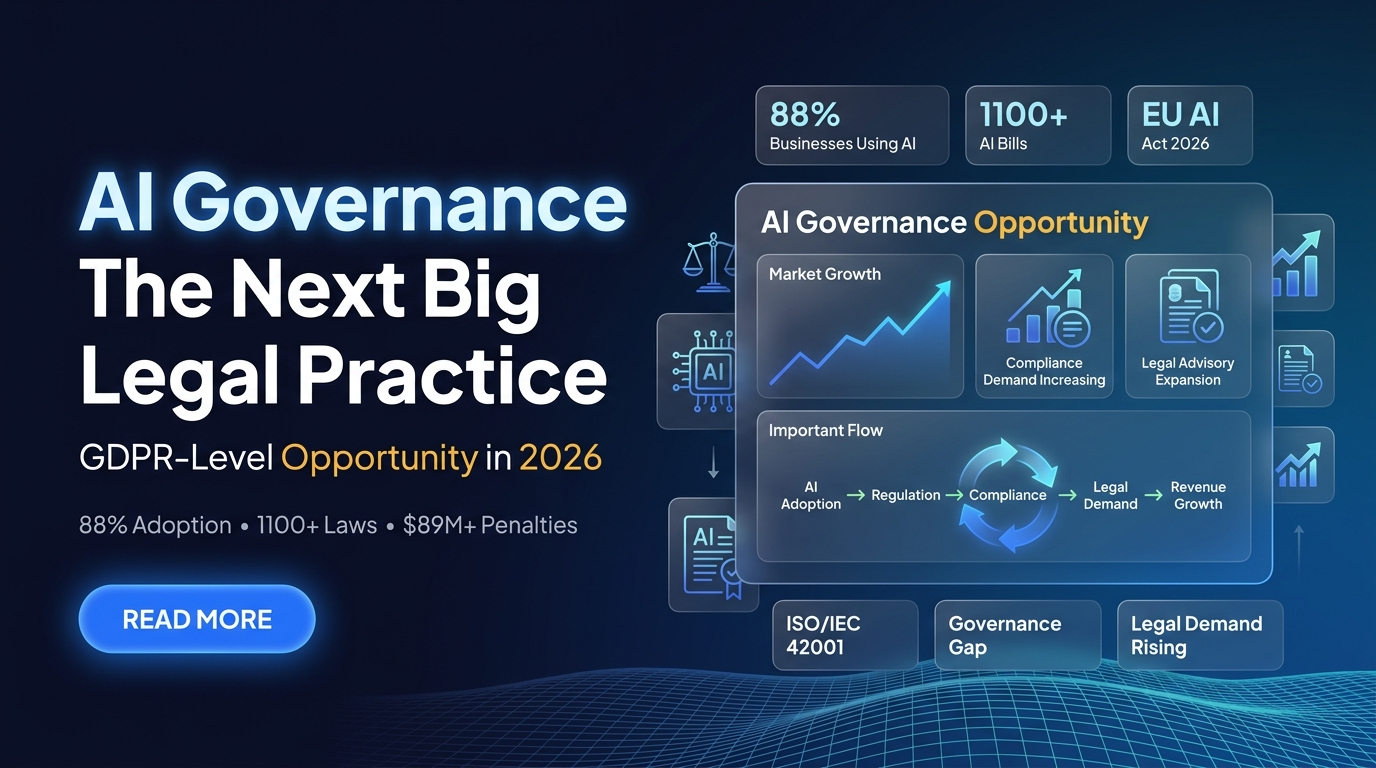
88% of businesses use AI. Only 10% of law firms have governance policies. 1,100+ state AI bills in a single year. The structural conditions that created billion-dollar privacy practices post-GDPR are present, and in several dimensions, more favorable for AI governance.
The formation window: AI tool usage among legal professionals surged from 19% (2023) to 79% (2024). 88% of businesses use AI. Enterprise AI budgets grew 2.5x to $18M. 95% of legal departments use or implement AI software. Yet only 10% of firms have AI policies and only 19% of organizations have governance frameworks. 1,100+ state AI bills introduced in 2025.
In 2023, 19% of legal professionals used AI tools. By late 2024, that figure reached 79%. By early 2026, 88% of businesses use AI in at least one function, with enterprise spending approaching $2 trillion globally. Yet only 10% of law firms have formal AI governance policies. On the regulatory side, 2025 produced over 1,100 state AI bills. Colorado, California, and Texas enacted legislation with 2026 compliance deadlines. The EU AI Act enters full high-risk enforcement in August 2026. Lawyers who recognized GDPR’s significance in 2016 built privacy practices that generated sustained revenue for a decade. AI governance presents the same structural pattern: universal adoption, fragmented regulation, a gap between capability and obligation, and client demand that grows with every enforcement action.
The GDPR Parallel: Why the Pattern Is Unmistakable
Every major technology regulation cycle produces a corresponding legal practice. Environmental regulation created compliance law. SOX created governance advisory. GDPR created privacy as a standalone practice. AI governance follows the same trajectory with wider scope and greater complexity.
Universal adoption preceding regulation. GDPR arrived after personal data processing was embedded in every function. AI regulation arrives after 88% of businesses already use AI operationally. Regulation applying to deployed technology creates immediate compliance demand.
Extraterritorial reach. GDPR applied globally based on where data subjects reside. The EU AI Act applies based on where AI outputs affect persons. U.S. state laws apply based on where affected individuals live. A Texas firm screening Colorado applicants must comply with the Colorado AI Act.
Fragmented landscape. Before GDPR, privacy was a national patchwork. AI governance in the U.S. is a state patchwork: 1,100+ bills, different definitions of “AI,” “high-risk,” and “consequential decisions.” Fragmentation creates the compliance complexity that sustains advisory practices.
Enforcement creating urgency. GDPR demand accelerated after the first fines. AI governance is following: FTC’s Operation AI Comply, Italy’s 15M euro OpenAI fine, $89M in U.S. AI credit penalties, 729+ court hallucination sanctions. Enforcement converts awareness into engagement budgets.
Standards infrastructure. GDPR had ISO 27701 and CIPP/US. AI governance has ISO/IEC 42001 (certifiable) and NIST AI RMF. The framework exists for lawyers to advise on implementation, assessment, and certification.
The timing comparison: GDPR was adopted in 2016, enforced in 2018. Firms that built practices in 2016 captured first-mover advantage. AI governance legislation is enacted (Colorado Feb 2026, EU AI Act Aug 2026). Enforcement has begun. The competitive market is not yet saturated. This is the 2016 equivalent.
Even without a single federal AI law, lawyers already have multiple enforcement pathways available, which we break down in detail in our guide on US AI governance and what lawyers can actually enforce.
The Demand Side: Why Clients Need AI Governance Lawyers Now
Every Organization Is a Potential Client
88% of businesses use AI. 78% use generative AI specifically. Enterprise budgets grew 2.5x to $18M. Robert Half: 95% of legal department leaders use or implement AI software. This is the entire commercial market, not a niche.
The Governance Gap Is the Revenue Opportunity
93% acknowledge AI risks. 19% have governance frameworks. 10% of firms have policies. 63% report governance skill gaps. The gap between awareness and capability is where external legal advisory fills demand.
Regulatory Pressure Converts Awareness to Budget
Colorado: impact assessments, February 2026. California AB 2013: training data disclosures, January 2026. Texas TRAIGA: healthcare/government AI disclosures, January 2026. NYC LL144: bias audits. CFPB: adverse action explanations. Each deadline creates billable work: assessment, gap analysis, program design, vendor review, documentation, monitoring.
Client Expectations Are Shifting
Legalweek 2026 centered on governance as a prerequisite for scaling AI. Wilson Sonsini’s innovation leader confirms governance demand from the client compliance patchwork. 60% of in-house teams don’t know if outside counsel uses AI. Firms demonstrating governance maturity through policies, audit trails, and certifications will differentiate in pitches.
The real opportunity lies in understanding where regulation is heading, not where it stands today, especially as AI regulation continues to expand across jurisdictions in ways many lawyers are still missing.
The Practice Architecture: Seven Service Lines
- Regulatory advisory and compliance monitoring. Ongoing interpretation across agencies, states, and international frameworks. Retainer-based recurring revenue. 1,100+ bills/year means continuous regulatory change.
- AI governance program design. ISO 42001 and NIST-aligned management systems: policy, committee charter, risk methodology, approval workflows, documentation, monitoring. Project-based, typically 200-400 hours for mid-market companies.
- AI risk assessment and gap analysis. Evaluating deployments against legal requirements, contracts, and risk tolerance. Regulatory compliance, liability mapping, evidentiary readiness, fiduciary risk. Annual or event-triggered.
- AI vendor and contract advisory. Provisions standard IT contracts lack: AI disclosure, training data transparency, model change notification, bias testing, audit rights, incident notification, subprocessor disclosure, exit terms. Applies to every vendor portfolio.
- AI incident response. Bias events, hallucinations, AI breaches, adversarial attacks, regulatory inquiries. On-demand with retainer. Incident frequency scales with AI deployment.
- Training, certification, and board advisory. Internal governance capacity. ISO 42001 readiness. Board AI oversight and Caremark fiduciary risk. Workshops, embedded programs, quarterly briefings.
- AI litigation and enforcement defense. FTC, CFPB, SEC, state AG actions. Employment discrimination from AI tools. Consumer protection. Caremark claims. IP disputes. Expert testimony on governance standards.
Competitive Positioning
Framework credentials signal credibility. ISO 42001 Lead Implementer certification demonstrates verifiable expertise. Combined with CIPP/US, CIPM, CISA, or CRISC, it positions practitioners at the law-governance intersection. 60% of enterprises are hiring CAIOs; credentialed lawyers can serve as fractional advisors.
Cross-disciplinary teams win. AI governance requires legal expertise, technical literacy, and organizational design. Firms building across disciplines capture larger engagements than pure legal advisory.
The compliance-to-incident pipeline. Governance program clients return for incident response, enforcement defense, and litigation. One governance engagement produces years of downstream revenue. GDPR demonstrated this: advisory led to breach response, which led to regulatory defense, which led to litigation.
Industry specialization creates premium positioning. Financial services, healthcare, employment, and technology each have distinct AI regulatory requirements. Domain-specific expertise commands premium rates.
Thought leadership accelerates entry. CLE programs, publications, conference presentations establish authority. State bars considering AI specialization. Practitioners contributing to education infrastructure build referral networks and credibility simultaneously.
The Timing Window: Why 2026 Is the Inflection Point
Goodwin states it directly: AI is table stakes for law firms in 2026. Wilson Sonsini confirms governance focus will intensify. Herbert Smith Freehills frames AI governance as non-negotiable. The legislation is enacted, deadlines are set, enforcement has begun, and client awareness is building. But the competitive market is not yet saturated. Most firms have not developed formal practices. Most lawyers have not obtained credentials. The window between awareness and saturation is when practice-building produces the highest return.
The GDPR timing analogy: first movers in 2016 captured advantage. Those who waited until 2018 enforcement competed in a crowded market. AI governance is at the equivalent moment. By 2028, this will be an established practice with defined competitive positions. The 18-24 month window from early 2026 is when investment produces disproportionate returns.
The Practice Area Is Forming Now
AI governance is not speculative. Laws are enacted. Deadlines are set. Enforcement has begun. Demand is active. The structural conditions that created billion-dollar privacy practices are present and, in several dimensions, more favorable. The variable is timing. Lawyers and firms that build expertise, credentials, and relationships during this formation period will define the practice for the next decade.
The practical first step: obtain framework literacy through ISO/IEC 42001 training, audit your firm’s own AI governance, and engage your first client on a risk assessment.
GAICC offers ISO/IEC 42001 Lead Implementer training designed for professionals building AI governance practices. The program covers the management system structure, risk assessment methodology, and compliance frameworks that AI governance advisory work requires. Explore the program to build your practice credential.
Frequently Asked Questions (FAQs)
1. How does AI governance compare to GDPR as a practice opportunity?
Identical structure: universal adoption preceding regulation, fragmented landscape, enforcement urgency, capability gap. AI governance has wider regulatory surface spanning employment, credit, healthcare, securities, consumer protection, and privacy simultaneously. Revenue potential is at least comparable.
2. What credentials should lawyers pursue?
ISO/IEC 42001 Lead Implementer for framework expertise. Combine with CIPP/US, CIPM, CISA, or CRISC. State bars considering technology specialization. AI CLE programs becoming mandatory in several jurisdictions.
3. Which clients need this most urgently?
Financial services (CFPB, SEC, FINRA), healthcare (FDA, state laws), employers with AI screening (EEOC, NYC LL144, Colorado), EU-exposed companies (AI Act August 2026), and any organization deploying generative AI at scale.
4. How should firms structure the practice?
Cross-disciplinary from privacy, regulatory, governance, employment, and tech law groups. Seven service lines from advisory to litigation. Retainer monitoring for recurring revenue. Build or partner across legal, technical, and organizational design capabilities.
5. What is the revenue model?
Mixed: retainer monitoring (recurring), project governance design, per-transaction vendor contracts, on-demand incident response, hourly litigation. The compliance-to-incident pipeline generates years of follow-on from single governance engagements.
6. Is federal preemption a risk?
No. Preemption reduces complexity but not need. Organizations still require governance, assessments, contracts, and incident response under any standard. A unified federal standard would expand the addressable market by creating universal compliance obligation.
7. How long is the window?
Roughly 18-24 months from early 2026. By 2028, established practice with defined positions. Firms investing now gain credentials, relationships, and knowledge that late entrants cannot replicate. The GDPR pattern confirms this timeline.