
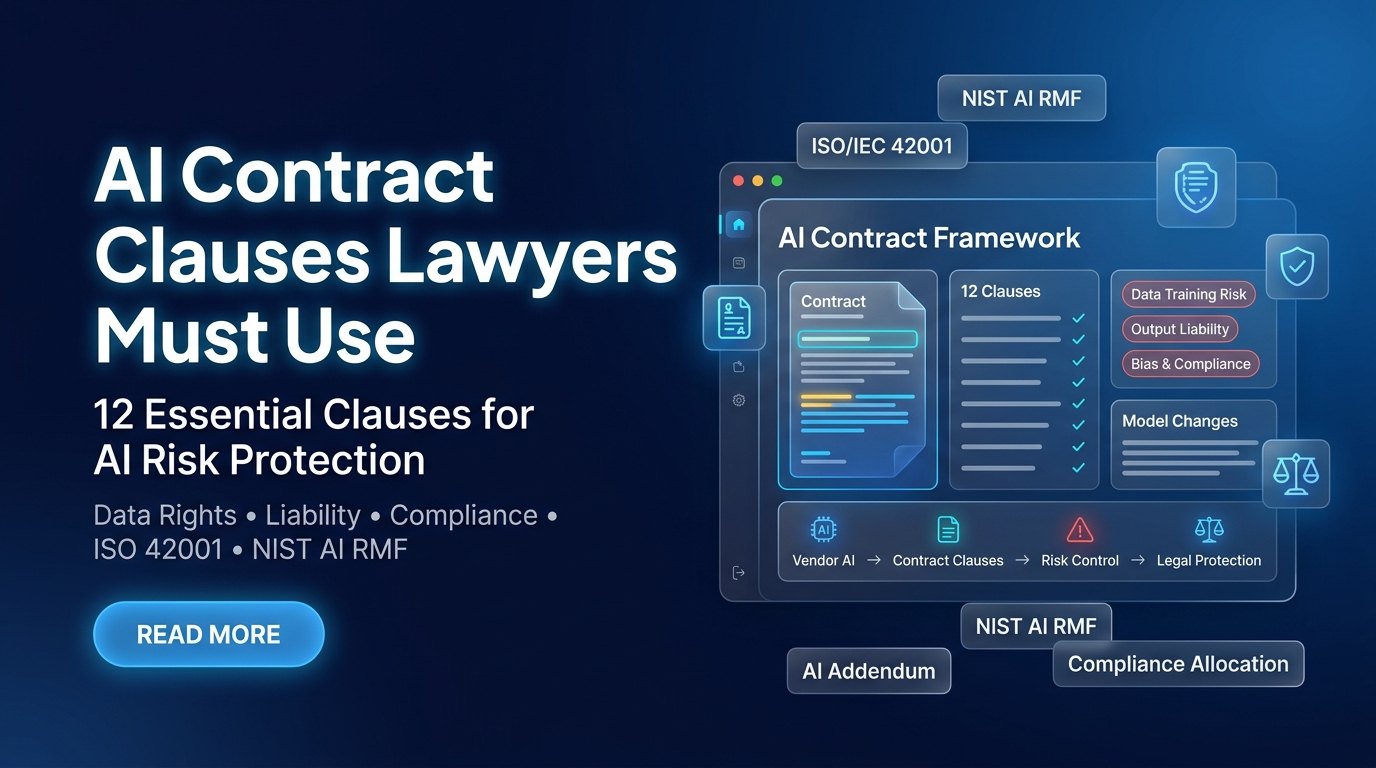
Only 17% of AI contracts include documentation warranties vs. 42% in standard SaaS. Most MSAs don’t address output liability, training data rights, or disgorgement risk. Here are the 12 clauses that close the gaps.
The contractual gap: Stanford CodeX: 17% of AI contracts include documentation warranties (vs. 42% SaaS). Most AI vendor agreements shift compliance to customers, limit liability for biased/infringing outputs, and silently allow training on customer data. Where private rights of action don’t exist, contracts are the primary enforcement mechanism between parties.
Stanford’s CodeX study found only 17% of AI contracts include documentation warranties. Most agreements favor providers, shifting compliance to customers. Training data provenance, model change notification, and bias testing rights are rarely addressed. Where AI-specific statutes don’t create private rights of action (most U.S. jurisdictions), contracts are the primary enforcement tool. A well-drafted AI addendum creates enforceable governance obligations. A poorly drafted agreement leaves clients exposed to output liability, IP claims, disgorgement risk, and regulatory penalties for AI they deployed but did not govern.
Why Standard Software Agreements Fail for AI
Output variability. Traditional software produces consistent outputs. AI is probabilistic. Vendors can’t warrant specific outputs, only that the system was designed and tested responsibly. Requires process warranties, not output warranties.
Training data risk. Most vendors default to training on customer data unless prohibited. Without explicit boundaries, proprietary data enters the vendor’s general model.
Evolving compliance. Colorado, Illinois, NYC, the EU AI Act, and DPDPA create obligations standard MSAs never addressed. Contracts must allocate regulatory responsibility and adapt.
The 12 Essential AI Contract Clauses
1. AI System Definition and Scope
Define “AI system” precisely (reference 15 U.S.C.). Define related terms: AI-generated content, training data, algorithmic decision-making, high-risk AI, model. Without precision, disputes arise about what falls within AI provisions.
2. Data Rights and Training Restrictions
The most commercially significant clause. No training on customer data without written consent. No commingling. No retention beyond contract. Customer owns all input and output data. Include “no training” default with opt-in exceptions. Most vendors allow training unless the contract prohibits it.
3. Training Data Provenance and IP Warranties
Vendor warrants lawful data collection, relevant licenses, and indemnifies for training data IP claims. Addresses algorithmic disgorgement risk: if vendor trained on improper data, customer needs contractual protection against cascading consequences.
4. AI Output Liability Allocation
Specify responsibility for: inaccurate/defamatory/infringing content, discriminatory decisions, hallucinations in business decisions, AI as “substantial factor” in consequential decisions. Negotiate carve-outs from standard liability caps for AI-specific harms.
5. Bias Testing and Algorithmic Audit Rights
Customer rights to: periodic third-party bias audits, documented testing results, methodology access, remediation within defined timeline (e.g., 5 business days). Align with NYC LL144, Colorado reasonable care, Illinois HB 3773. Where regulation doesn’t require audits, the contract creates the obligation.
6. Transparency and Explainability
Vendor must: provide documentation of capabilities/limitations for customer disclosure compliance, provide explainability for consequential decisions (CFPB, EEOC), disclose general architecture, label AI content where required (CA SB 942, EU AI Act Art. 50).
7. Model Change Notification and Approval
30-day advance notice of material model changes. Customer approval for high-risk system changes. Version control and documentation. Rollback rights if changes cause degradation. Without this, customers can’t detect when outputs deviate from expected parameters.
8. Human Oversight Requirements
Define which AI decisions require human review, reviewer qualifications, documentation of review decisions, escalation procedures. Aligns with EU AI Act Art. 14, ISO 42001 controls, Colorado reasonable care.
9. Regulatory Compliance Allocation
Shared-responsibility model: vendor warrants system compliance, vendor updates for regulatory changes, customer handles deployment-context compliance, both cooperate on regulatory inquiries. Without this, the “compliance gap” creates liability for both.
10. Incident Response and Notification
24-hour notification for security incidents, bias events, or material performance degradation. Root cause analysis within 5 business days. Remediation evidence. AI incident log access. Standard breach notification doesn’t cover bias events, drift, or adversarial attacks.
11. Audit Rights and Compliance Certification
Customer may audit governance practices on reasonable notice. Request ISO 42001 certification, SOC 2, or equivalent. Annual compliance certifications. Reference ISO 42001 and NIST AI RMF as benchmark standards.
12. Termination Rights and Exit
Terminate if vendor fails to remediate material issues within cure period. Suspend use pending investigation without triggering breach. Return/delete customer data within 30 days with deletion certificate. Delete models trained on customer data (contractual algorithmic disgorgement). Address data portability and transition.
Clause Priority by Risk Level
| Clause | High-Risk AI | Medium-Risk | Low-Risk |
|---|---|---|---|
| 1. Definition | Essential | Essential | Essential |
| 2. Data Rights | Essential | Essential | Important |
| 3. Training Data IP | Essential | Essential | Important |
| 4. Output Liability | Essential | Essential | Moderate |
| 5. Bias Testing | Essential | Important | Moderate |
| 6. Transparency | Essential | Important | Moderate |
| 7. Model Changes | Essential | Important | Optional |
| 8. Human Oversight | Essential | Important | Optional |
| 9. Compliance | Essential | Essential | Moderate |
| 10. Incident Response | Essential | Important | Moderate |
| 11. Audit Rights | Essential | Important | Optional |
| 12. Termination | Essential | Essential | Important |
AI Addendum structure: Place all AI provisions in a dedicated addendum, not scattered in the MSA. Updateable without renegotiating core terms. Standardizable across vendors. Reference MSA for general terms, layer AI specifics. Attach a schedule for technical controls needing periodic updates. Tier by risk level: heavier duties for customer-facing AI, lighter for internal analytics.
Contracts Are the Enforcement Mechanism Where Statutes Don’t Reach
Where private rights of action don’t exist (most U.S. jurisdictions outside Illinois), contracts are the primary tool for enforceable AI governance. These 12 clauses address the risks standard agreements leave open: training data IP, output liability, bias testing, model changes, compliance allocation, incident response. Every AI vendor agreement should include them, tiered by risk.
The practical first step: review every existing AI vendor agreement against these 12 clauses. The gaps you find are the risks your clients are currently carrying without contractual protection.
GAICC offers ISO/IEC 42001 Lead Implementer training that provides the governance framework these contractual clauses reference. Vendor ISO 42001 certification demonstrates the governance maturity that Clause 11 audit rights and Clause 9 compliance allocation demand. Explore the program to build the knowledge that strengthens both your contracts and your clients’ governance posture.
Frequently Asked Questions (FAQs)
1.Why aren’t standard SaaS agreements sufficient?
AI outputs are variable, vendors may train on customer data by default, and AI faces regulations standard software never did. Standard warranties, liability, and IP fail to cover hallucinations, bias, training data IP, or compliance allocation.
2. Which clause is most commercially significant?
Data rights and training restrictions (Clause 2). Most vendors default to using customer data. Without “no training” provisions, proprietary data enters the general model. Highest stakes for data-sensitive industries.
3. How do these relate to ISO 42001?
ISO 42001 provides the governance framework these clauses operationalize. Audit rights (Clause 11) reference ISO 42001 certification. Compliance allocation (Clause 9) uses ISO 42001 and NIST as benchmarks. Vendor certification demonstrates the maturity these clauses demand.
4. Should I use all 12 in every agreement?
Tier by risk. High-risk: all 12 essential. Medium: 10 important. Low-risk: core clauses essential, others moderate/optional. The priority table provides the guide.
5. How do I address disgorgement risk contractually?
Three clauses: Training Data IP (Clause 3) warranties. Data Rights (Clause 2) prohibitions. Termination (Clause 12) model deletion. Together: contractual protection against cascading disgorgement consequences.
6. What is an AI Addendum?
Dedicated MSA attachment for all AI provisions. Updateable without renegotiating core terms. Standardizable across vendors. References MSA for general terms, layers AI-specific obligations with attached technical schedule.
7. How do I negotiate with reluctant vendors?
Risk matrix. Request certifications upfront. Reference ISO 42001, NIST, SOC 2. Use EU MCC-AI benchmark language. Position as mutual risk management, not adversarial.