
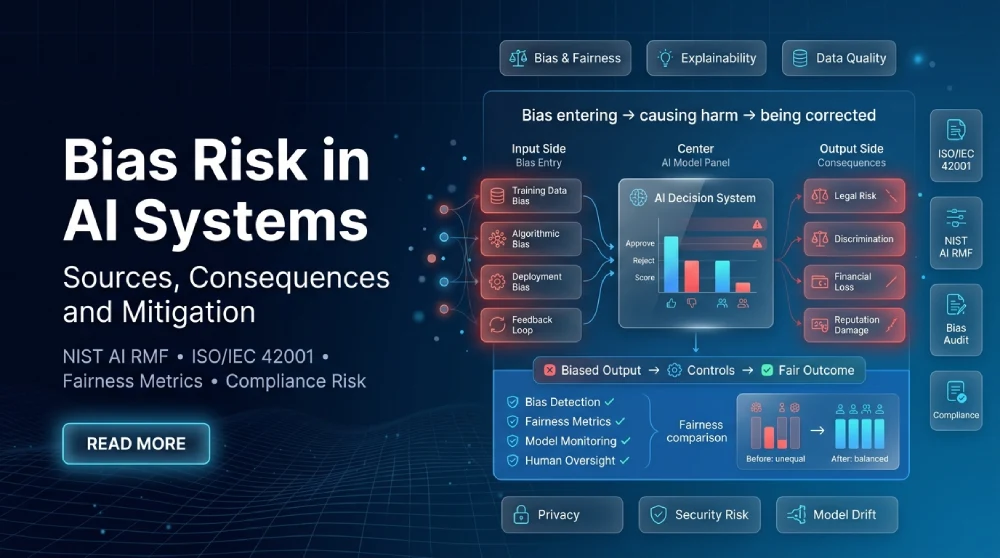
From the Workday class action to the healthcare algorithm that failed Black patients, AI bias has moved from theoretical concern to boardroom priority. Here is how to identify, measure, and manage it.
In May 2025, a federal judge in the Northern District of California allowed a nationwide collective action to proceed against Workday, the HR technology company, alleging that its AI-powered applicant screening system discriminated against job seekers based on age, race, and disability. The court’s reasoning was blunt: drawing a distinction between software decision-makers and human decision-makers would gut anti-discrimination laws in the modern era. That ruling marks a turning point. AI bias is no longer an abstract ethics concern discussed at conferences. It is a litigation risk, a regulatory risk, and a business risk with quantifiable financial consequences. This article explains where bias enters AI systems, what happens when it goes undetected, and the specific steps U.S. organizations should take to identify, measure, and mitigate it within the frameworks regulators expect.
Where Bias Comes From: The Four Entry Points
Bias does not enter AI systems through a single door. It accumulates across four distinct stages of the AI lifecycle, and organizations that focus on only one stage will miss the others.
1. Training Data Bias
The most well-documented source. If the data used to train an AI model reflects historical inequalities, the model learns those patterns as objective truth. A lending model trained on 50 years of mortgage data will learn that minority applicants are higher risk, not because of any inherent difference, but because the historical data encodes decades of discriminatory lending practices. A 2018 Berkeley study found that automated lending systems charged Black and Latino borrowers higher interest rates even after controlling for creditworthiness.
Training data bias takes several specific forms. Representation bias occurs when certain groups are underrepresented in the dataset. Measurement bias occurs when the variables used to represent a concept are systematically skewed, such as using healthcare spending as a proxy for healthcare need. Historical bias occurs when ground truth labels reflect past discrimination. Label bias occurs when human annotators apply inconsistent or prejudiced labels.
2. Algorithmic Design Bias
The choices engineers make during model development introduce bias independently of the data. Feature selection determines which variables the model considers, and including features that correlate with protected characteristics (zip code correlating with race, name correlating with ethnicity) creates proxy discrimination even when protected attributes are excluded. Optimization objectives that maximize overall accuracy will sacrifice performance on minority subgroups. Complex models can discover and exploit subtle correlations with protected characteristics that simpler models would miss.
3. Deployment Context Bias
An AI system can be fair on paper and biased in practice if the deployment context differs from the training context. A facial recognition system trained on a balanced dataset may fail when deployed in a population with different demographic distributions. A diagnostic tool validated in academic medical centers may underperform in community clinics. ISO/IEC 42001 requires risk assessments to consider the specific deployment environment, not just technical performance.
4. Feedback Loop Amplification
Once deployed, biased AI systems generate data that reinforces their own biases. A predictive policing algorithm that sends more officers to historically over-policed neighborhoods generates more arrests in those areas, which the system interprets as validation. A 2024 research study found that AI systems can amplify human bias by up to 2.9 times through these feedback loops.
Real-World Consequences: What Happens When Bias Goes Undetected
Employment: The EEOC settled a case against iTutorGroup after its AI automatically rejected female applicants over 55 and male applicants over 60, disqualifying 200+ qualified individuals. A University of Washington study found AI models preferred white-associated names 85% of the time. Amazon abandoned an AI recruiting tool in 2018 after discovering it systematically downgraded resumes containing “women’s.”
Healthcare: A 2019 Science study by Obermeyer et al. found a widely used hospital algorithm was biased against Black patients by using healthcare spending as a proxy for need. Correcting the bias would increase the percentage of Black patients receiving additional help from 17.7% to 46.5%. UnitedHealth’s nH Predict algorithm prematurely ended nursing home coverage for a 91-year-old, costing the family $12,000/month.
Financial Services: The Berkeley lending study found minority borrowers were charged higher rates than equally qualified white borrowers. In 2019, Apple Card was investigated after men received significantly higher credit limits than women with identical financial profiles.
Criminal Justice: ProPublica’s 2016 analysis of the COMPAS recidivism algorithm found Black defendants were nearly twice as likely to be incorrectly classified as high-risk (45% vs. 23% for white defendants).
The U.S. Legal and Regulatory Landscape for AI Bias
Federal enforcement: The EEOC holds employers liable for AI-caused discrimination regardless of whether the tool was built in-house or purchased. The FTC’s 2024 Civil Rights Report warned that AI bias violations could trigger significant enforcement actions.
State legislation: Colorado’s AI Act (May 2024) requires bias audits and impact assessments for high-risk AI. Illinois mandates employer notification for AI-analyzed video interviews. New York City requires annual independent bias audits for automated employment tools. California banned AI-only healthcare coverage denials.
Existing civil rights law: The Workday ruling established that federal anti-discrimination statutes (ADEA, ADA, Title VII) apply to AI-driven decisions. AI vendors can be liable as agents of the employers using their products.
ISO/IEC 42001 alignment: The standard requires risk assessment (Clause 6.1.2) and impact assessment (Clause 6.1.4) covering fairness. Annex C objective C.2.5 explicitly addresses fairness. Achieving certification demonstrates a systematic approach to bias risk that supports compliance with evolving regulations.
How to Detect Bias in AI Systems: Metrics and Tools
Quantitative Fairness Metrics
Disparate impact ratio: The selection rate for a protected group divided by the majority group rate. Under U.S. employment law’s four-fifths rule, a ratio below 0.80 triggers presumed adverse impact.
Equalized odds: Measures whether true positive and false positive rates are equal across groups. A system correctly identifying 90% of qualified white applicants but only 70% of qualified Black applicants violates this metric.
Demographic parity: Whether the positive outcome rate is equal across groups regardless of qualifications. Strictest definition but can conflict with predictive accuracy.
Calibration: Whether predicted probabilities mean the same thing across groups. If the model predicts 80% repayment likelihood, calibration requires that 80% holds for every demographic group.
These metrics can be mathematically incompatible. Chouldechova’s 2017 impossibility theorem proves that equalized odds and predictive parity cannot be simultaneously achieved except in trivial cases. Organizations must choose which definition applies and document the rationale.
Open-Source Toolkits
| Tool | Developer | Capabilities |
|---|---|---|
| AI Fairness 360 | IBM | 70+ fairness metrics, 10+ mitigation algorithms |
| Fairlearn | Microsoft | Integrates with scikit-learn, TensorFlow, PyTorch |
| Aequitas | Univ. of Chicago | Bias audit toolkit for ML models |
| What-If Tool | Interactive fairness analysis and visualization | |
| HELM Safety | Stanford | LLM safety benchmarks including discrimination testing |
Mitigating Bias: A Lifecycle Approach
Pre-Processing Interventions
These address the data before it reaches the model. Techniques include resampling to balance demographic representation, reweighting to give underrepresented groups more influence during training, removing or transforming proxy features, data augmentation with synthetic examples, and data quality audits evaluating representational quality alongside technical quality.
In-Processing Interventions
These modify the learning algorithm. Fairness constraints added to the optimization objective require the model to minimize error while satisfying a fairness metric. Adversarial debiasing trains a secondary model to predict the protected attribute from the primary model’s outputs, then penalizes the primary model for producing decodable outputs. These techniques trade some overall accuracy for improved fairness.
Post-Processing Interventions
These adjust outputs after prediction. Threshold adjustment sets different decision boundaries for different groups. Calibration adjustments ensure predicted probabilities are consistent across demographics. Post-processing is easiest to implement but only addresses outcome disparities, not underlying learned patterns.
Organizational Interventions
Technical fixes alone are insufficient. Organizational measures include diverse development teams, AI ethics review boards with deployment authority, pre-deployment bias audits by independent assessors, escalation procedures for bias incidents, and continuous monitoring dashboards. ISO/IEC 42001 provides the management system structure for formalizing these controls.
Fairness Drift: The Risk That Emerges After Deployment
A 2025 study in the Journal of the American Medical Informatics Association documented that fairness metrics can degrade over time even when overall accuracy remains stable. Over 11 years of clinical prediction data, the researchers found that population shifts cause bias to emerge where none existed at deployment. This phenomenon means a model that passes every fairness test on launch day can become discriminatory months later without any code change.
Continuous fairness monitoring with automated alerts is not optional. It is a structural requirement for any organization managing bias risk seriously. ISO/IEC 42001 requires ongoing risk assessments under Clause 8 for exactly this reason.
Building a Bias Risk Management Program
- Inventory all AI systems that make or influence decisions about people. Hiring tools, lending algorithms, healthcare triage, content recommendation, chatbots, and insurance underwriting all carry bias risk. Include third-party tools.
- Classify each system by risk level. Systems affecting employment, credit, healthcare, housing, education, or criminal justice are high-risk. Apply proportional scrutiny.
- Select and document fairness metrics for each high-risk system. Choose metrics aligned with legal context and document the rationale, including trade-offs.
- Conduct pre-deployment bias testing across protected groups. Test for race, gender, age, disability, and intersectional combinations. Document baselines.
- Deploy continuous fairness monitoring in production. Track fairness alongside accuracy. Set automated thresholds that trigger investigation.
- Establish an incident response process for bias events. Define investigation timelines, remediation options, and notification procedures.
- Formalize governance through ISO/IEC 42001 certification. Clause 5 (leadership), Clause 6.1.4 (impact assessment), Annex A (controls), and Clause 9 (evaluation) create an auditable bias risk framework.
Bias Risk Is a Business Risk
AI bias is not a theoretical concern for ethicists to debate. It is a legal liability that has produced class-action lawsuits, regulatory enforcement, and settlements. It is a reputational risk that erodes customer trust. And it is a governance gap that auditors, investors, and enterprise customers increasingly evaluate when assessing AI maturity.
The most effective response is systematic: identify where bias can enter your AI systems, measure it with appropriate metrics, mitigate it through lifecycle interventions, monitor it continuously in production, and formalize the entire process within a certifiable management system.
GAICC offers ISO/IEC 42001 Lead Implementer training that covers bias risk identification, fairness measurement, and the governance structures needed to manage AI bias as part of a complete AI Management System. Explore the program to build your organization’s approach.
Frequently Asked Questions (FAQs)
1. What is AI bias?
AI bias occurs when an AI system produces outcomes that systematically favor or disadvantage particular groups. It originates from training data reflecting historical inequalities, algorithmic design choices, deployment context mismatches, or feedback loops that amplify initial disparities.
2. Is AI bias illegal in the United States?
Yes, under existing law. The Workday rulings established that federal anti-discrimination statutes including Title VII, ADEA, and ADA apply to AI-driven decisions. AI vendors can be held liable as agents. State laws in Colorado, Illinois, NYC, and California add additional requirements.
3. How does ISO/IEC 42001 address AI bias?
ISO 42001 requires risk assessment (Clause 6.1.2) and impact assessment (Clause 6.1.4) covering fairness. Annex C objective C.2.5 addresses fairness. Annex A controls require data quality management and transparency. Certification demonstrates systematic bias management.
4. What fairness metrics should my organization use?
Disparate impact ratio aligns with employment law. Equalized odds measures equal error rates. Calibration ensures probabilities are meaningful across demographics. These are often mathematically incompatible, so the choice must be documented and justified for each use case.
5. Can bias be completely eliminated from AI systems?
No. The impossibility theorem proves certain fairness definitions cannot be simultaneously satisfied. The goal is documented, monitored, and managed bias within thresholds reflecting legal requirements, organizational values, and stakeholder expectations.
6. What is fairness drift?
Fairness drift occurs when fairness metrics degrade over time even though overall accuracy remains stable. A 2025 JAMIA study documented this over 11 years. Population and data distribution shifts cause bias to emerge post-deployment.
7. What tools are available for bias detection?
IBM AI Fairness 360 (70+ metrics), Microsoft Fairlearn, Google What-If Tool, University of Chicago Aequitas, and Stanford HELM Safety are the most widely used open-source options for classification and regression models.